Friday, October 19, 2018

Initial Setting Time and Final Setting Time of Concrete

Initial setting time of concrete is the time when cement paste starts hardening while final setting time is the time when cement paste has hardened sufficiently in such a way that 1 mm needle makes an impression on the paste in the mould but 5 mm needle does not make any impression.
Theoretically, Initial setting time of concrete is the time period between addition of water to cement till the time at 1 mm square section needle fails to penetrate the cement paste, placed in the Vicat’s mould 5mm to 7mm from the bottom of the mould. Final setting time is that time period between the time water is added to cement and the time at which 1 mm needle makes an impression on the paste in the mould but 5 mm attachment does not make any impression.

Technical Aspects of Concrete Setting Times

  1. It is essential that cement set neither too rapidly nor too slowly. In the first case there might be insufficient time to transport and place the concrete before it becomes too rigid. In the second case too long a setting period tends to slow up the work unduly, also it might postpone the actual use of the structure because of inadequate strength at the desired age.
  2. Setting should not be confused with hardening, which refers to the gain in mechanical strength after the certain degree of resistance to the penetration of a special attachment pressed into it.
  3. Setting time is the time required for stiffening of cement paste to a defined consistency.
  4. Indirectly related to the initial chemical reaction of cement with water to form aluminum-silicate compound.
  5. Initial setting time is the time when the paste starts losing its plasticity.
  6. Initial setting time test is important for transportation, placing and compaction of cement concrete.
  7. Initial setting time duration is required to delay the process of hydration or hardening.
  8. Final setting time is the time when the paste completely loses its plasticity.
  9. It is the time taken for the cement paste or cement concrete to harden sufficiently and attain the shape of the mould in which it is cast.
  10. Determination of final setting time period facilitates safe removal of scaffolding or form.
  11. During this period of time primary chemical reaction of cement with water is almost completed.

Procedure to Find Setting Time of Cement

Apparatus Required

  • Vicat’s apparatus
  • Balance
  • Measuring cylinder
  • Stop watch
  • Glass plate
  • Enamel tray
  • Trowel

Test Procedure

Initial Preparation

  1. Consistency test to be done before starting the test procedure to find out the water required to give the paste normal consistency (P).
  2. Take 400 g of cement and prepare a neat cement paste with 0.85P of water by weight of cement.
  3. Gauge time is kept between 3 to 5 minutes. Start the stop watch at the instant when the water is added to the cement. Record this time (T1).
  4. Fill the Vicat mould, resting on a glass plate, with the cement paste gauged as above. Fill the mould completely and smooth off the surface of the paste making it level with the top of the mould. The cement block thus prepared is called test block.
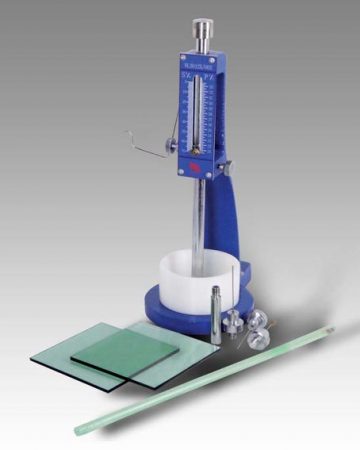
Vicat's Apparatus used for determination of setting time of cement
Fig 1: Vicat’s Apparatus used for determination of setting time of cement

Test for Initial Setting Time

  1. Place the test block confined in the mould and resting on the non-porous plate, under the rod bearing the needle.
  2. Lower the needle gently until it comes in contact with the surface of test block and quick release, allowing it to penetrate into the test block.
  3. In the beginning the needle completely pierces the test block. Repeat this procedure i.e. quickly releasing the needle after every 2 minutes till the needle fails to pierce the block for about 5 mm measured from the bottom of the mould. Note this time (T2).

Test for Final Setting Time

  1. For determining the final setting time, replace the needle of the Vicat’s apparatus by the needle with an annular attachment.
  2. The cement is considered finally set when upon applying the final setting needle gently to the surface of the test block; the needle makes an impression thereon, while the attachment fails to do so. Record this time (T3).

Calculations

Initial setting time=T2-T1
Final setting time=T3-T1
Where,
T=Time at which water is first added to cement
T=Time when needle fails to penetrate 5 mm to 7 mm from bottom of the mould
T=Time when the needle makes an impression but the attachment fails to do so.

Standard Specification of Setting Time for Different Type of Cement

Depending upon the admixtures added into the cement in the process of manufacture of cement, the setting time differs for different cement. Standard setting times are listed in the below table as per IS Codes.
Table-1: Setting Time for Different Type of Cement
Cement TypeInitial Setting Time, min (min.)Final Setting Time, min (max.)
OPC(33)30600
OPC(43)30600
OPC(53)30600
SRC30600
PPC30600
RHPC30600
PSC30600
High alumina30600
Super sulphated30600
Low heat60600
Masonry cement901440
IRS-T-4060600

Tensile Fabric Structures – Properties, Types and Advantages


Fabric tensile structures is a stretched fabric material  in surface tension formed to a three-dimensional surface that can be used to create a roof, shading, or decorative component by tensioning it to cables and . It is constructed using a specialised fabrics under tension to support self-weight and take care of the live load providing a very cost effective and covering a large distances without intermediate supports.
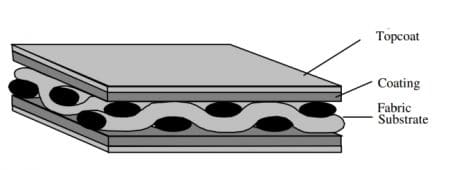
A fabric material consists of three main components are fabric substrate, coating and top coating.
Main Component of Fabric Tensile Structure
Fig 1: Main Component of Fabric Tensile Structure
In this article we study about the properties, types of fabric, types of top coating and advantages of fabric tensile structure.

Properties of Fabrics for Tensile Structures

the different properties of a fabric which are considered for design are

1. Tensile Strength

It is a basic indicator of relative strength. It is fundamental for architectural fabrics that function primarily in tension.

2. Tear Strength

Tear strength is important in that if a fabric ruptures in place, it generally will do so by tearing.

3. Adhesion Strength

It is a measure of the strength of the bond between the base material and coating or film laminate that protects it. It is useful for evaluating the strength of welded joints for connecting strips of fabric into fabricated assembly.

4. Flame Retardancy 

Fabric that contains a flame-retardant coating can withstand even a very hot point source. However, it can still burn if a large ignition source is present.

5. Flexibility

Free Form Tensile fabric allows one to use free form in building construction as it is flexible material.

Fig 2 : Flexible Fabric Umbrellas.

Types of Fabric Material for Tensile Structures

Fabric structures are composed of actual fabric rather than meshes or films. Typically, the fabric is coated and laminated with synthetic materials for increased strength, durability, and environmental resistance. Different type of fabrics used in tensile structures are,

1. Cotton Canvas

This is oldest n commonly used fabric material for the making of tents and shades on old days. It can be a light cotton twill, light canvas, or heavy proofed canvas.

2. Polyesters

The property of strength, durability, cost, and stretch make polyester material the most widely used in fabric structures. Polyesters that are laminated or coated with PVC films are usually the least expensive option for longer-term fabrications.
Polyester fabrics are futher divided into 2 types,

A. Vinyl-laminated polyesters

A laminated fabric usually is composed of a reinforcing polyester scrim pressed between two layers of unsupported PVC film. For most fabric structure uses, however, it refers to two or more layers of fabric or film joined by heat, pressure, and an adhesive to form a single ply.

B. Vinyl-coated polyester

Vinyl-coated polyester is made up of a polyester scrim, a bonding or adhesive agent, and exterior PVC coatings. It  is the most frequently used material for flexible fabric structures.

3. Fiberglass

Woven fiberglass coated with PTFE is also a widely used base material. Glass fibres are drawn into continuous filaments, which are then bundled into yarns. The yarns are woven to form a substrate. The fiberglass carries a high ultimate tensile strength, behaves elastically, and does not suffer from significant stress relaxation or creep. 
Because of its energy efficiency, high melting temperature and lack of creep, fiberglass-based fabrics have been the material of choice for stadium domes and other permanent structures.
Fiberglass fabrics are further divided into,
  1. Olefin / polyolefin fabric
  2. Polyvinylidene fluoride woven
  3. ePTFE woven

4. Blackout Fabric

Blackout fabric is a opaque material which consists of a laminate that sandwiches an opaque layer between two white exterior layers. Heating and lighting of a structure may be controlled because the fabric does not allow light to permeate the top or walls. The opaque quality also prevents stains, dirt, repairs, or slightly mismatched panels on the structure’s exterior from being noticed from the inside.

Types of Top Coating for Tensile Fabric Structures

Topcoating provides a hard surface on the outside of the material, forming a barrier that aids in preventing dirt from sticking to the material, while allowing the fabric to be cleaned with water. Based on the material used to topcoat the fabric, they are classified into following,
  1. PVF film lamination
  2. PVDF topcoating
  3. PVDF/PVC topcoating
  4. Tio2 (Titanium Dioxide) Top coating.

Advantages of Fabric Tensile Structure

  1. Quicker Installation
  2. Bright, Natural Diffused Day lighting
  3. Flexible Design Aesthetics
  4. Low Maintenance
  5. Lightweight Nature
  6. Energy Efficient
  7. Tensile Structures Need Less Materials
  8. Prefabrication Saves Time, Materials And Energy
  9. Wide Range Of Uses