Friday, October 19, 2018

Trapezoidal Footing Formula

The trapezoidal footing formula is used to determine the volume of a trapezoidal footing from the respective drawing specifications. Here, the trapezoidal footing formula is explained and clarified with the help of an example.

Trapezoidal Footing Formula

As shown in figure-1 below, the trapezoidal footing is a combination two components:
  1. Truncated Pyramid
  2. Rectangular Cuboid
Trapezoidal Footing- Combination of Rectangular cuboid and Truncated Pyramid
Fig.1. Trapezoidal Footing- Combination of the Rectangular cuboid and Truncated Pyramid
So,
The volume of trapezoidal footing = Sum of (Volume of truncated pyramid + Volume of  Rectangular Cuboid)
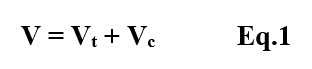
                       

1. The volume of the Truncated Pyramid is given by,
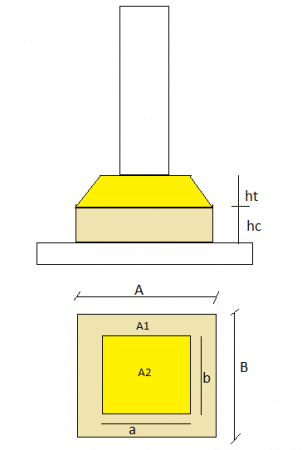
From figure-2,
ht = height of the pyramid
A1 =  Area of the bottom surface of the pyramid
A2 = Area of the top surface of the pyramid
A1 = A x B
A2 = a x b
2. The volume of a cuboid is given by,
From figure-2,
A = Length of the cuboid
B = Breadth of the cuboid
hc = Height of the cuboid

Example – Calculation Using Trapezoidal Footing Formula

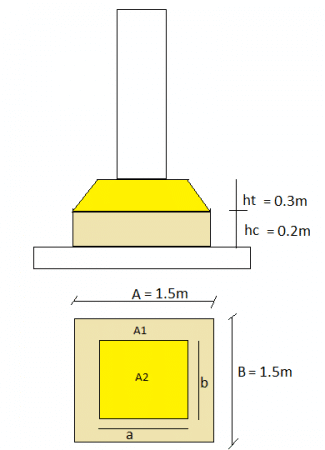
The trapezoidal footing formula can be explained with an example. Consider a trapezoidal footing arrangement as shown in figure-3 below.
Plan and Elevation of Trapezoidal Footing
Fig.2. Example of Plan and Elevation of Trapezoidal Footing

Here, a square trapezoidal footing is taken into consideration. Let a= 0.8 m and b = 0.8m.
From, the figure-2, A = 1.5m and B = 1.5m
Hence,
  1. A1= A x B = 1.5 x 1.5 = 2.25m2
  2. A2 = a x b = 0.8 x 0.8m = .64m2
  3. ht = 0.3m
Therefore, from Eq.2 and substituting the respective values,
Vt = (0.3/2)( 2.25 + 0.64 + square root of ( 2.25 x 0.64))
= 0.15(2.89 + 1.2)
= 0.614m3
From Eq.3 and substituting the respective values
Vc = 1.5 x 1.5 x 0.2
= 0.45m3
From Eq.1,
Volume of Trapezoidal Footing V = Vt + Vc = 0.614 + 0.45 = 1.064m3
The formula can be used for trapezoidal footing which is either rectangle or square in dimension.
 

Checklist for Masonry Wall Construction

The checklist in masonry wall construction is prepared to ensure that the masonry projects are constructed according to the higher standards. This is carried out by providing proper assistance for undergoing the review processes at the site.
The in-charge of inspecting the masonry work at the site is supposed to prepare the masonry wall construction checklist. The checklist of item is also provided to the mason to review his work frequently so that the quality of work is assured from his side also.
The method of checklist preparation in masonry work ensures the confirmation of standards not only for the masonry work but also the workmanship standards.

How to Prepare Masonry Wall Construction Checklist?

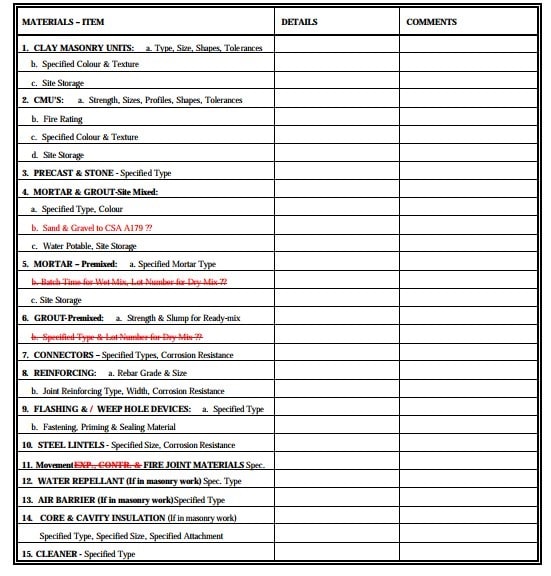
Now masonry checklist, in general, will consist of three columns as shown in the figure-1. The first column is for specifying the Item and the Work. The second column is for specifying the details of the respective work.
The third column is remarks or comments. This column designation will vary based on the specific requirements of the project item.
The figure-1 below is an example of Masonry checklist that is prepared for the inspection purpose.
Checklist for Masonry Wall Construction
Fig.1. An Example for Masonry Inspection Checklist

Details Required in Checklist for Masonry Wall Construction

So as a summary, the masonry checklist incorporates the following essentials:
  • Mention and updating the availability of the materials available and yet to reach.
  • Preparation of the area for the preparation of the concrete or the material. This will involve the cleaning of the work zone.
  • Proper and appropriate bundling of the bricks. This will check improper placement and spoiling of brick materials.
  • Quality of bricks and the sand materials are mentioned once the test is conducted.
  • Check for over-burnt clays or under burnt clays.
  • Wetting of the bricks.
  • In case of clay bricks, they have to soaked before the work start.
  • The plumb level is checked.
  • Amount of salt content in the silt is checked.
  • Dead mortars are cleaned for new work and checked.
  • Racking and curing is checked – all vertical joints and horizontal joints have to be properly aligned.
  • Any chances of expansion or modification is checked.
  • Proper and accurate checking for pointing, plastering and finishing details.
  • Erection of frames – Alignment and position of the door is checked.
  • Checking the outline of each room – compared with the plan, checking the diagonal, the position of the windows and the openings.
  • Based on the diagonals and the dimension of the room, the first layer of the bricks is laid.
  • Joint must be checked for uniformity and thickness not greater than 10 to 12mm is maintained.
  • Mortar Mix
  • Water for mixing-storage of materials
  • Specified Mortar type
  • Check the mortar preparation and mix consistency
  • Mortar Mixing and Mortar Ration in Masonry Wall Construction
  • Application of Mortar- Proper filling of the joints
  • Filling the cavities and grouted cells
  • The joints in masonry must be properly cleared
  • Ensure the brickwork height to be made on a single day ( 1.5m)
  • Curing Details –Checked
  • After the work, the top of the wall is covered with wet jute bag after the end of every work
  • The curing has to be done for 7 to 10 days

Estimation of Brickwork in Masonry Building

In the procedure for the estimation of brickwork in masonry building, two approaches – Centre-line, and Long and Short-wall methods – are used. While in the case of centre-line approach (in straight forward cases), the total length dimension remains unchanged with the width and height of the masonry courses (in footings, plinth, and superstructure) varying according to the design as detailed in the given section of the wall; but the length dimensions (as well as width and height) in long- and short-wall method do register a change from course to course (Figure-1).
In fact there are no strict straightjacket rules for arriving at (taking out) dimensions from the plan, elevation, and sectional drawings – experience and suitability (vis-à-vis, each drawing) always guide one dividing a plan into parts so that the dimensions are easily worked out for ultimately computing the quantities.
Three procedures (for the sake of clear understanding of full basics of the mode of mensuration) however, are available concerning the quantification of foundation work – excavation, concreting and masonry – and superstructure in a given building as listed below:
(a) out-to-out and in-to-in method (i.e., long- and short-wall method),
(b) crossing method, and
(c) centre-line method.
Out-to-out and in-to-in method is the most commonly adopted procedure. Here the length of long walls (say for excavation purposes) are reckoned from out to out – AB in Figure 1 – and, the length of short walls measured in between the long walls in-to-in – EF.
These lengths shall, obviously, apply to foundation concreting also. The magnitude of these dimensions changes (in fact, decreases) for long walls, and increases for short walls at every change in the breadth (or, ray, thickness) of a course of brickwork:
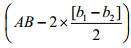
AB will decrease to clip_image001, i.e. for the first footing of the foundation masonry the length of long wall shall be (2 – 3). And EF shall increase by same amount, becoming clip_image002, i.e. (5 – 3). Here, the width for excavation is b1and height (or thickness, vertically) is d1; while for the first footing, width = b2, and depth = d2. Similarly, in the plinth course (or for next footing if it is there), long wall length shall be [(10) – (11)], and short-wall length shall be [(15) – (16)] – width being b3, and depth = (d3+ d4). And for the superstructure, long-wall will have a length [(18) – (19)], and short wall length will be [(23) – (24)] – width being = b4, and height = height of the room from the top of DPC (of floor top) to the underside of roof slab (or whatever it is).
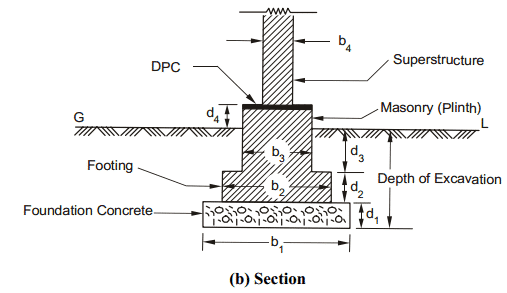
Here it is important to point out that the width and depth of excavation shall be b1and (d1+ d2+ d3), respectively; while for foundation concrete the values will be b1 and d1, respectively.
estimation-of-brick-masonry-in-building
estimation-of-brickwork
Fig.1: A Simple Rectangular Trench Plan of a Building and Section of Wall-cum-Foundation
It is obvious that with the decrease in the thickness of walls of a room, (i.e. proceeding up from the first footing towards the superstructure) the length of a long wall decreases, whereas the length of a short wall increases in accordance with the breadth (or, thickness as it is generally designated).
At the plinth level, the length of long wall = the length of the room (wall to wall, i.e. inner dimension plus twice the wall thickness; and the length of short wall = width of the room (inner dimension). If the thickness of the walls is different, the dimensions are reckoned accordingly.

Thursday, October 18, 2018

Materials for Damp Proof Course in Construction

There are various types of materials for damp proof course used in construction works based on type of damp proofing required and type of structural element of building.
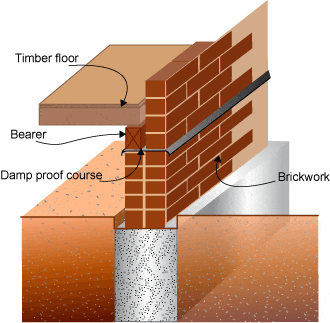
Damp proof course (DPC) is a barrier of impervious material built into a wall or pier to prevent moisture from moving to any part of the building.

Materials for damp proof course

Following are the materials generally used for damp proofing of structures:

1) Flexible Materials for Damp Proof Course

The materials, which do not crack and deform their shape when subjected to loading, are called Flexible Materials

a) Bitumen Mastic (Mastic Asphalt)

  • It consists of asphalt or bitumen mixed with fine sand in hot state to form an impervious mass.
  • Due to this consistency it can be spread (when hot) to a depth of 2.5cm to 5cm, which sets on cooling.
  • It provides good impervious layer but special care is needed in its laying.

b) Bitumen Felts (Sheets)

  • It consists of 6mm thick sheet of bitumen prepared in rolls having width equal to that of brick wall.

c) Hot laid Bitumen

This material is used on a bedding of cement concrete or mortar.
  • This should be applied in two layers at the rate of 1.75kg/m2 of the area.

d) Metal Sheets

  • Metal sheets of Copper, Aluminium, or Lead are used to prevent dampness, but they are costly.
  • Sheets of these materials are used throughout the thickness of the wall.
  • The sheets of Lead are laid over Lime Mortar and not with Cement.
  • Mortar due to the chemical reaction of Cement over the Lead.
  • The sheets of metal should be coated with asphalt.
  • The thickness of the sheets should not be less than 3mm.
damp-proof-course

2) Rigid Materials for Damp Proof Course

  • The materials, which do not resist transverse stresses and cracks when subjected to sever loading, are known as Rigid Materials.

a) Rich Concrete

  • 1.2cm to 4cm thick layer of Rich Concrete (1:2:4) painted with two coats of hot bitumen is used as horizontal D.P.C.
  • It also prevents the moisture penetration by capillary action.
  • These layers are laid where the damp is not excessive.

b) Mortar:

  • 2cm thick layer of Rich Cement and Sand Mortar (1:3) is applied on the inner face of external wall.
  • This is a vertical D.P.C.
  • The surface is than painted with two coats of hot bitumen.

c) Bricks:

  • Over burnt or dense bricks in one or two layers can be used as cheap and effective DPC.
  • They are laid in Rich Cement and Sand Mortar (1:3).
  • Bricks are rarely used as DPC except in cheap houses.

d) Stones or Slates:

  • Two layers of stone slabs or slates laid in Lime, Cement and Sand Mortar (1:1:6) make a best DPC.
  • They can also be laid in Cement Sand Mortar.
  • It is used where a good quality of stone is easily and cheaply available.

What is a Cavity Wall? Construction and Advantages of Cavity Walls


What is a Cavity Wall?

Cavity wall is constructed with two separate walls for single wall purpose with some space or cavity between them. These two separate walls are called as leaves of cavity wall. The inner wall is called as internal leaf and outer wall is called as external leaf. Cavity wall is also called as Hollow wall.
Cavity Walls Construction Details
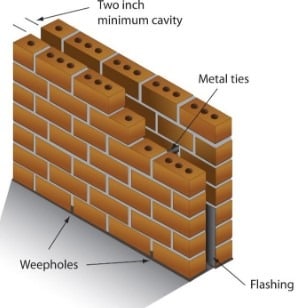
For non-load bearing cavity wall, two leaves are of equal thickness or sometimes internal leaf with more thickness is provided. The cavity size should be in between 4 to 10cm. The internal and external leaves should have at least 10 mm thickness. The two leaves are interconnected by metal ties or links as shown in above figure.

Construction of Cavity Walls

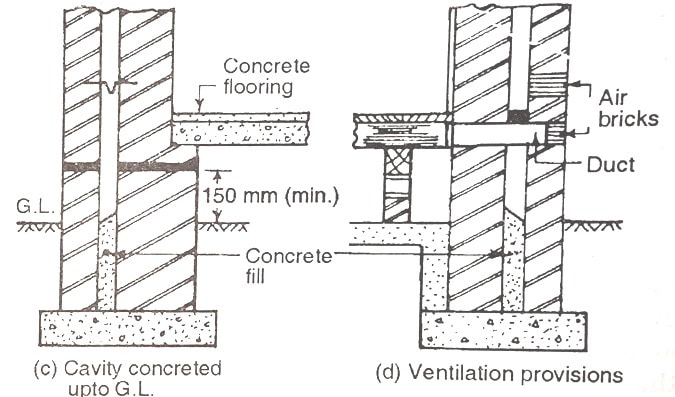
In general, cavity wall doesn’t require any footings under it, just a strong concrete base is provided on which cavity wall is constructed centrally. Two leaves are constructed like normal masonry, but minimum cavity must be provided in between them. The cavity may be filled with lean concrete with some slope at top up to few centimeters above ground level as shown below.
Construction of Cavity Walls
Weep holes are provided for outer leaf at bottom with an interval of 1 m. Normal bricks are used for inner leaf and facing bricks are used for outer leaf. Different masonry is also used for cavity wall leaves. The leaves are connected by metal ties or wall ties, which are generally made of steel and are rust proof.
The maximum horizontal spacing of wall ties is 900mm and maximum vertical spacing is 450mm. The wall ties are provided in such a way that they do not carry any moisture from outer leaf to inner leaf. Different shapes of wall ties are shown in below figure.
For half brick thickness leaves, stretcher bond is provided. And for one brick thickness or more thickness, English bond or Flemish bonds type constructions are provided. While laying bricks, care should be taken without filling the cavity with cement mortar.
To prevent mortar dropping in cavity, wooden battens are provided in the cavity with suitable dimensions. These battens are supported on wall ties and whenever the height of next wall tie location is reached, then the battens are removed using wires or ropes and wall ties are provided.
Two leaves should be constructed simultaneously. Spacing should be uniform and it is attained by predetermining the location of wall ties. Damp proof course is provided for two leaves separately. In case of doors and windows, weep holes are provided above the damp proof course.

Advantages of Cavity Walls

Following are the advantages of cavity wall when compared to solid walls.
  • Cavity walls give better thermal insulation than solid walls. It is because of the space provided between two leaves of cavity walls is full of air and reduces heat transmission into the building from outside.
  • Economically they are cheaper than solid walls.
  • Moisture content in outer atmosphere is does not allowed to enter because of hollow space between leaves. So, they also prevent dampness.
  • They also act as good sound insulators.
  • They also reduce the weights on foundation because of their lesser thickness.
  • Outer Efflorescence is also prevented.