Thursday, October 18, 2018

Cement Consumption Coefficients for Various Construction Works

Construction works involving cement as one of the material requires cement consumption coefficients for estimation of quantities and cost of such works. Coefficients of cement consumption works for various construction activities involving cement mortar, concrete etc. are presented in table.
S. No.Construction Work DetailsCoefficient
1P.C.C. (1:5:10)2.6 Bags/cu.mt.
2P.C.C. (1:4:8)3.4 Bags/cu.mt.
3P.C.C. (1:3:6)4.4 Bags/cu.mt.
4R.C.C. M-15 (1:2:4)6.3 Bags/cu.mt.
5R.C.C. M-20 (1:2:4)8.00 Bags/cu.mt.
6R.C.C. M-25 (1:1:2)12.20 Bags/cu.mt.
7Brick work in CM (1:6)1.32 Bags/cu.mt.
8Brick work in CM (1:4)1.90 Bags/cu.mt.
9Half Brickwork in (1:4)0.213 Bags/Sq.mt.
10Plastering in CM (1:4) – 15mm thick0.131 Bags/Sq.mt.
11Plastering in CM (1:4) – 12mm thick0.109 Bags/Sq.mt.
12Plastering in CM (1:4) – 6mm thick0.055 Bags/Sq.mt.
13Plastering in CM (1:6) – 15mm thick0.086 Bags/Sq.mt.
14Plastering in CM (1:6) – 12mm thick0.072 Bags/Sq.mt.
15Plastering in CM (1:6) – 6 mm thick0.073 Bags/Sq.mt.
1620mm thick sand face plastering in two layers. (13 mm thick plaster in CM 1:4 and 7 mm thick plaster in CM 1:2)0.220 Bags/Sq.mt.
17Plastering in CM (1:3) – 13mm thick0.157 Bags/Sq.mt.
18Plastering in CM (1:4) – 13 mm thick0.117 Bags/Sq.mt.
19Plastering in CM (1:3) – 20mm thick0.228 Bags/Sq.mt.
20Plastering in CM (1:4) – 20mm thick0.170 Bags/Sq.mt.
21Floating coat of neat cement0.044 Bags/Sq.mt.
22Brick on edge pitching in CM (1:4)0.138 Bags/Sq.mt.
23Brick on edge pitching in CM (1:3)0.185 Bags/Sq.mt.
24Flush pointing in brick work with CM (1:3)0.031 Bags/Sq.mt.
2540mm thick Damp proof course in M-200.32 Bags/Sq.mt.
2625 mm thick IPS in M-150.244 Bags/Sq.mt.
2740 mm thick IPS in M-150.340 Bags/Sq.mt.
2850mm thick granite flooring, 1st layer 35mm thick (1:1.5:3), 2nd layer 15 thick (1:2)0.433 Bags/Sq.mt
29125mm high plaster skirting in CM (1:3)0.034 Bags/R.M.
3025mm thick kota stone over 20mm thick bedding in CM (1:6)0.24 Bags/Sq.mt.
3140mm thick kota stone over 20 mm thick bedding in CM (1:6)0.264 Bags/Sq.mt.
3218mm thick kota stone over 12 mm thick bedding in CM (1:6)0.264 Bags/Sq.mt.
336 mm thick glazed tiles fixing0.088 Bags/Sq.mt.
3425mm thick CM screed in CM (1:5)0.218 Bags/Sq.mt.
3520mm thick mosaic tiles over 25mm thick bedding in CM (1:6)0.228 Bags/Sq.mt.
3618mm thick mosaic tiles over 20mm thick bedding in CM (1:6)0.200 Bags/Sq.mt.
3718mm thick marble skirting over 12mm thick bedding in CM (1:6)0.160 Bags/Sq.mt.
38Water Proofing treatment with 50mm thick screed in CM (1:5), 115 thick brick bats in CM (1:3), third layer of 25 mm thick in CM (1:3)1.18 Bags/Sq.mt.
39Fixing of rainwater Pipes
110 mm diameter PVC0.048 Bags/Opening
160mm diameter PVC0.075 Bags/Opening
40Joining & Fixing of CI rainwater Pipes
100 mm diameter0.176 Bags/100 mtr.
150 mm diameter0.264 Bags/100 mtr.
41Fixing wooden Frame/Steel frame doors in M-15 concrete of block size. 350 x 100 x 100 mm0.129 Bags/Door
42Fixing of steel louvers/windows in M-15 grade concrete of block 150 x 50 x 50 at 750 mm c/c.0.008 Bags/Sq.mt
43Fixing of rolling shutters.0.70 Bags/ 100 Sq.Mt.
44Providing and Fixing of 50mm thick RCC jali.0.329 Bags/Sq.mt.
45Fixing of 50 mm thick RCC Jali.0.051 Bags/Sq.mt.
46Fixing of glazed earthen ware Orissa pan type water closet.0.5 Bags/No’s
47Fixing of white glazed EWC.0.05 Bags/No’s
48Fixing of large flat back urinal.0.03 Bags/No’s
49Fixing of hand wash basin/sink0.03 Bags/No’s
50Fixing of floor trap of 100/100 mm0.05 Bags/No’s
51Jointing and fixing of soil waste Pipe.
80mm diameter.0.132 Bags/RM
100mm diameter.0.176 Bags/RM
150mm diameter.0.264 Bags/RM
52Fixing of GI water pipes concealed work.
15 mm diameter0.642 Bags/100M
20 mm diameter0.770 Bags/100M
25 mm diameter0.90 Bags/100M
32 mm diameter0.96 Bags/100M
53Construction of brick masonry valve chambers of size 300 x 300 x 600 mm CM (1:4) fixing cover in M-15 concrete, M-15 foundation concrete 13mm thick plaster on inside & outside exposed surface.0.700 Bags/No’s
54Construction of brick masonry inspection chamber of size 750 x 750 x 1000 mm in CM (1:4) RCC of M-15, 13mm plastering in CM (1:3).5.0 Bags/No’s

8 Types of Construction Companies

The construction companies are divided into different types depending upon the type of job the companies perform. The role in the construction such as acquisition of land, design, financial planning, execution, operating, maintaining and paper works  denotes the construction company type.

Types of Construction Companies

Depending upon the job they perform, construction companies are classified into following types,

1. Small Renovation Contractors

Small renovation contractors generally work on jobs requiring small amounts of capital and the type of work that does not require much estimating or a large construction organisation.
They usually perform home alterations or small commercial and office work. Many small renovation contractors have their offices in their homes and perform the ‘‘paper work’’ at night.

2. General Contractors

These companies often are experts in either new buildings or alteration work. Many building contractors subcontract a major portion of their work, while alteration contractors generally perform many of the trades with their own forces. Some general contractors specialise in public works.

3. Owner-Builder

The company that acts as an owner-builder is not a contractor in the strict sense of the word. Such a company builds buildings only for its own ownership, either to sell on completion, or to rent and operate.
Many owner-builders, on occasion, act in the capacity of general contractor or as construction manager as a sideline to their main business of building for their own account.

4. Real Estate Developer

This is a type of owner-builder who, in addition to building for personal ownership, may also build to sell before or after completion of the project. One- and two-family home builders are included in this category.

5. Professional Construction Manager

A professional construction manager may be defined as a company, an individual, or a group of individuals who perform the functions required in building a project as the agent of an owner, but do so as if the job was being performed with the owner’s own employees.
The construction management organisation usually supplies all the personnel required. Such personnel include construction superintendents, expediters, project managers, and accounting personnel.
The manager sublets the various portions of the construction work in the name of the owner and does all the necessary office administration, field supervision, requisitioning, paying of subcontractors, payroll reports, and other work on the owner’s behalf, for a fee.

6. Program Manager

A general contractor or construction manager may expand services by undertaking program management. Such services will include, demolition of existing buildings on the site, devising and providing financial analyses of new buildings. The acquisition of a new site, hiring an architect and other design professionals on behalf of the owner.
Supervising their services, performing pre construction services during the planning stage, advertising for and receiving bids from contractors for the new work, consulting on financing and methods of payment for the work, supervising the contractor, obtaining tenants, whether commercial, residential, or industrial for the completed project, helping to administer and manage the complete project.
Obviously, the comprehensive services outlined above will require that the general contractor or construction manager augment his staff with trained architects, accountants, real estate professionals, and management and leasing experts.

7. Package Builders

Such companies take on a contract for both design and construction of a building. Often these services, in addition, include acquisition of land and financing of the project.
Firms that engage in package building usually are able to show prospective clients prototypes of similar buildings completed by them for previous owners.
Package builders often employ their own staff of architects and engineers, as well as construction personnel. Some package builders subcontract the design portion to independent architects or engineers.
It is important to note that, when a package builder undertakes design as part of the order for a design-construction contract, the builder must possess the necessary professional license for engineering or architecture, which is required in most states for those performing that function.

8. Sponsor-Builder

In the field of government-aided or subsidised building, particularly in the field of housing, a sponsor-builder may be given the responsibility for planning design, construction, rental, management, and maintenance.
A sponsor guides a project through the government processing and design stages. The sponsor employs attorneys to deal with the various government agencies, financial institutions, and real estate consultants, to provide the know-how in land acquisition and appraisal.
On signing the contract for construction of the building, the sponsor assumes the builder’s role and in this sense functions very much as an owner-builder would in building for its own account.

Friday, October 12, 2018

Reinforcement Detailing of Reinforced Concrete Slabs


Reinforcement detailing of a slab is done based on its support conditions. Slab may be supported on walls or beams or columns. Slab supported directly by columns are called flat slab.
Slab supported on two sides and bending takes place predominantly in one direction only is called One Way Slab. On the other hand, when slab is supported on all four sides and bending take place in two directions are said to be Two Way Slab.
The slabs having ratio of longer length to its shorter length (Ly/Lx) greater than 2 is called one way slab otherwise as two way slab. In one way slab main reinforcement is parallel to shorter direction and the reinforcement parallel to longer direction is called distribution steel. In two way slab main reinforcement is provided along both direction.
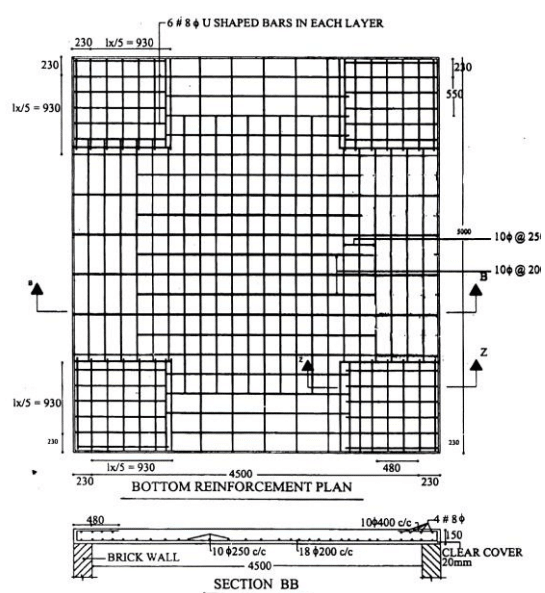
Slabs could be simply supported, continuous or cantilever. In two way slab the corners may be held down by restraints or may be allowed to lift up. Additional torsion reinforcement is required at corners when it is restrained against uplifting as shown in Fig.1.
Details of Slabs with Restrained Corners
Thickness of the slab is decided based on span to depth ratio specified in IS456-2000. Minimum reinforcement is 0.12% for HYSD bars and 0.15% for mild steel bars. The diameter of bar generally used in slabs are: 6 mm, 8 mm, 10 mm, 12mm and 16mm.
The maximum diameter of bar used in slab should not exceed 1/8 of the total thickness of slab. Maximum spacing of main bar is restricted to 3 times effective depth or 300 mm whichever is less. For distribution bars the maximum spacing is specified as 5 times the effective depth or 450 mm whichever is less.
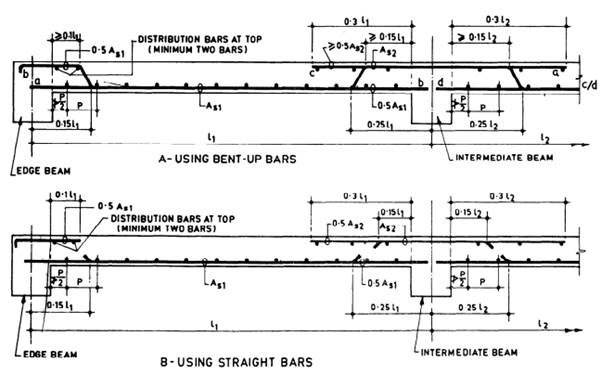
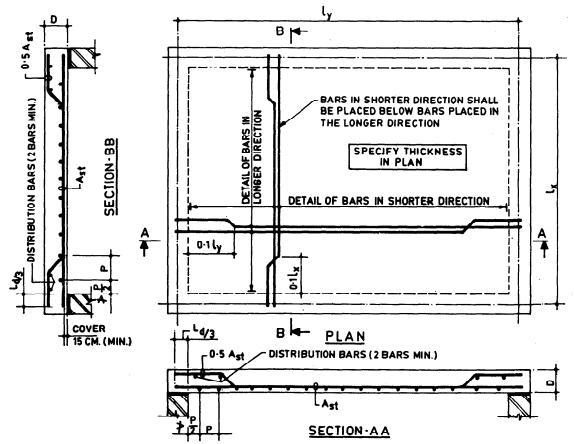
Minimum clear cover to reinforcements in slab depends on the durability criteria and this is specified in IS 456-200. Generally 15mm to 20mm cover is provided for the main reinforcements. Alternate main bars can be cranked near support or could be bent at 1800at the edge and then extended at the top inside the slab as shown in Fig.1. Curtailment and cranking of bars and is shown in Fig. 2.
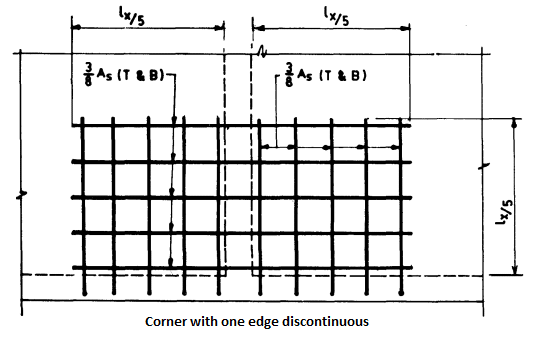
Torsion reinforcement shall be provided at any corner where the slab is simply supported on both edges meeting at that corner and is prevented from lifting unless the consequences of cracking are negligible. It shall consist of top and bottom reinforcement, each with layer of bars placed parallel to the sides of the slab and extending from the edges a minimum distance of one fifth of the shorter span.
The area of reinforcement per unit width in each of these four layers shall be three quarters of the area required for the maximum midspan moment per unit width in the slab.
Torsion reinforcement equal to half that described above shall be provided at a corner contained by edges over only one of which the slab is continuous. Torsion reinforcement to be provided is shown in Fig. 3 below.
Torsional Reinforcement in SlabsTorsional Reinforcement in Slabs
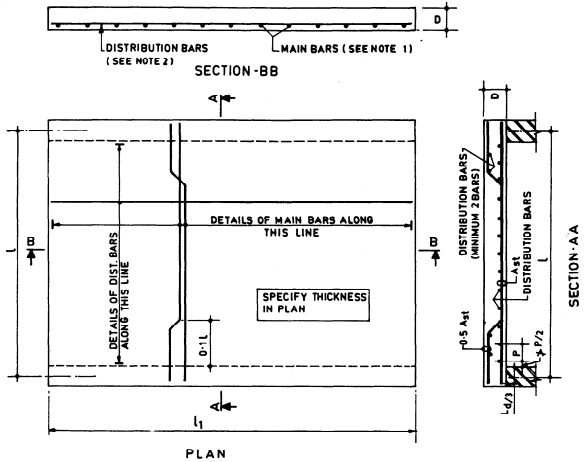
The drawing showing the detailing of reinforcement has a plan showing typical reinforcement in both direction and sectional elevations. Typical detailing of slab is shown in Fig.4 and 5.
One-Way Slab Reinforcement DetailsFig.4: Slab spanning in one direction (One-way slab)
Two-Way Slab Reinforcement DetailsFig.5: Slab spanning in two-directions (two-way slab)


Pre-Concrete Checks for Reinforcement and Its Cover


What is Reinforcement Cover? How to Provide Cover to Reinforcement?

It is essential that the steel reinforcement bars are surrounded sufficient impermeable concrete cover to protect them from corrosion, and to allow the combined strength of the reinforcement and concrete to be effective.
Reinforcement cover
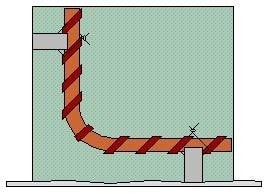
From the diagram above, we can see how the process unfolds. When the binding has set, the steel bars are placed into position. The bars are kept the correct distance from the surface by spacers.
When the formwork is erected the concrete can be poured. When the concrete has reached the required strength the formwork can be poured. The cover blocks have ensured that the steel has sufficient protection from the elements.
If the steel had been placed too close to the surface and the concrete had been poured then over time the steel may become exposed to moisture and corrosion will commence.
Spacers can be made from plastic, mortar or steel. Plastic spacers are made to fit particular bar size and give specified depths of cover.
Small mortar blocks are also commonly used which are tied to the reinforcement bars using soft iron binding wire. The ends of these ties should be bent away from the surface of the concrete, otherwise the wire may facilitate the corrosion of the reinforcement.
Steel spacers can be used, but only when the structure is not in a corrosive atmosphere or be exposed to water.
The required amount of cover will always be specified on the design drawings, but no time should the cover be less than the maximum size of aggregate plus 5mm.

Pre-Concrete Checks for Reinforcement and its Cover

The pre-concrete check for reinforcement essentially comes in two parts. The first part is a visual inspection by the clerk of works or equivalent.
Inspection of reinforcement before concreting
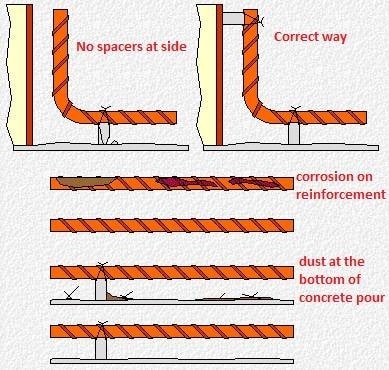
Using a steel tape, cover thickness will be checked and any spacers that have fallen off or been broken will need to be replaced.
The clerk or equivalent will be looking to see that the reinforcement bars are free of excessive rust and not covered in mud from foot traffic.
Similarly, the bottom of the concrete pour must be free of debris including the cutoffs from the steel tying bars.
The clerk will also check for under-bent bars that may mail to allow the correct cover and that the bars are at the correct spacing.
Inspection of reinforcement before concreting
In the above fig, left side images shows reinforcement have not been placed correctly. Right side images shows correct way of placing of reinforcement.
The second part is carried out by a surveyor, who will check the steel levels against the required levels from the design drawings. If these levels are satisfactory and the clerk has completed the visual checks then the pour will proceed.