Wednesday, October 10, 2018

Pointing in Brick Masonry Construction


Pointing in Brick Masonry Construction


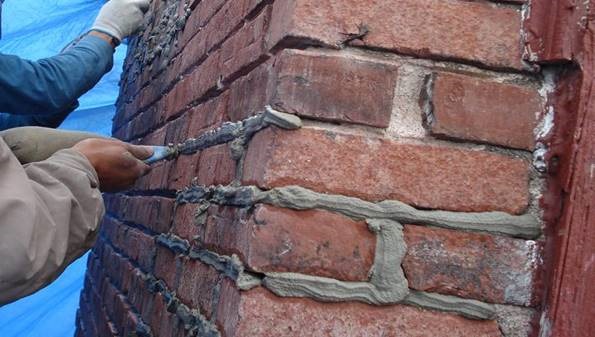
Pointing in masonry construction is the finishing of mortar joints in brick or stone masonry. Pointing is the implementing of joints to a depth of 10 to 20mm and filling it with better quality mortar in desired shape.
In exposed masonry, joints are considered to be the weakest and most vulnerable spots from which rain water or dampness can enter.
Pointing in Brickwork Construction

Mortar for Pointing Work

  1. Lime mortar of 1:2 ( 1 fat lime : 2 sand or surkhi)
  2. Cement mortar of 1:3 ( 1 cement : 3 sand)

Preparation of Surface for Pointing

All the joints in masonry are raked down to a depth of 20mm while the mortar is still soft. The joints and surface are cleaned and then thoroughly wetted.

Methods of Pointing

After preparing the surface as mentioned above, mortar is carefully placed in joints using a small trowel. The placed mortar should be of desired shape. Whenever the fresh mortar is placed in the joints it should be pressed hardly to gain strong bond with old interior mortar.
Care should be taken while using ashlar or 1st class brick work otherwise the mortar does not cover the face edges. The pointed surface is kept wet for at least a week or till it sets after application.

Types of Pointing

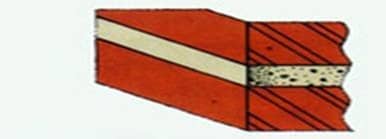
1. Flush Pointing

In this type, mortar is pressed hard in the raked joints and by finishing off flush with the edge of masonry units. The edges are neatly trimmed with trowel and straight edge. It does not give good appearance. But, flush pointing is more durable because of resisting the provision of space for dust, water etc., due to this reason, this method is extensively used.
Flush pointing

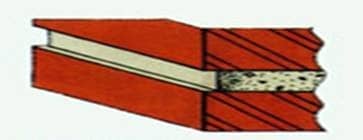
2. Recessed Pointing

In this case, mortar is pressing back by 5mm or more from the edges. During placing of mortar the face of the pointing is kept vertical, by a suitable tool. This type gives very good appearance.
Recessed pointing

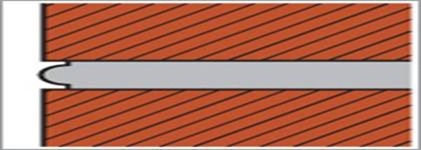
3. Beaded Pointing

It is formed by a steel or ironed with a concave edge. It gives good appearance, but it will damage easily when compared to other types.
Beaded pointing

4. Struck Pointing

This is a modification of flush pointing in which the face the pointing is kept inclined, with its upper edge pressed inside the face by 10mm which drains water easily.

Struck pointing

5. Rubbed, Keyed or Grooved Pointing

This is also a modification of flush pointing in which groove is formed at its mid height, by a pointing tool. It gives good appearance.
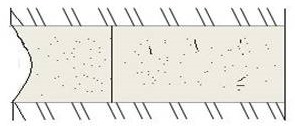
Rubbed, keyed or grooved pointing

6. Tuck Pointing

In this case mortar is pressed in the raked joint first and finishing flush with the face.
While the pressed mortar is green, groove or narrow channel is cut in the center of groove which is having 5mm width and 3mm depth. This groove is then filled with white cement putty, kept projecting beyond the face of the joint by 3 mm. if projection is done in mortar, it is called bastard pointing or half tuck pointing.
Tuck pointing

7. V- Pointing

This is formed by forming V-groove in the flush-finishing face.
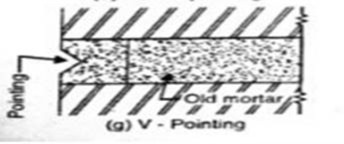
V- Pointing

8. Weathered Pointing

This is made by making a projection in the form of V-shape.
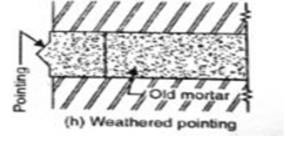
Weathered pointing

Tuesday, October 9, 2018

What is Self-Levelling Concrete (SLC)? – Properties and Benefits


What is Self-Levelling Concrete (SLC)? – Properties and Benefits


Self-levelling concrete (SLC) is a polymer modified high -performance concrete that have the ability to flow, compact and provide a levelled surface when poured over an area. An SLC does not require separate vibration or compaction as required by normal concrete construction.
The basic properties, construction features and benefits of self-levelling concrete are explained in the below section.

Properties of Self-Levelling Concrete

The self-levelling concrete is designed such a way that the following properties are attained:
  1. Low Plastic Viscosity
  2. High Flowability
  3. Low segregation
  4. Low Bleeding
  5. Stability
The low plastic property of SLC increase the flowability properties which imparts the self-levelling property. The balance and proportion of the above-mentioned properties in mix design helps to design the desired SLC concrete.
Providing low viscosity of the concrete mix can result in stability issues. This can result in high segregation and bleeding problems. This low viscosity or high flowability is introduced by the addition of superplasticisers or polymer agents that maintains the stability without affecting the flowability characteristics.
The viscosity agents added prevents the settling down of aggregates that causes segregation and keep the cohesiveness of the mix within the bond which in turn helps in avoiding bleeding.
High-homogeneity is received by self-levelling concrete with its self-levelling and consolidating property. The flowability properties of self -levelling concrete is greater when compared with self-compacting concrete. This increase in flowability is one reason to obtain good finish in final hardened SLC.

Construction of Self-levelling Concrete Surface

The main two applications of SLC are in the construction of toppings and underlayment. Whatever be the surface under consideration, the SLC mix is initially poured over the surface.
Fig.1.Pouring SLC Mix
The highly viscous SLC mix is spread throughout the surface with the help of a gauge rake. Care must be taken not to spread in thin layers.
Fig.2.Spreading SLC with a Gauge Rake; Image Courtesy: http://weopenhouse.camerashop.pw
A smoother is used later to finish the surface tension over the surface to facilitate finishing process. The polymer addition in the SLC mix helps to maintain the viscosity throughout the layer without letting the aggregates to settle at the bottom.

Advantages of Self-Levelling Concrete

The major advantages of self-levelling concrete are:
  1. Ease of Application
  2. Less labour required
  3. Levelled and smooth surface is obtained
  4. Water Resistant surface is obtained
  5. Resist growth of microorganisms
  6. Best choice of heavily reinforced concrete construction
  7. Hardening of concrete is taking place in a homogeneous way
  8. Best option where formwork is arranged in unusual geometry
  9. Compressive strength higher than traditional concrete is obtained
  10. SLC concrete gives flat and smooth concrete surface
  11. Self-levelling concrete give cohesive concrete that resist bleeding and segregation issues

How to Calculate Steel Quantity for Slab, Footing and Column?


How to Calculate Steel Quantity for Slab, Footing and Column?


Estimation of steel reinforcement quantity for concrete slab, footing and column, beams etc. is crucial for the cost evaluation for the construction. Design drawings are used as a base for computing rebar quantity in different structural elements.
This article presents steel quantity computation process for slabs, columns, and footings.
Table of Contents

Calculate Steel Quantity for Slab

  1. Obtain slab dimension and reinforcement details from design drawings as shown in Fig.1.
  2. Compute number of steel bars.
Main Steel Bars
No. of bars= (Slab length(L)/spacing)+1               Equation 1
Shrinkage and Temperature Steel Bars 
No. of bars= (Slab length(S)/spacing)+1               Equation 2
In equation 1, center to center spacing of main reinforcement steel bars are used and shrinkage and temperature bar spacing is used in equation 2.
Fig. 1: Types and arrangement of steel bars in one way slab
3. Calculate cutting length:
Main steel bars 
Cutting length= clear span(S)+Ld+inclined length+2×45 degree bend      Equation 3
Shrinkage and Temperature steel bars 
Cutting length= clear span(S)+Ld+inclined length+2×45 degree bend      Equation 4
Where:
Ld: development length which illustrated in Fig. 2.
Inclined length can found from the following expression:
Inclined length= 0.45D                                                    Equation 5
D=slab thickness-2*concrete cover-bar diameter               Equation 6
Fig. 2: Bent up bars in slab
3. Convert that length into kilograms or tons because steel bars are ordered by weight. The same equation used for both main and shrinkage and temperature reinforcement, but corresponding cutting length, number of bars, and bar diameter is used.
Main steel bars=No. of bars*cutting length*weight of the bar (/162)     Equation 7
(/162) is the weight of a steel which is derived from steel volume times its density which is 7850 kg/m3.

Calculate Steel for Footing

Size of footing and its reinforcement details (bar size and spacing) shall be known. This can be achieved from design drawings. After that, the following steps will be taken to compute steel quantity.
  1. calculate the required number of bars for both directions.
No. of bars = {(L or w – concrete cover for both sides) ÷ spacing} +1       Equation 8
where L or W: length or width of footing
  1. Then, find the length of one bar
Length of bar = L or W–concrete cover for both sides + 2*bend length     Equation 9
Where L or W is length or width of footing
  1. After that, compute the total length of bars which is equal to the number of required bars multiply by the length of one bar. If the same size of bars is used in both directions then you can sum up both quantity of the bars
  2. Convert that length into kilograms or Tons. This can be done by multiplying cross section area of steel by its total length by density of steel which 7850 kg/m3
The above calculation procedure is for  single reinforcing net. Therefore, for footings with the double reinforcing net, the same procedure need to be used again to compute steel quantity for another reinforcing net.

Calculate Steel Quantity for Columns

Achieve column size and reinforcement detailing from design drawings. Then, compute quantity of steel in the column using the following steps:

Longitudinal steels

  1. Compute total length of longitudinal bars which equal to the column height plus laps for footing multiply number of longitudinal bars.
  2. Convert that length into kilograms or Tons. This can be done by multiplying cross section area of steel by its total length by density of steel which 7850 kg/m3

Stirrups

  1. Compute cutting length of stirrups using the following equation
Cutting length=2*((w-cover)+(h-cover))+Ld                             Equation 10
where:
w: column width
h: column depth
Ld: stirrup development length
2. Calculate number of stirrup by dividing column height over stirrup spacing plus one.
3. Estimate total length of stirrup which is equal to stirrup cutting length times number of stirrups.
4. Convert that length into kilograms or Tons. This can be done by multiplying cross section area of steel by its total length by density of steel which 7850 kg/m3.
Total steel quantity of column equal to the sum of both main and stirrup steels.

Monday, October 8, 2018

Practical Methods of Providing Concrete Cover to Reinforcement


Practical Methods of Providing Concrete Cover to Reinforcement


The concrete cover thickness is a major protection measure that prevents corrosion and deterioration of reinforcement steel bars. There are number of approaches that have been used to make sure that the exact required cover thickness is obtained during construction.
This article will shed light on the different practical techniques used to execute and maintain concrete cover during building construction process so as to match the cover thickness specified in the design.
Methods of Providing Concrete Cover to Reinforcement
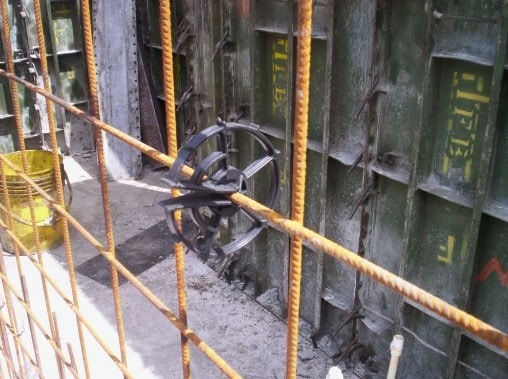
Fig.1: Plastic spacer for maintaining concrete cover during concrete pouring
Methods of Providing Concrete Cover to Reinforcement
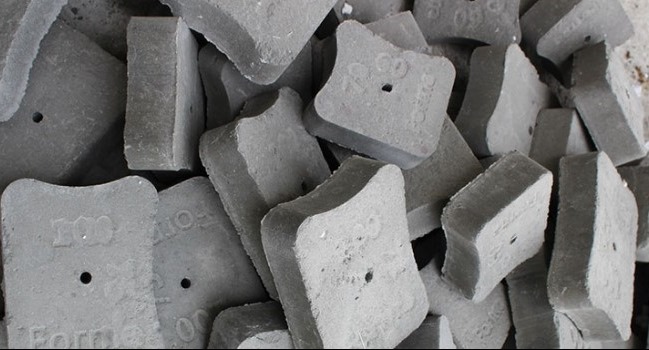
Fig.2: Concrete spacer used to maintain accurate concrete cover during construction

Methods of Providing Concrete Cover During Construction

Application of Concrete Cuboids (Biscuits)

This technique is one of the most well known practical methods used to execute concrete cover. Commonly, the dimension of biscuit is 50x100mm and its thickness varies based on the concrete cover thickness requirement.
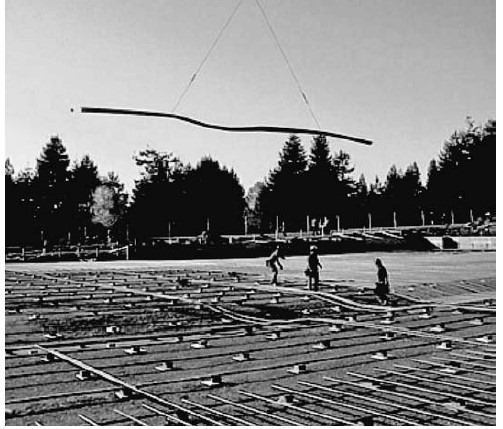
Figure 3 shows the application of pieces of concrete cuboids in the construction of reinforced concrete slab.
Utilization of concrete cuboids for reinforcement cover
Fig.3: Utilization of concrete cuboids to make sure that designed cover thickness is maintained during construction
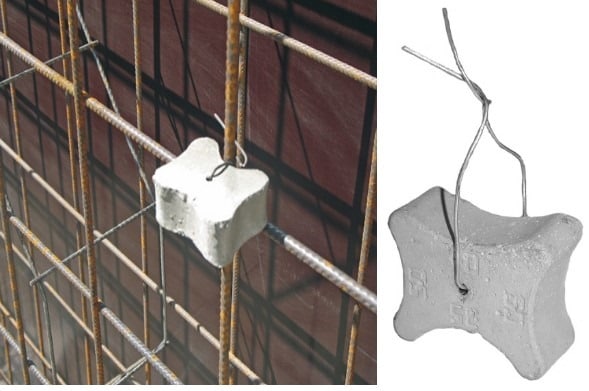
Steel wires are inserted into biscuits to tie steel bars to cuboids and keep the required spacing between bars as shown in Figure 4.
Steel wire used to tie concrete cuboids with steel bras
Fig.4: Steel wire used to tie concrete cuboids with steel bras
The most outstanding advantage of biscuit is that they are cost effective. With regard to concrete cuboids disadvantage, cuboids might be cracked and damaged due to concentrated loads that imposed by workers when they are move along bars to pour concrete or to inspect and supervise the construction process.
So, if biscuits are cracked and damaged, then they would not serve their purpose which is to maintain the designed concrete cover thickness during construction process.

Utilization of Plastic Pieces for Concrete Cover

This technique is assumed to the most practical one compare with other methods. Not only does the cost of plastic pieces is low but also it executes the cover thickness accurately since it can bear great loads due to its high strength. That is why the application of these plastics has recently been increased significantly.
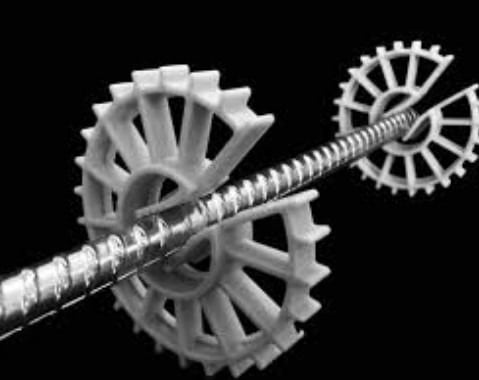
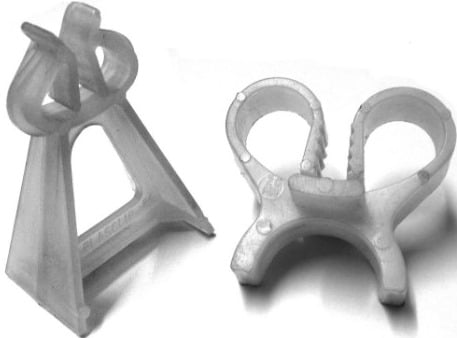
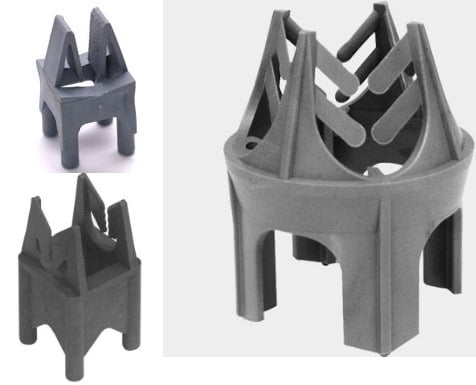
Various types of plastics are produced based on the diameter and forms of the bar, thickness of concrete cover, and the location of steel bars.
Different forms of plastic pieces are shown from Figure 5 to Figure 7.
Plastic Pieces for Concrete Cover
Fig.5: Round plastic spacer used to maintain concrete cover during construction
Plastic A clip spacer
Fig.6: Plastic A clip spacer
Plastic pieces used to keep accurate concrete cover during construction
Fig.7: Plastic pieces used to keep accurate concrete cover during construction
Plastic pieces would stabilize reinforcement bars and maintain cover thickness of different reinforced concrete elements such as beams, columns, slabs, and foundations.
When a customer makes an order, the supplier should receive certain information from the customer. This information includes quantity and thickness of concrete cover, diameter of steel bars which will be utilized, and type of reinforced concrete element that will be constructed since type of plastic would vary according to the type of members like columns, beams, and slabs.
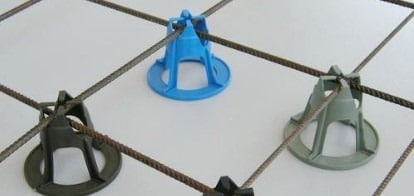
Moreover, there are certain types of plastics which are specifically manufactured for intersection of steels as shown in Figure 8.
Plastic pieces at steel intersection
Fig.8: Plastic pieces at steel intersection
Not only does this type of cuboids maintain the cover thickness but also prevent the movement of steel bars and consequently keep the required spacing reinforcements.
Finally, biscuits can also be employed to support chairs which are beneficial to protect steel bars that are exposed to concrete’s outer surface.

Use of Aggregate Beneath Steel Bars for Concrete Cover

The application of suitable size of aggregate beneath steel bars is another method to maintain concrete cover thickness that has been employed prior to the previous techniques.
But this method is not acceptable nowadays since it does not guarantee proper execution of designed cover thickness.
However, the application of using proper aggregate size underneath steel bars has not stopped totally and it is still employed in low cost buildings in certain developed countries.
Nonetheless, it is shown that, this method lead to improper execution of concrete cover thickness and consequently steel bars would suffer corrosion.
The repair cost of deteriorated concrete element is higher than cost of the use of plastic pieces and concrete cuboids. That is why, certain specification requires the measurement of concrete cover thickness in structures exposed to sever condition.
For example, British Standard states that, concrete cover thickness should be measured according to BS 1881 part 204 employing electromagnetic devices. Such device measures the cover thickness and size of embedded bars.
According to the British standard, the measured cover thickness should not be smaller than needed nominal cover minus 5mm.
Finally, it is necessary to check reinforcements and nominal concrete cover both before and during placement in order to decrease or eliminate errors.