Monday, August 20, 2018

Deterioration of Concrete by Cation-Exchange Reactions


Deterioration of Concrete by Cation-Exchange Reactions

Concrete exposed to aggressive chemical solutions will result in some deleterious reactions which is carried out by cation-exchange. The reaction occurs between the aggressive solution and the components of portland cement in the concrete. These deleterious cation exchange reactions can result in the deterioration of concrete.

Types of Cation-Exchange Reactions

Different Cation-Exchange reactions are categorised based on the harmful products formed. They are:
  1. Formation of Calcium Salts
  2. Formation of Soluble Calcium Salts
  3. Formation of Magnesium Salts

1. Formation of Calcium Salts

Insoluble salts of calcium are found when anions present in aggressive water react with cement paste. The damage to the concrete due to these reaction products is not caused if the calcium salt formed are either expansive or washed out by running water seepage or vehicular traffic.
In most cases the reaction between calcium hydroxide in concrete and acids like tannic hydrofluoric, phosphoric, tartaric, oxalic and humic acids will give products of calcium salts which are categorised as insoluble and non-expansive. Humic acids is mainly found in decaying organic matters. When concrete is exposed to such materials humic acid is responsible for chemical deterioration.

2. Formation of Soluble Calcium Salts

In industries, the environment mostly contains acidic solution which have anions. These anions can form soluble calcium salts. Most of the effluents present in the chemical industries consist of nitric acids sulfuric acid and hydrochloric acid. Most of the food products will have lactic, formic, and acetic acid. Soft drinks consist carbonic acid and natural water with a high concentration of carbon dioxide.
Between the acidic solution and constituent material of portland cement paste, there take place cationic exchange reactions. This will give rise to soluble source of calcium. Some of these salts are calcium acetate, calcium bicarbonate and calcium chloride. These soluble salts are removed by leaching.
Concrete deterioration by Cation Exchange
Fig.1: Leaching out of Deposited Salts in Concrete
Cation – exchange reactions are common in environments like fertiliser and agriculture industries. These cation – exchange reactions transform the cement paste components into soluble products. The main solutions that are involved in such reactions in these industries are ammonium chloride and ammonium sulphate.
2NH4Cl + Cl (OH)2 -> CaCl2 + 2NH OH     Eq (1)   
The products of above reaction are soluble, this makes the attack more severe. If the solution was magnesium chloride the products would have been calcium chloride and magnesium hydroxide which are insoluble that won’t increase the permeability and porosity of the whole system, thus making the attach less severe.
Below mentioned is the cationic exchange reaction between carbonic acid and calcium hydroxide.
Ca (OH)2 + H2CO3 -> CaCO­+ 2H2O         Eq (2)
CaCO­3 + CO2 + H2O -> Ca (HCO3)2            Eq (3)
The precipitation of insoluble calcium carbonate during Eq (2) mentioned above will stop, given that there is no carbon dioxide in water. As per Eq (3) the calcium carbonate is transformed to soluble bicarbonate. The free carbon dioxide will facilitate the hydrolysis of calcium hydroxide.
This reaction is reversible so some amount of free carbon dioxide is required to maintain the equilibrium of the reaction. If this free carbon dioxide is more than or less than what required for balancing, will result in aggressive action on cement paste. The hardness of the water will affect the balancing of the carbon dioxide.
Note: Acidity of naturally occurring water is mainly due to the presence of dissolved carbon dioxide. This is major in ground water, sea water and mineral water. As a general rule the concentration of carbon dioxide is negligible for ground water and sea water when the ph is greater than or equal to 8. The ph less than 7 will show harmful concentration of carbon dioxide.

3. Formation of Magnesium Salts

Some of the industrial effluents, ground water and sea water will have magnesium chlorides or magnesium sulphates or magnesium bicarbonates. The reaction takes place between the magnesium solution and calcium hydroxide present in portland cement. This will result in salts of calcium.
The reaction of magnesium solutions is found to be very aggressive as it results in sulphate attack on alumina bearing hydrates present in cement.
Note: An important characteristics of magnesium ion attack is that the extended reaction will give calcium silicate hydrate (C-S-H) which is an essential and principle constituent of concrete.
If this contact of C-S-H with the magnesium is sustained for long period the product will lose calcium ion which can be replace by magnesium. Hence the final product will be magnesium silicate hydrate which have adverse effect on cement characteristics.

Low Heat Cement- Composition, Properties, Uses and Advantages


Low Heat Cement- Composition, Properties, Uses and Advantages

Low heat cement is a special tailored cement which generates low heat of hydration during setting. It is manufactured by modifying the chemical composition of normal Portland cement. In this article we discuss about the composition, properties, characteristics, uses and advantages of low heat cement.
Construction of Dam using Low Heat Cement.
Fig 1: Construction of Dam using Low Heat Cement.

Composition of Low Heat Cement

This special type of cement is same as that of normal Portland cement, with some percentage changes in the chemical compositions. This cement contains low percentage (5%) of tricalcium aluminate (C3A) and higher percentage (46%) of dicalcium silicate (C2S).

Properties of Low Heat Cement

Table 1: Properties of Low heat Cement
ItemStandard Value
Specific Surface Area250 m2/kg Min
Initial Setting60 minutes Min
Final Setting12 hours Max
Compressive Strength at 7d13.0 MPa Min
Compressive Strength at 28d42.5 MPa Min
Breaking Strength at 7d3.5 MPa Min
Breaking Strength at 28d6.5 MPa Min
Heat of Hydration at 3d230 KJ/kg Max
Heat of Hydration at 7d260 KJ/kg Max

Characteristics of Low Heat Cement

  1. Low heat of hydration is 20% lesser than that of OPC cement.
  2. The amount of water required for hydration is low.
  3. High workability is obtained as the concrete is fluidly in nature
  4. Good volume stabilisation.
  5. Initial strength is low but the high growth rate of final strength.
  6. More high technical strength of concrete.
  7. Excellent impact erosion.
  8. Excellent wear resistance.
  9. Lower temperature upward value of heat insulation.
  10. Super-high performance of chemical corrosion resistance.
  11. Excellent resistance to drying shrinkage.
  12. Good resistance to rupture.

Compatibility for Admixtures

Low Heat Cement is compatible with:
  • Chemical Admixtures for Concrete.
  • Supplementary Cementitious Materials for Use with Portland cement: Fly ash, Slag – ground granulated Iron blast-furnace, Amorphous silica.

Uses of Low Heat Cement

  1. To make the road and workroom surface of factories such as chemical plants and sulphuric acid factories.
  2. Majorly used in constructing dams large footings, large raft slabs, wind turbine plinths.
Construction of Power Plant using Low heat cement.
Fig 2: Construction of Power Plant using Low heat cement.

Advantages of Low Heat Cement

  1. Assists in minimising the potential for thermal cracking in thick concrete sections.
  2. Improvised durability performance.
  3. Excellent performances such as high final strength, sulphate corrosion resistance, good lasting properties, good resistance to rupture,anti-seepage.
  4. Increased workability and pumpability with large pours in hydraulic engineering concrete and marine concrete works.
  5. Significantly improved later-age concrete strengths.
  6. Resistant to sulphate attack on reinforcement majorly in concrete pipes.

Disadvantages of Low Heat Cement

  1. Initial strength gained is lower than that of OPC concrete, but the final strength is same as that of OPC.
  2. This cement cannot be used in the cold weather conditions.
  3. Cost of the cement is higher than that of Ordinary cement.

Pelton Turbine – Parts, Working and Design Aspects


What is a Pelton Turbine?

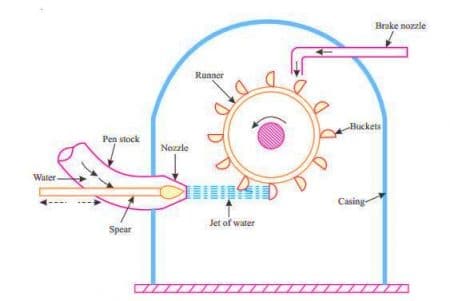
Pelton Turbine is a Tangential flow impulse turbine in which the pressure energy of water is converted into kinetic energy to form high speed water jet and this jet strikes the wheel tangentially to make it rotate. It is also called as Pelton Wheel.

Parts and Their Functions of Pelton Turbine

Different parts and their functions of Pelton turbine are as follows.
Different Parts of Pelton Wheel Turbine
Fig 1: Parts of Pelton Turbine
  1. Nozzle and Flow Regulating Arrangement
  2. Runner and Buckets
  3. Casing
  4. Braking Jet

1.Nozzle and Flow Regulating Arrangement

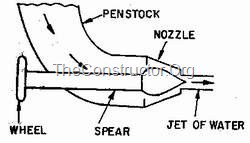
The water from source is transferred through penstock to which end a nozzle is provided. Using this nozzle the high speed water jet can be formed. To control the water jet from nozzle, a movable needle spear is arranged inside the nozzle.
Nozzle and Flow Arrangement Of Pelton Turbine
Fig 2: Nozzle and Flow Arrangement
The spear will move backward and forward in axial direction. When it is moved forward the flow will reduce or stopped and when it is moved backward the flow will increase.

2.Runner and Buckets

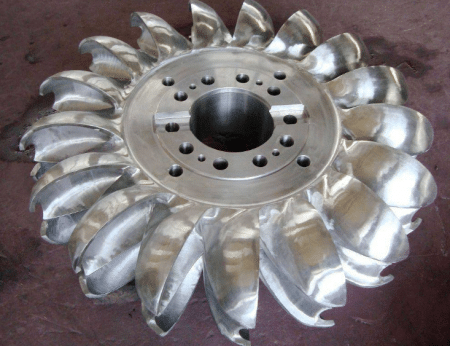
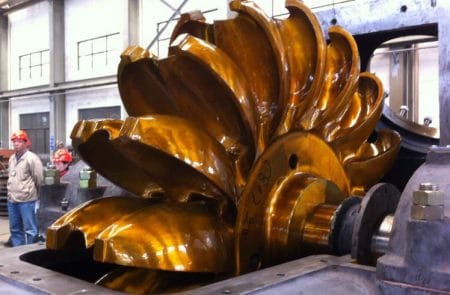
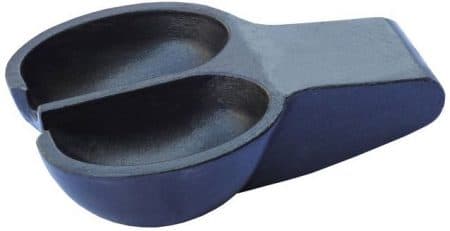
A Pelton turbine consists of a runner, which is a circular disc on the periphery of which a number of buckets are mounted with equal spacing between them. The buckets mounted are either double hemispherical or double ellipsoidal shaped.
Runner and Buckets of Pelton Wheel Turbine
Fig 3: Runner and Buckets of Pelton Wheel
A dividing wall called splitter is provided for each bucket which separates the bucket into two equal parts. The buckets are generally made of cast iron or stainless steel or bronze depending upon the head of inlet of Pelton turbine.

3.Casing

The whole arrangement of runner and buckets, inlet and braking jets are covered by the Casing. Casing of Pelton turbine does not perform any hydraulic actions but prevents the splashing of water while working and also helps the water to discharge to the tail race.
Model of Pelton Turbine
Fig 4 : Pelton Turbine Model With Casing

4.Braking Jet

Braking jet is used to stop the running wheel when it is not working. This situation arises when the nozzle inlet is closed with the help of spear then the water jet is stopped on the buckets. But Due to inertia, the runner will not stop revolving even after complete closure of inlet nozzle.
To stop this, a brake nozzle is provided as shown in figure 1. The brake nozzle directs the jet of water on the back of buckets to stop the wheel. The jet directed by brake nozzle is called braking jet.

Working of Pelton Turbine

The working of Pelton turbine is as follows:
  • The water is transferred from the high head source through a long conduit called Penstock.
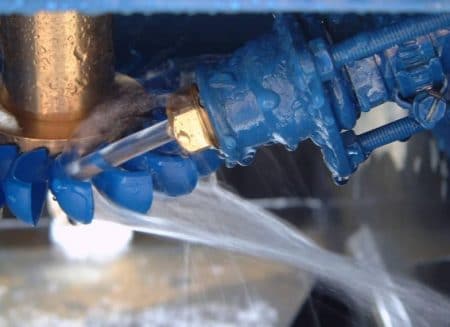
  • Nozzle arrangement at the end of penstock helps the water to accelerate and it flows out as a high speed jet with high velocity and discharge at atmospheric pressure.
  • The jet will hit the splitter of the buckets which will distribute the jet into two halves of bucket and the wheel starts revolving.
  • The kinetic energy of the jet is reduced when it hits the bucket and also due to spherical shape of buckets the directed jet will change its direction and takes U-turn and falls into tail race.
Water Jet striking Pelton Wheel Buckets
Fig 5: Water Jet striking Pelton Wheel Buckets
  • In general, the inlet angle of jet is in between 1o to 3o, after hitting the buckets the deflected jet angle is in between 165o to 170o.
  • The water collected in tail race should not submerge the Pelton wheel in any case.
  • To generate more power, two Pelton wheels can be arranged to a single shaft or two water jets can be directed at a time to a single Pelton wheel.

Design aspects of Pelton Turbine

Following are the aspects to be considered while designing the Pelton wheel turbine.
  1. Velocity of jet
  2. Velocity of wheel
  3. Angle of deflection of jet
  4. Mean diameter of the wheel
  5. Jet ratio
  6. Bucket dimensions
  7. Number of jets
  8. Number of buckets
Large Pelton Turbine
Fig 6: Pelton Wheel

1.Velocity of Jet

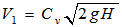
The velocity of the jet at inlet is given by
Velocity of Jet equation
Where     Cv = co-efficient of velocity =0.98 or 0.99.
H= Net head on turbine.

2.Velocity of Wheel

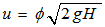
The velocity of wheel (u) is given by
Velocity of Wheel Equation
Where,  = speed ratio = 0.43 to 0.48

3.Angle of Deflection of Jet

The angle of deflection of jet after striking the buckets is taken as 165o if no deflection angle is given.

4.Mean Diameter of The Wheel

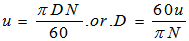
The mean diameter or the pitch diameter D of the pelton turbine is given by
Mean Diameter of Wheel Equation

5.Jet Ratio

It is defined as the ratio of the pitch diameter (D) of the pelton turbine to the diameter of the jet (d). It is denoted by m and is given as
m = D/d 
Jet ratio(m) is lies between 11 to 16 for maximum hydraulic efficiency. however, In most of the cases it is taken as 12.

6.Bucket Dimensions

Buckets dimensions are designed in such a way that its breadth should be 3 to 4 times of diameter of jet, length should be 2 to 3 times of diameter of jet and thickness should be 0.8 to 1.2 times the diameter of jet.
Shape of Pelton Wheel Bucket
Fig 7: Pelton Wheel Bucket

7.Number of Jets

It is obtained by dividing the total rate of flow through the turbine by the rate of flow of water through a single jet.
In general, Number of jets are limited to two in case of vertical runner and six in case of horizontal runner.

8.Number of Buckets

The number of buckets (z) on a runner is given by
Equation for number of Buckets
Where,      D = Pitch diamater
d = Diameter of Jet
m = jet ratio


Sunday, August 19, 2018

Vastu Sastra For Religious People

Impress Lord Kuber!

1 / 22Lord Kuber, the lord of wealth will shower you with prosperity if he is pleased with you. But how to please the lord? If you follow these simple Vastu tips to gain wealth you can surely please the lord and be blessed with health and wealth always!Place the cash locker in right direction!

2 / 22We keep our belongings and jwellery stored ina cash locker or a cupboard locker at home. According to Vastu, it is important to place this locker closer to the south-west or the south wall in the room so that it opens onto the north direction. This is because Lord Kuber resides in the north direction and if the locker opens in north, the lord will refill it over and over again.Where not to place the cash locker

3 / 22Cash locker is the most important object in the house. A cash locker should never be placed under a focus light or beam. This indicates financial stress on the family or family business.Double your wealth by using a mirror

4 / 22Place a mirror in front of your cash locker so that the image of the locker gets reflected in the mirror. This is symbolic of doubling of wealth.Position of staircase for wealth prosperity

5 / 22The staircase should never be made in the north-east direction. This portion should always clear of clutter and open as it helps to attract wealth towards an individual. No machinery should be kept in this direction as well.Effect of Swimming Pool on wealth

6 / 22A swimming pool, if required to be created, or any water body should never be made lower than the ground level in the south-west corner. This is applicable to one’s office, home or even an apartment building.Purchase of land as per Vastu

7 / 22It is best to avoid purchasing a plot of land that has high-rise buildings or temples in frontof the north-east side of your land. This leads to a loss of wealth. Also, if this is unavoidablethen one needs to make sure that these building structures are not casting a shadow on your plot of land.Avoid Curved Walls

8 / 22Curved walls should be avoided in the north-east corner of your boundary wall. They should always be in right angles.Vastu guidelines for Roof

9 / 22When making the roof, it is better to keep the north-east portion of the roof lower than the south-west portion. In short, the roof must slope south west down to north east.Height of boundary walls also affect incoming wealth

10 / 22The south and west side walls of the houseand the boundary walls on this side should behigher as well as thicker than those of the east and north side.Are neighboring areas elevated?

11 / 22When buying the plot to build your home or office, you need to ensure that the land has the same elevation or is higher than the adjacent roads. No point in purchasing a piece of plot that is lower than the road.Planting trees in SouthWest

12 / 22To stabilize finance, Vastu experts suggest that planting large big trees in the south-west side of the plot will do a lot of good. Doing so also helps to avoid any mishap or unfortunateevents in family and family business.Where not to plant trees

13 / 22However, planting trees in the north-east side will have the exact opposite effect, i.e. it will obstruct the flow of finances.Keep Center of house clutter free

14 / 22The center portion of the house should not have anything. It should be free of clutter or one can build a temple there as this is known as the Brahmasthan area in the house.Direction of Store Rooms

15 / 22Store Rooms are inevitable. If we want to keep the house clean and clutter free then we do end up making a store room. The west portion or the south-west portion in the house is good for a store room.Keep Doors and windows clean and dust free.

16 / 22The main entrance to the house should always be clean. Cleanliness invites Lord Kuber and Goddess Lakshmi. Doors and windows should always be clean. If not, then they will obstruct the flow of wealth into the house.Don't let water flow out like a waste

17 / 22Never leave taps leaking. A leaking tap or faucet is considered inauspicious as it indicates wastage of money just like waste ofwater. Water is symbolic of money.Placement of water fountain

18 / 22Keep a water fountain the north-east part of your home. Also, make sure that the water in fountain is always flowing and not stagnant. Flowing water indicates flow of energy and wealth.Where to place your aquarium

19 / 22If you have an aquarium at home, always place it in the north-east portion in the house. Also, aquarium should be cleaned regularly.How to decorate your entrance

20 / 22The main door of the house calls for distinctive decoration so that wealth and prosperity find you easily. A nameplate outside your home is a must. The area outside the main door should be kept well lit with beautiful colours.Bird feeder attracts wealth

21 / 22Keep a bird feeder in your yard. Keep it filled with water as well as grains as this helps attract wealth and positive energy.Purple colour is symbolic of wealth

22 / 22The colour purple is a royal colour and wealth is symbolised by this colour as well. It is goodto keep a purple coloured plant within your home or if that is not possible, you need at least have a purple-coloured pot.