Thursday, October 11, 2018

What are the Errors in Borehole Data Interpretation for Site Investigation


What are the Errors in Borehole Data Interpretation for Site Investigation?


Borehole is small diameter vertical hole drilled into ground to take samples for soil investigation and evaluation. Errors in borehole data interpretation for site investigation is discussed.
Borehole data is used to specify suitable types of foundation for structure. While boreholes are interpreted, certain errors are highly likely to be made which could be fatal for the foundation and safety of the structure. These errors will be discussed and explained in the following sections.
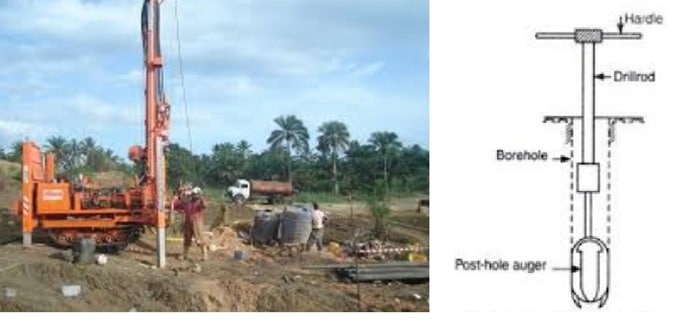
Errors in Borehole Data Interpretation
Fig.1: Drilling Boreholes to Take Soil Samples for Assessment of Soil Condition
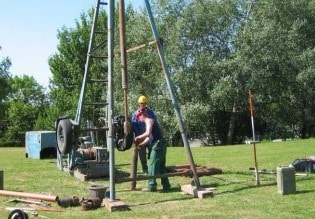
Drilling Borehole
Fig.2: Drilling Borehole

What are the Errors in Borehole Data Interpretation?

Misinterpretations of boreholes include:
  • Interpreting folded strata as straight strata
  • Drift underlain by unexplored rock
  • Overloading due to lack of dip assessment
  • Bedrock misinterpretation
  • Improper interpretation of strata formation
  • Misinterpretation of soil profile

Interpreting Folded Strata as Straight Strata

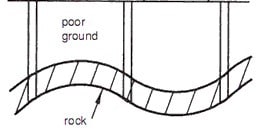
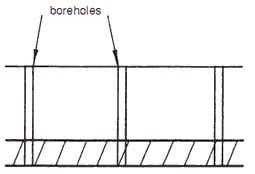
This type of error is made due to borehole distribution. In this situation, borehole data tells straight strata and other interpretation cannot be made based on that number and layout of the boreholes. This situation is demonstrated in Figure-3 and Figure-4.
This type of error could lead to increase in cost of foundation construction when piles with specified length do not reach soil layer with adequate bearing capacity and consequently the pile length should be increased.
Interpreting Folded Strata as Straight Strata
Fig.3: Actual strata shape, all boreholes provide the same data at the same depth
Unrealistic Assumption of Strata Formation
Fig.4: Unrealistic Assumption of Strata Formation

Drift Underlain by Unexplored Rock

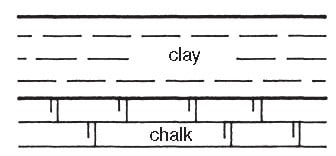
It is possible that strong layer of soil sits on a low bearing capacity soil layer. For example, layer of clay material overlay layer of chalk as shown in Figure-5. In this case, borehole may not reach chalk layer and clay layer would shows satisfactory strength and consequently appropriate for foundation construction.
But this assumption would be fatally wrong and would lead to not only extend construction period but also increase construction cost. This type of case has been encountered practically and these detrimental effects were encountered.
Clay Overlay Chalk
Fig.5: Clay Overlay Chalk
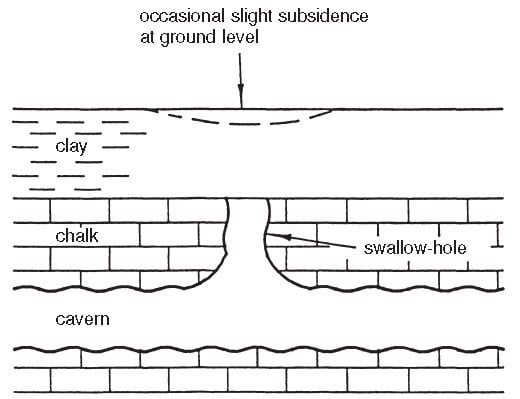
By and large, considerable sink holes quantity would be formed when chalk is present. These holes are usually formed between limestone and chalk joints through which water infiltrate into the ground and reach chalk layer.
Then, the water would dissolve chalk as it travels down and create a shaft. After the water reach chalk material, it might move horizontally and dissolve chalk again and eventually create a cave as can be observed Figure-6.
This is type of error is substantially fatal and should be considered while boreholes are used to investigate soil condition.
Water infiltrate into the ground at construction site
Fig.6: Water infiltrate into the ground at construction site, created swallow hole and subsequent shaft, then the water moved horizontally and dissolved chalk and finally produced a cave which considerably deteriorate foundation

Overloading Due to Lack of Dip Assessment

Occasionally, foundations would be subjected to a load that is out of expectation due to unexamined dip in the construction area.
So, it is recommended to check any dips if existing, to prevent foundation overloading and subsequent failure. Figure-6 illustrates the case where retaining wall structure subjected to extra load.
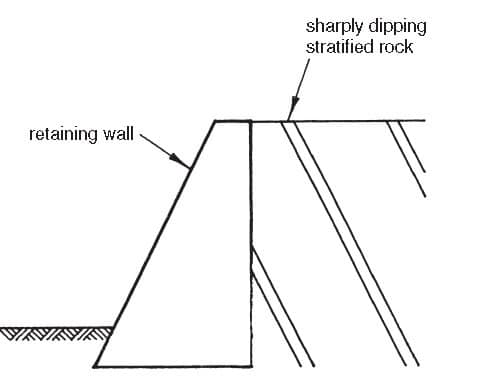
Existing dip has not been assessed
Fig.7: The existing dip has not been assessed, as a result, extra loads are imposed for which the retaining wall has not been designed

Bedrock Misinterpretation

Making errors in the interpretation of bedrock is possible. This might occur when borehole machine reach boulders in boulder clay and consequently bedrock would be assumed wrongly.
This type of errors is illustrated in Figure-8, which shows realistic soil profile and Figure-9 that shows improper interpretation of soil profile. This problem could be avoided by drilling higher number of boreholes.
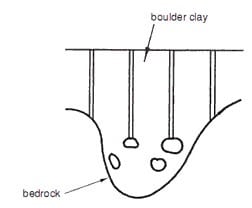
True Soil Profile, Boreholes Reach Boulders
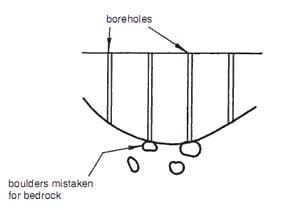
Fig.8: True Soil Profile, Boreholes Reach Boulders
Wrong Interpretation of Bedrock
Fig.9: Wrong Interpretation of Bedrock due to Boulders in Clay

Improper Interpretation of Strata Formation

This error might encounter when there is a fault in the area and is not examined. Consequently, strata formation generated would not represent the actual strata as it explained in Figure 10 and Figure 11.
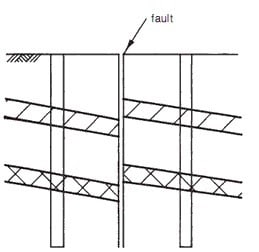
Realistic Formation of Strata
Fig.10: Realistic Formation of Strata
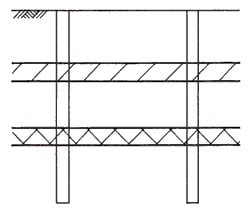
Interpreted strata formation
Fig.11: Interpreted strata formation which is considerably different from the realistic one shown in figure 4

Misinterpretation of Soil Profile

It is possible to interpret soil profile wrongly due to small number of boreholes or poor borehole layout. Figure-12 shows misinterpreted soil profile and actual soil profile are shown in Figure-13.
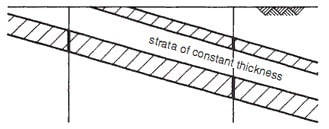
Misinterpreted Soil Profile
Fig.12: Misinterpreted Soil Profile
Actual soil profile
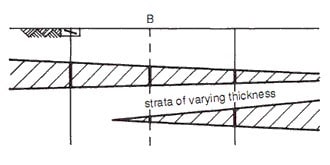
Fig.13: Actual soil profile that interpreted corrected because of digging borehole at (B)
The above possible errors should be considered while boreholes are used for soil investigations. As it has been pointed out, some of the errors could be prevented by increasing the frequency of boreholes.
One might argue that this would increase the cost of the construction but the increase is not proportional.
Added to that, it might not be necessary to test every sample which are taken and if poor bearing capacity soil layer is laid above strong soil layer, then it would not be necessary to assess low bearing capacity soil layer when pile foundation is considered.

Components of a Hydropower Plant and their Functions


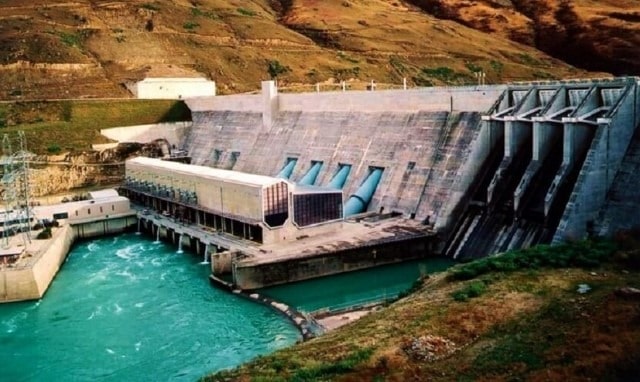
Components of a Hydropower Plant and their Functions


Table of Contents

What is Hydropower Plant?

Hydropower plant uses hydraulic energy of water to produce electricity. The power obtained from this plant is termed as hydroelectric power. Nearly 16% of total power used by the world is represented by hydropower.
There are several types of hydropower plants classified on different characteristics. But for every hydropower plant some important principal components are needed and those are explained here.
Components of a Hydropower Plant

Components of a Hydropower Plant

The major components of a hydroelectric plant are as follows.
  • Forebay
  • Intake structure
  • Penstock
  • Surge chamber
  • Hydraulic turbines
  • Power house
  • Draft tube
  • Tailrace

Forebay

A forebay is a basin area of hydropower plant where water is temporarily stored before going into intake chamber. The storage of water in forebay is decided based on required water demand in that area. This is also used when the load requirement in intake is less.
We know that reservoirs are built across the rivers to store the water, the water stored on upstream side of dam can be carried by penstocks to the power house. In this case, the reservoir itself acts as forebay.

Intake Structure

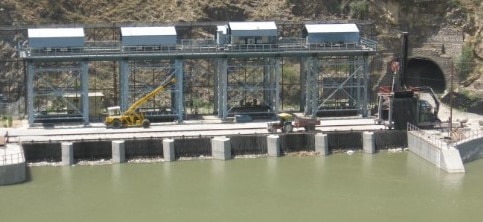
Intake structure is a structure which collects the water from the forebay and directs it into the penstocks. There are different types of intake structures are available and selection of type of intake structure depends on various local conditions.
Intake structure contain some important components of which trash racks plays vital role. Trash racks are provided at the entrance of penstock to trap the debris in the water.
If debris along with water flows into the penstock it will cause severe damage to the wicket gates, turbine runners, nozzles of turbines etc. these trash racks are made of steel in rod shape. These rods are arranged with a gap of 10 to 30cm apart and these racks will separate the debris form the flowing water whose permissible velocity is limited 0.6 m/sec to 1.6 m/sec.
In cold weather regions, there is chance of formation of ice in water, to prevent the entrance of ice into the penstocks trash racks heated with electricity and hence ice melts when it touches the trash racks.
Other than trash racks, rakes and trolley arrangement which is used to clean the trash racks and penstock closing gates are also provided in intake structure.
Intake structure

Penstock

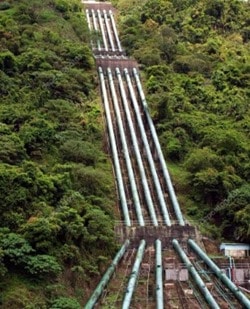
Penstocks are like large pipes laid with some slope which carries water from intake structure or reservoir to the turbines. They run with some pressure so, sudden closing or opening of penstock gates can cause water hammer effect to the penstocks.
So, these are designed to resist the water hammer effect apart from this penstock is similar to normal pipe. To overcome this pressure, heavy wall is provided for short length penstock and surge tank is provided in case of long length penstocks.
Steel or Reinforced concrete is used for making penstocks. If the length is small, separate penstock is used for each turbine similarly if the length is big single large penstock is used and at the end it is separated into branches.
Penstock

Surge Chamber

A surge chamber or surge tank is a cylindrical tank which is open at the top to control the pressure in penstock. It is connected to the penstock and as close as possible to the power house.
Whenever the power house rejected the water load coming from penstock the water level in the surge tank rises and control the pressure in penstock.
Similarly, when the huge demand is needed in power house surge tank accelerates the water flow into the power house and then water level reduces. When the discharge is steady in the power house, water level in the surge tank becomes constant.
There are different types of surge tanks available and they are selected based on the requirement of plant, length of penstock etc.
Surge Chamber

Hydraulic Turbines

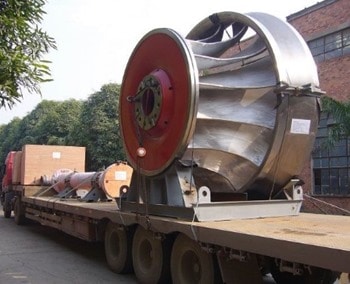
Hydraulic turbine, a device which can convert the hydraulic energy into the mechanical energy which again converted into the electrical energy by coupling the shaft of turbine to the generator.
The mechanism in this case is, whenever the water coming from penstock strike the circular blades or runner with high pressure it will rotate the shaft provided at the center and it causes generator to produce electrical power.
Generally hydraulic turbines are of two types namely
  • Impulse turbine
  • Reaction turbine
Impulse turbine is also called as velocity turbine. Pelton wheel turbine is example for impulse turbine. Reaction turbine is also called as pressure turbine. Kaplan turbine and Francis turbine come under this category.
Hydraulic Turbine

Power House

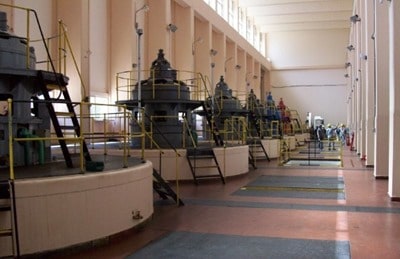
Power house is a building provided to protect the hydraulic and electrical equipment. Generally, the whole equipment is supported by the foundation or substructure laid for the power house.
In case of reaction turbines some machines like draft tubes, scroll casing etc. are fixed with in the foundation while laying it. So, the foundation is laid in big dimensions.
When it comes to super structure, generators are provided on the ground floor under which vertical turbines are provided. Besides generator horizontal turbines are provided. Control room is provided at first floor or mezzanine floor.
Power House

Draft Tube

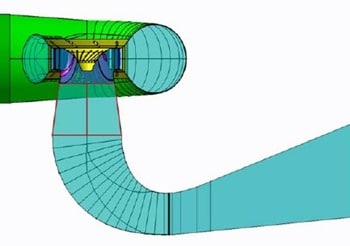
If reaction turbines are used, then draft tube is a necessary component which connects turbine outlet to the tailrace. The draft tube contains gradually increasing diameter so that the water discharged into the tailrace with safe velocity. At the end of draft tube, outlet gates are provided which can be closed during repair works.
Draft Tube

Tailrace

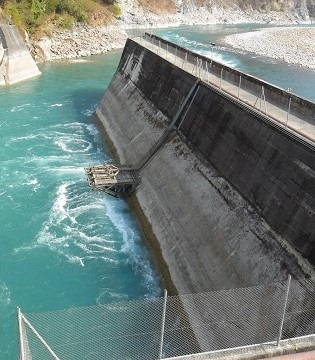
Tailrace is the flow of water from turbines to the stream. It is good if the power house is located nearer to the stream. But, if it is located far away from the stream then it is necessary to build a channel for carrying water into the stream.
Otherwise the water flow may damage the plant in many ways like lowering turbine efficiency, cavitation, damage to turbine blades etc.
This is because of silting or scouring caused by unnecessary flow of water from power house. Hence, proper design of tailrace should be more important.
Tailrace

Wednesday, October 10, 2018

Ready Mix Concrete


Ready Mix Concrete

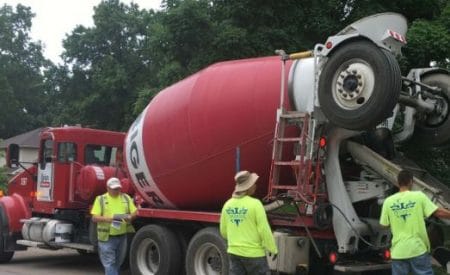
Ready mix concrete is a type of concrete processed in highly qualified manner at batching plant and supplier through transit mixers at site ready to be used.

Inspection and Testing of Ready Mix Concrete


Inspection and testing of ready mix concrete is crucial to ensure that all specified conditions meet the acceptable criteria. Ready mix concrete, which produced in batching plant and transported to construction site by truck mounted mixers, are commonly inspected and tested in accordance with applicable standards such as ASTM international.

Inspect Ready Mix Concrete

Batching Plant Inspection

  • Firstly, examine and specify whether facilities, scales, and truck mixers meet the specified project requirements or not.
  • Inspect storage areas of all materials like cement, aggregate, and admixtures to ensure their cleanness, free of contamination, and properly protect materials from effect of freezing.
  • Inspect and verify that coarse and fine aggregate gradation tests are conducted in accordance applicable standards like ASTM C 136, and result reach project requirements.

Onsite Inspection of Ready Mix Concrete

  • Every delivery ticket shall be inspected to ensure that a mixture with the correct designation is delivered.
  • Inspect delivered concrete; it should be uniform and adequately mixed prior to discharge at the construction site.
  • Inspect and monitor water, admixture, and fiber reinforcement addition onsite to make sure that the process performed properly.
  • Monitor and examine concrete delivery and placement time to find out whether it completed within the time constraints of the project specifications.
    Inspection of ready mix concrete onsite
    Fig. 1: Inspection of ready mix concrete onsite

Testing Ready Mix Concrete 

1. Onsite Tests

There are certain types of tests that shall be conducted on ready mix concrete upon reaching construction sites. Table 1 provide lists of tests that need to be performed on ready mix concrete on project site.
Table 1 Tests conducted on ready mix concrete upon reaching construction site
Type of testsASTM international for testing proceduresTest frequencies Purpose of the test
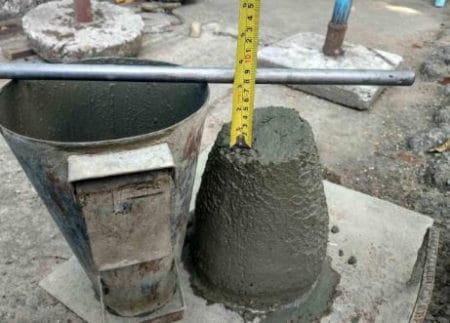
SlumpASTM C 143/C 143MFirst truck load, whenever the consistency of the concrete appears to vary.Measure fresh concrete consistency, check its workability, and use as an indicator of poor mixed batch
Air contentASTM C 173, ASTM C 231Performed on all samples taken to measure concrete strengthTo check air entrained concrete
TemperatureASTM C 1064At the time of sampling for each strength testto make sure that concrete comply with certain specifications that define a certain allowable temperature range
DensityASTM C 138, ASTM C 567Whenever required by project specificationsTo estimate concrete density
slump test on first batch of ready mix concrete
Fig. 3: slump test on first batch of ready mix concrete

2. Laboratory tests

There are certain properties that required to be evaluated. For this purpose, concrete specimen of ready mix concrete is tested in the laboratory. Table 2 provide list of tests needed to be performed for ready mix concrete.
Table 2 laboratory tests conducted on ready mix concrete specimens
Type of testsASTM international for testing proceduresTest frequencies Purpose of the test
compressive strengthASTM C 39/C 39MMinimum two specimens are test at each ageTo estimate concrete compressive strength and determining conformance with the specified strength
Flexural strengthASTM C 78 or ASTM C 293To estimate concrete flexural strength and determining conformance with the specified strength
Test results shall be compared with values provided in ACI 318/318R to find out whether the concrete confirm with specifications or not.

Sampling of Ready Mix Concrete

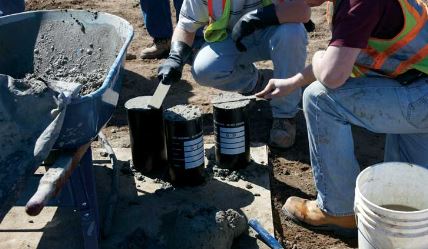
  • Specimens shall represent concrete conditions as placed.
  • Date, time, placement location, truck number, and ticket number should be recorded.
  • For each test age, minimum three strength specimens shall be casted.
  • Additional specimens should be casted for field curing if in-place concrete strength verification is required prior to removal of forms, shoring, or placement of the structure in service
  • Minimum one set of strength test specimens shall be casted according to ASTM C 31/C 31M for each 76 m3 of each class of concrete placed in any one day.
    Ready mix concrete sampling
    Fig. 4: Ready mix concrete sampling

Curing and Handling Specimens

  • Samples, which casted for acceptance testing purposes, should be stored and cured for up to 48hr after molding on project site.
  • Curing specimen should be according to applicable standards like ASTM C 31/C 31M.
  • Specimens shall be stored in temperature ranges 16 to 27 ÂșC.
  • Loss of temperature or damages of specimens shall be prevented
  • Specimens shall be transported within 16 to 48 hours after molding to laboratory, and transportation time should not be longer than 4 hours.