Saturday, October 6, 2018

Concrete Floor Slab Construction Process


Concrete Floor Slab Construction Process


Concrete floor slab construction process includes erection of formwork, placement of reinforcement, pouring, compacting and finishing concrete and lastly removal of formwork and curing of concrete slab.

Concrete Floor Slab Construction Process

  1. Assemble and Erect Formwork
  2. Prepare and Place Reinforcement
  3. Pour, Compact and Finish Concrete
  4. Curing Concrete and Remove Formwork

1. Assemble and Erect Formwork for Slab

The formwork shall be designed to withstand construction loads such as fresh concrete pressure and weight of workers and operators and their machines. Guide to Formwork for Concrete ACI 347-04 shall be followed for the design of formworks.
Moreover, there are various construction aspects that need to be considered during the erection of formworks. For example, it should be positioned correctly, lined and levelled, joints sealed adequately, and prevent protruding of nails into the concrete etc…
Furthermore, different materials such as wood, steel, and aluminum can be used for the formworks of concrete floor slab.

Concrete Floor Slab Formwork
Fig. 1: Concrete Floor Slab Formwork

Finally, there are several common formwork construction deficiencies that site engineer needs to be aware of and prevent their occurrence otherwise formwork failure may occur. These construction deficiencies are provided below:
  • Poor or lack of formwork examination during and after concrete placement to identify uncommon deflections or other indications of possible failure that could be corrected
  • Inadequate nailing, bolting, welding, or fastening
  • Improper lateral bracing
  • Construct formwork that does not comply with form drawings
  • Lack of proper field inspection to ensure that form design has been properly interpreted by form builders
  • Use of damaged or inferior lumber having lower strength than needed.

2. Prepare and Place Reinforcement for Slab

Prior to the placement of reinforcement for concrete floor slab construction, inspect and check forms to confirm that the dimensions and the location of the concrete members conform to the structural plans.
Added to that, the forms shall be properly cleaned and oiled but not in such amount as to run onto bars or concrete construction joints.
Design drawings provides necessary reinforcement details, so it only needs understanding to use designated bar size, cutting required length, and make necessary hooks and bents.
After preparation is completed, steel bars are placed into their positions with the provision of specified spacings and concrete cover.
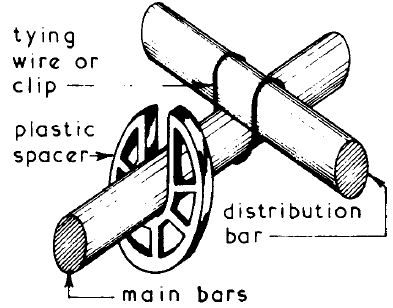
The concrete cover and spacing for floor slabs can be maintained by introducing spacers and bars supporters. Wires are used to tie main reinforcement and shrinkage and temperature reinforcement (distribution reinforcement).

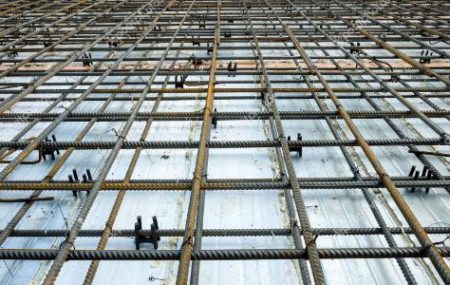
wires used to tie reinforcement and supporters used to maintain concrete cover
Fig. 2: wires used to tie reinforcement and supporters used to maintain concrete cover

It should be known that incorrect reinforcing steel placement can lead to serious concrete structural failures. Improper concrete cover exposes reinforcement bars to danger and jeopardize concrete-steel bond.
Finally, after all requirements of reinforcement placements (positions, concrete cover, spacing, and correct bars size; length; hooks; and bending) are finalized, then site engineer can order concreting.

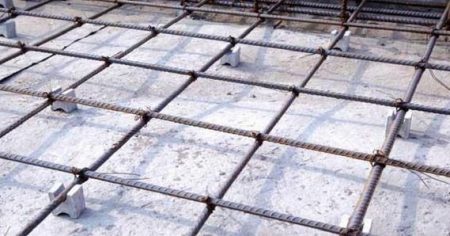
Provision of concrete cover for reinforcement bars in slab
Fig. 3: Provision of concrete cover for reinforcement bars in slab

3. Pour, Compact and Finishing Concrete Floor Slab

Mixing, transporting, and handling of concrete shall be properly coordinated with placing and finishing works. In floor slab, begin concrete placing along the perimeter at one end of the work with each batch placed against previously dispatched concrete.

Concrete placement started from one end of the slab
Fig. 4: Concrete placement started from one end of the slab

Concrete should be deposited at, or as close as possible to, its final position in order to prevent segregation. So, Concrete placement in large and separate piles, then moving them horizontally into final position shall be prevented.
Moreover, site engineer shall monitor concreting properly, and look for signs of problems. For example, loss of grout is the indication of improper sealing and movement of joints. Added to that, cracking, excessive deflection, level and plumb, and any movement shall be checked and tackled to prevent further problems.

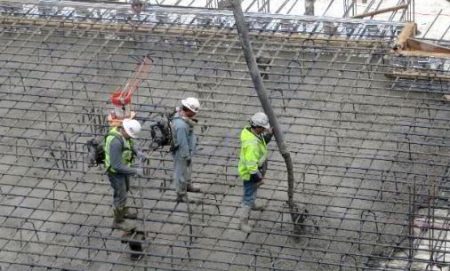
Concrete placement using pumps
Fig. 5: Concrete placement using pumps

Furthermore, fresh concrete should be compacted adequately in order to mold it within the forms and around embedded items and reinforcement and to eliminate stone pockets, honeycomb, and entrapped air. Vibration, either internal or external, is the most widely used method for consolidating concrete.
Lastly, slabs could be finished in many ways based on floor application. Helpful information about forms before, during, and after concreting can be found in ACI 311.1R.

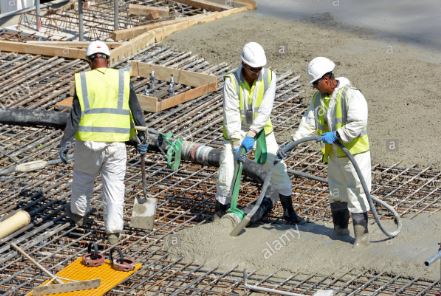
Placing and vibrating fresh concrete
Fig. 6: Placing and vibrating fresh concrete

4. Curing Concrete and Remove Formwork

After finishing ended, suitable technique shall be used to cure the concrete adequately. Slab curing methods such as water cure; concrete is flooded; ponded; or mist sprayed.
In addition to water retaining method in which coverings such as sand; canvas; burlap; or straw used to kept slab surface wet continuously, chemical Membranes,and waterproof paper or plastic film seal.
Regarding curing, it is recommended to remove formworks after 14 days. For detailed formwork removal time.

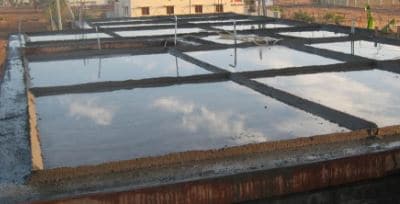
Curing concrete slab by ponding
Fig. 7: Curing concrete slab by ponding

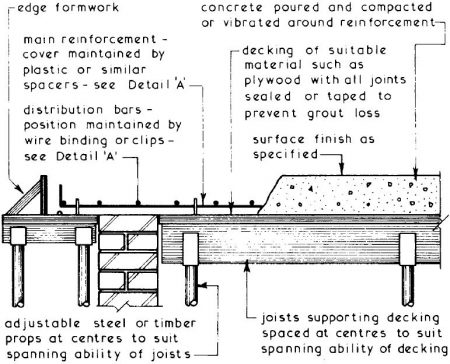
All construction process of concrete floor slab are illustrated in Fig.8 and Fig.9.

Illustration of reinforced concrete slab construction
Fig. 8: Illustration of reinforced concrete slab construction
Wire used to bind main and shrinkage and temperature reinforcement
Fig. 9: Wire used to bind main and shrinkage and temperature reinforcement (Detail ‘A’)


Prestressed Concrete Pipes – Types, Uses and Manufacture


Prestressed Concrete Pipes – Types, Uses and Manufacture


Prestressed concrete pipes are widely used around the world and slowly replacing RCC pipes and steel pipes. They have more strength than RCC pipes and economical compared to steel or cast iron pipes. The strength of PSC pipe can be achieved by circumferential prestressing in which a prestressed steel wire is helically wound under tension around the concrete core.

Types of Prestressed Concrete Pipes

Prestressed concrete pipes are classified into two different types as follows:
  1. Prestressed Concrete Lined Cylinder Pipes
  2. Prestressed Concrete Non-cylinder Pipes

1. Prestressed Concrete Lined Cylinder Pipes

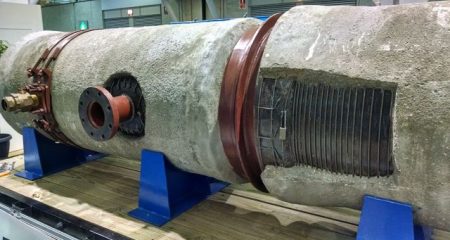
In this type of Prestressed Concrete Pipes, concrete core pipe is lined by steel cylinder which wrapped with a helix of highly prestressed wire and this wire arrangement is protected by a coat of cement mortar or dense concrete. Steel cylinder contains steel joint rings at its ends which are used to connect two pipes during installation.

Prestressed Concrete Lined Cylinder Pipe
Fig 1: Prestressed Concrete Lined Cylinder Pipe

2. Prestressed Concrete Non-cylinder Pipes

Prestressed Concrete Non-cylinder Pipes does not contain steel cylinder between prestressed wiring and the concrete core pipe and this is the only difference between cylinder and non-cylinder type pipes. In this type circular prestressing is directly provided on the concrete core pipe.

Prestressed Concrete Non-cylinder Pipe
Fig 2: Prestressed Concrete Non-cylinder Pipe

Manufacturing Methods of Prestressed Concrete Pipes

Prestressed concrete pipes can manufactured in two different ways which are
  1. Monolyte Construction
  2. Two Stage Construction

1. Monolyte Construction

  • Monolyte method of prestressed concrete pipes making consists, a vertical steel mold which has an inner shell and outer shell.
  • Outer shell of mold consists of longitudinal section which are hold together by spring arrangements. Inner shell of mold consist an expandable rubber membrane.
  • In this method, concrete is poured from the top of the mold under high frequency vibration.
  • Once the concrete is poured, the longitudinal sections of outer shell are permits the mold to expand and rubber membrane in the inner shell also starts expanding.
  • This introduces prestress in concrete and curing is done by steaming in monolyte method.
  • In monolyte construction, the whole production process is done in a single stage or cycle.

Fig 3: Prestressed Concrete Pipe Mold

2. Two Stage Construction

  • Two stage construction of prestressed concrete pipes, contains two stages of making and this method can be used to make both cylinder and non-cylinder type pipes.
  • To manufacture Non-cylinder type P.S.C pipe, concrete is cast over a tensioned longitudinal reinforcement in the first stage.
  • After curing of concrete, in second stage, prestressed wires are wound around the circumference of concrete pipe under tension and cement mortar layer is coated on it.
  • Longitudinal stresses induced in first stage are helpful in second stage to resist cracking due to circumferential winding and cracking during installation of pipes.
  • In case of cylinder type pipes, steel cylinder is lined with concrete on the inside and this cylinder is wrapped using highly stressed wire.
  • After wrapping the wire, a rich cement mortar is coated as a protection layer.
  • The wires and the splices are fixed at ends by using tubular fasteners.
  • For very high pressures, larger diameter pipes are used which may require double winding of wires and double mortar coating.

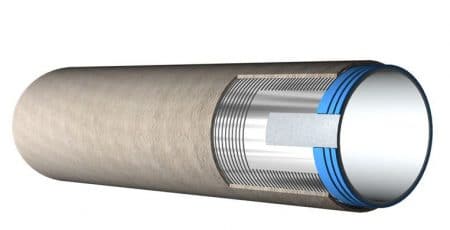
PSC Pipe
Fig 4: Typical PSC Pipe Showing Prestressed Wire Wound Around Steel Cylinder

Uses of Prestressed Concrete Pipes

Prestressed concrete pipes are used for many purposes as follows:
  • To supply water for domestic needs, where water needs high pressure to supply uniformly to distributed mains.
  • For Industrial purposes such as re-circulating pipes, cooling water pipe lines etc.
  • Used as Pipe lines which carry sewage using gravity.
  • Run-off or rainwater collecting pipe lines.
  • To construct culverts under roadway, railroad or through any obstruction etc.
  • To construct inverted siphons.

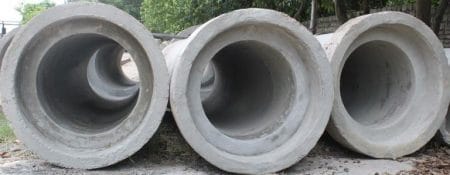
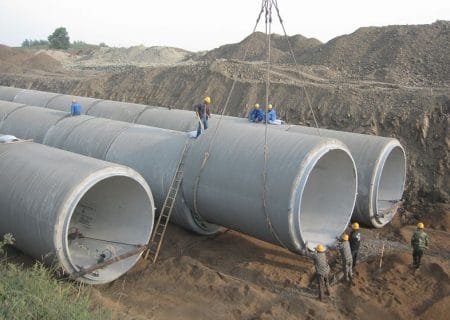
Laying Prestressed Concrete Pipes
Fig 5: Laying Prestressed Concrete Pipes


Friday, October 5, 2018

Mix Design Requirements for Self Compacting Concrete(SCC)


Mix Design Requirements for Self Compacting Concrete(SCC)


Self Compacting Concrete (SCC) mix design must involve key practices to achieve the requirements of quality and durable mix. The mix designed as per the requirements are tested before using it in construction.
The basic properties to be achieved by an SCC mix is flowability, passing ability, strength, and segregation resistance. The requirements to attain these properties are explained below.

SCC Mix Design Requirements

1. High Volume of Paste

As SCC concrete undergoes self-compaction by its own weight, it has to attain adequate filling ability so that the mix reaches every area. Friction between the aggregates restricts this spreading and hence the filling ability. This issue is solved by increasing the paste content in SCC mix design in a range of 300 to 400 l/m³. The volume of paste implies the combination of cement, water, additions, and air. This increase in paste helps separation of the aggregates and easy movement of the mix.

2. High Volume of Fines (<80µm)

SCC must be designed for sufficient workability to show the property of self-compaction. This workability must not bring segregation and bleeding issues. To limit these risks, SCC is designed to have a large number of fines in a range of 500 kg/ meter cube.
Excessive fines in the form of cement alone bring chances of an increased heat of hydration. For this, a part of fines is replaced by pozzolans or mineral admixtures like silica fume or fly ash.
The strength and durability requirements of the SCC concrete governs the volume of filler fines added to the mix.

3. High Dosage of Superplasticisers

Superplasticizers are introduced in SCC to obtain the fluidity and workability. Nevertheless, a high dosage near the saturation amount can increase the proneness of the concrete to segregate.The increase of workability by using superplasticisers won’t leave segregation or bleeding issues.

4. Use of Viscosity Modifying Agent

The viscosity modifying agent in SCC mix design has the same objective as that of fine particles. These help to attain flowability property for concrete without segregation and bleeding issues. These hold the mix by thickening the paste and holding the water with the skeleton created by these agents.Viscosity modifying agents are cellulose derivatives, polysaccharides or colloidal suspensions.
The introduction of such products in SCC seems to be justified in the case of SCC with the high water to binder ratio (for e.g. residential building). On the other hand, they may be less useful for high-performance SCC (strength higher than 50 MPa) with low water to binder ratio.
Viscosity agents make SCC less sensitive to water variations in water content of aggregates occurring in concrete plants.

5. Less Coarse Aggregate

To increase the passing ability of SCC, the volume of coarse aggregate added is less. The coarse aggregate used can be either naturally rounded, crushed or semi-crushed aggregate.
The coarse aggregate has a role in increasing the packing density of the SCC. So the volume of the coarse aggregate must not be too high nor too low. The size of coarse aggregate used can be between 10mm and 20mm. With the increase in the size of the coarse aggregate, the passing ability decreases. The choice of a higher aggregate size is thus possible but is only justified with low reinforcement content.

6. Addition of Admixtures

Admixtures added to SCC can have a retarding effect on the strength and the temperature development in the fresh concrete, & this has to be kept in mind in the construction process. Suppliers of admixture can produce various admixtures suitable for different weather conditions & temperatures. The additions have to be performed based on the guidelines provided by the admixtures.