Thursday, September 27, 2018

Types of Floors Systems for Multi-Storey Steel Structure Construction


Types of Floors Systems for Multi-Storey Steel Structure Construction


What are the common types of floors systems used in the construction of multi storey steel structure?
Types of floor system used in the construction of multi storey steel structures with span ranges, advantages and criteria considered while floor system is specified for a given structure are discussed.
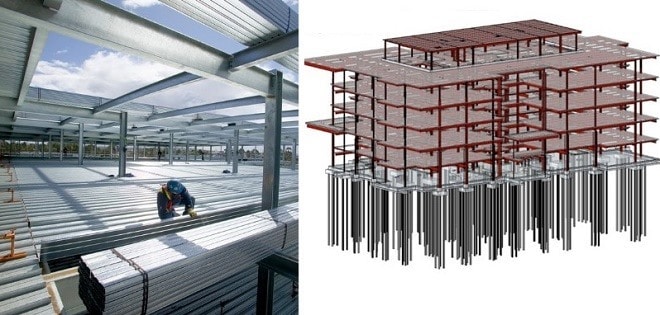
Types of Floors Systems for Multi-Storey Steel Structure Construction
Fig.1: Floor System of Multi Storey Steel Structure

Types of Floors Systems Used for Multi-Storey Steel Structure Construction

Different types of floor system used for steel structures include:
  • Short-span composite beams and composite slabs with metal decking
  • Slimdek floor system
  • Cellular composite beams with composite slabs and steel decking
  • Slimflor beams with precast concrete units
  • Long-span composite beams and composite slabs with metal decking
  • Composite beams with precast concrete units
  • Non-composite beams with precast concrete units

Short-Span Composite Beams and Composite Slabs with Metal Decking

As it may be observed from Figure 2, the components of such system consist of steel beam with shear studs fixed on its top flange that create a composite action between the beam and composite slab.
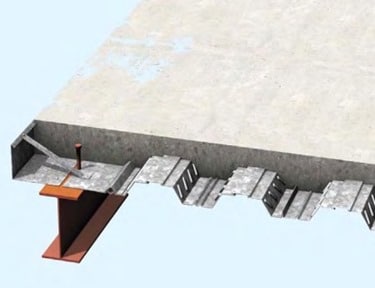
Composite Floor System
Fig.2: Composite Floor System
The slab consists of steel profile on which in situ concrete are poured. Various steel deck profiles are available and their span ranges are from 3m to 4m.
Different Steel Deck Profiles
Fig.3: Different Steel Deck Profiles
Moreover, both primary and secondary beams are designed as composite member whereas edge beams could be designed as non-composite element.
The thickness of the beams ranges from 0.9 m to 1.2m; slab thickness is 130mm and steel deck depth is about 60mm. The span of primary beams varies between 6m and 9m and secondary beam span ranges from 6m to 7.5m.
It should be known that services and utilities are run under the slab, so it affects the overall thickness of the slab. Due to the fact that edge beams are mostly deeper than interior beams, therefore the thickness of floor system is controlled by edge beams.
Common advantages of this floor system are cost effective, light weight and requires thinner beams compared with non-composite floor systems.
As far as composite floor disadvantages are concerned, beams need fire protection, large numbers of columns are needed, greater floor thickness compared with other systems.

Slimdek Floor System

Details of slimdek floor systems are provided in Figure-4. It is composed of asymmetric steel beam that carry a slab with 225mm thickness.
The overall floor thickness is between 500mm to 1200mm. The span of slimdek floor system ranges from 6.5m to 7.5m.
The most outstanding advantages of slimdek floor system is that it provides almost a leveled soffit which simplify utility installation and the thickness of the floor is smaller compared with other systems. Consequently, the total height of the structure can be decreased.
There are certain disadvantages that associated with slimdek floor system. For example, special connection detailing would be required due to the difference between top and bottom flange width. The weight of steel is commonly larger in comparison with other floor systems.
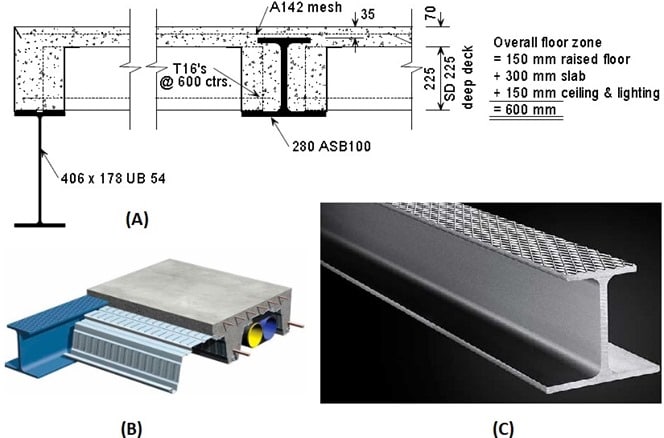
Slimdek Floor System
Fig.4: Slimdek floor system; (A) details of beams, reinforcement and thickness, (B) 3D view of Slimdek floor system and (C) Slimdek steel which its top flange is smaller than bottom flange

Cellular Composite Beams with Composite Slabs And Steel Decking

It is composed of cellular beams that support composite slab that consist of steel deck profile and top concrete. The span of the beams ranges from 10m to 18m and openings are provided in close intervals.
Commonly, the shapes of openings are circular but other shapes are feasible to employ. It is recommended to omit openings at high shear locations such as regions close to supports.
Beams with Various Opening Shapes
Fig.5: Beams with Various Opening Shapes
The total thickness of such floor system is around 1200mm for span of 15m and opening of 400mm. Secondary beams are normally placed at 3-4m spacing.
Advantages of this floor system are provision of large clear area without the need of columns, use lightweight utilized beams compared with other systems with the same span ranges and are cost effective.
The only disadvantage is high cost of fabrication in comparison with plain section.
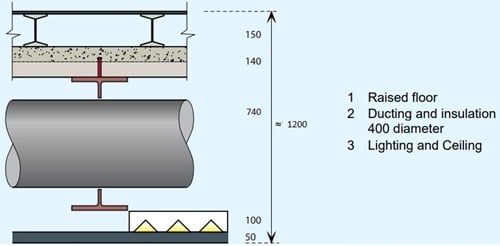
Cellular Beam with Composite Floor Slab and Utilities
Fig.6: Cellular Beam with Composite Floor Slab and Utilities

Slimflor Beams with Precast Concrete Units

Slimflor consist of slim beam and precast concrete slab that rests on the beam and reinforced concrete is used to join units together. Composite beams and non-composite beams can be used in this type of floor system.
The slim beam produced by welding 15mm thick plate to underside of beams section and exceed bottom flange by 100mm on either side.
Slimflor Beams with Precast Concrete Units
Fig.7: Slimflor Beam
The depth of the beams is restricted to the floor depth and its span ranges from 4.5m to 7.5m and occasionally up to 10m. However, deflection of shallow beams should be contained within the code specifications.
Regarding the thickness of precast concrete slab, it is governed by the span of the slab, for example, 150mm for span of 6m, 200mm for span of 7.5m and 260-300 mm for span of 9m.
The overall floor thickness is 600mm and 1000mm for small and large services respectively.
Advantages include no need for beam fire protection for 60min, small floor thickness permits the decrease of overall structure height and shear studs can be welded off site so on-site operations are reduced.
Disadvantages are heavy steel work, extra fabrication, great connection details and more works required to deliver and install precast slabs compared with composite slab.
Slimflor Construction
Fig.8: Slimflor Construction
Precast Concrete Slab Placed on Slimflor Beam
Fig.9: Precast Concrete Slab Placed on Slimflor Beam

Long-Span Composite Beams and Composite Slabs with Metal Decking

It is composed of primary and secondary steel beams and composite slab. There are two main beam arrangements for this floor system. The slab is supported by long span beams at spacing of 3 to 4m and act as secondary beams. These secondary beams are carried by short span primary beams.
Alternatively, the slab is supported by short span secondary beams and these beams are supported by long span primary beams.
The span of long beams ranges from 10 to 15m and their spacing is 6-9m when it is used as a primary beam and 3-4m spacing used for long span secondary beam.
The overall thickness is based on the span used, for instance, 1000mm for span of 13.5m and 1200 for span of 15m.
The most outstanding advantage is the provision of large clearance area without the need for columns. Nonetheless, floor thickness is large, fire protection needed and heavy steel works required compared with short span floor systems.
 Long Span Composite Beam and Composite Slab Construction
Fig.10: Long Span Composite Beam and Composite Slab Construction

Composite Beams with Precast Concrete Units

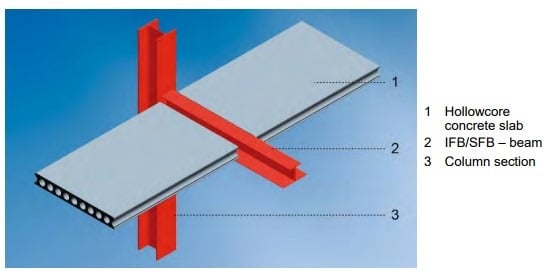
This floor system is composed of hollow or solid precast concrete units placed on steel beams on which shear studs are welded.
The thickness of the concrete precast units is 150-160mm for hollow units and 75-100mm for solid units.
Reinforced concrete toppings are placed on the beams to connect units as can be seen in Figure-11.
It is necessary to provide adequate flange with to provide sufficient seat for the precast units.
Composite Beam with Precast Construction
Fig.11: Composite Beam with Precast Construction
The span of both beams and precast concrete units are between 6m and 9m, and the entire floor thickness if around 900mm.
Advantages of this floor system are smaller numbers of secondary beams are needed compared to other systems due to large concrete unit spans. Shear connectors can be welded offsite that leads to reduced onsite works.
Disadvantages include the likelihood of lateral tensional buckling of beams, careful detailing needed to encase precast concrete units and greater works are needed to transport, lift and place precast concrete units.
It is necessary to provide temporary lateral supports for beams to prevent lateral tensional buckling during construction.
Composite Beams with Precast Unit Construction
Fig.12: Composite Beams with Precast Unit Construction

Non-Composite Beams with Precast Concrete Units

It consists of precast concrete units placed on steel beam flanges or shelves which are bolted or welded to the web of the beams. The shelves are used to decrease the overall thickness of floor system. Overall floor thickness is around 800mm.
Hollow core and solid precast units are suitable to be used with the same thickness used for composite construction. The span of both beams and precast concrete units ranges from 6-7.5m.
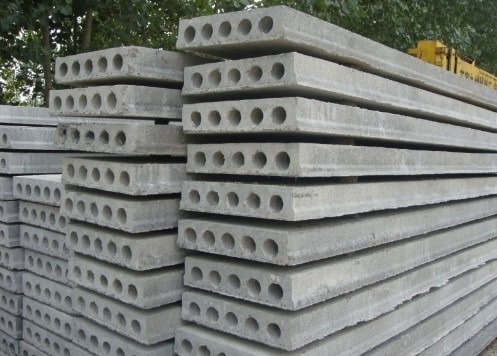
Hollow Precast Concrete Slab
Fig.13: Hollow Precast Concrete Slab
Grouting is used for the precast concrete units after they have been placed in their position.
The advantages of non-composite beams with precast units include fewer secondary beams are needed due to long precast concrete spans.
Disadvantages involve the need for lateral temporary support for beams to prevent lateral tensional buckling, sequential precast concrete installation needed and more work are required for individual lifting and placement of precast units.
Non-Composite Beam with Precast Concrete Units
Fig.14: Non-Composite Beam with Precast Concrete Units
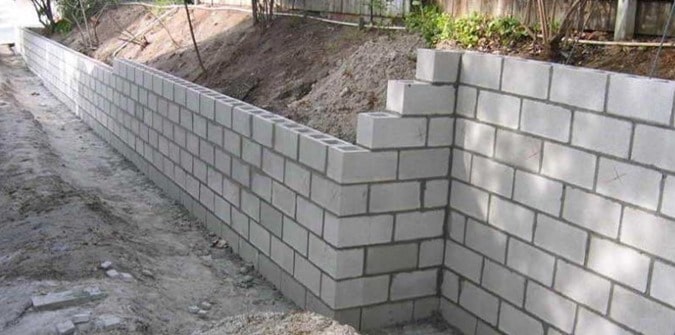
Construction of Concrete Block Retaining Walls with Steps


Construction of Concrete Block Retaining Walls with Steps


How to Build Concrete Block Retaining Walls?

Construction of concrete block retaining walls, with step by step process, materials, advantages, applications and its construction inspection are discussed.
Retaining wall structure is commonly constructed to retain earth mass or back fill materials. It is constructed in various engineering projects to serve different purposes.
There are different types of retaining wall such as reinforced concrete retaining wall, segmental retaining wall, gabion wall and concrete block retaining wall.
The focus of this article will be on the construction of concrete block retaining wall.
Construction of Concrete Block Retaining Walls
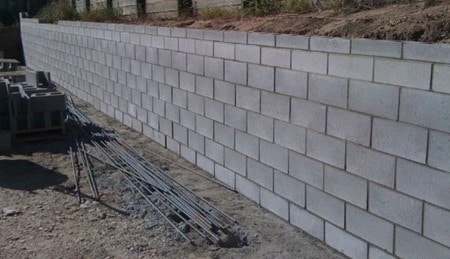
Fig.1: Concrete Block Retaining Wall (SEXTON, 2017)
concrete-block-retaining-wall
Fig.2: Concrete Block Retaining Wall (GADANG, 2017)
Following topics regarding construction of concrete block retaining walls are discussed:
  • Advantages and application of concrete block masonry wall
  • Concrete block retaining wall construction steps
  • Construction inspection

Advantages of Applications of Concrete Block Retaining Wall

  • It retains backfill materials.
  • It eliminates slopes of earth or earth fill materials.
  • It helps in control of erosion.
  • Concrete block retaining wall is simple and easy to construct.
  • It is cost effective.
  • It is durable compared to other types of retaining walls.

Construction of Concrete Block Retaining Wall with Steps

Concrete block retaining wall construction consists of number of phases including excavation, foundation soil preparation, retaining wall base construction, concrete block unit placement, grouting and drainage system installation. These phases are explained briefly:

Excavation Work for Concrete Block Retaining walls

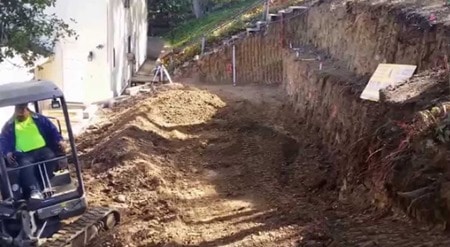
Proper machines or tools should be selected and used for this purpose and undisturbed and satisfactory strong soil can be reached after the removal of the soil.
The work should be carried out based on the lines and grades provided by the retaining wall design drawings. Considerable care should be practiced to prevent excessive excavation.
It should be remembered that the position of structures and utilities at the vicinity of the project site should be specified and necessary measures should be taken to prevent damages because of excavation work.
Excavation Work for Concrete Block Retaining walls
Fig.3: Site Excavation and Grading for Retaining Wall Construction

Foundation Soil Preparation for Concrete Block Retaining walls

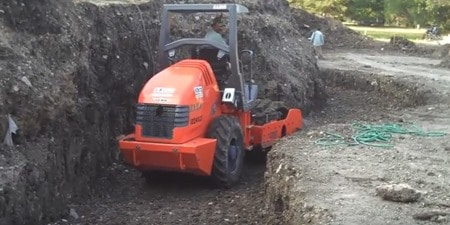
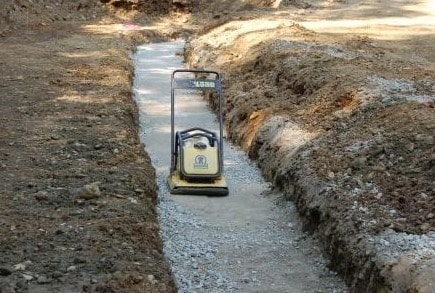
Foundation soil under the basement should be excavated in accordance with drawings of the concrete block retaining wall design. It should be compacted to at least 95% standard proctor compaction test.
Site engineer should explore and examine foundation soil to ensure that it meets the requirements of the design. If the soil foundation does not meet the design requirements, it should be replaced with acceptable material.
Foundation Soil Preparation for Concrete Block Retaining walls
Fig.4: Compaction of foundation Soil (Ref. Properly Compacting Soil When Building a Retaining Wall, Part 2, 2011)

Construction of Concrete Block Retaining Wall Base

Similar to other part of the retaining wall, the placement of base material should be carried out as per drawings provided. It is recommended to consider low permeable granular material as a base material and this soil layer is placed on foundation soil.
When base materials are placed, adequate depth should be lifted according to recommendations of applicable codes or design documents to install and bury the bottom of the wall.
The base material need to be compacted at 95% standard proctor and the top surface is advised to be leveled using 13mm thickness of well graded sand.
Construction of Concrete Block Retaining Wall Base
Fig.5: Retaining Wall Base Material Leveling (KOWALSKI, 2008)
The thickness of the base material is based on the height of retaining wall. For example, 100mm can be adopted for heights less than 1.2m and 150mm for heights greater than 1.2m.
Retaining Wall Base Material Compaction
Fig.6: Retaining Wall Base Material Compaction (KOWALSKI, 2008)

Concrete Block Unit Placement in Retaining Wall

Concrete block units should be installed properly in accordance with design documents and need to be plumbed. They should be placed cells vertical and mortar need to be applied for all sides of the block both in horizontal and vertical directions. It should be guaranteed that first course of the wall should adequately be in contact with base material.
The horizontal and vertical mortar joint thickness should not be smaller than 10mm. If joints are visible, then concave joint section should be created otherwise the finishing work will be struck with trowel.
It is recommended to use a mortar of 1 cement or 1 lime: 6 sand or 1 cement: 5 sand plus water thickener. If the retaining wall is reinforced with steel bars, then cell should be cleaned from the first course using proper means and techniques.
The cleaning is considerably advantageous since the position of the steel bars would be influenced by debris in the spaces.
Additionally, mortars that stick into the spaces should be removed either along construction progression or after completion of block placement. Weep holes are required to be placed at a recommended spacing of 1200mm.
The reinforcement bars are embedded into the space of the wall and fastened sufficiently to prevent their disposition.
Reinforcement Placement in Concrete Block Retaining Wall
Fig.7: Reinforcement Placement in Concrete Block Retaining Wall
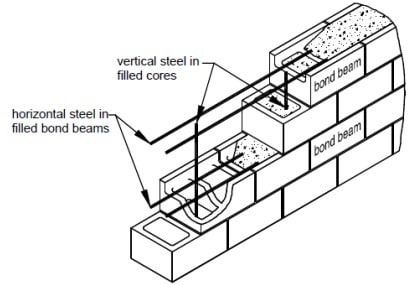
Placement of Horizontal and Vertical Reinforcement
Fig.8: Typical Placement of Horizontal and Vertical Reinforcement in Concrete Block Masonry Wall
Detailing of Reinforced Concrete Block Retaining Wall
Fig.9: Detailing of Reinforced Concrete Block Retaining Wall

Grouting of Concrete Block Retaining Wall

Grouting process carried out as follow:
  • Seal clean out holes.
  • Pour the grout and ensure that all spaces are filled adequately with grout to produce the best possible bond in the wall.
  • Voids in the grout should be eliminated by applying compaction.
  • Building code requirement for masonry structures and commentary provides minimum space requirements for grouting which can be seen in Table 1.

Table-1: Grout Space Requirements (MSJC, 2011)

Grout typeMaximum grout pour height, mMinimum clear width of grout space, mmMinimum clear grout space dimensions for grouting cells of hollow units, mm x mm
Fine0.319.138.1 x 50.8
Fine1.6350.850.8 x 76.2
Fine3.8663.563.5 x 76.2
Fine7.3276.276.2 x 76.2)
Coarse0.3038.138.1 x 76.2
Coarse1.6350.863.5 x 76.2
Coarse3.8663.576.2 x 76.2
Coarse7.3276.276.2 x 102

Construction Inspection of Concrete Block Retaining Wall

It is necessary to conduct inspection at various construction phases which are explained below:
  • Inspection would be necessary after the completion of foundation excavation work and reinforcement placement, and it should be conducted prior to concrete pouring.
  • Before the placement of grouts, after concrete blocks are placed and steel bars are inserted.
  • Prior to the placement of backfill material.
  • Finally, after the entire construction work is ended.

Wednesday, September 26, 2018

Efflorescence and its Treatment in Concrete and Brick Masonry


Efflorescence and its Treatment in Concrete and Brick Masonry

Efflorescence is a deposit of water soluble salts formed on the surface of concrete and brick masonry due to movement of water through pores. When water gets evaporated, efflorescence is formed as the dissolved salts gets deposited on the surface.
This article discusses different aspects of efflorescence and its treatment in concrete and brick masonry.

Causes of Efflorescence

The condition in which efflorescence occurs is unique and all conditions should be met otherwise concrete and brick masonry would not suffer from it.
There are three main conditions that offer excellent condition for efflorescence formation on concrete and brick masonry wall. These conditions are as follows:
  1. Concrete and brick masonry wall should contain soluble salts and the salt might be in masonry brick, mortar, adjacent soil and backing material
  2. Water should present in concrete and brick masonry wall and need to be in contact with soluble salt to dissolve it.
  3. Concrete and brick masonry wall shall possess pore structure to permit the migration of soluble salt to the surface where water may evaporate and leave the salt.
Causes of efflorescence
Fig. 1: Causes of efflorescence

Efflorescence Treatment on Concrete and Masonry Surfaces

Following methods can be adopted for treatment of efflorescence:
  1. Material selection
  2. Design and detailing
  3. Construction practices

1. Material Selection

Avoid selection of materials that has low potential to produce efflorescence. For example, use cements with low alkali content since the possibility of efflorescence formation increases with the increase of alkali content.
Moreover, specify potable water and clean and washed sand for the production of grout or mortar mixtures.
Furthermore, building trims for instance copping, sills, and cops that manufactured from low salt content materials shall be selected otherwise the likelihood of efflorescence formation will increase.
Finally, materials can be tested to find out whether they potentially cause efflorescence formation or not for example, test method C 67 efflorescence test for brick.
Efflorescence test on bricks
Fig. 2: Efflorescence test on bricks

2. Design and Detailing

Generally, rainwater can ingress into all kinds of masonry walls to a certain extent, but proper design and detailing can be employed to decline or eliminate the water penetration which subsequently contribute to the prevention of efflorescence formation.
The design measures that recommended to avoid efflorescence formation involves:
Commonly, groundwater contains sizable quantity of soluble salts that may accumulate in masonry and cause efflorescence creation.
This source of efflorescence can be removed through watertight masonry below grade in addition to install base flashing to discharge water out of the wall a few courses of masonry above the grade.
Finally, it is recommended to use grout or mortar to support base flashing below the air space.
Watertight below grade masonry
Fig. 3: Watertight below grade masonry
2.2 Flashing on trim
Flashings shall be employed to prevent capillary action and avoid the contact between masonry and trim materials.
2.3 Air Space
Air space between exterior walls and interior of masonry walls reduces efflorescence formation.
Air space function includes separation of exterior wall from other elements of masonry wall, permits water to drain down the back of the of the brick wythe, and impede the movement of salts from backing material by separating the brick wythe from the materials containing salt compounds.
Air space in masonry wall
Fig. 4: Air space in masonry wall
2.4 Proper Detailing of Movement Joints
If the movement joints are adequately sized, located, and sealed, then water penetration into the wall will be declined to a great extent.

3. Construction Practices

Beneficial construction practices that lead to decrease efflorescence formation are as follows:
3.1 Utilized Water
Use clean water and free from salts.
3.2 Material protection during transportation and construction process
Masonry units shall be isolated from dirt, contamination, groundwater, snow, and rain water through suitable storing. In addition to cover material during transportation and construction process.
3.3 Filling Joints Adequately
Sufficient filling of joints such as head and bed mortar joints in solid unit masonry, face shells head and bed joints in hollow unit masonry, and grapevine mortar joints on the exterior face of the wall is considerably critical factors that must be considered to eliminate efflorescence.
This is will create adequate bond between masonry units and prevent the ingression of wind driven water into masonry walls.
Proper filling of joints reduce water penetration
Fig. 5: Proper filling of joints reduce water penetration
3.4 Covering unfinished brickwork
Covering partially completed masonry works with waterproofing membranes at the end of each working day is a must.
If such measure is not considered, the masonry works may be subjected to rainwater and saturated which takes long time to dry. Consequently, the likelihood of efflorescence formation will increase.

Removal of Efflorescence

The removal of efflorescence is conducted using one of the following methods:
There are number of factor that controls the selection of efflorescence removal. For example, if the salt is soluble, it is recommended to apply dry brush. Hand washing is recommended to choose for small efflorescence batches.
It should be known that the removal and cleaning of the efflorescence on masonry surface would not solve the problem. So, it is required to seal the wall to tackle the problem permanently.
Removal of efflorescence
Fig. 6: Removal of efflorescence