Monday, September 17, 2018

Design of Reinforced Concrete Footings: ACI 318-14 and IS456


Design of Reinforced Concrete Footings: ACI 318-14 and IS456


Reinforced concrete footing are designed based on column loads and moments at base and the soil data. This article shed light on the design of reinforced concrete footing.

Reinforced concrete footing types 

Following are the types of foundations in order of preference with a view to economy:
  1. Individual footings (isolated footing)
  2. Combined footings (combination of individual footings)
  3. Strip footings with retaining wall acting as strip beam wherever applicable.
  4. Raft foundations of the types (a) slab (b) beam-slab.
The brick wall footings can also be designed. Often plinth beams are provided to support brick walls and also to act as earthquake ties in each principal direction.

Important considerations in design of footings

footings are the structural elements which transfer loads from the building or individual columns to the earth.
If these loads are to be properly transmitted, footings must be designed to prevent excessive settlement or rotation, to minimize differential settlement and to provide adequate safety against sliding and overturning.

Depth of footing

  • As per clause 34.1.3 of IS456: 2000 and section 15.7 of ACI 318-14 the thickness of footing at its edge shall not be less than 15cmm on soils, or less than 30cm for footings on piles.
  • Depth of foundation below ground level can be obtained by using Rankine’s formula:equation 1Where:h: minimum depth of foundationp: gross bearing capacity
    : density of soil
    : angle of repose or internal friction of soil.

Dimension of pedestal

In the case of plain cement concrete pedestals, the angle between the plane passing through the bottom edge of the pedestal and the corresponding junction edge of the column with pedestal and the horizontal plane shall be governed by the expression.

equation 2
Where:
qo: calculated maximum bearing pressure at the base of the pedestal/footing in N/mm2
fckcharacteristic strength of concrete at 28 days in N/mm2

dimension of pedestal
Fig.1: dimension of pedestal

Recommendations of IS 456: 2000, Limit state design

To determine the area of foundation required for proper transfer of total load on the soil, the total load (combination of dead load, live load and any other load without multiplying it with any load factor) are considered.
equation 3

Maximum Bending moment in footings


According to ACI 318- 14 section 15.4.1 and 15.4.2, and IS 456: 2000 clause 34.2.3.1 and 34.2.3.2, The bending moment will be considered at the face of column, pedestal or wall and shall be determined by passing through the section a vertical plane which extends completely across the footing, and over the entire area of the footing or one side of the said plane.
Maximum bending moment in footing
Fig.2: Maximum bending moment in footing

Shear capacity checks for footings

The shear strength of footing is governed by the following two factors:
  1. The footing acting basically as a wide beam, with a potential diagonal crack intending in a plane across the entire width, the critical section for this condition shall be assumed as a vertical section located from the face of the column, pedestal or wall at a distance equal to the effective depth of the footing in case of footings on soils. For one way shear action, the nominal shear stress in calculated as:
equation 4Where:
: shear stress
:factored vertical shear force
b: width of critical section
d: effective depth
, where:design shear strength of concrete based on % longitudinal tensile reinforcement. Refer table 61 of SP -16)

Critical section for one-way shear in foundation
Fig. 3: Critical section for one-way shear in foundation
2. For two way shear (or two way bending action or punching shear) of foundation, the following should be checked in punching shear. Punching shear shall be around the perimeter 0.5 times the effective depth away from the face of the column or pedestal.
For two way shear action, the nominal shear stress is calculated in accordance with clause 31.6.2 of IS456: 2000 as follows:
equation 5Where
: shear stress
: periphery of the critical section
d : effective depth
: factored vertical shear force
When shear reinforcement is not provided, the nominal shear stress at the critical section should not exceed
Where:
= 0.5 + Bc (but not greater than 1)
Bc: short dimension of column or pedestal / long dimension of column or pedestal
equation 6
The result of equation 6 is in N/mm2
Note: It is general practice to make the base deep enough so that shear reinforcement is not required.

Development length of reinforcement bars in footing 

According to ACI 318-14 section 15.6 and IS 456: 2000 clause 34.2.4.3, the critical section for checking the development length in a footing shall be assumed at the following planes:
  • At the face of the column, pedestal or wall, for footings supporting a concrete column, pedestal or wall.
  • Halfway between the centre-line and the edge of the wall, for footings under masonry walls.
  • Halfway between the face of the column or pedestal and the edge of the gussetted base, for footings under gussetted bases.
  • All other vertical planes where abrupt changes in section occur.

Reinforcement in footings 

The minimum reinforcement in footing slab specified by the code is 0.12% and maximum spacing specified is 3 times the effective depth or 450mm whichever is less. (clause 34.3).
In one-way reinforced footing; two-way reinforced square footing; and long direction of two way rectangular footing, the-reinforcement extending in each direction shall be distributed uniformly across the full width of the footing.
However, there shall be a central band, equal to the width of the footing for short direction of two way rectangular footings. The reinforcement in the central band shall be provided in accordance with the following equation.
equation 7
Where B is the ratio of long side of the footing to its short side.

Transfer of load at the base of column

According to IS 456: 2000, Clause: 34.4, forces and moments at the base of column, walls, or reinforced pedestal shall be transferred by bearing to the top of supporting pedestal or footing.
The bearing pressure on the loaded area shall not exceed the permissible bearing stress in direct compression multiplied by a value equal to but not greater than 2.
Where:
: supporting are for bearing of footing, which is sloped or stepped footing may be taken as the area of the lower base of the largest frustum of a pyramid or cone contained wholly within the footing and having its upper base, the area actually loaded and having side slope of one vertical to two horizontal.
: loaded area at the column base.
For limit state design, the permissible bearing stress specified is 45 fck.
If the permissible bearing stress is exceeded either in the column concrete or in footing concrete, reinforcement must be provided for developing the excess force. The reinforcement may be provided either extending the longitudinal bars into the footing or by providing dowels in accordance with the code as given by the following:
  1. Minimum area of extended longitudinal bars or dowels must be 0.5% of cross-sectional area of the supported column or pedestal.
  2. A minimum of four bars must be provided.
  3. If dowels are used their diameter should not exceed the diameter of the column bars by more than 3mm.
  4. Enough development length should be provided to transfer the compression or tension to the supporting member.
  5. Column bars of diameter larger than 36mm, in compression only can be dowelled at the footing with bars of smaller diameters. The dowel must extend into the column a distance equal to the development length of the column bar. At the same time, the dowels must extend vertically into the footing a distance equal to the development length of the dowel.
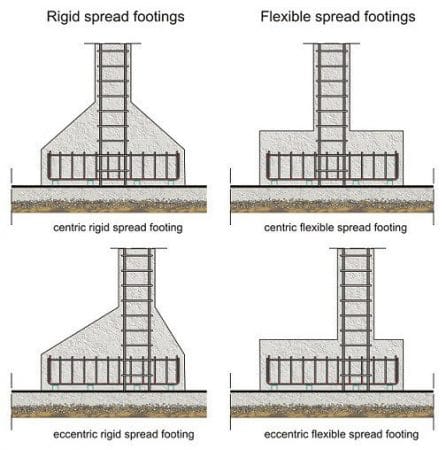
    different types of footing with reinforcement details
    Fig.4: different types of footing with reinforcement details

Retaining Wall Types, Materials, Economy, and Applications


Retaining Wall Types, Materials, Economy, and Applications


What is a retaining wall?

Retaining wall is a structure that are designed and constructed to withstand lateral pressure of soil or hold back soil materials. The lateral pressure could be also due to earth filling, liquid pressure, sand, and other granular materials behind the retaining wall structure. There are various types of retaining wall structures which are used for numerous goals.

Types of Retaining Walls

  1. Gravity Retaining Wall
  2. Crib Retaining Wall
  3. Gabion Retaining Walls
  4. Cantilever Retaining Wall
  5. Counter-fort / Buttressed Retaining Wall
  6. Anchored Retaining Wall
  7. Piled Retaining Wall
  8. Mechanically Stabilized Earth (MSE) Retaining wall
  9. Hybrid Systems

1. Gravity Retaining Wall

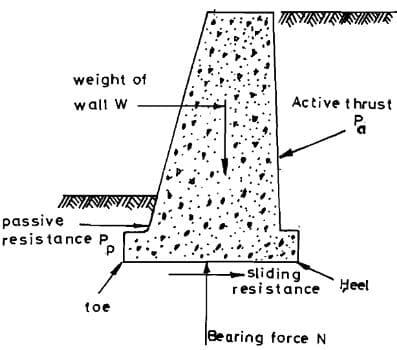
  • Gravity retaining wall depends on its self weight only to resist lateral earth pressure.
  • Commonly, gravity retaining wall is massive because it requires significant gravity load to counter act soil pressure.
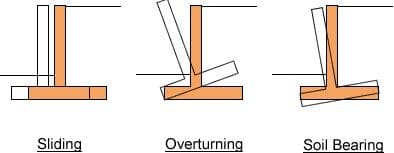
  • Sliding, overturning, and bearing forces shall be taken into consideration while this type of retaining wall structure is designed.
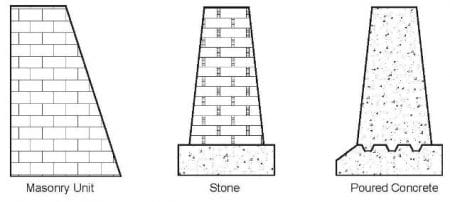
  • It can be constructed from different materials such as concrete, stone, and masonry units.
  • It is economical for a height up to 3m.
  • Crib retaining wall, gabions, and bin retaining wall are also type of gravity retaining walls
Gravity retaining wall
Fig. 1: Gravity retaining wall
Materials used for gravity retaining wall construction
Fig. 2: Materials used for gravity retaining wall construction
Pressure acting on gravity retaining wall
Fig. 3: Pressure acting on gravity retaining wall

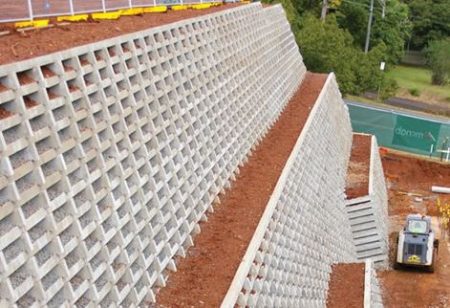
2. Crib Retaining Wall

  • Crib retaining walls are a form of gravity wall.
  • They are constructed of interlocking individual boxes made from timber or pre-cast concrete.
  • Then, the boxes are filled with crushed stone or other coarse granular materials to create a free draining structure.
  • Basic types of crib retaining walls include reinforced precast, and timber retaining walls.
  • It is suited to support planter areas, but it is not recommended  for support of slopes or structures.
Crib retaining wall
Fig. 4: Crib retaining wall
Timber Crib retaining wall
Fig. 5: Timber Crib retaining wall

3. Gabion Retaining Walls

  • Gabion retaining wall walls are multi-celled, rectangular wire mesh boxes, which are filled with rocks or other suitable materials.
  • It is employed for construction of erosion control structures.
  • It is also used to stabilize steep slopes.
Gabion retaining wall
Fig. 6: Gabion retaining wall

4. Cantilever Retaining Wall

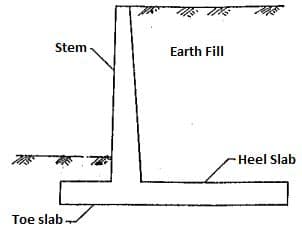
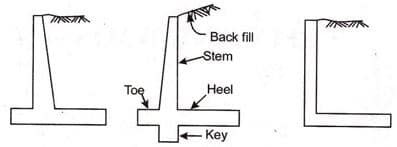
  • Cantilever retaining wall composed of stem and base slab
  • It is constructed from reinforced concrete, precast concrete, or prestress concrete.
  • Cantilever retaining wall is the most common type used as retaining walls.
  • Cantilever retaining wall is either constructed on site or prefabricated offsite i.e. precast.
  • The portion of the base slab beneath backfill material is termed as heel, and the other part is called toe.
  • Cantilever retaining wall is economical up to height of 10m.
  • It requires smaller quantity of concrete compare with gravity wall but its design and construction shall be executed carefully.
  • Similar to gravity wall, sliding, overturning, and bearing pressure shall be taken into consideration during its design.
Cantilever retaining wall
Fig.7: Cantilever retaining wall
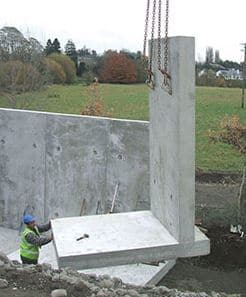
Precast retaining wall
Fig. 8: Precast retaining wall
Different pressure on cantilever retaining wall
Fig. 9: Different pressure on cantilever retaining wall
Different configuration for cantilever retaining wall
Fig. 10: Different configuration for cantilever retaining wall

5. Counter-fort / Buttressed Retaining Wall

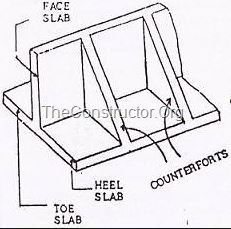
  • It is a cantilever retaining wall but strengthened with counter forts monolithic with the back of the wall slab and base slab.
  • Counter fort spacing is equal or slightly larger than half of the counter-fort height.
  • Counter-fort wall height ranges from 8-12m.
Counter-fort or buttress retaining wall
Fig. 11: Counter-fort or buttress retaining wall

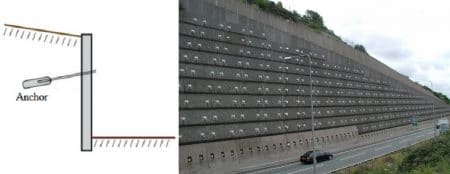
6. Anchored Retaining Wall

  • This type of retaining wall is employed when the space is limited or thin retaining wall is required.
  • Anchored retaining wall is suitable for loose soil over rocks.
  • Considerably high retaining wall can be constructed using this type of retaining wall structure system.
  • deep cable rods or wires are driven deep sideways into the earth, then the ends are filled with concrete to provide anchor.
  • Anchors (tiebacks) acts against overturning and sliding pressure.
Anchored retaining wall
Fig. 12: Anchored retaining wall
Different configuration for anchored retaining wall
Fig. 13: Different configuration for anchored retaining wall

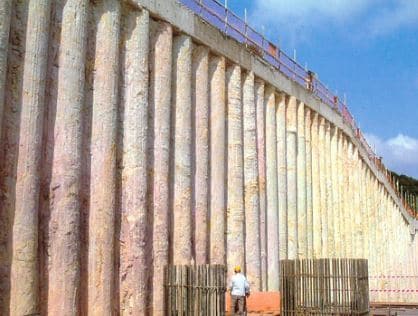
7. Piled Retaining Wall

  • Pile retaining wall are constructed by driving reinforced concrete piles adjacent to each other as shown in the Fig.
  • Piles are forced into a depth that is sufficient to counter the force which tries to push over the wall.
  • It is employed in both temporary and permanent works.
  • Piled walls offer high stiffness retaining elements which are able to hold lateral pressure in large excavation depths with almost no disturbance to surrounding structures or properties.
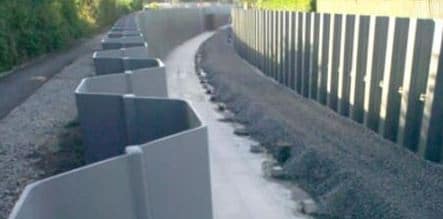
  • Sheet pile walls are built using steel sheets into a slope or excavations up to a required depth, but it cannot withstand very high pressure
  • Sheet pile retaining wall economical till height of 6m
pile retaining wall
Fig. 14: pile retaining wall
Temporary pile retaining wall
Fig. 15: Temporary pile retaining wall
Sheet pile retaining wall
Fig. 16: Sheet pile retaining wall

8. Mechanically Stabilized Earth (MSE) Retaining wall

  • It is among the most economical and most commonly constructed retaining walls.
  • Mechanically stabilized earth retaining wall is supported by selected fills (granular) and held together by reinforcements, which can be either metallic strips or plastic meshes
  • Types of MSE retaining wall include panel, concrete block, and temporary earth retaining walls.
Mechanically stabilized earth retaining wall
Fig. 17: Mechanically stabilized earth retaining wall

9. Hybrid Systems

Retaining walls that use both mass and reinforcement for stability are termed as Hybrid or Composite retaining wall systems.
Hybrid retaining wall system
Fig. 18: Hybrid retaining wall system

Operations in Embankment Dam Construction


Operations in Embankment Dam Construction


Construction of Embankment Dam

The construction operation of embankment dams is divided into four major groups of construction activities which include:
  • Material source development activities
  • Foundation preparation activities
  • Fill construction operation
  • Ancillary works construction activities
Construction of Embankment Dam
Fig.1: Embankment Dam Construction

Material Source Development Activities

The material source development activities include opening out quarries from which necessary materials are obtained, installation of fixed plants for instance crushers, and conveyor which is employed to transfer crushed materials to a specified location.
Construction of roads between various areas of quarries and the embankment dam is another material source development activity. These roads are commonly utilized to haul and transport materials to the embankment dam, in addition to move transportation and haulage plant between various parts of the quarry.
Installation of plants and conveyor and road construction to haul materials
Fig.2: Installation of plants and conveyor and road construction to haul materials

Foundation Preparation Activities

One of the first works needs to be tackled properly is drying up the foundation area. This usually can be done through the construction of temporary diversion tunnel at the sides of the embankment dam.
construction of hoover dam in the united states
Fig.3: Inlet portal of diversion tunnel used in the construction of hoover dam in the united states
Such tunnel may host outlet works as well. Sometimes, the outlet culvert through or under the embankment dam is built instead of diversion tunnel and this outlet culvert would be used for river diversion.
Earth fill source development is another construction activity at this stage. This can be carried out along with river diversion works. After the previous works finished, weathered materials, which migrated due to water and weak soil at the top surface would be removed at the project site.
There are cases in which soil foundation strength needs improvement. In addition to consolidate the area in advance and install sand drains. Necessary instruments and tools are also installed at this phase.
Not only do these devices used to measure pore water pressure but also observe the performance of cutoff point. Finally, the foundation construction stage is finished with the drainage blanket placement beneath downstream shoulder.
Drainage blanket placement in embankment dam
Fig.4: Drainage blanket placement in embankment dam

Fill Construction Operation

It is another dam construction activity that could be easily carried out. The material used should be conformed to the requirements of applicable code. As far as fill placement is concerned, it could be affected by weather conditions in addition to possible variations in material characteristics.
Placement of earth fill material
Fig.5: Placement of earth fill material
The quality of the construction is governed by number of factors for instance water content, thickness of soil layer being compacted, and compaction effort.
So, fill placement cannot be carried out properly unless the works is supervised and monitored adequately. The quality and uniformity of compacted core fill is considerably significant and need to be taken into consideration.
Then, the placement of horizontal drain layer in both shoulders at a vertical distance of 3-6m is proceeded. This construction activity is required to control construction pore water pressure and increase speed of consolidation in cohesive materials of low permeability.
While fill material are placed, devices and instruments needed to be placed in the core and shoulders are installed. The final activity of this stage is the construction of protection measures for instance placement of armoring layer at the upstream of the embankment dam.

Ancillary Works Construction Activities

It may involve the construction of spillway, stilling basin, tunnel or culvert for outlet works, valve towers, drainage works, wave wall, road way, and grassing of downstream face of embankment dam in the locations where weather condition would not spoil it.
Spillway of Dam
Fig.6: Spillway of Darbandikhan Dam In Kurdistan Region-Iraq
Spillway of Dam
Fig.7: Removing excess water using spillway of Darbandikhan dam in Kurdistan region-Iraq
Grassing downstream of an embankment dam
Fig.8: Grassing downstream of an embankment dam