Saturday, September 15, 2018

Construction of Stone Masonry Footing


Construction of Stone Masonry Footing

The construction of stones bonded together with mortar is called stone masonry. Stone masonry footing is a structural foundation constructed to support walls. Different aspect of stone masonry footing is discussed.

Purpose of Stone Masonry Footing

The purpose of stone masonry foundation is to support structural walls and transfer load to the soil beneath it. It should serve its purpose without settlement or sinking. The load exerted on stone masonry footing should be vertical.
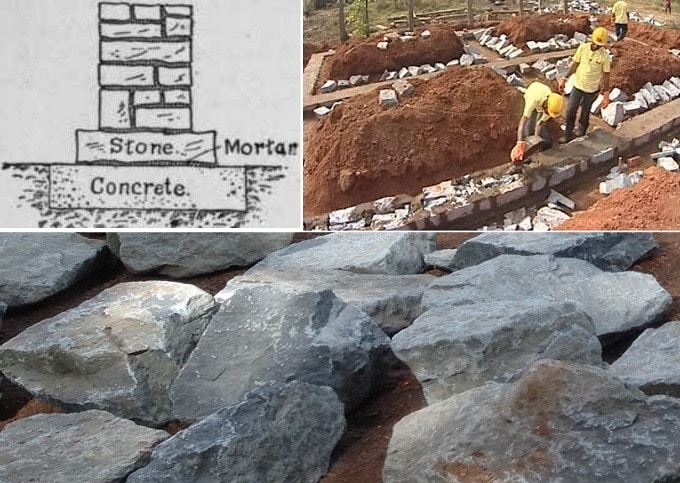
Construction of Stone Masonry Footing
Fig.1: Stone Masonry Footing

Construction of Stone Masonry Footing

Dimensions of Excavation for Stone Masonry Footing

Prior to the construction of stone masonry footing, a trench with depth ranges from 1m to 1.5 m should be excavated.
The width of excavation would be controlled by amount of loads exerted on the footing. So, the width of footing is specified based on the imposed loads and properties of soil on which the footing is constructed.
Then, the soil at the bottom of the trench needs to be compacted properly. At this stage, the excavation is ready for the construction of stone masonry footing.
Trench excavated for stone masonry footing construction
Fig.2: Trench excavated for stone masonry footing construction

Properties of Stones for Footing

Stones should possess the following properties otherwise they will be disqualified for the construction of stone masonry footing:
  • The stone should durable
  • Free from cracks
  • Free from cavity
  • It need to be hard and tough
Examples of stones which are desirable for stone masonry footing construction include granite, hard laminated stand stone and limestone, and bluestone.

Desired Dimensions of Stones

  • The thickness of stones should be one fourth of their width
  • If it is possible, the width of each stone used for the construction of footing first course should match the stone masonry footing width. If such stones are not obtainable, then joints can be provided and it is acceptable.

Preparation of Stones for Stone Masonry Construction

Stones need to be adequately wetted before they are laid in the foundation. this measure is considered to prevent water absorption which detrimentally affect the mortar.
Wetting stones for stone masonry footing construction
Fig.3: Wetting stones for stone masonry footing construction

Concrete Mix Ratio used for Plain Concrete Bed

The plain concrete bed provided at the bottom of the foundation is made of one part of cement four part of sand and eight parts of coarse aggregate. The maximum size of the aggregate is 40mm.

Dimensions of Plain Concrete Bed

The plain concrete bed thickness ranges from 10cm to 15cm. The plain concrete layer should extend about 15cm from the stone masonry foundation on each side of bottom course. So, the width of plain concrete is 30cm wider than the bottom course of stone masonry footing.
Plain concrete at the bottom of stone masonry footing
Fig.4: Plain concrete at the bottom of stone masonry footing

Mortar Ratio for Stone Masonry Footing

Mortar is used between joints of stones to create required bond between then and seal the joint to avoid the penetration of water. The proportion of the mortar is one portion of cement to six portions of sand.

Stone Masonry Footing Construction Steps

  • After the trench is dug and prepared, then a layer of plain concrete will be poured at the bottom of the trench.
  • After plain concrete bed is set, the construction of stone masonry footing will begin with laying a layer of mortar on which first stone masonry course will be installed.
  • Stones should be placed close to each other and the maximum joint between is 2 cm.
Filling joints between placed stones with mortar
Fig.5: Filling joints between placed stones with mortar
  • The face of stone should be arranged to stagger the joints
  • Long vertical joints should be avoided since it would be weakness point of the stone masonry footing.
  • To improve strength of stone masonry footing, bond stones will be placed at a specified spacing of 1m. This bond stones will run through the thickness of stone masonry footing.
Placing bond stones during the construction of stone masonry footing
Fig.6: Placing bond stones during the construction of stone masonry footing
  • If the thickness of stone masonry footing is large, then the length of bond stone should be increased to achieve its objective. This can be obtained by installing a set of two or more bond stones overlapping each other.
  • Heart stones, which are installed at the middle of stone masonry footing, should be as close to each other as possible and smaller stone sizes should be used to fill voids.
Then, heart stones and smaller stone sizes will be covered by mortar and spaces should be filled with mortar to improve footing strength.
Placement of heart stone
Fig.7: Placement of heart stone in the stone masonry footing
Small sized stones are placed to fill voids
Fig.8: Small sized stones are placed to fill voids
Placement of mortar
Fig.9: Placement of mortar over a course of masonry footing to fill spaces

Storage of Cement – Precautions, Duration and Place of Storage


Storage of Cement – Precautions, Duration and Place of Storage

Proper precautions for the storage of cement such as duration and place of storage, arrangement, atmospheric moisture content etc. is necessary after the process of manufacturing and before using it in the construction site.
Because the cement hygroscopic nature, the cement absorbs moisture from the atmosphere very actively and hardens like stone which cannot be used for constructional purpose. So, storage of cement should be done with care.
Storage of Cement

Precautions for Proper Storage of Cement

Cement should not be stored normally. There are some precautions to be considered in the storage of cement. Following are the different situations against which precautions are to be taken:
  1. Atmospheric moisture content
  2. Duration of cement storage
  3. Place of storage
  4. Arranging cement bags
  5. Withdrawal of cement bags

1. Moisture Content at Place of Storage

Moisture content or dampness is the main hazard for the cement. The moisture present in the atmosphere is enough for the cement to become useless material. The cement should be stored in such a way that it cannot expose to the atmosphere. So, air tight bags are used to pack the cement.
The absorption of moisture from atmosphere will also depends up on the quality of cement. If the cement is finely grained and very good in quality, then it will absorb moisture vigorously. Hence, extra care should be taken for this type of cement and it is better use it in its fresh stage.
In any case if it is exposed to atmosphere, the present of moisture content is to be tested. If the moisture content is more than 5% then it is not useful for the construction.
Moisture Content at Place of Storage

2. Duration of Cement Storage

Time of storing is also a factor that affects the cement especially its strength. Longer the time reduces the strength of cement. It is preferred that the cement should not be stored for more than 3 months. However, if it is stored more than 3 months the strength of cement should be tested before using it.
The following table gives us the percentage reduction of strength of cement for different time periods.
Period of storageFresh stage3 months6 months1 year5 years
% Reduction in strength at 28 days0%20%30%40%50%
If the cement is stored for longer time and strength is found to be reduced, then it is not good for construction. But however, it can be reactivated by different methods like vibro grinding etc. vibro grinding improves fineness quality of long period stored cement and make it fit for the constructional purpose.
Duration of Cement Storage

3. Place of Cement Storage

The bags of cement should not be stored in open places. Preferably specially designed storage sheds are good for cement storage. They can be used for longer periods.
The main purpose of special design is to provide waterproof floors, roofs and walls. The floor of shed should be well above the ground level. Small windows with air tight doors should be provided. Proper drainage should be provided inside and outside the shed to drain water in any case.
In general, one bag of cement contains 50 kilograms of cement, 20 bags of cement will require 1 cubic meter to store. Based on this the dimensions of storage shed are designed.

4. Arrangement of Cement Bags

A wooden platform of height 150 to 200 mm is prepared above the floor of storage shed to avoid the direct contact between the floors and cement bags.
On the prepared wooden platform, the cement bags should be arranged one above the other which forms stack of cement bags. Each stack should not consist not more than 10 bags of cement. The stack should not touch the walls of shed and it should be considerably 300 mm away from the external walls. Each stack should be closely connected to avoid the circulation of air.
To prevent collapsing of high stacks, cross arrangement of bags one above the other is preferable. All the stacks are covered with water proof layer for long term protection. Passage width of 900mm to 1000mm is provided between the stacks. The stack should consist same type of cement and for each stack date of placing should be noted to know their period of storage.
Arrangement of Cement Bags

5. Withdrawal of Cement Bags

When the time of using arrives, Withdrawal of cement bags from stacks happens. The cement bags should be taken out in such a way that the bag first placed in storage shed should be withdrawal first.
Withdrawal of Cement Bags

Types of Joints in Concrete Water Tank Structures and their Spacings


Types of Joints in Concrete Water Tank Structures and their Spacings

There are different types of joints which are provided in the reinforced concrete water tank structures for different purposes such as to contain different movements and during construction process. This article presents various types of joints provided in water tanks structures.

Movement joints

Movement joints are introduced to contain relative movements between different types of the structure. This type of joints may not be needed in elevated water tanks since restraints are small. There are three types of movement joints which are discussed below:

1. Contraction Joint

  • Contraction joint purpose is to contain contraction of concrete.
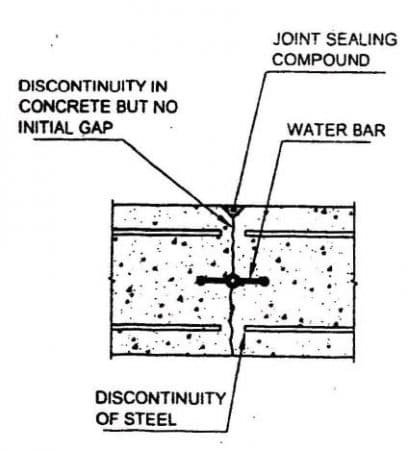
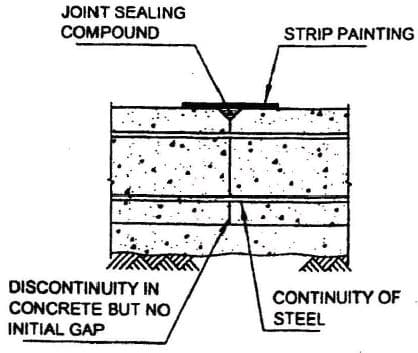
  • It is a movement joint with deliberate discontinuity without initial gap between the concrete on either side of the joint.
  • A contraction joint may be either complete contraction joint (Fig.1) or partial contraction joint (Fig.3).
  • complete contraction joint is one in which both steel and concrete are interrupted.
  • In complete contraction joint, the mouth of the joint is filled with joint sealing compound and then strip painted.
  • partial contraction joint is one in which only the concrete is interrupted, the reinforcing steel running through.
Complete contraction joint
Fig.1: Complete contraction joint
Partial contraction joint
Fig.2: Partial contraction joint

2. Expansion Joint

  • expansion joint provided to contain either expansion or contraction of concrete.
  • It is a joint with complete discontinuity in both reinforcing steel and concrete.
  • This type of joint requires the provision of an initial gap between the adjoining parts of a structure which by closing or opening accommodates the expansion or contraction of the structure.
  • The initial gap is filled with joint filler.
  • Joint fillers are usually compressible sheet or strip materials used as spacers.
  • With an initial gap of 30 mm, the maximum expansion or contraction that the filler materials may allow may be of the order of 10 mm.
  • An expansion type water bar shall be provided either centrally in a wall or on the soffit of a floor.
Expansion joint
Fig.3: Expansion joint

3. Sliding Joint

  • It is a joint with complete discontinuity in both reinforcement and concrete and with special provision to facilitate movement in plane of the joint.
  • This type of joint is provided between wall and floor in some cylindrical tank designs.
  • It allows two structural members to slide relative to one another with minimal restraint.
Sliding joint
Fig.4:Sliding joint

Construction joints

  • This type of joint is provided for convenience in construction.
  • Arrangement is made to achieve subsequent continuity without relative movement.
  • One application of these joints is between successive lifts in a reservoir wall.
  • The number of joints should be as small as possible and these joints should be kept from possibility of percolation of water.
  • The position and arrangement of all construction joints should be predetermined by the engineer.
Construction joint
Fig.5: Construction joint

Temporary joint

  • A temporary open joint is a gap temporarily left parts of a structure, which after a suitable interval and before the structure is put into use, is filled with mortar or concrete completely as shown in fig, or with the inclusion of suitable jointing material as illustrated in.
  • when the gap is filled with concrete, width of gap should be sufficient to allow the sides to be prepared before filling.
Temporary joints
Fig.6: Temporary joints

Spacing between joints of water tank structures

Unless alternative effective means are taken to avoid cracks by al lowing for the additional stresses that may be induced by temperature or shrinkage changes or by unequal settlement, movement joints should be provided at the following spacing:
  • In reinforced concrete floors, movement joints should be spaced at not more than 7.5m apart in two direct ions at right angles.
  • For floors with only nominal percentage of reinforcement (smaller than the minimum specified) the concrete floor should be cast in panels with sides not more than 4.5m.
  • In concrete walls, the movement joints should normally be placed at a maximum spacing of 7.5m. In reinforced walls and 6m in unreinforced walls.
  • expansion joints should normally be provided at a spacing of not more than 30m between successive expansion joints or between the end of the structure and the next expansion joint.
  • When, however, the temperature changes to be accommodated are abnormal or occur more frequently than usual as in the case of storage of warm liquids or in uninsulated roof slabs, a smaller spacing than 30m should be adopted that is greater proportion of movement joints should be of the expansion type).
  • When the range of temperature is small, for example, in certain covered structures, or where restraint is small, for example, in certain elevated structures none of the movement joints provided in small structures up to 45m length need be of the expansion type.