Friday, September 14, 2018

CONSTRUCTION OF WALL FOOTINGS


CONSTRUCTION OF WALL FOOTINGS

Wall footings are pad or spread and strip Footings. The basic purpose of this foundation is to spread the load over a larger area so that the soil is able to withstand the stress, and the safe bearing pressure is not exceeded. In such types of foundations, if the resultant of the load deviates from the centre line by more than 116 of its least dimension at the base of the footing, it should be suitably reinforced.

Construction of Wall Footings:

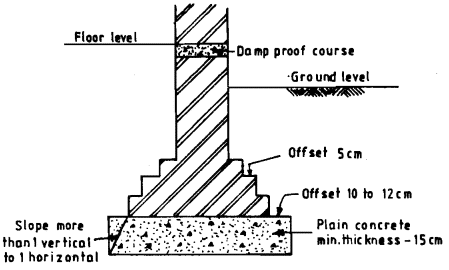
In the case of brick walls, the width of section is increased by 114 brick (5 cm) offset on either side. The base rests on a plain concrete footing which projects 10 to 15 cm beyond the last brick offset as shown in Figure 1.
Masonry Wall Footing
Fig.1: Masonry Wall Footing
The width at the base shall not be less than the width of the supported wall plus 30 cm. The depth of each course can be one brick or multiples of brick thicknesses. In the case of stone masonry walls, the offsets could be 15 cm with the heights of the course as 30 cm. The depth of the concrete which is generally of 1:4:8 (1 Cement : 4 Fine aggregate : 8 Coarse aggregate) or 1 : 5 : 10 ( 1 Cement : 5 Fine aggregate : 10 Coarse aggregate) mix should not be less than 15 cm. The angular spread of load from the wall should not be more than 1 vertical to 112 horizontal in masonry and 1 vertical to 1 horizontal for cement concrete.
If the load on the wall is heavy or the soil is of low bearing capacity, reinforced concrete strip footing can be provided (Figure 2). The thickness of the strip can be reduced towards the edge to effect economy.
RCC Wall Footing
Fig.2: RCC Wall Footing

SETTING OUT OF FOUNDATION TRENCHES


SETTING OUT OF FOUNDATION TRENCHES

Setting out of foundation trenches done by the following steps:

(1) First of all, the corners of the building are marked and then the lengths of the sides are checked by diagonal measurements.
(2) The axial lines (center lines) of the trenches are marked with the help of profiles, sighting rails, strings and pegs.
(3) The off-sets are measured from axial lines and the frontage lines are placed in their correct position relative to local requirements.
(4) The position of cross walls should be measured along the main walls and squared from these wails if desired, the total width of trenches being carefully outlined.

The following points should he observed while setting out trenches:

(i) Profiles, nails, strings and lime are used for Setting out the foundation plan.
(ii) Sight rails may be erected at the corners of a building to determine the correct position of trenches.
A theodolite may be used for marking accurately the axial lines ‘or’ center lines.
Strings are tied and stretched to the nails on profiles ‘or’ on pegs for horizontal control of dimensions.
(v) Vertical reference pillars are erected at a distance of 1 meter from the edges of excavation for vertical control of building during construction.
All the levels on site should be obtained from a fixed datum previously determined by the Surveyor. The depth of trenches and other levels should also be regulated by measurements from this point.
(vi) The bottom of all trenches should be well rammed before placing the concrete in position.
Setting out of foundation

Types of Foundation for Buildings and their Uses


Types of Foundation for Buildings and their Uses

Foundations are classified as shallow and deep foundations. Types of foundations under shallow and deep foundations for building construction and their uses are discussed.
It is advisable to know suitability of each types of foundation before their selection in any construction project.

Types of Foundation and their Uses

Following are different types of foundations used in construction:
  1. Shallow foundation
    • Individual footing or isolated footing
    • Combined footing
    • Strip foundation
    • Raft or mat foundation
  2. Deep Foundation
    • Pile foundation
    • Drilled Shafts or caissons

Types of Shallow Foundations

1. Individual Footing or Isolated Footing

Individual footing or an isolated footing is the most common type of foundation used for building construction. This foundation is constructed for single column and also called as pad foundation.
The shape of individual footing is square or rectangle and is used when loads from structure is carried by the columns. Size is calculated based on the load on the column and safe bearing capacity of soil.
Rectangular isolated footing is selected when the foundation experiences moments due to eccentricity of loads or due to horizontal forces.
For example, Consider a column with vertical load of 200 kN and safe bearing capacity of 100 kN/m2 then the area of the footing required will be 200/100 = 2m2. So, for a square footing, length and width of footing will be 1.414 m x 1.414 m.

2. Combined Footing

Combined footing is constructed when two or more columns are close enough and their isolated footings overlap each other. It is a combination of isolated footings, but their structural design differs.
The shape of this footing is rectangle and is used when loads from structure is carried by the columns.

3. Spread footings or Strip footings and Wall footings

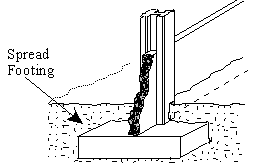
Spread footings are those whose base is more wider than a typical load bearing wall foundations. The wider base of this footing type spreads the weight from the building structure over more area and provides better stability.
Types of Foundation - Spread Footing
Fig: Spread Footing
Spread footings and wall footings are used for individual columns, walls and bridge piers where the bearing soil layer is within 3m (10 feet) from the ground surface. Soil bearing capacity must be sufficient to support the weight of the structure over the base area of the structure.
These should not be used on soils where there is any possibility of ground flow of water above bearing layer of soil which may result in scour or liquefaction.

4. Raft or Mat Foundations

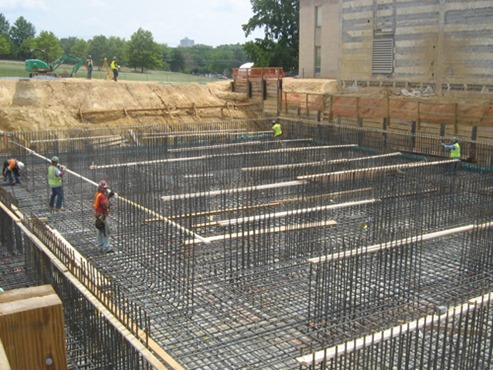
Raft or mat foundations are the types of foundation which are spread across the entire area of the building to support heavy structural loads from columns and walls.
Types of Foundation - Mat Foundation
Fig: Mat Foundation
The use of mat foundation is for columns and walls foundations where the loads from structure on columns and walls are very high. This is used to prevent differential settlement of individual footings, thus designed as a single mat (or combined footing) of all the load bearing elements of the structure.
It is suitable for expansive soils whose bearing capacity is less for suitability of spread footings and wall footings. Raft foundation is economical when one-half area of the structure is covered with individual footings and wall footings are provided.
These foundations should not be used where the groundwater table is above the bearing surface of the soil. Use of foundation in such conditions may lead to scour and liquefaction.

Types of Deep Foundation

5. Pile Foundations

Pile foundation is a type of deep foundation which is used to transfer heavy loads from the structure to a hard rock strata much deep below the ground level.
Pile Foundation
Fig: Pile Foundation
Pile foundations are used to transfer heavy loads of structures through columns to hard soil strata which is much below ground level where shallow foundations such as spread footings and mat footings cannot be used. This is also used to prevent uplift of structure due to lateral loads such as earthquake and wind forces.
Pile foundations are generally used for soils where soil conditions near the ground surface is not suitable for heavy loads. The depth of hard rock strata may be 5m to 50m (15 feet to 150 feet) deep from the ground surface.
Pile foundation resists the loads from structure by skin friction and by end bearing. Use of pile foundations also prevents differential settlement of foundations.

6. Drilled Shafts or Caisson Foundation

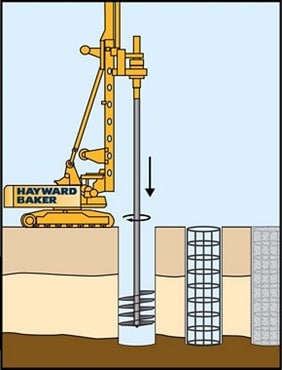
Drilled shafts, also called as caissons, is a type of deep foundation and has action similar to pile foundations discussed above, but are high capacity cast-in-situ foundations. It resists loads from structure through shaft resistance, toe resistance and / or combination of both of these. The construction of drilled shafts or caissons are done using an auger.
Drilled Shafts or Caisson Foundation
Fig: Drilled Shafts or Caisson Foundation (Source: Hayward Baker)
Drilled shafts can transfer column loads larger than pile foundations. It is used where depth of hard strata below ground level is location within 10m to 100m (25 feet to 300 feet).
Drilled shafts or caisson foundation is not suitable when deep deposits of soft clays and loose, water-bearing granular soils exists. It is also not suitable for soils where caving formations are difficult to stabilize, soils made up of boulders, artesian aquifer exists.
Construction of Foundation under Different Ground Conditions


Construction of Foundation under Different Ground Conditions

Factors Affecting Depth of Foundation

Mentioned below are the various factors of soils and ground conditions that would affect the depth of the foundation.
  1. The depth of the foundation is highly affected by the allowable bearing capacity of the soil. This will decide the need soil improvement or increase in depth of foundation.
  2. If the site is more off clay, it is important to identify the zone where the shrinkage and the swelling of the particles takes place as a result of seasonal weather changes. These change in clay material are caused by trees or the shrubs located nearby. Hence the penetration of the foundation has to be performed below this critical zone.
  3. In sites with fine sand and silts, there are chances of frost action happening at a particular zone. Foundation constructed must penetrate below this zone.
  4. The maximum depth of scouring must be considered during the foundation construction of structures like bridges and piers. Hence the foundation depth must be below this scouring depth.

Foundation for Different Soil Types

Generally, the foundation is penetrated down to a minimum depth of 0.5m when considered below the natural ground level. If the ground site is a filled-up type, the penetration must go beyond the depth of fill or other methods given that special precautions are taken. In cases, where we need to have the foundation at a higher level, we determine the difference between the base of the foundation and the level of the excavation, which is filled up by
  • The concrete with allowable compressive strength not less than the allowable bearing pressure of the soil or
  • By means of an incompressible fill material like gravel and sand. Here the width of filling must be greater than the width of the foundation for load dispersion from either side of the foundation base.
Below mentioned are recommendations for foundation construction under different ground conditions and soil types.

1. Foundation on Sloping Grounds

While constructing the foundation on a ground with slope, the distance from the edge of the footing to the ground surface as shown in figure-1 below is taken as:
  • 60cm for Rock
  • 90cm for Soil
As shown in the figure below, a line drawn at an angle of 30 degrees with the footing base must be parallel to the slope of the ground i.e. these lines must not intersect with each other.
Foundation on sloping ground
Fig.1: Foundation on sloping ground

2. Foundation near Existing Building

When a new footing has to be constructed near to an old footing, the width of the wider footing (w) is taken. The distance maintained during the construction of new footing with the old one is this width ‘w’. Based on the severity of the project, analysis of the bearing capacities and the settlement can be performed.

3. Foundation at Different Levels

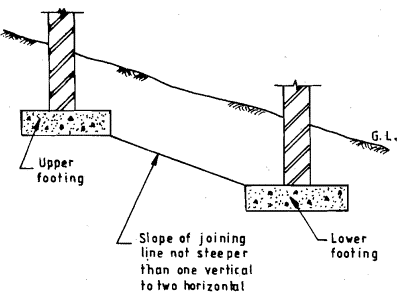
The figure-2 below shows the construction of footing at different levels on granular soils. As shown in figure, while constructing the footing at different level, it is recommended that the line joining the lower adjacent edges of the footing must not have a slope that is steeper than ½ (1 vertical to 2 horizontal).
Foundation on granular soils
Fig.2: Foundation on granular soils
While constructing footing at different levels over clayey soil, the line drawn between the adjacent edges of the footing as shown in figure-3 below must not be steeper than ½ ( One vertical and 2 horizontal).
Foundation on clayey soils
Fig.3: Foundation on clayey soils

Combined Footing Design with Example and Types of Combined Footing


Combined Footing Design with Example and Types of Combined Footing

Combined footings are constructed for two or more columns when they are close to each other and their foundations overlap. Design of combined footings with example is discussed.
The function of a footing or a foundation is to transmit the load form the structure to the underlying soil. The choice of suitable type of footing depends on the depth at which the bearing strata lies, the soil condition and the type of superstructure.

Combined Footings

Whenever two or more columns in a straight line are carried on a single spread footing, it is called a combined footing. Isolated footings for each column are generally the economical.
Combined footings are provided only when it is absolutely necessary, as
  1. When two columns are close together, causing overlap of adjacent isolated footings
  2. Where soil bearing capacity is low, causing overlap of adjacent isolated footings
  3. Proximity of building line or existing building or sewer, adjacent to a building column.
Combined Footings Design with Loads

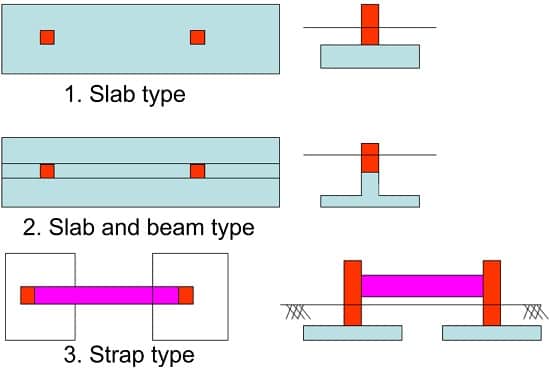
Types of Combined Footing

Types of Combined Footing
  • The combined footing may be rectangular, trapezoidal or Tee-shaped in plan.
  • The geometric proportions and shape are so fixed that the centeroid of the footing area coincides with the resultant of the column loads. This results in uniform pressure below the entire area of footing.
  • Trapezoidal footing is provided when one column load is much more than the other. As a result, the both projections of footing beyond the faces of the columns will be restricted.
  • Rectangular footing is provided when one of the projections of the footing is restricted or the width of the footing is restricted.
Types of Combined Footing

Rectangular combined footing

  • Longitudinally, the footing acts as an upward loaded beam spanning between columns and cantilevering beyond. Using statics, the shear force and bending moment diagrams in the longitudinal direction are drawn. Moment is checked at the faces of the column. Shear force is critical at distance ‘d’ from the faces of columns or at the point of contra flexure. Two-way shear is checked under the heavier column.
  • The footing is also subjected to transverse bending and this bending is spread over a transverse strip near the column.
Rectangular combined footing
Critical Sections for Combined Footing

Steps for Design of Combined Footing

  • Locate the point of application of the column loads on the footing.
  • Proportion the footing such that the resultant of loads passes through the center of footing.
  • Compute the area of footing such that the allowable soil pressure is not exceeded.
  • Calculate the shear forces and bending moments at the salient points and hence draw SFD and BMD.
  • Fix the depth of footing from the maximum bending moment.
  • Calculate the transverse bending moment and design the transverse section for depth and reinforcement. Check for anchorage and shear.
  • Check the footing for longitudinal shear and hence design the longitudinal steel
  • Design the reinforcement for the longitudinal moment and place them in the appropriate positions.
  • Check the development length for longitudinal steel
  • Curtail the longitudinal bars for economy
  • Draw and detail the reinforcement
  • Prepare the bar bending schedule

Detailing of Combined Footing

Detailing of steel (both longitudinal and transverse) in a combined footing is similar to that of conventional beam-SP-34. Detailing requirements of beams and slabs should be followed as appropriate-SP-34