Saturday, August 18, 2018

Methods to Check Verticality of Structure during Building Construction


Methods to Check Verticality of Structure during Building Construction

Checking verticality works would encounter during building construction at several stages such as during installing vertical formworks of columns and transferring levels up successive floors of multi storey structures. Various methods which to control or check verticality works during building construction are discussed.
 Methods to Check Verticality of Structure during Building Construction
Fig.1: Verticality Works During Building Construction

Methods to Control Verticality of Structure during Building Construction

Methods used to check or control verticality works include:
  1. Plumb-bob technique
  2. Spirit level
  3. Theodolite
  4. Optical plummet

1. Plumb-Bob Technique

Plumb-bob as shown in Figure 2 consist of a weight with pointed tip on the bottom attached to end of a string. The heavy weight will hang under gravity and offer a precise vertical line which is called plumb line.
Plumb-Bob Tool
Fig.2: Plumb-Bob Tool
This method is applied for checking or controlling vertical line of structural elements especially indoors such as lift shaft. Added to that, it is used to control verticality of foundation, walls, and columns.
Checking Verticality of Structural Elements
Fig.3: Checking Verticality of Structural Elements
Checking Verticality of Columns using Plumb-Bob
Fig.4: Checking Verticality of Columns
The plumb line or vertical line of plumb-bob is influenced by wind force and it will lose its accuracy and precision. Small to moderate lateral movement of plumb-bob can be reduced satisfactorily by damping it in oil or water.
If the height of structural member is large, then it is possible to replace the string with a long wire, but substantial cautions should be plasticized so as to avoid imposing risks to the personals working below.

2. Spirit Level Method

This tool is appropriate for controlling verticality of small scale works for example checking formworks and door frames. If spirit level is employed for approximate checks, then it is required to check the verticality with more accurate technique.
Spirit Level Method
Fig.5: Spirit Level

3. Theodolite Method

Theodolite is substantially powerful instrument which can be used to check verticality works during construction with great precision and accuracy.
It is suitable for checking or controlling verticality of towers as shown in Figure 8, wall, foundation and columns as shown in Figure 9; specifically large number of columns along a one grid line.
It is possible to measure the slope of out of plumb line of the member by using Theodolite in combination with a tape.
The procedure used to check column verticality includes:
  • Setting up the digital Theodolite centered on a peg that installed 500 mm from the column grid.
  • After Theodolite set up accurately the laser beam will be turned on and focused it to the steel tape which is held to the formwork.
  • Take the reading of the steel tape through the telescope.
  • Take the readings of two positions at the same level on both top and bottom levels of the formwork. By taking two readings at the same level any curvature on the surface can be identified. These steps are illustrated in Figure 9.
Checking Structure Verticality Using Theodolite
Fig.6: Checking Verticality Using Theodolite
Checking Column Verticality Using Theodolite
Fig.7: Checking Column Verticality Using Theodolite

4. Optical Plummet Method

It is an instrument that sight directly down or directly up. Optical plummet has an automatic compensator which increases its accuracy significantly compare with other methods used for controlling verticality.
optical-plummet-instrument
Fig.8: Optical Plummet
Optical Plummet to Check Structure Verticality
Fig.9: Optical Plummet to Check Structure Verticality

Friday, August 17, 2018

Penetration Value of Bitumen -Determination for Road Construction


Penetration Value of Bitumen -Determination for Road Construction

Penetration value test on bitumen is a measure of hardness or consistency of bituminous material. A 80/100 grade bitumen indicates that its penetration value lies between 80 & 100.
Penetration value is the vertical distance traversed or penetrated by the point of a standard needle into the bituminous material under specific conditions of load, time and temperature. This distance is measured in one tenths of a millimeter.
Penetration test is used for evaluating consistency of bitumen. It is not regarded as suitable for use in connection with the testing of road tar because of the high surface tension exhibited by these materials.
Penetration test on bitumen is carried to determine:
  1. Consistency of bituminous material
  2. Suitability of bitumen for use under different climatic conditions and various types of construction.

Determination of Penetration Value of Bitumen

Apparatus for Penetration Test

Container

A flat bottomed cylindrical metallic dish 55 mm in diameter and 35 mm in depth is required. If the penetration is of the order of 225 or more, dish of 70mm diameter and 45mm depth is required.

Needle

A straight, highly polished, cylindrical hard steel rod.

Water bath

Water bath maintained at 25° ± 0.1 °C, containing not less than 10 litres of water, the sample being immersed to a depth not less than 100mm from top and supported on perforated shelf not less than 50mm from bottom of the bath.

Transfer dish or tray

Should provide support to the container & should not rock it. It should be of such capacity as to completely immerse container during test.

Penetration apparatus

Should be such that it allows needle to penetrate without much friction& is accurately calibrated to give results in one tenth of a millimeter.

Thermometer

Range 0- 44 °C and in readable upto 0.20 C.

Time measuring device

With an accuracy of l second.

Procedure for Bitumen Penetration Test

(i) Preparation of test specimen: Soften the material to a pouring consistency at a temperature not more than 60°C for tars and 90°C for bitumen above the approximate softening point and stir it thoroughly until it is homogeneous and is free from air bubbles and water.
Pour the melt into the container to a depth at least 10mm in excess of the expected penetration. Protect the sample from dust and allow it to cool in an atmosphere at a temperature between 15° to 30° C for one hour. Then place it along with the transfer dish in the water bath at 25° ± 0.1 °C, unless otherwise stated.
(ii) Fill the transfer dish with water from the water bath to depth sufficient to cover the container completely, place the sample in it and put it upon the stand of the penetration apparatus.
(iii) Clean the needle with benzene, dry it and load with the weight. The total moving load required is 100 ± 0.25 gms, including the weight of the needle, carrier and super-imposed weights.
(iv) Adjust the needle to make contact with the surface of the sample. This may be done by placing the needlepoint in contact with its image reflected by the surface of the bituminous material.
(i) Make the pointer of the dial to read zero or note the initial dial reading.
(ii) Release the needle for exactly five seconds.
(vi) Adjust the penetration machine to measure the distance penetrated.
(vii)Make at least 3 readings at points on the surface of the sample not less than 10 mm apart and not less than l0mm from the side of the dish. After each test return the sample and transfer dish to the water bath and wash the needle clean with benzene and dry it.
In case of material of penetration greater than 225, three determinations on each of the two identical test specimens using a separate needle for each determination should be made, leaving the needle in the sample on completion of each determination to avoid disturbance of the specimen.

Precautions during Penetration Test

  1. There should be no movement of the container while needle penetrates into sample.
  2. The sample should be free from any extraneous matter.
  3. The needle should be cleaned with benzene and dried before penetration.

Observations for Penetration Test

Actual test temperature = °C
Penetration dial readingTest 1Test 2Test 3
(a) Initial
(b) Final
Penetration Value

Result of Test

Mean Penetration Value =

Recommended Penetration Value of Bitumen

Penetration test is a commonly adopted test on bitumen to grade the material in terms of its hardness. A 80/100 grade bitumen indicates that its penetration value lies between 80 & 100.
Grading of bitumen helps to assess its suitability in different climatic conditions and types of construction. For bituminous macadam and penetration macadam, IRC suggests bitumen grades 30/40, 60/70, 80/100.
In warmer regions, lower penetration grades are preferred to avoid softening whereas higher penetration grades like 180/200 are used in colder regions to prevent the occurrence of excessive brittleness. High penetration grade is used in spray application works.

DESIRABLE PROPERTIES OF ASPHALT MIXES FOR PAVEMENTS


DESIRABLE PROPERTIES OF ASPHALT MIXES FOR PAVEMENTS

Bituminous mixes (some times called asphalt mixes) are used in the surface layer of road and airfield pavements. The mix is composed usually of aggregate and asphalt cements. Some types of bituminous mixes are also used in base coarse. The design of asphalt paving mix, as with the design of other engineering materials is largely a matter of selecting and proportioning constituent materials to obtain the desired properties in the finished pavement structure.
Asphalt Mixes for Pavements
Fig: Asphalt Mixes for Pavements

The desirable properties of Asphalt mixes are:

1.  Resistance to permanent deformation: The mix should not distort or be displaced when subjected to traffic loads. The resistance to permanent deformation is more important at high temperatures. 
2.  Fatigue resistance: the mix should not crack when subjected to repeated loads over a period of time.
3.  Resistance to low temperature cracking.This mix property is important in cold regions.
4.  Durability:the mix should contain sufficient asphalt cement to ensure an adequate film thickness around the aggregate particles. The compacted mix should not have very high air voids, which accelerates the aging process.
5.  Resistance to moisture-induced damage.
6.  Skid resistance.
7.  Workability:the mix must be capable of being placed and compacted with reasonable effort.
8.  Low noise and good drainage properties:If the mix is to be used for the surface (wearing) layer of the pavement structure.
Marshall stability and Hveem stabilometer tests are largely used for the routine testing. Criteria for the suitable mix design have been specified by the Asphalt Institute.

Wednesday, August 15, 2018

Roof Waterproofing Using Bituminous Waterproofing Membrane Sheet


Roof Waterproofing Using Bituminous Waterproofing Membrane Sheet

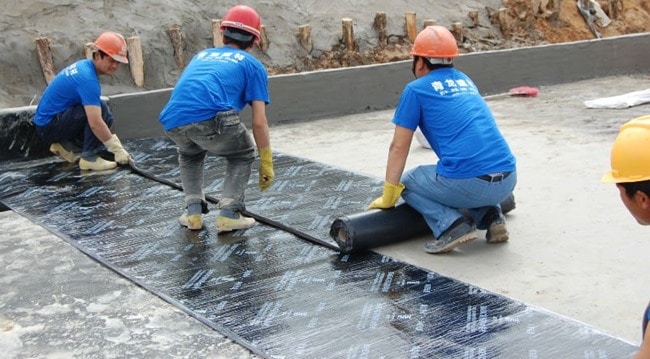
A bituminous waterproofing membrane is used for reinforced concrete roof waterproofing. This waterproofing membrane comes on site in the form of rolls manufactures and packed in the factory properly sealed.
The specifications and safety manuals of this membranes provided by manufacturer should be read before installation process. Fire safety and prevention is the most important while using this membrane.
All inflammable materials from roofs to be removed and good roofing practices should be followed.
The bituminous waterproofing membranes are unfolded on the site and laid firmly on surface with tar based adhesives using blowtorches.
Bituminous Waterproofing Membrane
A layer of bituminous water proof membrane is laid over the structural roof which acts as a shield against the seepage of water onto the roof. Roof tiles & membrane is applied over the filler material laid to slope to pass the flow of water into drains. A proper slope is necessary to allow the water to flow steadily to drains.
These membranes have 2 to 4 mm thick water proof materials. Membrane should be flexible with elongation 150 % to cover any small cracks, strong, chemical & UV resistant, flexible enough to take any shape over which it is laid.

Procedure for Roof Waterproofing Using Bituminous Waterproofing Membrane

Roof Waterproofing Using Bituminous Waterproofing Membrane

Roof Surface Preparation

The surface to be membrane should be clear from dirt, dry and clean. Must not be installed during adverse weather and below 450 F. For slope up to 3 inch the membrane should be laid perpendicular to slab and more than 3 inch slope should be laid parallel to slope. This ensures that water is never be running at joint lap edge.

Torch Equipment

Torch equipments should be properly connected and hoses to be in good working condition. Check the equipment against gas leakage by using soapy water. When torch is opened it should be at lowest possible settings to avoid sudden gush of fire.

Roll Alignment

No wrinkles should be allowed while laying membrane and proper alignment is necessary.

Bituminous Waterproofing Membrane installation

The torch fire should be applied uniformly and slow over the roll while laying. The best movement of the torch is as shown in the picture.

Compound flow out

While torching membrane on joints, approximately 1-inch chemical from the waterproofing membrane should be flowing out to ensure proper filling of gaps. More than 1-inch flow out signals to overheating of membrane.
Roller should be laid over joints along with torching so that compound sets properly and no gap is created in joints.

Check Joints between Waterproofing Sheets

Ensure perfect joint between two sheets is the most crucial part. Check all the edges of joints properly to ensure proper adhesion of end laps of membrane, air gaps is not acceptable. At gaps the sheets should be lifted and heated with the torch and resealed again.

End Laps in Waterproofing Membrane Sheets

At the end of sheet should be heated properly as to bitumen starts appearing over the sheet. Heat the underside of membrane properly to ensure proper bond at laps.
The bituminous waterproofing membrane sheets are overlapped 3 inches at the sides and 6 inches at the ends for proper grip and waterproof joint and block water seepage. Staggered end laps must be 18 inches apart so that no adjacent end laps coincide

Granules Applications

Granules applications matching the sheet at the end laps and roller is spread to set it properly. This all applications will give roof an enhanced professional finish.