Wednesday, August 15, 2018

Types of Bitumen Mixes for Pavement Construction and their Applications


Types of Bitumen Mixes for Pavement Construction and their Applications

There are various types of bitumen mixes with aggregates for pavement construction. Applications of these bitumen mixes for pavements is discussed in this article.

Types of Bitumen Mixes for Pavement Construction and their Applications

Based on the nature of gradation selected for the bitumen mixes, they can be classified into:
  • Dense Graded Bitumen Mixes
  • Semi-Dense Graded Bitumen Mixes
  • Open Graded Bitumen Mixes
  • Gap Graded Bitumen Mixes
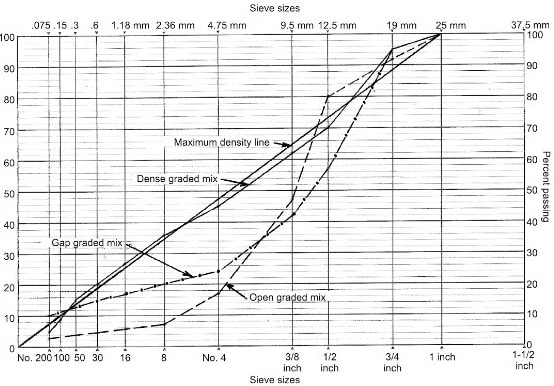
Gradation Chart for Dense, Open Graded and Gap Graded Bitumen Mixes
Fig.1: Gradation Chart for Dense, Open Graded and Gap Graded Bitumen Mixes Density
The bitumen mix that is densely graded has continuous gradation, say in the proximity of maximum density line. The bitumen mix with a large amount of fine aggregate i.e. sand will form open graded bitumen mix.
When the mix lack materials of two or more sizes, it will form gap graded bitumen mix. The semi-graded mix will have a gradation lying in between the open graded and the gap graded. All the gradation variations are represented in figure-1.
Types of Bitumen Mixes for Pavement Construction and their Applications

Dense Graded Bitumen Mixes for Pavements

These mixes possess continuous gradation of all primary aggregates. These particles are packed together. Here inter-particle surface friction is the reason behind their property of strength gain.
All most all possible flexible pavements constructed in the world employ dense graded bitumen mixes.
There are two main types of dense graded mix used. They are:
  • Dense Bitumen Macadam (DBM)
  • Bituminous Concrete(BC)

Dense Bitumen Mixes

This mix is mainly employed for base course and the binder course. This itself consist of two gradations; Grading-1 and Grading-2. Grading-1 has 37.5mm as the nominal maximum aggregate size (NMAS). While Grading-2 have NMAS of 25mm.
The fine aggregate percentages in both the grading are same in a range of 28 to 42%. The main criteria that differ both the grading are that the grading 1 consist of large size particles i.e. 25mm to 45mm.
The grading-1 with NMAS of 37.5mm has many disadvantages like segregation. This segregation will later result in honeycombing. At lower air-void levels, these mixes become permeable compared to the grading 2, with NMAS of 25mm.
Hence, the grading-1 causes problems related to water exposure. With the increase of NMAS, the permeability will increase the multi-fold at a present void level condition.
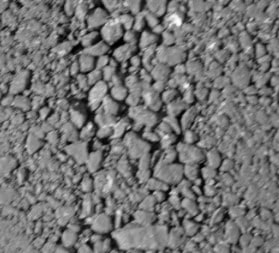
Dense Graded Bitumen Mixes for Pavements
Fig.2: Dense Bitumen Mixes Grade-1, NMAS mix of 37.5mm -Honeycombing Defect due to Segregation
The effect of the nominal maximum aggregate size on the permeability of the flexible pavement is represented in the graph shown in figure-3.
The grade-1, have the advantage of rutting resistance compared to the grading-2. During the rainy season, the pavement made of NMAS 37.5MM, Grade 1 must be sealed or overlaid. This will avoid penetration of the water into the pavement and reach the Wet mix macadam. This is the WMM course also called as crushed stone base source.
Effect of Nominal Maximum Aggregate Size on Permeability of Flexible Pavement
Fig.3: Effect of Nominal Maximum Aggregate Size on Permeability of Flexible Pavement

Bituminous Concrete Mixes (BC)

The bituminous concrete mix is used in two forms: Grade-1 and Grade-2. Grade-1 with NMAS of 19mm. The Grade-2 of 13mm as the NMAS.
From the above description about dense bitumen mixes, it was clear that dense bitumen mix grade-2 have larger use as the base course due to its fewer disadvantages compared to dense bitumen mix Grade-1. This hence was necessary to determine a grade for the binder and the surface course.
The bituminous concrete grading-1 with nominal maximum aggregate size 19mm as the binder course binds the base course (dense bitumen mix Grade-1) as well as the wearing course bituminous concrete grade-2 of nominal maximum aggregate size 13mm, with NMAS 19 mm employed as a transition. The bituminous concrete grading-2 is good to be used as a wearing course.
To facilitate medium and low traffic, a bituminous concrete grade of nominal maximum aggregate size 9.5 mm was necessary to considered for the construction of smooth and impermeable pavement in urban areas.
To facilitate thin asphalt lifts, bituminous concrete grading-3 is more suitable than grade-2. The bituminous concrete grade-2 of NMAS 9.5mm has been efficiently used in the highway construction for the US. For higher traffic BC grade-2 are recommended.
Table-1: Recommended Bitumen Concrete(BC) Gradations
Recommended Bitumen Concrete(BC) Gradations

Semi-Dense Bitumen Mixes

The two types of semi-bituminous mixes used in the pavement construction in India are;
  • Semi-Dense Bituminous Concrete (SDBC)
  • Mixed Sealed Surfacing (MSS)

Semi-Dense Bituminous Concrete (SDBC)

The semi-dense bituminous concrete mixes have neither dense or open graded characteristics. It consists of the so called pessimum voids when they are fully constructed.
The word is an anonym of optimum. So, it is advised to make the mix get rid of pessimum voids. These tend to capture moisture or water that will later cause stripping.
When the semi dense bituminous concrete is employed above the bitumen macadam (BM) layer, there is chances for the penetration of rainwater through the SDBC and reach the BM.
This will create the separation of aggregate and the bitumen in the BM layer. This will cause stripping and the scaling of SDBC. The scaling later with time will result in the potholes on the road.
Semi-Dense Bituminous Concrete Highways with Shallow Potholes
Fig.4: Semi-Dense Bituminous Concrete Highways with Shallow Potholes

Mixed Seal Surfacing (MSS)

The Mixed Seal Surfacing design mix is based on the IRC: SP:78-2008. This is an alternative used for the premix carpet (PMC). Both the PMC and the MSS are employed in 20mm thickness.
There are two gradations that are specified for the mixed seal surfacing mix. They are
  • Type A – Closed Gradation with an NMAS value of 9.5mm
  • Type B- Open Gradation with an NMAS value of 9.5mm or 12mm
The aggregate grading for the MSS mix is mentioned in table-2.
Table-2: Aggregate Grading for Mixed Seal Surfacing Mix
Aggregate Grading for Mixed Seal Surfacing Mix

Open Graded Bitumen Mixes

The open graded Bitumen Mixes have fine aggregates in a minimum amount, hence they are very permeable to water. They are employed based on specific functions in the base and for surface mixes.

Open Graded Bitumen Base Mixes

Three open graded mix types are employed as the base mixes. They are the
  • Asphalt Treated Permeable Base (ATPB)
  • Bituminous Macadam(BM)
  • Built up Spray Grout (BUSG)
Asphalt Treated Permeable Base (ATPB)
Permeable asphalt treated base (PATB) is used extensively on major highway construction in the US. This system will help to have sub surface drainage. The PATB is also called as the Asphalt Treated Permeable Base (ATPB). The system consists of separate course for the subsurface drainage. The thickness of the PATB ranges from 75mm to 100mm.
The PATB is given between the granular sub-base (GSB) and the bituminous course. The granular sub-base in flexible pavement too have the intention to provide subsurface drainage.
The GSB consist of large quantity of fines that are passing through 0.075mm sieve, which will let in providing excellent drainage system. A two-layer drainage system is implemented by this system.
Bituminous Macadam (BM)
The BM mix is open graded and highly permeable in nature. This is a recipe type mix produced that gain no kind of quality in terms of strength and volumetric. The void content is 20 to 25% higher than the dense graded bitumen (DBM). The DBM have a void content of 3 to 5%. The BM have high potential to attract water and moisture.
Built-up spray Grout (BUSG)
For flexible pavements, BUSG has been recommended as a base course. It is a two-layer composite construction with single size aggregates, which are nicely compacted. This has a hot bitumen layer applied after each layer. At the top, single sized key aggregate is applied.
As the sprayed bitumen does not help in filling the voids that are created by the coarse aggregate, these pavements behave to be highly permeable in nature. This does have a property to attract moisture and water. The application of BUSG as a remedy for the removal of potholes is stopped.

Open Graded Bitumen Surface Mixes

Three open graded mix types are employed as the surface mixes. They are:
  • Open graded Friction course (OGFC)
  • Premix Carpet (PMC)
  • Surface Dressing
Open Graded Friction Course (OGFC)
The OGFC system consists of interconnected voids that help to improve the surface drainage property. Here the rainwater will drain through the OGFC and reach the bituminous concrete grade 2 (BC), that will later flow laterally within the OGFC. Which is later ended at the shoulder. The last OGFC layer will have a thickness of 20mm.
This system will have no trace of water on the surface. The OGFC system was developed in 2002, by the US nationals. The safety and the environmental features of OGFC are mentioned below:
  • Improvement of frictional resistance of wet pavement
  • Hydroplaning: Hydroplaning is the effect of skidding on ice and the loss of control problems of the vehicles. This is due to the presence of water during and after rain. The OGFC lets removal of water from the surface, letting no water trace on the pavement.
  • The splash and the spray are reduced: The high-speed movement of vehicles will cause splashing and spraying of water to the nearby vehicles, which will cause problems to the visibility. The OGFC results in no water flooding in the road hence no splashing or spraying.
  • Glare: The OGFC results in the reduction of glare from the headlights in the wet conditions. This will help in better visibility and have reduced driver fatigue.
  • Noise Reduction
Premix Carpet (PC)
Here the PC is laid as a wearing course with a thickness of 20mm. The mix will compose two single size aggregates. One is the aggregate that is passing through 22.5mm and that will retain in 11.2mm.
The second aggregate type will pass through 13.2mm and retain on 5.6mm sieve. Here with respect to the climate and the traffic intensities, the viscosity grade bitumen are employed. It can be either VG-10 or VG-30.
Based on the aggregate and aggregate application rates that are specified in IRC: 14-2004, in “Recommended Practice for Open Graded Premix Carpet”, the bitumen content by weight of mix is 3.3%.
Surface Dressing
As per IRC:110 -2005, ” Specification and Code of Practice for Design AND Construction of Surface Dressing”, the surface dressing has the following significances and objectives:
  • The surface dressing will provide a dust free wearing course over a granular base course that act similar to a water bound macadam (WBM) or a wet mixed Macadam (WMM).
  • The surface Dressing will help in providing impermeability for water percolation for the road surface
  • Surface Dressing provide high friction for the riding surface
  • This will provide a renewal coat for periodic maintenance of bituminous wearing surfaces.
  • The surface dressing work involves the process of spraying of proper grade paving bitumen mainly VG-10 or the rapid setting cationic emulsion. This is applied over an aggregate layer of appropriate size and gradation.
Surface dressing does not increase the structural strength and the riding quality of the pavement constructed.

Gap Graded Bitumen Mixes

The Stone Matrix Asphalt (SMA) is the most commonly used gap graded bituminous mixes. With the increasing traffic and the high pressure of tires of the vehicles will give large stresses to the road pavement. The roads are subjected to overloading conditions in certain cases.
The stone matrix asphalt mix is tough, highly stable in structure and rut resistant asphalt mix. These systems rely on the stone to stone contact that will facilitate in strength. The rich mortar used in the system will provide better durability.

The advantages of stone matrix asphalt mix are:

  • Surface Frictional Resistance are improved
  • The noise is reduced
  • Compared to the conventional dense graded asphalt mix, the night visibility is reduced.

The following steps are involved in the stone matrix asphalt mix design:

  1. The selection of the materials i.e. aggregates, binder and the cellulose fiber.
  2. Three trial gradations are involved to ensure stone to stone contact.
  3. Optimum binder content is used for the all the gradation chosen
  4. The binder drains down as well as the moisture susceptibility is evaluated.
The performance of the stone matrix asphalt mix pavement as studied by the US, based on the rutting effect seen in the road pavement. The figure-5 below shows the rut depth caused for different ranges of the project conducted.
Gap Graded Bitumen Mixes Performance
Fig.5: As per NCAT, the rutting performance of the stone matrix asphalt mix pavement constructed in the US
The performance of the SMA pavements that are constructed in India has performed well.
Compared to bitumen concrete, the cost for stone matrix asphalt mix has been found to be 25 to 30% higher. The increased cost of the SMA material is due to its composing materials like cellulose fiber, modified binder, and the binder content.
In the US, the life cycle study conducted showed that the stone matrix asphalt mix is more cost effective in terms of performance and lesser maintenance.

Different Types of Bitumen, their Properties and Uses


Different Types of Bitumen, their Properties and Uses

There are different types of bitumen available with different properties, specifications and uses based on requirements of consuming industry.
The specification of bitumen also shows variation with the safety, solubility, physical properties, and the durability.
To understand the performance of the bitumen when it is on service, the design of physical properties of the material is highly essential. The standard testing methods are carried out to grade bitumen.

Types of Bitumen and their Properties and Uses

The bitumen can be classified into the following grade types:
  • Penetration Grade Bitumen
  • Oxidized Bitumen Grades
  • Cut Back Bitumen
  • Bitumen Emulsion
  • Polymer Modified Bitumen

Penetration Grade Bitumen

The penetration grade bitumen is refinery bitumen that is manufactured at different viscosities. The penetration test is carried out to characterize the bitumen, based on the hardness. Thus, it has the name penetration bitumen.
The penetration bitumen grades range from 15 to 450 for road bitumen. But the most commonly used range is 25 to 200. This is acquired by controlling the test carried out i.e. the distillation process.
The partial control of fluxing the residual bitumen with the oils can help in bringing the required hardness.
Penetration Grade Bitumen
The table below shows the penetration grade bitumen’s test carried out as per BS EN 12591. This test is for bitumen that is for road application.
Table.1. Paving Grade Bitumen Specification As per BS EN 12591
Paving Grade Bitumen Specification As per BS EN 12591
The BS EN 1426 and BS EN 1427 provides the penetration and softening point values for the respective grades, as from Table-1. This will help in identifying the equiviscosity and the hardness of the bitumen grade.
The grades are represented by the penetration values i.e. For example, 40/60 as a penetration value of 50 ± 10.
The BS EN 13303 also gives the measure of loss on heating with respective limits for all penetration bitumen grades. This measure is to ensure that there are no volatile components present.
So, no component whose loss will contribute to the setting and hardening of bitumen during its preparation or lay course is undergone. The BS EN 12592 provides the solubility values to ensure that there is less or no impurities in the bitumen material.

Oxidized Bitumen

The refinery bitumen is further treated by the introduction of processed air. This will give us oxidized bitumen. By maintaining a controlled temperature, the air is introduced under pressure into soft bitumen.
Compounds of higher molecular weight are formed by the reaction of this introduced oxygen and bitumen components. Thus, the Asphaltenes and the Maltenes content increases resulting in a harder mix. This harder mix has a lower ductility and temperature susceptibility.
Oxidized Bitumen
The oxidized bitumen is used in industrial applications such as roofing and coating for pipes. By this method of processing, the bitumen that has a lower penetration can be manufactured, which can be employed for paving roads.

Cutback Bitumen

These are a grade of bitumen that comes under penetration grade bitumen. This type of bitumen has a temporarily reduced viscosity by the introduction of a volatile oil. Once after the application, the volatile material is evaporated and bitumen gain its original viscosity.
The penetration grade bitumen is a thermoplastic material. It shows the different value of viscosity for different temperature. In areas of road construction, it is necessary for the material to be fluid in nature at the time of laying i.e. during surface dressing.
It is also essential for the material to regain back to its original hardness and property after setting. This is ensured by cutback bitumen. The fluidity is obtained for any bitumen by raising the temperature. But when it is necessary to have fluidity at lower temperatures during surface dressing, cutback bitumen is employed.
The time for curing and the viscosity of cutback bitumen can be varied and controlled by the
  1. dilution of volatile oil, and
  2. the volatility of the oil added.
70/100 or 160/220 pen bitumen that is diluted with kerosene are the main composition of bitumen in the construction of roads in the UK. The standard tar viscometer is used to test the standard viscosity.
Types of Bitumen - Cutback Bitumen
The table-2, shows the cutback specifications based on BS 3690. This provides the requirement of the bitumen to satisfy solubility property, distillation property as well as recovery of properties after curing.
Table-2: The Cutback Bitumen Specification As per BS 3690: Part 1 & BS EN 12591
Cutback Bitumen Specification As per BS 3690: Part 1 & BS EN 12591

Bitumen Emulsion

The this type of bitumen forms a two-phase system with two immiscible liquids. One of them is dispersed as fine globules within the other liquid. When discrete globules of bitumen are dispersed in a continuous form of water, bitumen emulsion is formed.
This is a form of penetration grade bitumen that is mixed and used for laying purposes.
An emulsifier having a long hydrocarbon chain with either a cationic or anionic ending is used for dispersing the bitumen globules. This emulsifier provides an electrochemical environment. The ionic part of the chain has an affinity towards water and the bitumen is attracted by hydrocarbon part.
Types of Bitumen - Bitumen Emulsion
As shown in figure below, the hydrocarbon binds the bitumen globules strongly and the ionic part is seen on the surface of the globules. Depending on the ions present, the droplets take a charge.
The emulsions can be cationic (positive charge) or anionic (negatively charged). The globules of the same charge hence repel each other, making the whole system stable. To facilitate adhesion with the aggregates (that are negatively charged), cationic emulsions are more preferred.
Bitumen Emulsions
Bitumen during Dispersion in an emulsifier

The stability of emulsions is dependent on the following factors:

  • Types of bitumen emulsifier and its quantity
  • Water evaporation rate
  • Bitumen quantity
  • Bitumen globules size
  • Mechanical forces
The emulsions are applied by using sprays. For this viscosity is a primary concern. With the increase of bitumen content, the mixture becomes more viscous. This is found to be sensitive when the amount exceeds 60%.
The BS 434: Part 1 and BS EN 13808 gives the specification for the viscosity of road emulsions.

Polymer – Modified Bitumen

Polymer modified bitumen is the type of bitumen obtained by the modification of strength and the rheological properties of the penetration graded bitumen. Here for this 2 to 8% of polymer is added.
Polymer - Modified Bitumen
The polymer used can be either plastic or rubber. These polymers vary the strength and the viscoelastic properties of the bitumen. This is achieved by:
  1. Elastic response increase
  2. Improvement in cohesive property
  3. Improvement in Fracture strength
  4. Providing ductility
Some of the examples of rubber polymers used are styrene block copolymers, synthetic rubbers, natural and recycled rubbers. Plastics that are thermoplastic polymers are also used.

Why is Bitumen Used in Road Construction? Properties and Advantage of Bitumen for Pavements


Why is Bitumen Used in Road Construction? Properties and Advantage of Bitumen for Pavements

Bitumen is used in road construction due to various properties and advantages it has over other pavement construction materials. Advantages of bitumen for road construction is discussed.

Why is Bitumen Used in Road Construction?

Bitumen gain certain unique properties that are inbuilt in it during its manufacture. The bitumen as a raw material in flexible road construction and bitumen as a mix (composing other materials i.e. aggregates/ pozzolans) serves certain advantages, that prompt to use bitumen widely in road construction.
Why is Bitumen Used in Road Construction? Advantage of Bitumen for Pavements

Use of Bitumen in Flexible Road Construction

The reason behind the significant application of bitumen in flexible pavements are explained below:

1. Production of Bitumen is economical

Bitumen is a by-product of crude oil distillation process. Crude oil itself is a composition of hydrocarbons. The primary products that are available are the petrol, diesel, high octane fuels and gasoline.
When these fuels are refined from the crude oil, the bitumen is left behind. Further treatment of by-product, to make it free from impurities give pure bitumen.
As the primary product demand is of utmost importance to the society, the bitumen as a by product has survival for long. This by product is utilized as a new construction material, without going for any other new resource.

2. Physical and Rheological Properties of Bitumen bring Versatility

The physical and the chemical properties of Bitumen are found to be a function of load level, temperature and the duration of loading. It is a thermoplastic and viscoelastic material.
These dependencies make us to truly access the traffic on the road so that a bitumen mix properties can be varied based on the stress levels calculated. This versatility of bitumen results in a large variety of bitumen mix, based on the road application.

3. The Melting Point of Bitumen is low

It is highly appreciable about the fact that bitumen has a favorable melting point, that helps in both surface dressing and wearing resistance with ease.
The melting point of the bitumen should not be too high, that it can be melted easily during laying the pavement. At the same time, bitumen has a melting point, which would not let the already casted road pave to melt and deform under high temperatures.
In areas of high temperatures, along with this quality of bitumen, the aggregate composition helps to cover up the effect of large temperature.

4. Bitumen can undergo Recycling

As the melting point of bitumen is favorable, it can be melted back to its original state. This is called as asphalt recycling process.
The torn-up asphalt pieces are taken up to the recycling plant, instead of sending them to landfills. This recycled mix can be reused. If necessary, the old bitumen is mixed with new bitumen and new aggregates to make the mix live again.

5. Bitumen gain Adhesive Nature

As explained in the production of bitumen, it is free from hydrocarbon and hence not toxic. The by product is refined to maximum to get rid of organic materials and impurities.
The bitumen has a highly adhesive nature, which keeps the materials in the road mix bind together under strong bonds. These become stronger when the mix is set i.e. ready for vehicle movement.

6. Bitumen has Color Variety

The traditional bitumen is black in color. This is because the dense organic material within bitumen is black in color. Now, when certain pigments are added to bitumen, the color of our choice can be obtained. These are colored bitumen.
It is costly than the normal colored bitumen. The disadvantage of colored bitumen is that it requires more chemical additives and materials.

Requirements of Bitumen Mixes for Road Construction

An overall bitumen mix is used in the construction of flexible pavement to serve the following needs.
  • Structural Strength
  • Surface Drainage
  • Surface Friction

Structural Strength of Bituminous Pavements

The figure below shows a typical cross section of flexible pavement, that was developed in the USA. The structural bitumen layer composes of:
  • Bituminous surface or wearing course
  • Bituminous binder course
  • Bituminous base course
The primary purpose of these bitumen mixes is structural strength provision. This involves even load dispersion throughout the layers of the pavement. The loads involved are dynamic or static loads, which is transferred to the base subgrade through the aggregate course.
A granular base with a bituminous surface course is only provided for roads of low traffic. It is just sufficient and economical.
The rebounding effect of bitumen upper layers helps in having resistance against high dynamic effect due to the heavy traffic. Rebounding property is reflected by the stiffness and the flexibility characteristics of the bitumen top layers. When looking from bottom to top, the flexibility characteristics should increase.
Studies have shown that the above mentioned characteristics of aggregates are attained using densely graded bitumen mixes. This mix should make use of nominal maximum size aggregate (NMAS), that must decrease from the base course- binder course – surface course.
The nominal maximum size aggregate (NMAS) = One sieve larger than first sieve-to retain more than 10% of combined aggregate.
There is a higher amount of bitumen content in the wearing course, that make the layer more flexible. This would help in increasing the durability.

Surface Drainage of Bituminous Pavements

Subsurface drainage can be facilitated using granular sub base in the construction of flexible pavement. Permeable asphalt treated base (PATB) can be used to provided positive surface drainage in major highways. This would behave as a separate course for facilitating subsurface drainage.

Surface Friction of Bituminous Roads

It is essential for the pavement layer to provide enough skid resistance and friction, during vehicle passage, especially in wet condition. This would ensure the safety of the passengers. The macro and the micro surface texture of the asphalt mix contributes towards the surface friction.
The mix gradation i.e. open graded or dense graded will contribute to macro surface texture. The open graded mix have higher macro surface than dense graded. The water is squeezed out from the bottom of vehicle tire when the high macro surface texture is implemented.
The micro surface texture is contributed by the aggregate surface, that is exposed when the above bitumen layer is torn.

Advantages of Bituminous Road Construction Over Concrete Pavements

1. A smooth Ride Surface

It does not make use of any joints; Hence provide a smooth surface to ride. It also gives less sound emission when compared with concrete pavements. The wear and tear are less in the bituminous pavement, thus maintaining the smoothness.

2. Gradual Failure

The deformation and the failure in the bituminous pavement is a gradual process. The concrete pavement shows brittle failures.

3. Quick Repair

They have an option to be repaired to be quick. They don’t consume time in reverting the path for traffic; as they set fast.

4. Staged Construction

This helps in carrying out staged construction in a situation when problems of fund constraint or traffic estimation problems are faced.

5. Life Cost is Less

The initial cost and overall maintenance cost of bituminous pavement are less compared to concrete pavement.

6. Temperature Resistant

They act resistant against high temperature from melting and are not affected by de-icing materials.

Disadvantages of Bituminous Pavement

Disadvantages of Bituminous Roads - Distress in Pavements
  1. Bituminous pavements are less durable
  2. Low tensile strength compared to concrete pavement
  3. Extreme weather and improper weather conditions tend to make bituminous pavement slick and soft.
  4. Bitumen with impurities can cause pollution to soil, hence ground water by their melting. These may have hydrocarbons in small amounts.
  5. Clogging of pores and drainage path during construction and service life
  6. More salting- to prevent snow during winter season
  7. Cost of construction high during extreme conditions of temperature

Steps in Bituminous Road Construction


Steps in Bituminous Road Construction

Bitumen road construction consists of various steps such as preparation of base course, application of bituminous coat, placement of bituminous mix, rolling and check for quality etc. which are discussed.

Steps in Bituminous Road Construction

1. Preparation of the existing base course layer

The existing surface is prepared by removing the pot holes or rust if any. The irregularities are filled in with premix chippings at least a week before laying surface course. If the existing pavement is extremely way, a bituminous leveling course of adequate thickness is provided to lay a bituminous concrete surface course on a binder course instead of directly laying it on a WBM.

2. Application of Tuck Coat

It is desirable to lay AC layer over a bituminous base or binder course. A tack coat of bitumen is applied at 6.0 to 7.5 kg per 10 sq.m area, this quantity may be increased to 7.5 to 10 kg for non-bituminous base.

3. Preparation and placing of Premix

The premix is prepared in a hot mix plant of a required capacity with the desired quality control. The bitumen may be heated up to 150 – 177 deg C and the aggregate temperature should not differ by over 14 deg C from the binder temperature.
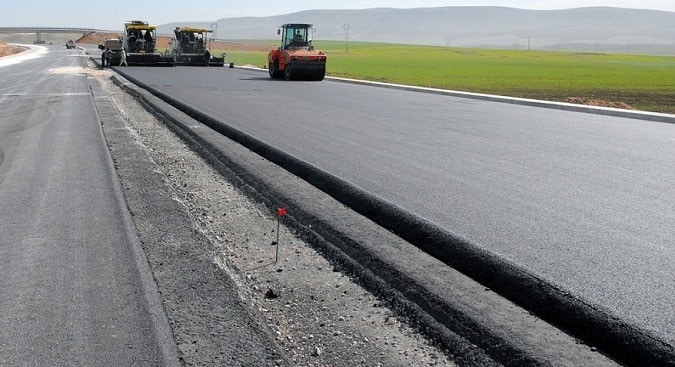
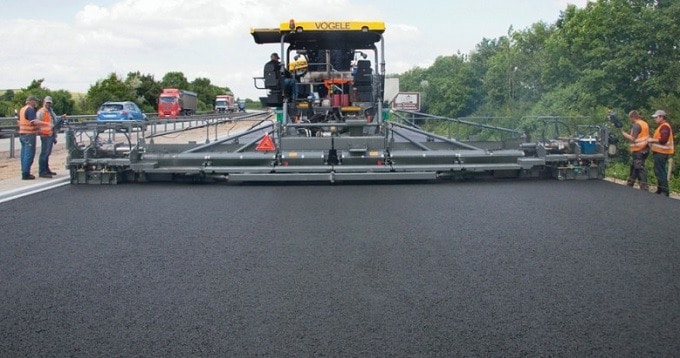
The hot mixed material is collected from the mixture by the transporters, carried to the location is spread by a mechanical paver at a temperature of 121 to 163 deg C. the camber and the thickness of the layer are accurately verified.
The control of the temperatures during the mixing and the compaction are of great significance in the strength of the resulting pavement structure.

4. Rolling

A mix after it is placed on the base course is thoroughly compacted by rolling at a speed not more than 5km per hour.
The initial or break down rolling is done by 8 to 12 tonnes roller and the intermediate rolling is done with a fixed wheel pneumatic roller of 15 to 30 tonnes having a tyre pressure of 7kg per sq.cm. the wheels of the roller are kept damp with water.
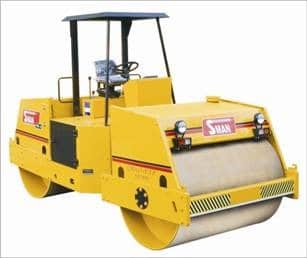
The number of passes required depends on the thickness of the layer. In warm weather rolling on the next day, helps to increase the density if the initial rolling was not adequate. The final rolling or finishing is done by 8 to 10 tonne tandem roller.
Tandem Roller - Road Construction
Fig: Tandem Roller

5. Quality control of bituminous concrete construction

The routine checks are carried out at site to ensure the quality of the resulting pavement mixture and the pavement surface.
Periodical checks are made for
a) Aggregate grading
b) Grade of bitumen
c) Temperature of aggregate
d) Temperature of paving mix during mixing and compaction.
At least one sample for every 100 tonnes of the mix discharged by the hot mix plant is collected and tested for above requirements. Marshall tests are also conducted.
For every 100 sq.m of the compacted surface, one test of the field density is conducted to check whether it is at least 95% of the density obtained in the laboratory. The variation in the thickness allowed is 6mm per 4.5m length of construction.

6. Finished surface

Road Construction - Finishing
The AC surface should be checked by a 3.0 m straight edge. The longitudinal undulations should not exceed 8.0 mm and the number of undulations higher than 6.0 mm should not exceed 10 in a length of 300 m. The cross-traffic profile should not have undulations exceeding 4.0mm.