Thursday, August 30, 2018

What is Vertical Alignment of Highways? Gradients and Vertical Curves


What is Vertical Alignment of Highways? Gradients and Vertical Curves

What is vertical alignment of highways?

The vertical alignment of highway generally defined as the presence of heights and depths in vertical axis with respect to horizontal axis of alignment. These heights and depths in roads may be in the form of gradients (straight lines in a vertical plane) or vertical curves.
vertical alignment of highways
Vertical alignment of highways consists of
  • Gradients
  • Grade compensation
  • Vertical curves (valley curve, summit curve)

Gradients

Gradient is defined as the rise or fall corresponding to some horizontal distance.
Raise with respect to horizontal distance is called Upward gradient (+n %)
Fall with respect to Horizontal distance is called Downward Gradient (-n %)
Gradient is represented as below fig:
vertical alignment of highways

Types of gradients

  • Ruling gradient
  • Limiting gradient
  • Exceptional gradient
  • Minimum gradient

Ruling gradient

This is the maximum gradient which is generally used to design the vertical profile of highway. So it is also called as designer gradient. Ruling gradient depends on the terrain, length of the grade, speed, pulling power of the vehicle and the presence of the horizontal curve. It is adopted by considering a particular speed as the design speed and for a design vehicle with standard dimensions. In flat terrains it is possible to provide flat gradients and in hilly terrains it is very costly and sometimes it is difficult to provide ruling gradient in hilly terrains.

Limiting gradient

This gradient is provided as shorter stretches in highways. Whenever ruling gradients costs high for the hilly terrains then limiting gradient is provided which will reduce the cost. This gradient is adopted frequently in terrains with limited stretches.

Exceptional gradient

These are very steeper gradients given at unavoidable situations and they are adopted for stretches not exceeding 100m of length.

Minimum gradient

To drain of rain water from the road minimum gradient is needed. Generally for lateral drainage Camber is provided. But for the longitudinal drainage along the side drains require some slope for smooth flow of water. For concrete drains minimum gradient of 1 in 500 and open soil drains gradient of 1 in 200 is suitable.

Grade Compensation

When a horizontal circular curve lies in vertical curve there will be an increased resistance offered by the circular curve in the form of curve resistance in addition to the component of gravity.
IRC specifications for grade compensations are as follows.
  • For grades flatter than 4% grade compensation is not required due to negligible loss of tractive force.
  • Grade compensation isvertical alignment of highways
  • Maximum value of gradient compensation =vertical alignment of highways%, R= radius of horizontal curve.

Vertical Curves

Generally two types of vertical curves are there to adopt for the vertical alignment. They are
  • Summit curve
  • Valley curve
Summit curve
Summit curve is a vertical curve adopted mainly when the gradient is upwards. In case of summit curve simple parabola is considered as best curve shape. There are four different cases are involved in adoption of summit curve as follows.
Case-1:
When upward gradient meets a flat gradient.
Summit curve
Case-2:
When upward gradient meets another upward gradient
Summit curve
Case-3:
When upward gradient meets downward gradient
Summit curve
Case-4:
When downward gradient meets another downward gradient
Summit curve
Valley curve
It is a vertical curve provided when the gradient is downwards. Generally when the vehicle meets downward gradient it accelerates more and discomfort arises. So, in the design of valley curve in vertical alignment comfort is considered along with sight distance. Here also four cases are considered but case 2 and case 3 are same as summit curve and the other cases are as follows.
Case-1:
When downward gradient meets flat gradient
Valley curve
Case-2:
When downward gradient meets upward gradient
clip_image019

Air-Entrained Cement – Manufacture, Properties and Advantages


Air-Entrained Cement – Manufacture, Properties and Advantages

Air-entrained portland cement is a special cement which has air bubbles introduced in the cement or concrete that provides the space for expansion of minute droplets of waters in the concrete due to freezing and thawing and protects from cracks and damage of concrete.
In this article we discuss about manufacture, air entraining agents, properties, advantages and disadvantages.

Manufacture of Air-Entrained Cement

The manufacture of this special concrete is same as that of normal ordinary portland cement, after the cement clinkers are formed, in the grinding process the cement clinkers are added with some air entraining materials which makes the cement as air entrained cement.

The ways of incorporating air in concrete:

  1. Using gas forming materials as aluminium powder, zinc powder and hydrogen peroxide.
  2. Using surface active agents that reduces surface tension. They may be natural wood resins and their soaps, animal or vegetable fats or oils, alkali salts of sulfonated or sulphated organic compounds.
  3. Using cement dispersing agents.
  4. Calcium ligno-sulphate and Calcium salts of glues.
Process of expansion of water droplets in concrete.
Fig 1: Process of expansion of water droplets in concrete.

Properties of Air-Entrained Cement

The following are properties of air entrained concrete:

1. Workability

The workability property of this cement is high due to the air bubbles which act as lubricant between aggregates, which reduces water and sand requirement and hence increases strength of the concrete. It else reduce segregation and bleeding of plastic concrete.

2. Strength

Abraham’s law is well know for a civil engineer. Strength and the W/C ratios are inversely proportional to each other. Less the W/C ratio, greater is the strength. With the use of air entrainer , the W/C ratio is kept low and hence the strength parameter of the concrete is not compromised.
But it is difficult to attain high level strength concrete with air-entrained cement.

3. Freezing and Thawing Durability

In the cold environment, due to low temperature the water inside the concrete freezed and expands. Use of this cement provides required space for the water to expand and thus doesn’t let the concrete to rupture. However, entrained air bubbles serve as reservoirs for the expanded water, thereby relieving expansion pressure and preventing concrete damage.

4. Sulphate Resistance 

The resistance ability for sulphate attack is high in the air entrained cement as the W/c ratio can be kept low, which initiates the sulphate attack.

5. Permeability

The permeability of air entrained concrete is greater than that of non air-entrained concrete as the air bubbles break the capillary channels. Therefore, use air-entrained concrete where water tightness is a requirement.

6. De-Icing Resistance

In the sloped structure, the ice is formed on the building. To remove these ice, de-icing chemicals used for snow and ice removal. The use of this chemicals forms a layer of scales in the concrete. Air entrained cement prevents scaling caused by de-icing chemicals and is recommended for all applications where the concrete contacts de-icing chemicals.
Bubbles formation in concrete due to air entained cement.
Fig 2: Bubbles formation in concrete due to air entained cement.

Advantages of Air-Entrained Cement

The advantages of air entrained concrete are,
  1. Workability of concrete increases.
  2. Use of air entraining agent reduces the effect of freezing and thawing.
  3. Bleeding, segregation and laitance in concrete reduces.
  4. Entrained air improves the sulphate resisting capacity of concrete.
  5. Reduces the possibility of shrinkage and crack formation in the concrete surface.

Disadvantages of Air-Entrained Cement

The disadvantages of air entrained concrete,
  1. The strength of concrete decreases.
  2. The use of air entraining agent increases the porosity of concrete thereby reducing the unit weight.
  3. Air-entrainment in concrete must not be done if the site control is not good. This is due to the fact that the air entrained in a concrete varies with the change in sand grading, errors in proportioning and workability of the mix and temperatures.

Hydrophobic Cement – Manufacture, Properties and Uses


Hydrophobic Cement – Manufacture, Properties and Uses

As the name of the cement denotes, hydro means water and phobic means against. Hydrophobic cement is obtained by grinding portland cement clinker with a film-forming substance such as oleic acid in order to reduce the rate of deterioration when the cement is stored under unfavourable conditions. It is also known as Hydrographic cement.
In this article we discuss about the manufacture, properties, uses, advantages, disadvantages and safety precautions of hydrophobic cement.
Water resistant concrete made of Hydrophobic cement.
Fig 1: Water resistant concrete made of Hydrophobic cement.

Manufacture of Hydrophobic Cement

The process of manufacture of this special cement is same as that of portland cement. The clinkers formed in the manufacture of cement are grinded with water repellent film substance such as Oleic Acid or Stearic Acid. These chemicals form a layer on the cement particle and does not allow water to mix and start hydration process in the transportation or storage stage. Anyhow during the mixing process, due to great agitation, this layer of water repellent break and allows the hydration to take place.

Properties of Hydrophobic Cement

Table 1: Properties and their values of Hydrophobic cement.
PropertiesValue
Fineness350 m2/kg
Soundness
Lechatelier (mm)10mm
Autoclave0.8 %
Setting Time
Initial Setting30min
Final Setting600min
Compressive Strength
3days16 MPa
7days22 MPa
28days30 MPa
Water Absorption0.3 – 1 %

Uses of Hydrophobic Cement

  1. Uses in longer storage periods and extremely wet climatic conditions.
  2. Majorly used in the Tunnel construction as the underground repairs are difficult and costly.
  3. These cements are used in construction of dams, spillways, under water constructions.
  4. Used in the structures that are exposed to rain or rain puddling, such as green roofs, other kinds of roofs, parking structures, and plazas.
  5. Used in drainage system works and manholes.
  6. Used in water treatment plants , dams and retaining walls.
  7. It can fix leaky pipes and basements without having to stop the leaking.

Advantages of Hydrophobic Cement

The major advantages of hydrophobic cement are,
  1. Provide durable repairs that will last for long period of times.
  2. Strength is same as that of ordinary cement.
  3. Sets and hardens fast, normally three minutes after being mixed with water.
  4. Setting time is fast, hardens fast, thus it can be painted within one hour of it being applied.

Disadvantages of Hydrophobic Cement

The major disadvantages of hydrophobic cement are,
  1. Does not work on frozen surfaces.
  2. Cannot be used when the temperature is below 40 degrees Fahrenheit.
  3. This cement solves the problem of leaking, but does not solve the problems which are due to condensation.
  4. Needs skilled labour and favourable climatic conditions to use this type of cement.
  5. Cost is high as it is very expensive.

Health and Safety Precautions of Hydrophobic Cement

  1. Avoid breathing the dust.
  2. Avoid any contact with eyes or skin.
  3. Silica inhaling may cause lung problems, although there is no real evidence silica is a carcinogen.
  4. The use of protective clothing: gloves or mask is recommended.

Spray Foam Insulation for Buildings – Properties,Working and Benefits


Spray Foam Insulation for Buildings – Properties,Working and Benefits

Spray foam Insulation is a spray applied plastic that is used for the insulation of the buildings. A spray foam insulation is a combination of two components A and B. Where A is Isocyanate and B is a Polyol resin.
The main two characteristics of the spray foam insulation are that they resist heat transfer effectively and reduce the infiltration of air into the seam, joints, and cracks.
Spray Foam Insulation Applied on the Building Exterior; Image Courtesy: www.whysprayfoam.org
Fig.1: Spray Foam Insulation Applied on the Building Exterior; Image Courtesy: www.whysprayfoam.org
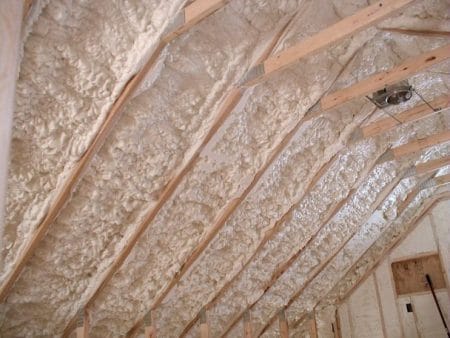
The two materials are heated and collected in a spray gun. The mixture is sprayed out of the spray gun during the application. The mixture reacts to become a foam and when sprayed will cover the floor, wall and the cavity areas.
The physical properties attained by a foam insulation is extraordinary that it is considered as one of the best materials that can be used to insulate home and structures.

History of Spray Foam Insulation

Before 5 decades, the increasing fuel prices was a great concern for the homeowners. They tried to use formaldehyde in order to retrofit and insulate the homes. The formaldehyde was used to fill the holes, cavities and walls with liquid formaldehyde. Once the liquid is injected, they will start to expand and fill the areas.
The use of this material soon made the homeowners to realize the health issues emitted from these. They also found that the protection provided by these materials are incomplete. The formaldehyde couldn’t fill the cavities evenly that it resulted in cold spots. The US government hence banned the use of these materials due to the health concerns it gives rise to.
Now, the product is once again in to market but the material used is Isocyanate an alternative to formaldehydes.

Working of Spray Foam Insulation

The spray foam insulation consists of materials that will change their characteristics when sprayed on the surface to be insulated. The mixture when sprayed will travel from the gun and gets heated before coming out of the gun. This heating will make the mixture to react together and become foam when applied on the surface.
Spray foam Insulation application
Fig.2: Spray foam Insulation application
The expansion of the foam will be happening within fraction of seconds. This property enables the foam insulation to cover up large areas of the commercial building very fastly within minutes. When compared to the insulation of buildings with rolls and sheets, the foam application is a better choice. The areas which are very tough to insulate with the rolls and sheets are easily accessible by the foam insulation like ceilings and attics.
Spray Foam Insulation Expansion
Fig.3: Spray Foam Insulation Expansion
The homes and building that are partially finished can be insulated with foams in their exposed areas and made usable.

Properties of Spray Foam Insulation

The major properties provided by spray foam insulation in buildings are mentioned below:

1.Energy Efficient

The phenomenon of air filtration results in the loss of energy from the building by 40%. Presence of gaps, holes and air leaking can increase the energy bills. The use of spray foam insulation will help to act as an air barrier that will close the gaps. The escape of air from the indoor of the building is prevented.
Figure -4 below shows the picture of a house completely sealed by a spray foam insulation as per the American Chemistry Council,Inc (2011).
Building Air Sealed by Spray foam Insulation
Fig.4: Building Air Sealed by Spray foam Insulation; Image Courtsey : American Chemistry Council (2011)

2. Cool Roofs

Bringing cool roofs helps the house to be energy efficient. This helps to maintain a lower temperature when compared to the traditional roofs. The spray foam roofs do not demand for metal fastening thus avoiding the potential for thermal shots.

3. Strength and Durability

The spray foams help to create a strong bond that makes the roof and other components air tight avoiding the chances of water seepage. This can considerably increase the lifespan and durability of the building structure.
The bond provided by the spray foam insulation increase the resistance of the building against the uplift caused by the winds. High winds causes huge damage to roof without spray foam insulation compared with the insulated ones.
The buildings insulated with spray foam insulation can help the building prevent wetting and drying during floodwater. This hence increases the strength and the resilience of the building.
The spray foam application in the cavities helps the moisture and condensation activities to reduce thus increasing the durability of the wall systems.

Benefits of Spray Foam Insulation

The benefits of spray foam insulation are:
  1. Spray foam insulation is easy to install and fast.
  2. Bring properties equivalent to traditional insulation methods
  3. The application is clean and precise. No mess is left after the application of spray foam.
  4. Installation of foams are performed fastly by the technicians
  5. The spray foam insulation provides a tight energy seal with the roof or wall surface
  6. This insulation protects the home from humidity, pest, and rodents
  7. Air quality is improved reducing the indoor air pollutant level
  8. Roofs are made more durable by this insulation as water seepage is resisted.
  9. The new foam material does not contain any ozone depleting materials.
  10. The heating and cooling costs of the building can be reduced