Tuesday, June 26, 2018

Methods for Repair of Small and Large Cracks in Concrete


Repair of small, medium and large cracks in concrete and repair of crushed concrete is required to enhance the strength and durability of damaged concrete members.

Repair of small and medium cracks in concrete

Small and medium cracks in reinforced concrete and masonry structures reduce their strength considerably to bear the design loads. Thus repair of such cracks is necessary to restore the designed strength of members.
The repair of small and medium cracks is done by first marking out the critical damaged zones in concrete members. Then these cracks can be repaired by injecting cement grout or chemical grouts or by providing jacketing.
The smaller cracks less than 0.75 mm width can be effectively repair by using pressure injection of epoxy.
The surface of the member near cracks is thoroughly cleaned. Loose materials are removed and plastic injection ports are placed along the length of crack at an interval equal to the thickness of the structural member. These ports are placed on both sides of the member and secured in placed with the help of epoxy seal.
When the epoxy seal has hardened, the low viscosity resin is injected into one port at a time starting from the port at lowest level and moving upwards.
The injection through port is continued till the resin flows out from the adjacent port or from the other side of the member. Then the current injection port is closed and epoxy injection is continued from the adjacent port.
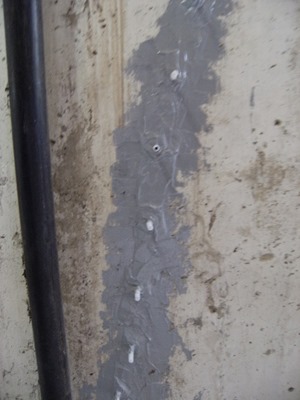
Injection grouting for concrete crack repair
This process is carried out in sequence till all the ports and cracks are filled with the grout. This method can be used for all types of structural members such are beams, columns, walls and slabs.
This method can also to repair of small cracks in individual masonry blocks or for filling large continuous cracks.

Repair of Large Cracks and Crushed Concrete:

Repair of large cracks (cracks wider than 5mm) and crushed concrete and masonry structure cannot be done using pressure injection or grouting.
For repair of large cracks and crushed concrete, following procedure can be adopted:
1. The surface of cracks or crushed concrete is cleaned and all the loose materials are removed. These are then filled with quick setting cement mortar grouts.
2. If the cracks are large, then these cracks are dressed to have a V groove at both sides of the member for easy placement of grouts.
Repair of large cracks in concrete and masonry walls
Fig: Filling of cement mortar and stone chips in large cracks in masonry walls.
3. For cracks which are very large, filler materials such as stone chips can be used.
4. Additional reinforcement and shear reinforcements can be used for heavily damaged concrete members or wherever necessary based on requirements.
These additional reinforcement should be protected from corrosion by using polymer mortar or epoxy coatings.
5. For damaged walls and roofs, additional reinforcement in the form of mesh is used on one side or both sides of the members. These mesh should sufficiently tied with existing members.
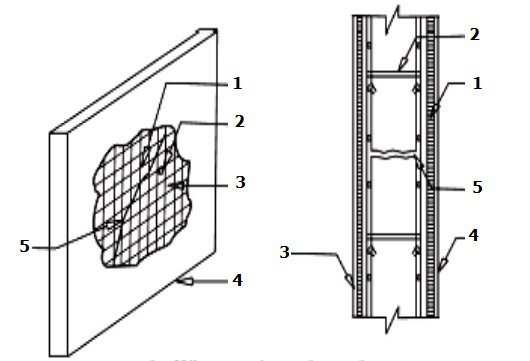
Reinforcement meshes in repair of roof slabs and walls
Fig: Reinforcement meshes in repair of roof slabs and walls. 1. Wire mesh on front face, 2. Clamps, 3. Wire mesh on back face, 4. Cement plaster, 5. Crack in member.
6. Stitching of cracks are done to prevent the widening of the existing cracks. In this case, holes of 6 to 10mm are drilled on both sides of the crack. Then these drilled holes are cleaned, legs of stitching dogs are anchored with short legs.
The stitching of cracks is not a method of crack repair or to gain the lost strength, this method is used to prevent the cracks from propagating and widening.

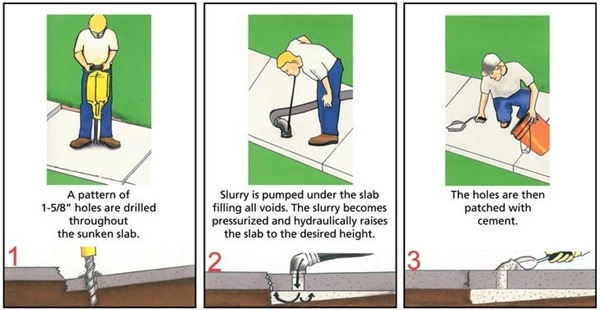
Grouting Procedure for Repair of Cracks in Concrete Structures


Grouting is a method of filling up and repair of cracks in concrete. Step by step grouting procedure needs to be followed for effective repair of concrete cracks.

Grouting Procedure for Repair of Cracks in Concrete Structures:

Procedure of grouting for repair of concrete cracks in structures are:
1. Holes  are  drilled  in  structure  along  cracks  and  in  an  around  hollow spots.
2.If  there  are  several  cracks,  holes  can  be  drilled  in  a staggered  manner  at  500  to  750mm  spacing  in  both  directions covering  adequately  the  area  proposed  to  be  grouted.  Holes spacing  can  be  altered  as  per  site  conditions.
3. G.I.  pieces  (12  to  20mm  dia  x  200mm)  with  one  end  threaded  or PVC nozzles are fixed in the holes with rich cement mortar.
4. All  the  cracks  and  annular  space  around  G.I.  pipes  are  sealed  with rich  cement  mortar.
5. All  the  cracks  are  cut  open  to  a  ‘V’  shaped groove, cleaned & sealed with rich cement mortar.
6. All  the  grout  holes  should  be  sluiced  with  water  using  the  same equipment  a  day  before  grouting  as  per  following  sequence;  so  as to saturate the masonry.
All holes are first plugged with proper wooden plugs or locked in the case  of  PVC  nozzles.  The  bottom  most  plug  and  the  two  adjacent plugs  are  removed  and  water  injected  in  the  bottom  most  hole under  pressure.
When  the  clear  water  comes  out  through  the adjacent holes the injection of water is stopped and the plugs in the bottom  most  hole  and  the  one  immediately  above  are  restored.
The  process of grouting of concrete cracks is  repeated  with  other  holes  till  all  the  holes  are covered. On  the  day  of  grouting  all  the  plugs  are  removed  to  drain out excess water and restored before commencing grouting.
The same sequence as described above is adopted for injecting the cement  grout  also.  The  grout  is  kept  fully  stirred/  agitated  under pressure  throughout  the  grouting.
The  grouting  is  carried  out  till refusal  and/  or  till  grout  starts  flowing  from  the  adjacent  hole.  A proper record of the quantity of grout injected into every hole should be maintained.
After grouting, curing should be done for14 days. Tell tales are provided for checking the effectiveness of grouting.
Only such quantities of material for preparing grout should be used, as can be used within 15 minutes of its mixing. Grouting equipment must be cleaned thoroughly after use.
Grouting Procedure for Repair of Cracks in Concrete
Fig: Grouting Procedure for Concrete Cracks Repair

Precautions during Grouting of Cracks in Concrete :

  • During  the  grouting  operation  in  track  or  close  to  it,  speed restrictions  of stop-dead  and  proceed  at  10  kmph  shall  be  imposed at the site of work and same should be continued for a period of 24 hours.
  • The restriction  may  then  be  relaxed  to  non-stop  30  kmph  to be  continued  for  a  period  of  another  2-3  days.  However,  speed restrictions indicated above are only guidelines and appropriate  speed restriction at each individual site should be considered.
  • Immediately  after  grouting  work,  all  the  grouting  equipment including  the  slurry  and  mixing  drums,  pipes,  nozzles,  etc.  should be  thoroughly  washed  so  that  set  cement  does  not  damage  the equipment.
  • After  the  work  has  been  completed,  it  should  be  inspected thoroughly  and  should  be  kept  under observation  for  a  period  of  6  months  to  12  months  for  its  behaviour after  grouting.
  • In  case  arch  masonry  of  bridges  is  grouted  to strengthen  the  structure,  some  load  tests  may  be  carried  out  in selected  cases  to  satisfy  that  grouting  has  helped  to  reduce  the deflection  of  crown  and  spread  at  the  springing  to  within permissible limits.

Repair of Dormant Cracks in Concrete


Repair of dormant cracks in concrete can be done by 4 methods such as sealing, routing and sealing, bond breaking and epoxy injection methods of crack repair.
Dormant cracks are those cracks in concrete which once occurred does not propagate or extend anymore and becomes dormant.

Repair of Dormant Cracks in Concrete

Following are the Methods of Repair for Dormant Cracks in Concrete:

Sealing of Cracks

Sealing of cracks as standalone repair should be used in conditions where structural repair is not necessary. Isolated cracks whether extending through the concrete section or partially into it, should be sealed at the concrete surfaces.
For this a slot of approx. 25mm wide should be saw cut upto 10mm deep along the crack keeping crack at the center of the slot.
The concrete should be chiseled out from between the two saw cut edges and concrete should be further undercut beyond the 10mm depth up to say 20mm depth so that the base width is slightly greater than the surface width.
After the slot is thoroughly cleaned, soaked with water for 10 hrs. and surface dried, a bond coat/ primer coat, of an approximate latex bonding compound should be applied.
Once the primer becomes tacky, high strength polymer modified cementitious mortar should be filled in the slot, properly tamped and surface finished.
Curing compound should be applied as soon as surface becomes touch dry. 7 days wet curing should be done by covering with wet Hessian and polythene sheet.

Routing and Sealing of Cracks

Alternatively, a V-groove should be prepared along the crack at the surface ranging in depth from 6 to 25mm and minimum opening at surface of 6mm (Fig. 1)
 Repair of crack by routing and sealing
Fig: Repair of crack by routing and sealing
A concrete saw, hand tools or pneumatic tools may be used. The groove is then cleaned by air blasting, sand blasting or water blasting and dried. A sealant is placed into the dry groove and allowed to cure.
The sealant may be any of several materials, including epoxies, urethanes, silicones, Polysulphide, asphaltic materials or polymer mortars.
A bond breaker may be provided at the bottom of the groove to allow the sealant to change shape, without a concentration of stress on the bottom. The bond breaker maybe polyethylene strip or tape which will not bond to the sealant.

Bond Breaking Method

In some cases, over bonding (strip coating) is used independently of or in conjunction with sealing. For this an area approx. 25 to 75mm on each side of the crack is sand blasted or cleaned by other means, and a coating (such as urethane) 1 to 2mm thick in a band is applied over the crack.
A bond breaker may be used over the crack or over a crack previously sealed (Fig. 2). Cracks subject to minimal movement may be over banded, but if significant movement can take place, sealing must be used in conjunction with over banding to ensure a waterproof repair.
Effect of bond breaker
Fig: Effect of bond breaker

Epoxy Injection Method

Cracks as narrow as 0.3mm can be bonded by the injection of epoxy successfully in buildings, bridges and other concrete structures. However, unless the cause of the cracking has been corrected, it will probably recur near the original crack.
If the cause of the crack cannot be removed and it is not causing reduction in strength of the structure, then either the crack could be sealed with flexible sealant thus treating it as a joint or establish a joint that will accommodate the movement and then the crack should be grouted with epoxy.
With the exception of certain moisture tolerant epoxies, this technique is not applicable if the cracks are actively leaking and cannot be dried out. Epoxy injection requires a high degree of skill for satisfactory execution, and the ambient temperature may limit application of the technique.

Plastic Shrinkage Cracks in Concrete and Its Prevention


Plastic Shrinkage Cracks in Concrete and Its Prevention

Cracking caused by plastic shrinkage in concrete occurs most commonly on the exposed surfaces of freshly placed floors and slabs or other elements with large surface areas when they are subjected to a very rapid loss of moisture caused by low humidity and wind or high temperature or both.
plastic shrinkage cracks in concrete
Plastic shrinkage usually occurs prior to final finishing, before curing starts. When moisture evaporates from the surface of freshly placed concrete faster than it is placed by curing water, the surface concrete shrinks.
Due to the restraint provided by the concrete on the drying surface layer, tensile stresses develop in the weak, stiffening plastic concrete, resulting in shallow cracks that are usually not short and run in all directions.
In most cases, these cracks are wide at the surface. They range from a few millimeters to many meters in length and are spaced from a few centimeters to as much as 3 m apart.

Preventing Plastic Shrinkage Cracks in Concrete

Plastic shrinkage cracks may extend the full depth of elevated structural slabs. Since cracking because of plastic shrinkage is due to a differential volume change in the plastic concrete, successful control measures require a reduction in the relative volume change between the surface and other portions of the concrete.
There are many methods and techniques to prevent this type of crack in case of rapid loss of moisture due to hot weather and dry winds.
These methods include the use of fog nozzles to saturate the air above the surface and using plastic sheeting to cover the surface between the final finishing operations.
In many cases, during construction it is preferable to use wind breakers to reduce the wind velocity; sunshades to reduce the surface temperature are also helpful.
Additionally, it is good practice to schedule flat work after the walls have been erected.

Types of Cracks in Concrete due to Moisture Change


Types of cracks in concrete due to moisture change is initial shrinkage cracks, plastic shrinkage, plastic settlement and initial expansion of concrete. These types of cracks occurs due to moisture change in concrete which are discussed in detail.
Building materials such as concrete, mortar, bricks, wood etc are porous in nature and expand by absorbing moisture from atmosphere and shrink on drying. These changes in building materials are cyclic in nature and are caused during moisture changes.
But building materials undergo irreversible changes due to change in moisture content during its initial conditions. These initial changes cause shrinkage or expansion of materials.
For example, irreversible  movement  in  materials  are shrinkage  of  cement  and  lime based  materials  on  initial  drying  i.e.  initial shrinkage/plastic shrinkage  and expansion of burnt clay bricks and other clay products on removal from kilns i.e. initial expansion.

Types of Cracks in Concrete due to Moisture Change

Initial Shrinkage in Concrete and Masonry

Initial  shrinkage of building materials which is partly  irreversible, occurs in all building materials that are cement / lime based such as  concrete, mortar, masonry units,  masonry and  plaster  etc. This initial shrinkage is one of the main causes of cracking in building structure.
Initial shrinkage as the name suggests occurs only once in the lifetime of concrete and mortar, i.e. during the time of construction when the moisture dries out during setting process. Initial shrinkage is most significant cause for the cracks in structures.
The effect of initial shrinkage in concrete and mortar depends on following factors:
Cement content – Shrinkage of concrete and mortar increases with richness of mix.
Water content – Increase in water quantity used in the mix increases the shrinkage.
Maximum size, grading and quality of aggregate –With increase in the maximum size of aggregate with good grading, the water-cement ratio decreases for the same workability requirement of concrete. The use of less water reduces the initial shrinkage of concrete due to reduction in porosity.
For example, the shrinkage of cement sand mortar is 2 – 3 times that of cement concrete using 20mm maximum size of aggregate and 3 – 4 times that of cement concrete using 40mm maximum size of aggregate.
Curing of concrete and masonry – Proper curing from the start of initial setting to at least 7 to 10 days helps in reducing initial shrinkages. The moisture provided through curing helps concrete and masonry to expand and thus, when they dry up, the final shrinkage is less.
Surface area of aggregates -Surface area of concrete increases with increase in fine aggregates and this requires large water quantity for the required workability. With increase in water quantity, the shrinkage of concrete and masonry increases when they dry up.
Chemical composition of cement – Shrinkage is less for the cement having greater proportion of tricalcium silicate and lower proportion of alkalis i.e. rapid hardening cement has greater shrinkage than ordinary portland cement.
Temperature of  fresh  concrete  and  relative  humidity  of  surroundings  – With  reduction  in  the  ambient  temperature  the  requirement  of  water  for  the same  slump/workability  is  reduced  with  subsequent  reduction  in
Concreting  done  in  mild  winter  have  much  less  cracking  tendency  than  the concreting done in hot summer months.
In cement concrete 1/3rd of the shrinkage take place in the first 10 days, ½ within one month and remaining ½ within a year time. Therefore, shrinkage cracks in concrete continues to occur and widens up to a year period.

Plastic shrinkage of concrete

Cracks appearing on the surface of concrete before setting of concrete is due to plastic shrinkage of concrete. The cause of shrinkage cracks in concrete is due to settlement of heavy aggregates at the bottom of concrete and rise of water to the surface. This process continues till the concrete has set and it is called as bleeding of concrete.
As long as  the  rate  of  evaporation  is  lower  than  the  rate  of  bleeding,  there  is  a continuous  layer  of  water  at  the  surface  known  as  “water  sheen”,  and shrinkage  does  not  occur.  When  the concrete  surface  looses  water  faster than  the  bleeding  action  bring  it  to  the  top,  shrinkage  of  top  layer  takes place, and since the concrete in plastic state can’t resist any tension, cracks develops on the surface. These cracks are common in slabs.
Plastic Shrinkage Cracks in Concrete
The extent of plastic shrinkage in concrete depends on:
  • Temperature of concrete,
  • Exposure to the heat from sun radiation,
  • Relative humidity of ambient air and velocity of wind.

Plastic settlement cracks

Plastic settlement cracks occurs on concrete surface due to settlement of large aggregates. In the case of reinforced concrete, sometimes the settlement of aggregates is obstructed by reinforcement. These obstructions break the back of concrete above them forming the voids under their belly.
Plastic Settlement Cracks in Concrete
Plastic settlement cracks are normally observed:
  • Over form work tie bolts, or over reinforcement near the top of section.
  • In narrow  column  and  walls  due  to  obstruction  to  sedimentation  by resulting arching action of concrete due to narrow passage.
  • At change of depth of section.

Initial expansion of concrete:

When the clay bricks are fired during manufacturing, due to high temperature not  only  the  intermolecular  water  but  also  water  that  forms  a  part  of molecular structure of clay is driven out. After burning, as the temperature of the bricks falls down, the moisture hungry bricks starts absorbing moisture from  the  environment  and  undergoes  gradual  expansion,  bulk  of  this expansion is irreversible.
For the practical purpose it is considered that this initial expansion ceases after first three months.
Use  of  such  bricks  before  cessation  of  initial  expansion  in  brickwork,  will cause irreversible expansion and may lead to cracking in masonry.