Wednesday, October 31, 2018

Concrete Forms – Types and Selection of Concrete Forms


Concrete forms can be defined as a solid barrier that helps to hold the fluid concrete in place until it hardens and acquire a particular shape. The concrete takes the shape of the form or the mold in which it is contained. Now new concrete form systems are developed that provides additional properties like insulation, surface patterns and effects to the concrete cast.
Here, the types and the criteria for the selection of formwork are explained.
Table of Contents

Types of Concrete Forms

The different types of concrete forms used in concrete casting are:
  1. Wooden Forms
  2. Insulated Concrete Forms
  3. Foam Concrete Forms
  4. Concrete Wall forms
  5. Steel Forms

1. Wooden Forms

Wooden form is the basic and the most conventional type of concrete form. It is employed mainly for concrete casting that does not exceed 6 inches of height.
The wooden form types consist of wooden boards. These are either nailed or screwed together to the desired mold or formwork shape. Special leveling devices are used to properly level or slope the form based on the requirement.
Fig.1.Wooden Concrete Forms; Image Courtesy: http://gatesconcreteforms.com
In order to cast concrete with curves or any sort of free-form designs, thinner cross-sections are employed to make the form. Before pouring concrete, the inner surfaces are applied with low-grade oil or any form releasing agent so that concrete does not stick to the surfaces.
If properly cleaned and maintained, these forms are suitable for multiple uses.

2. Insulated Concrete Forms

The insulated concrete forms (ICF) compromises of hollow blocks made of insulating material that is fit together like building blocks as shown in figure-2.
These systems are constructed on the foundation slab. This forms a part of the foundation and the wall systems. Reinforcement is placed within these blocks and filled with concrete of required slump and cast.

Fig.2.Insulated Concrete Forms (ICF)
The form and concrete are placed like a sandwich. This system provides high energy efficiency. Removal of forms is not necessary by implementing ICFs. Once the concrete is filled it need not be removed.

3. Foam Concrete Forms

These type of forms follows non-traditional methods. Here, the concrete is poured upside down, so that a concrete of desired finish is obtained. These forms are either made from melamine, acrylic glass or laminated board. These forms create negative spaces that bring an artistic look to the final concrete cast.

4. Concrete Wall Forms

These are pre-manufactured forming systems used to cast large area walls, foundations and piers. These systems are either made with engineering wood with a steel framing. This is also made completely with steel.
These individual elements are attached together by pins or latches as shown in figure-3. Ties are used in these formworks to hold the reinforcement in place when the concrete is poured.
Fig.3.Concrete Wall Forms; Image Courtesy: igknighttec.com
Concrete wall form sections come in different, sizes and shapes. There are also manufacturers who provide custom size wall forms based on the requirement of the project.

 5.Steel Concrete Forms

These are concrete forms made of steel. If properly maintained and used, the consistency of steel forms can be obtained even for 2000 work cycles. This hence, compared with wooden concrete forms is a better long-term solution in construction.
Fig.4.Steel Concrete Forms; Image Courtesy: www.whartonhardware.com
The steel forms do not absorb moisture from the concrete placed hence reducing errors observed after removing the concrete forms.

Selection of Concrete Forms

When coming to the decision of choosing concrete forms, it is dependent on “where” and “how “the system is used. The concrete form selected for a project is dependent on the:
  1. Pour Size
  2. Pressure on the Form
  3. Weight on the form
  4. Type of Compaction
  5. Amount of concrete to be retained
In detail, there are few key elements that are considered while selecting concrete forms, which are explained below:
  1. The concrete forms selected can be either owned or rented. The cost of owning and its long-term use must be analyzed before buying it. If it is better to rent the form, then form type which is easily available and economical is chosen.
  2. The experience with a particular type of form affects the choice of form. No production loss is expected if a form system is chosen that is more familiar to the workers. Without proper training of a new form system, loss is expected.
  3. In terms of aesthetics, steel forms provide a clean finish with fewer bug holes on the casted concrete surface compared with wooden forms.
  4. In providing tolerances steel forms are a better choice compared with other types. Steel forms have intrinsic stiffness and do not absorb moisture.
  5. For low height structures, wood forms are the best choice. For tall forms of 20ft height steel forms with extra bracing and supports are the best choice compared to wooden forms.
  • For casting concrete with straight, curve or several offsets, and abrupt turns, steel form are an efficient choice. Thin wooden forms can be used if cost is an issue.

Tuesday, October 30, 2018

What is Rebaring Technique in Reinforced Concrete Construction?

Rebaring technique in reinforced concrete construction is a method for proper fabrication and placement of reinforcement bars as per the design and drawings for RCC works.
We know that, concrete is very strong in compression and weak in tension. The reinforcement bars or rebars are good in tension, that are incorporated with concrete to make use of its tension property.
Estimation of reinforcement bars for a reinforced concrete work is done by the engineer in charge. The engineer provides us with the specific details of the number of reinforcement bars, the shape and size of each bars for each work.
There are different types of loads that including tension, compression, lateral, horizontal and torsion that are forms of pressure, against which the concrete has to show its strength.
The strength gained by the R.C.C structure is dependent on the method, as well as the techniques that are employed to install the reinforcement bar. The reinforcement bars are mainly patterned over its surface to facilitate proper bonding with the concrete.

Table of Contents

Necessity of Rebaring Technique in Reinforced Concrete Construction

The steel reinforcement mostly is divided into two categories i.e.
  • Primary Reinforcement or Main Steel reinforcement
  • Secondary reinforcement or distribution reinforcement
Main steel reinforcement bars are employed in R.C.C structures to ensure resistance against the whole design loads coming over it. The secondary reinforcement bars are mainly employed due to durability as well as for aesthetic reasons.
This reinforcement guarantee resistance for localized areas, like limited cracking. These also offer resistance against the stresses that are created due to temperature variations.
The main bars employed of specified diameter are bent at the ends. The stirrups are reinforcements that are provided laterally, to keep the main bars of the structural elements like beams and columns, in position.
The stirrups may be circular, square, rectangular, helical or diamond shape based on the cross-section of the structural element. The reinforcement bars in the corners may be L – shaped.
The caging for the structural element under consideration must be properly tied, so that during concreting no bar is disturbed from its position. This is a check to be always kept in mind during concreting, else it is a threat to the durability of the structural member.
The rebars are mainly provided at the junctions where the formwork of the structural element is closed as well as at the point where a new structural element needs to be bond with the former one.

Operations in Rebaring for Reinforced Concrete Works

The three main operations carried out in rebaring for reinforced concrete construction bars are cutting, bending and tying. The diameter of reinforcement bars used reinforced concrete work mainly ranges from 6 to 42mm. These reinforcement bars come from the steel mill in specified lengths.
So, during installation, the reinforcement bars must be cut into required size. The design engineer shows the details about the bars bending and related works, based on which the workers proceed the work. The rigid connection is made between all the members of the rebars with the help of steel wires.

Equipments used for Rebaring Techniques

The equipment that is used for rebaring operations is developed with time, as the size of bars is increasing. Larger size bars are difficult to be handled by hand operation.
The usage of chisel and hammer was an earlier practice used for bar bending. The bar is held fixed with the help of three thick bars over a bar bender bench. Then the bending is done by means of manual force, operated with the help of levers. To tie the rods, cutting pliers were used, and tied by steel wires.
The enormous demand for work and bars with large diameters have made to depend on machines for bar bending. This improved method helps in reduction of time consumed by an ordinary method.
Different Types of Rebaring Equipments are:
The different equipment that is used for rebaring based on cutting, bending and tying operation are explained below.

Equipment used for Cutting of Reinforcement Bars

1. Electric Rebar Cutters

Electrical cutters that can cut diameters up to 16mm are employed. These consume power to cut the bars. Higher varieties are available in the market.

2. Heavy Duty Rebar Cutter

These are a higher version of the same, the heavy-duty cutters, that have the capability to cut the bars up to 42mm. At a time, these cutters can cut three to six bars at a time. These cutters make use of oil bath lubrication, that makes the operation noiseless. The system is simple and hence easy to use.

3. Wire Rope Cutter

The cutting blade of wire rope cutters is made of steel with a titanium coating. They have a high-speed cutting. These cutters are employed to cut the bars up to a diameter of 20mm. They cut a single bar within 8 seconds, so fast and so clean cut.

4. Rebar Cutting Shear

Rebar cutting shear is a cutter used to cut the stirrups at the equal size in a huge amount. These can also be used for cutting the pipe section, angle or channel sections.

Equipment Used for Bending of Reinforcement Bars

1. Electric Automatic Rebar Benders

This machine helps to bend the bars either on site or at the workshops, based on the convenience. The machine is noiseless. It operates only during the bending procedure.

2. Spiral Hoop Radial Benders

This machine is used to get radius in the bars that are of higher diameter. It has rotating rollers, of which one is adjustable to hold the bars.

Equipment used for Tying of Rebars

As in rebar cutting machines, the rebar tying machines too are available, both manmade and automatic.

1. Manual Rebar Tying Machine

Manual rebars have a net weight of 680 to 700 grams, which can be used to tie a combination of bar size. Their size is mostly in the range of 300mm x 25mm. These are cheap and can be used for any working or weather conditions.

2. Automatic Rebar Tying Machine

There are automatic rebar tying machines that can help tying bars up to a range of 32mm. It requires 16 seconds for each tie. These rebaring machines can facilitate completion of a large volume of work within limited time. This method does not compromise on the quality as well as efficiency.
There are many agencies, that supply the bar bending, cutting and tying operation, based on the set of specifications provided to them. These suppliers also advise whether the concrete formwork must fully or completely erected before they are ready to supply the tied-up bars as per specification.

Safety During Rebaring

To prevent injury, the bars that are extended intentionally for later work must be covered with any plastic caps or “plate caps”. There are certain caps called mushroom caps, that too can be provided so that scratches or injuries can be avoided.

Preparation of Bar Bending Schedule and Its Advantages

Preparation of Bar Bending Schedule

Bar bending schedule (or schedule of bars) is a list of reinforcement bars for a given reinforced concrete work item, and is presented in a tabular form for easy visual reference.
Table of bar bending schedule summarizes all the needed particulars of bars – diameter, shape of bending, length of each bent and straight portions, angles of bending, total length of each bar, and number of each type of bar. This information is a great help in preparing an estimate of quantities.

Calculation of Reinforcement Shape, Cutting and Bending Lengths

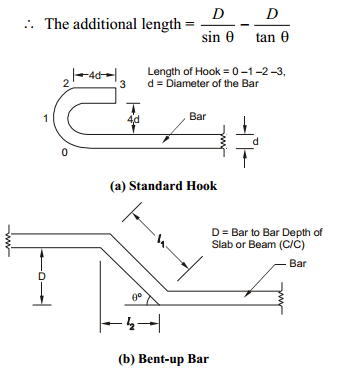
Figure 1 depicts the shape and proportions ofhooks and bends in the reinforcement bars – these are standard proportions that are adhered to:
(a) Length of one hook = (4d ) + [(4d+ d )] – where, (4d+ d ) refers to the curved portion = 9d.
(b) The additional length (la) that is introduced in the simple, straight end-to-end length of a reinforcement bar due to being bent up at  say 30o to 60o, but it is generally 45o) = l1 – l2 = la
Where,
Hooks and bends in reinforcement
Fig: Hooks and bends in Reinforcement
Giving different values to clip_image005respectively), we get different values of la, as tabulated below:
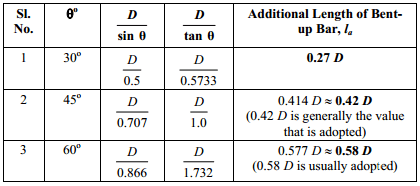
length of bent up bars
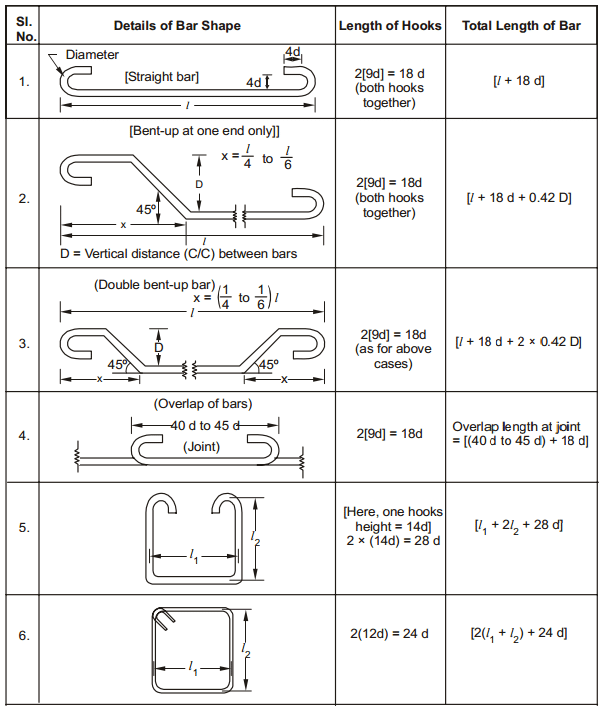
Figure 2 presents the procedure to arrive at the length of hooks and the total length of a given steel reinforcement.
Typical Bar Bending Schedule
Fig: Typical Bar Bending Schedule

Advantages of Bar Bending Schedule

Bar bending schedule provides details of reinforcement cutting and bending length. Advantages of bar bending schedule is when used along with reinforcement detailed drawing improves the quality of construction, cost and time saving for concrete construction works.
Advantages of bar bending schedule in concrete construction are:
1. When Bar bending schedule is available, cutting and bending of reinforcement can be done at factory and transported to site. This increases faster execution at site and reduces construction time and cost due to less requirement of workers for bar bending. Bar bending also avoids the wastage of steel reinforcement (5 to 10%) and thus saves project cost.
2. Using bar bending schedule for when used for Fe500, it saves 10% more steel reinforcement compared to fe415.
3. It improves the quality control at site as reinforcement is provided as per bar bending schedule which is prepared using the provisions of respective detailing standard codes.
4. It provides the better estimation of reinforcement steel requirement for each and every structural member which can be used to compute overall reinforcement requirement for entire project.
5. It provides better stock management for reinforcement. Steel requirement for next phase of construction can be estimated with accuracy and procurement can be done. This prevents stocking of extra steel reinforcement at site for longer time, preventing corrosion of reinforcement in case of coastal areas. It also prevents shortage of reinforcement for ongoing work by accurate estimation and thus concrete construction works can proceed smoothly.
6. Bar bending schedule is very much useful during auditing of reinforcement and provides checks on theft and pilferage.
7. Bar bending schedule can be used for reinforcement cutting, bending and making skeleton of structural member before it can be placed at the required position. Other activities such as excavation, PCC etc can proceed parallel with this activity. So, overall project activity management becomes easy and reduces time of construction. It becomes helpful in preventing any damages due to construction time overrun.
8. It provides benchmarks for quantity and quality requirements for reinforcement and concrete works.
9. Bar bending schedule provides the steel quantity requirement much accurately and thus provides an option to optimize the design in case of cost overrun.
10. It becomes easy for site engineers to verify and approve the bar bending and cutting length during inspection before placement of concrete with the use of bar bending schedule and helps in better quality control.
11. It enables easy and fast preparation of bills of construction works for clients and contractors.
12. The quantity of reinforcement to be used is calculated using engineering formulas and standard codes, so there is no option for approximate estimation of steel reinforcement.
13. With the use of bar bending schedule, mechanization of cutting and bending of reinforcement can be done, again reducing the cost and time of project and dependency on skilled labor requirement. It also improves the reliability on accuracy of bar cutting and bending.
14. When mechanized bar cutting and bending is used, the cost of reinforced concrete work per unit reduces and helps in cost optimization of construction project.

Typical Construction Joints Details and Location for Beams and Columns


Construction joints in RCC beams and columns are required when the concreting has to be stopped for the day or more than 30 minutes. In such case, typical construction joints shall be provided so that bond is maintained between set concrete and fresh concrete.
Below are some images showing correct method of construction joints to be provided in columns, beams and beam-column junction. To know about what is construction joint.

1. Construction Joints in Column

Following figure shows correct method of providing construction joint in column. Construction joint in column shall not be provided with smooth surface or inclined surface. The top surface of the column should be rough with parts of coarse aggregates being seen.
Fig: Typical Construction Joint in RCC Column

2. Construction Joints in Beams and Beam-Column Joint:

Following figure shows the typical construction joint to be provided in beams and beam column joints.
Fig: Typical Construction Joint in Beams and Beam-Column Joint
The arrow symbol shows the direction of concreting, tick mark shows the correct method of providing construction joint while cross-mark shows the wrong method.
From the figure it can be seen that construction joint in the beams should be provided at 1/4 the span of beam from the face of the column and should not be provided on the column.
For a beam column joint, the construction joint for the column should be provided after construction of some length of column above beam level, and for the beam, it should be provided at a span of 1/4th from the face of the column.