Monday, October 29, 2018

What is Affordable Concrete House Construction?

Affordable concrete house construction is needed at current times more than ever before due population growth, depletion of energy source, and other factors. The population growth leads to increase demand for houses which consequently the use of operational energy and embodied energy increases.
Affordable concrete house construction has become the attention of several builders. This attention is largely focusing on sustainability, reasonable price, green building, disaster resistance, energy conservation, and safety. This is because judging concrete house affordability by the selling price is starting to change as more attention is on the operation costs over time.
Several construction techniques have been investigated so as to construct affordable concrete house. For example, precast concrete construction method which is used in Kenya and India to build affordable concrete houses, and insulated concrete forms house have been developed to construction low cost and sustainable houses.

Factors Influence Concrete House Construction Affordability

1. Natural Disaster

Codes and standards set minimum requirements for concrete houses built in areas prone to natural disaster like hurricane, wind, and fire.
The goal is to reduce the risk from all types of natural disasters and making homes safer. It also increases their affordability because they do not have to be replaced due to the effects of natural disasters.
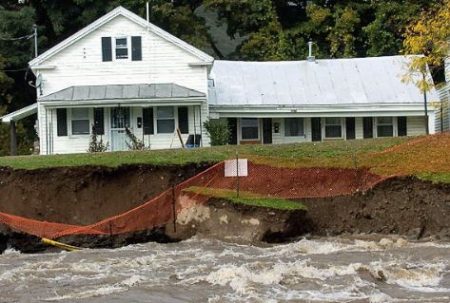
Safety of a house endangered by flood
Fig. 1: Safety of a house endangered by flood

2. Cost of Energy for Running the House

At the time of depletion of energy resources, the energy to heat and cool homes is becoming increasingly costlier and directly affecting the cost of ownership over time.
Owners and renters want to live in more energy-efficient and cost-efficient housing. So, it is required to build concrete houses that require less energy during its life span in order to improve the affordability of concrete houses.
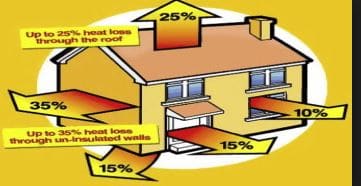
Operational Energy Dissipation in a House
Fig. 3: Operational Energy Dissipation in a House

3. Cost of Concrete House Construction

Obviously, low cost of concrete house construction is one of the major factors that controls the affordability of concrete house. Consequently, ordinary residents can own a house. That is why construction companies and builders are continuously looking for new construction technique that require low cost.
In summery, the cost of concrete house construction shall be kept low in order to construct affordable concrete houses.

Concrete House Construction Methods

It is clear that the increase of population lead to increase house demand. Consequently, the use of materials and both operational and embodied energy would increase.
The energy used for manufacturing and transportation of building materials, and construction on site is called embodied energy which constitute around 10 to 20% of the total energy of the house over 50 years.
Therefore, efficient construction method is one of the approaches through which affordable houses can be constructed. In this regard, two different construction methods are discussed namely insulated form concrete construction and precast concrete construction method.

1. Insulated Form Concrete Construction Method

Insulated concrete form houses is assumed to be one of the best construction approaches that can play significant role in the construction of affordable houses. Insulated concrete forms are rigid foam forms that hold concrete in place during curing and remain in place to serve as thermal insulation for concrete walls.
The insulate form concrete house construction is slightly expensive compare with standard wood frame construction but this is offset by crucial savings in other ways.
The foam blocks are lightweight and result in durable, energy-efficient construction. The insulated form concrete houses are affordable, storm resilient, construct quickly, and energy efficient.

2. Precast Concrete Construction Method

Generally, precast concrete results in better controlled quality, require low maintenance, long service life, and flexibility in design. More importantly, it requires less quantity of steel, cement, water, and labor in comparison with cast in situ concrete.
Precast concrete elements demonstrate significant performance in hot environment. It insulates sound waves and eats heat then gradually release it back into air. Therefore, it can be concluded that precast concrete construction saves concrete and energy.

Sunday, October 28, 2018

Initial Setting Time of Cement as per IS 4031, IS 269


Initial setting time of concrete is the time period between addition of water to cement till the time at 1 mm square section needle fails to penetrate the cement paste, placed in the Vicat’s mould 5mm to 7mm from the bottom of the mould. This test is required to understand the time cement takes for initial setting between mixing and transporting and placing of concrete.

Procedure to Find Setting Time of Cement

Apparatus Required

  • Vicat’s apparatus
  • Balance
  • Measuring cylinder
  • Stop watch
  • Glass plate
  • Enamel tray
  • Trowel

Test Procedure

  1. Consistency test to be done before starting the test procedure to find out the water required to give the paste normal consistency (P).
  2. Take 400 g of cement and prepare a neat cement paste with 0.85P of water by weight of cement.
  3. Gauge time is kept between 3 to 5 minutes. Start the stop watch at the instant when the water is added to the cement. Record this time (T1).
  4. Fill the Vicat mould, resting on a glass plate, with the cement paste gauged as above. Fill the mould completely and smooth off the surface of the paste making it level with the top of the mould. The cement block thus prepared is called test block.
  5. Place the test block confined in the mould and resting on the non-porous plate, under the rod bearing the needle.
  6. Lower the needle gently until it comes in contact with the surface of test block and quick release, allowing it to penetrate into the test block.
  7. In the beginning the needle completely pierces the test block. Repeat this procedure i.e. quickly releasing the needle after every 2 minutes till the needle fails to pierce the block for about 5 mm measured from the bottom of the mould. Note this time (T2).
Fig 1: Vicat’s Apparatus used for determination of setting time of cement

Observations

Weight of cement taken (g) = _________
Quantity of water added to cement =
=0.85 X Quantity of water required for standard consistency in ml = _____
Time at which water is first added to cement (T1)  in sec = _____
Time when needle fails to penetrate 5 mm to 7 mm from bottom of the mould (T2) in sec = _____

Calculations

Initial Setting Time = T2-T1

Result

The initial setting time of the given sample of cement= _____ min

Precautions 

Some necessary precaution taken while performing initial setting time test are,
  • Release the initial and final setting time needles gently.
  • The experiment should be performed away from vibration and other disturbances.
  • Needle should be cleaned every time it is used.
  • Position of the mould should be shifted slightly after each penetration to avoid penetration at the same place.
  • Test should be performed at the specified environmental conditions.

Standard Specification of Setting Time for Different Type of Cement

Depending upon the admixtures added into the cement in the process of manufacture of cement, the setting time differs for different cement. Standard setting times are listed in the below table as per IS  4031, IS 269.
Table-1: Setting Time for Different Type of Cement
Cement TypeInitial Setting Time in Min As per IS Codes
OPC(33)30
OPC(43)30
OPC(53)30
SRC30
PPC30
RHPC30
PSC30
High alumina30
Super sulphated30
Low heat60
Masonry cement90
IRS-T-4060

Saturday, October 27, 2018

Setting Out Building Foundations on Ground

Setting out of building foundation trenches is the process of laying down the excavation line and centerline on the ground based on the foundation plan. The setting out process is also called as ground tracing that is performed before commencing the excavation process.
Once the design of foundation is complete, a setting out plan or foundation layout is prepared for a suitable scale and the plan is dimensioned accordingly. Procedure and requirements in setting out foundation trenches are explained below.

Procedure for Setting Out Building Foundation

The basic steps involved in setting out the foundation trenches are:
  1. The initial step is to mark the corners of the building. After which, the lengths of the sides are checked by diagonal measurements.
  2. The axial lines (center lines) of the trenches are marked with the help of profiles, sighting rails, strings, and pegs.
  3. The trench positioning is controlled by outline profile boards. Profiles are set 2m away from the outline so that they do not interrupt the excavation process.
  4. The offsets are measured from axial lines and the frontage lines are placed in their correct position relative to local requirements.
  5. The cross walls positioning is performed by measuring along the main walls and squared from these walls as required. The total width of trenches must be carefully outlined during this process.
Fig.1.Setting Out Foundation Trenches Using Pegs

Requirements in Setting Out Foundation

The setting out playout must establish the following requirements:
  1. The size of the excavation
  2. The shape of excavation
  3. The direction
  4. The width of the walls
  5. The position of the walls
 The following points should be observed while setting out trenches:
  1. In order to set out foundation plan, nails, pegs, profiles, strings, and lime are used.
  2. In order to correctly determine the position of trenches, the sight rails have to be properly erected at the corners of the building.
  3. Accurate center lines or axial lines can be determined and marked by using a theodolite.
  4. To the nails or pegs on the profiles, strings are tied and stretched to achieve horizontal control of dimensions.
  5. At a distance of 1 meter from the edges of excavation vertical reference pillars are erected. Hence vertical control is achieved during building construction.
  6. A standard datum is previously determined and marked by the surveyor, based on which the levels on the site are obtained. The depth of trenches and other levels should also be regulated by measurements from this point.
  7. Before placing the concrete into the trenches, the bottom must be properly rammed and compact.
  8. The width is marked by means of lime powder when the excavation is performed by hand. These markings give accurate cutting.
  9. Centreline is marked when the excavations are performed by a machine.
     

Civil Construction Project Technical Specification and its Contents

What is Technical Specification of a Civil Construction Project?

Technical specifications are written requirements and instruction which is used with construction drawings to complete heavy civil construction projects. So, information provided in technical specifications and construction drawings are different.
If the information provided in technical specification conflicts with those provided in construction drawing, the provisions of the former will precede those of construction drawings.

Provisions of Technical Specifications of Civil Construction Projects

Technical specifications provide information about civil projects which is not provided in construction drawing. Information provided in technical specifications of heavy civil projects are as follows:
  • Testing requirements for quality assurance and quality control.
  • Steps for equipment and material placement
  • Detailed material requirements
  • List of materials and equipments which are not provided or shown in construction drawings
  • Construction sequence and restrictions
  • Submittal and schedule requirements
  • Measurement and payment provisions for all work items
  • Coordination with other contractor at work
  • Permits achieved by owner
  • Responsibilities
  • Safety issues
  • Reference data for instance field and laboratory test data, records of existing site and facilities, stream flow records, and climatic data
Miscellaneous general requirements for example environmental abatement, temporary facilities, and waste disposal which cannot be shown in the drawings.