Wednesday, October 24, 2018

What is Cost of Concrete Construction

Concrete construction cost is one of the crucial and major components of total cost of a project. It greatly influences the total cost, so it is required to be estimated accurately. There are several parameters that influence the cost of concrete construction for instance grade of concrete, cost of materials like formworks, reinforcement steel, labors, finishing etc.
The cost of these parameters are not constant but rather vary from one location to another one, in addition to the material quality which also affect concrete construction cost.
Moreover,  if concrete construction cost is overestimated, it leads to overestimation in the total project cost and the owner would have to spend more money, or he/she probably makes a decision not to proceed with the project.
However, if construction costs are underestimated, there would be several unexpected expenses during the construction stage. These costs affect the contractor, the owner, or both, in addition to substantial loses. Therefore, it is considerably important to have adequate information about different variables and item of concrete construction cost.

Components of Concrete Construction Cost 

Costs for specific items of concrete construction varies from one location to another one. There are many variables that need to be considered which are being discussed below:
  1. Grade of Concrete
  2. Surface Preparation Cost
  3. Cost of Formwork
  4. Cost of Reinforcing Materials
  5. Concreting Cost
  6. Finishing Work Cost
  7. Cost of Hiring Engineers
  8. Contingency Cost

1. Grade of Concrete

The most important item to consider is the cost of concrete whether it is ready mix concrete or onsite mix concrete. Commonly, concrete supplier gives the cost of concrete after the project specifications and the job location are provided. The cost of concrete is priced per cubic meter.
It should be known that, the price of concrete increases with the increase of concrete grade. According to Allied ready mix concrete price list, Grade 25 concrete price in Canada range from 182 to 200$ per cubic meter whereas Grade 35 concrete price range from 202 to 217$. The distance between project site and concrete plant would influence concrete construction cost. As the distance increase the cost would rise.
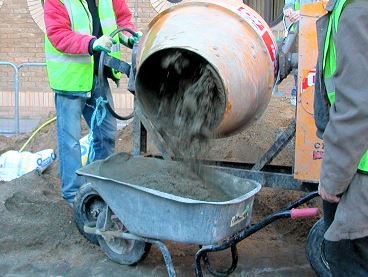
Fig. 1: Onsite Concrete Mixer

2. Surface Preparation Cost

If concrete is poured over nearly leveled soil surface, then the ground should be prepared for concrete placement. This involves cost of grading, compaction, excavation, trenching, and other components. special work is needed to prepare the site.
In contrary, when concrete is placed on a surface which is not leveled. Then the cost of surface preparation would be greater than previous case. It includes excavation and filling with suitable material or removing a soft soil.
If filling process is needed, then the distance between the project and the borrowing material source affect preparation cost.
Fig. 2: Surface preparation

3. Cost of Formwork

Cost of formwork make up fairly large quantity of the entire cost of concrete construction. There are certain details which should be known so as to be able to estimate cost of formwork.
For instance, cost of type of formwork employed, how the it is fixed, and whether the form is rental or bought, the use of crane is needed or not, machines used to transport formwork materials, re-using formwork material, and repair of forms after multiple utilization. Commonly, the cost of formwork is priced and expressed in square meter of the concrete area. Added to that, the cost of working hours of labors shall be included. The cost of labor who fix formwork ranges from 180 to 215$ per 2.6h in the United States.
Fig. 3: Fixing Formwork

4. Cost of Reinforcing Materials

There are various types of reinforcements which are used to reinforce concrete. For example, steel bars, wire mesh, fiber reinforced polymer (FRP) bars, plastic mesh, and fiber added to concrete mixer to improve strength and crack resistance.
The cost of reinforcing materials would vary based on the material type and size of reinforcement. for example, the cost of FRP bars are higher than steel reinforcement and larger diameter bars are costlier than small ones. Lastly, cost of reinforcement installation is one of the major components of material cost. In 2017, the price of reinforcing steel was 619$ in the United States.

5. Concreting Cost

It begins after formwork is fixed and reinforcements are installed. The technique used for concrete placement and equipment used for placement, spreading, and compacting concrete affect concrete costing, in addition to labor costs. Concrete may be ready mix and pumped to the specified locations or mixed onsite and require other machinery to deliver fresh concrete to its final position.

6. Finishing Work Cost

The type of finishing and its complexity determined in the design controls the cos of finishing operations. Concrete could be finished in number of different ways for example smooth surface, exposed aggregate surface, or stamped concrete finish.
Certain surfaces may require only a strike-off and screed to proper contour and elevation, while other surfaces, a broomed, floated, or troweled finish may be specified. Finally, the cost of any curing compound or testing services is also included in finish work cost.
Fig. 4:Finishing Concrete Surface

7. Cost of Hiring Engineers

Frequently, it is required to hire an engineer to supervise the project and make sure that the work is done in accordance with applicable codes and specifications. So, the cost of services provided by the engineer should be taken into considerations.

8. Contingency Cost

Obviously, no construction work is totally accurate and there is no guarantee for  stoppage of concreting due to technical problems or natural events like rain. This needs to be accounted for in the total cost of concrete construction and allocate certain quantity of money for contingency works. This amount is commonly specified by experienced estimator based on their experience.


Tuesday, October 23, 2018

What is Slab, Beam, Column, and Footing Construction?

Clearly, buildings are composed of various structure elements such as slabs, beams, columns, and footings. Each of these structural members play certain role in a structure.
This article presents various aspects of these structural members for instance their function, types of loads imposed on them, and load transfer mechanism from one member to another one.

Slabs

Slab is an important structural element which is constructed to create flat and useful surfaces such as floors, roofs, and ceilings. It is a horizontal structural component, with top and bottom surfaces parallel or near so. To read more about slab thickness evaluation please click here .
Commonly, slabs are supported by beams, columns (concrete or steel), walls, or the ground. The depth of a concrete slab floor is very small compared to its span.
Reinforced concrete slab
Fig. 1: Reinforced concrete slab

Types of Loads on a Slab

Types of loads acting on a slab include:
  1. Dead load of the slab
  2. Live load
  3. Floor finish load
  4. Snow load in the case of roof slab
  5. Earthquake loads

Load Transfer Mechanism in Slabs

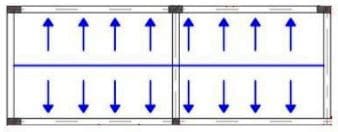
The forces transfer from slab to beams occur either in one way or in two ways. The total system completely counts on the geometrical dimensions of the slab.
Slabs may be supported by columns only, in this case two way action will prevail. If the ratio Long side / short side < 2 it is considered as 2-way slab, and if Longer side to shorter side greater than 2 then it is considered as 1-way slab.
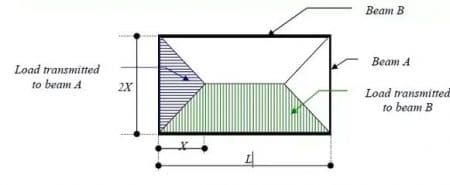
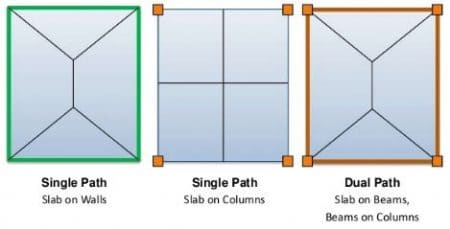
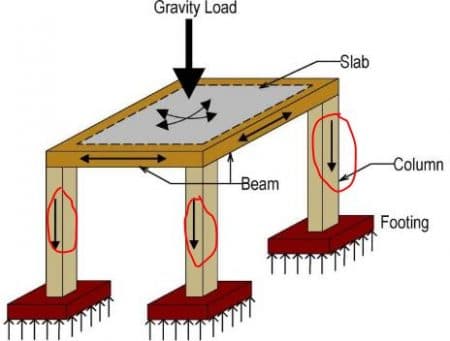
The load transfer mechanism from floor slab to supporting elements for one way slab and two way slab are shown in Fig. 2 and Fig. 3. Lastly, Fig. 4 illustrate the transfer of loads from slabs to different types of supporting elements.
Load distribution mechanism from one way slab to supporting member
Fig. 2: Load distribution mechanism from one way slab to supporting member
Load distribution mechanism from slab to beams or other supporting elements
Fig. 3: Load distribution mechanism from slab to beams or other supporting elements
Transfer of loads from slab to different types of supporting members
Fig. 4: Transfer of loads from slab to different types of supporting members

Beams

beam is a horizontal structural element that withstand vertical loads, shear forces and bending moments. The loads applied to the beam result in reaction forces at the support points of the beam.
The total effect of all the forces acting on the beam is to produce shear forces and bending moment within the beam, that in turn induce internal stresses, strains and deflections of the beam.
Reinforced concrete beam
Fig. 5: Reinforced concrete beam

Types of Loads on Beams

  1. Self-weight of the beam
  2. Dead load includes point load for instance column constructed on beam, distributed load for example setting slabs on a beam.
  3. Live load
  4. Torsional load

Load Transfer Mechanism in Beams

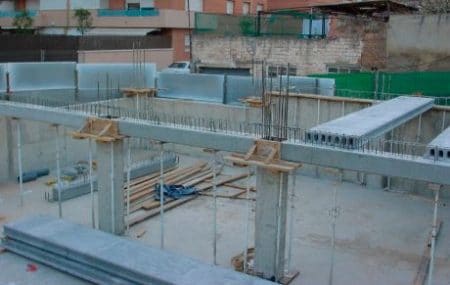
They transfer loads imposed along their length to their end points where the loads are transferred to columns or any other supporting structural elements.
Transfer loads from beams to column
Fig. 6: Transfer loads from beams to column

Columns

Column is a vertical structural member that carry loads mainly in compression. It is assumed to be the most crucial structural member of a building because the safety of a building rest on the column strength.
This is because failure of column would cause progressive collapse in buildings whereas such event would not occur when other members fail.
Columns transfer vertical loads from a ceiling, floor or roof slab or from a beam, to a floor or foundation. They also carry bending moments about one or both of the cross-section axes.
Reinforced concrete column
Fig. 7: Reinforced concrete column

Types of Loads on Columns

  1. Self-weight of the column multiplies by number of floors
  2. Self-weight of beams per running meter
  3. Load of walls per running meter
  4. Total Load of slab (Dead load + Live load + Self weight)

Loads Transfer Mechanism in column

Since the columns are supported by foundation; the load relocated from the all components to the columns. Then, it will be transferred from the column through the column necks adjacent to the footing in the form of axial force.
Moreover, Columns transfer lateral loads to foundations as well when such loads imposed. Lastly, It will transfer moment and shear also to the footing.
Load transfer mechanism from column to footing
Fig. 8: Load transfer mechanism from column to footing

Footings

Footings are structural elements that transmit load of entire superstructure to the underlying soil below the structure. Footings are designed to transmit these loads to the soil without exceeding its safe bearing capacity. Thus, prevent excessive settlement of the structure to a tolerable limit, to minimize differential settlement, and to prevent sliding and overturning.
Reinforced concrete footing
Fig. 9: Reinforced concrete footing

Types of Loads on Footings

  1. Dead load
    • Self-Weight of the elements
    • Superimposed loads such as finishes, partitions, block work, services.
  2. Live load
  3. Impact load
  4. Snow load
  5. Wind load
  6. Earthquake force
  7. Soil pressure
  8. Rain loads
  9. Fluid loads

Load Transfer Mechanism in Footing 

Soil is the root support of the footing. All the forces that come in contact with the footings will be transferred to the soil.
The soil shall bear these loads by the aspect known as bearing capacity. The bearing capacity changes from one type of soil to another and it is the key factor in estimating the size of footings.
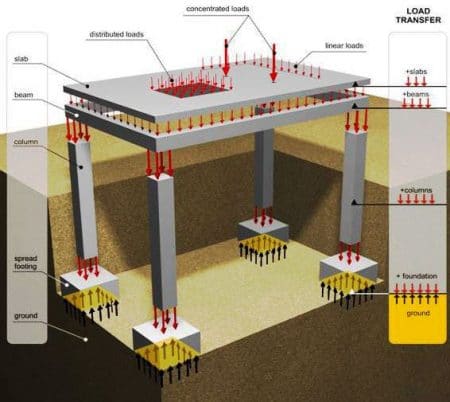
Transfer of loads from structural elements to the ground through footing
Fig. 10: Transfer of loads from structural elements to the ground through footing
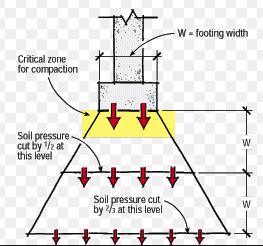
Dissipating loads of footing in underlying soil
Fig. 11: Dissipating loads of footing in underlying soil

Balanced Footings and Cantilever Footings

Balanced and Cantilever Footings

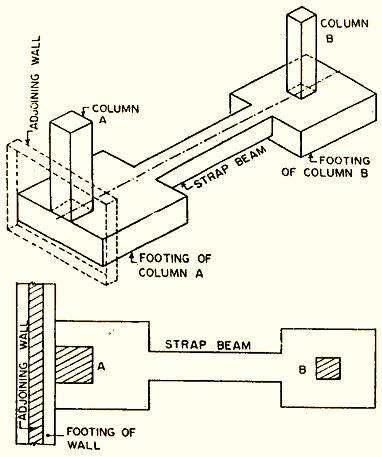
A balanced footing which is also called as strap footings consists of two separate footings connected by a strap beam. Balanced footing is required where the one of the footing has limited space for bearing, or if there is any restriction over the transfer of pressure from the footing to the ground. This case may arise where there is difference in soil bearing capacity, or loose soil beneath one of the footing.
The loads in a balanced footing is transferred from one footing to the other by means of cantilever action, thus it is also called as a cantilever footing.
Balanced footing is different from a combined footing in the sense that a combined footing has a single footing and a balanced or cantilever footing has two separate footings which are connected by a strap beam. The strap beam transfers the loads from external footing to the main footing by means of cantilever action.
Balanced Footings

When to Use Balanced and Cantilever Footings

A balanced footing and cantilever footing is used under following circumstances:
1. When the foundation does not have sufficient area to transfer the loads safely to the ground, such as in case of footing built on the property line. It is also used when the soil supporting the foundation does not have enough bearing capacity to transfer the loads safely and area of the footing cannot be increased beyond the limit.
2. When the new structure is built near the existing building or structure, and the existing building cannot support the loads from new structure, then new column and footing has to be provided near the existing structure, but there will be limited space for footing.
3. Combined footings can also be used for supporting two columns, but when the distance between the two columns is very large, it becomes uneconomical due to large bending moment to support two columns on a single footing, then a strap beam is used for connecting such footings.
In balanced footings, center of gravity of loads and footings has to coincide so that the pressure on the foundation is uniform. In case of cantilever footing, since one of the column is supported by a cantilever action, the center of gravity of loads and footings may not coincide and thus pressure on foundations may not be uniform.
balanced footing types
types of balanced footings
Fig: Types of Balanced Footings

Design of Balanced and Cantilever Footings

The balanced footings and cantilever footings are designed by balancing the loads on the footings through addition of dead loads on the internal column. In case when the fulcrum is near the internal column, the internal footing may be very heavy. The strap beam connecting the two footings are designed based bending moments due to external and internal column loads and as a cantilever in case of cantilever footings.