Friday, October 19, 2018

What is Concrete Temperature Limit

Concrete Temperature limits are established to ensure that high quality concrete with specified requirements are produced. Various standards and specifications provide limits on temperature of concrete so as to achieve designated strength and durability.
Concrete temperature limits changes based on the type of the elements and working conditions; hot or cold, windy or calm, dry or humid. This article highlights concrete temperature limits at different conditions based on different standards such as ACI Code, ASTM standards, and Australian Standard (AS).

Reasons to Set Concrete Temperature Limit

High initial temperature requires high water content to maintain required slump. High water content lead to lower strength, high permeability, greater shrinkage, lower air content at given air entraining admixture.
If ambient temperature increase in combination with high initial temperature, then it reduces set time, higher early age strength, durability problem, thermal cracking in massive concrete structure.
Concrete Temperature limit
Fig. 1: Concrete Temperature limit
Lastly, low initial temperature lead to intolerable setting time in cool weather, influence rate of strength achievement, and reduce ultimate strength up to 50% if fresh concrete is frozen.

Concrete Temperature Limits

  • ACI 301.5, ACI 301, and ASTM C94 set no temperature limit on fresh concrete in hot weather conditions if precautions are considered in proportioning, production, delivery, placing, and curing concrete. Nonetheless, ASTM C 1064-86 set a maximum limit between 26.7°C and 35°C. This can be modified in accordance with project specifications.
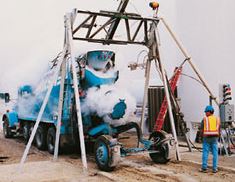
    Reduction of concrete temperature in hot weather conditions
    Fig. 2: Reduction of concrete temperature in hot weather conditions
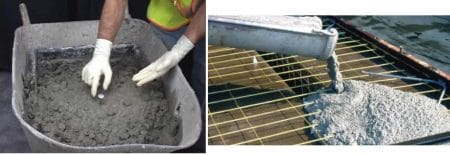
  • For temperatures greater than 35°C, the use of ice-cold water is recommended to prevent formation of cracks at early stages.
  • In hot weather conditions, AS 1379 requires that concrete temperatures at the point of delivery shall be within a range of 5°C to 35°C.
  • Concrete placed & cured at a moderate temperature (15–25°C) will gain higher strength & durability than 35°C concrete.
  • Curing concrete at high temperature accelerates curing and strength achievement, but provide lower maximum concrete strength.
  • ACI 306 specify limits for concrete temperature in cold weather conditions.  These are provided in Table 1 and greatly related to the minimum dimensions of the structural member under consideration. Sections with smaller dimensions have higher minimum temperature requirements to account for less heat that can be retained.
Table 1 Minimum Concrete temperature limit during placement
Least dimensions of sections, cmMinimum temperature of concrete as placed and maintained during the protection period, °C
Less than 30.4812.77
30.48 to less than 91.4410
91.44 to less than 182.887.22
Greater than 182.884.44
  • Freezing of freshly poured concrete shall be prevented during the first 24 hours after concrete placement to allow concrete to achieve minimum strength of 3.45MPa otherwise irreparable loss in strength occurs.
  • Whenever air temperature at the time of concrete placement is below 4.5°C and freezing temperatures within the first 24 hours after placement are expected, high initial temperature shall be established, protect concrete during placing, consolidating, and finishing to avoid delay of setting.
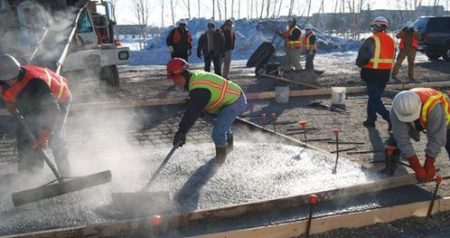
    Limiting concrete temperature in cold weather conditions
    Fig. 3: Limiting concrete temperature in cold weather conditions
  • For structures that carry large loads at an early age, concrete must be maintained at a minimum of 10°C to accommodate stripping of forms and shoring and to permit loading of the structure.
  • Drying placed concrete from low wintertime humidities, and heaters used in enclosures is a concern. It is advised to leave forms in place as long as possible, because they help distribute heat more evenly and help prevent drying of the concrete.
  • If concrete is heated, sudden cooling needs to be prevented because it causes thermal cracking. This can be achieved by loosening the forms while maintaining cover with plastic sheeting, gradual decrease in heating inside an enclosure, or turning off the heat and allowing the enclosure to slowly equilibrate to ambient temperature.
  • ACI 305 R-10 recommend that trial batches of concrete for any project shall be performed at a specified limited temperature or at maximum expected temperature of project site instead of temperature limit ranges from 20 to 30°C provided in ASTM C192/C192M.

Types of Shallow Foundations and their Uses

Shallow foundations are constructed where soil layer at shallow depth (upto 1.5m) is able to support the structural loads. The depth of shallow foundations are generally less than its width.

Different Types of Shallow Foundations

The different types of shallow foundation are:
  1. Strip footing
  2. Spread or isolated footing
  3. Combined footing Strap or cantilever footing
  4. Mat or raft Foundation

1. Strip Footing

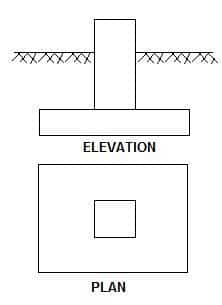
A strip footing is provided for a load-bearing wall. A strip footing is also provided for a row of columns which are so closely spaced that their spread footings overlap or nearly touch each other. In such a case, it is more economical to provide a strip footing than to provide a number of spread footings in one line. A strip footing is also known as continuous footing.
Strip Footing

2. Spread or Isolated Footing or Individual Footing

A spread footing also called as isolated footing, pad footing and individual footing is provided to support an individual column. A spread footing is circular, square or rectangular slab of uniform thickness. Sometimes, it is stepped or haunched to spread the load over a large area.
Isolated Footing

3. Combined Footing

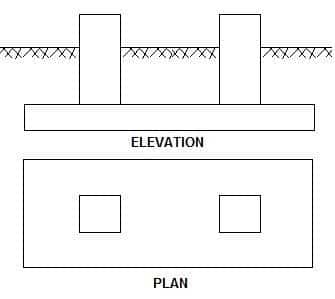
A combined footing supports two columns. It is used when the two columns are so close to each other that their individual footings would overlap. A combined footing is also provided when the property line is so close to one column that a spread footing would be eccentrically loaded when kept entirely within the property line. By combining it with that of an interior column, the load is evenly distributed. A combined footing may be rectangular or trapezoidal in plan.
Combined Footing

4. Strap or Cantilever Footing

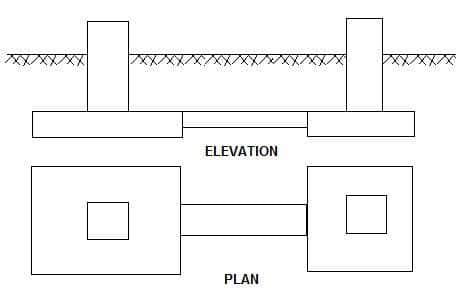
A strap (or cantilever) footing consists of two isolated footings connected with a structural strap or a lever. The strap connects the two footings such that they behave as one unit. The strap is designed as a rigid beam. The individual footings are so designed that their combined line of action passes through the resultant of the total load. a strap footing is more economical than a combined footing when the allowable soil pressure is relatively high and the distance between the columns is large.
Cantilever Footing

5. Mat or Raft Foundations

A mat or raft foundation is a large slab supporting a number of columns and walls under the entire structure or a large part of the structure. A mat is required when the allowable soil pressure is low or where the columns and walls are so close that individual footings would overlap or nearly touch each other.
Mat foundations are useful in reducing the differential settlements on non-homogeneous soils or where there is a large variation in the loads on individual columns.

Factors Affecting Deflections of Reinforced Concrete Beams and Slabs


There are various factors which affect deflections of reinforced concrete beams and slabs which needs to be considered and assessed adequately during design and construction.
These factors can be divided into two group including parameter known before construction and factors unknown before construction. It is demonstrated that unknown factors are more influential than those known before construction.
Moreover, the potential deflection variation of reinforced concrete beams and slabs can be assessed by calculating deflections employing realistic maximum and minimum values for parameters. In this article the most important and influential factors are discussed.
Factors Affecting Deflections of RCC Beams and Slabs

Factors Affecting Deflections of RCC Beams and Slabs

Following are the factors which affect deflections of flexural members (beams and slabs) in reinforced concrete structures:
  • Errors in the deflection computation of flexural members
  • Loading of flexural members
  • Flexural stiffness
  • Factors affecting fixity
  • Construction variations of flexural members
  • Creep and shrinkage in flexural members

Errors in computation of deflections for beams and slabs

Generally, calculations are carried out by a human that is why discrepancy between actual and computed deflections can be originated mainly from computational errors. Numbers of such computational errors are discussed and explained in the following sections.
There are many deflection calculation steps which must be considered to achieve the final deflection result. Any error in any step could have a considerable detrimental effect on the final result. For example, when error probability is 1% in each step, the probability of errors in the final result is around 10%. Moreover, it is considered that the computation errors between 25 – 50% are uncommon.
The length and complex detail of deflection calculation could be decreased by applying a computer program. The program should take most of the parameters, which affect the flexural member deflection into account and credibly compute and expect structural deflection in wide range of conditions with substantial accuracy.
Lastly, it is significant that practical engineer compare calculated and performance deflection in order to achieve and develop strong judgment skills.
Utilization of factored loads or moments unintentionally rather than actual service loads or moments in calculation of deflection is another source of errors in the deflection calculation of beams and slabs (flexural members).
Finally, ultimate moments from moment coefficients of pattern load may be employed instead of actual moments for the loading conditions under considerations.

Loadings on RCC Beams and Slabs

There are numbers of factors based on loads which affect deflections of RCC beams and slabs, such as:
  • It is important to take loading history due to the fact that concrete modulus of elasticity and rupture is different at different ages and consequently affect immediate deflection.
  • Use actual loads instead of loads that considered in strength design. Moreover, it is common to find that live loads determined by building codes are never reached in real situations.
  • Consider the proportion of long term loading versus temporary loading. Because creep deflection happens when loads sustain for some time, therefore permanent live loads lead to more creep deflection compared to transient live loads. Furthermore, some live loads might stay for considerably long period of time and responsible for substantial deflection whereas those remain for a while could not cause measurable long term deflection.
  • Correctly evaluate the live load; when actual service live load is less than design live load, applied moment to cracking moment ratio will be smaller. This might produce higher effective moment of inertia, consequently dead and live load deflection will be lower.
  • Consider redundancy; for instance when reinforced concrete element transverses to the main span may some loads, consequently the moment is decreased which in return the deflection of the member under consideration is reduced.

Flexural Stiffness of RCC Beams and Slabs

It is recommended to employ both actual modulus of elasticity (Ec) and modulus of rupture (fr) due to their influence on deflection. American Concrete Institute Code specify the ratio of fr?(fc‘)0.5 = 7.5 however depends on number of researches the ratio is changing from 7.5 up to 10.
The moment of inertia will increase by 75 percent if modulus of rupture is increased by one third. The ACI Code value is conservative, so computed deflection is greater than actual deflection.
Moreover, in the case where premature cracks due to construction loads are not permitted, it is advised to use effective moment of inertia at all loading stages based on cracking amount of that stage.
Furthermore, only one flexural stiffness computation is required to be carried out and one cracking condition, which is when maximum load is reached, is considered if the ultimate load is occurred during construction.
Not only is this assumption is supported by site observation which the most extreme loading situation take place during construction when shoring loads from above stories and other construction loads are imposed on the structure but also provide simpler and easier calculation.
Furthermore, actual location of reinforcement as built should be used when the structure is explored entirely especially when considerable deviation is occurred between as built location and specified position.
Apply actual location and amount of compression reinforcement for calculating gross and cracked moment of inertia. Similarly, employ actual location and amount of tension reinforcement for cracked moment of inertia estimation.
Last but not least, consider flange effect even if they are small. Both uncracked and cracked moment of inertia is small and calculated deflection is high when rectangular section is employed rather than T-section.
Finally, produce reasonable assessment about the contribution of end region stiffness to the overall stiffness instead of averaging end and mid span stiffness.
Mid-span stiffness application might provide satisfactory results for normal and simple computation procedure however accuracy for extended calculation could be increased by including end region stiffness.

Fixity of RCC Beams and Slabs

Rotation of the support in cantilever should be considered since support rotation can create a movement which is larger than the flexural deflection of the member. Moreover, rotation might lead to raising or lowering in the end based on loading and dimensions of back span.
Moreover, take nearby restraint into account which is provided by unloaded parallel members through tensional stiffness of supporting beams.
Furthermore, establish moment distribution on actual stiffness and loading conditions of the member instead of suggested prismatic elements.
Another measure that should be considered is providing allowance for stiffness of joints unless they are strong or have enough anchored reinforcement. This effect is similar to the influence of support rotation in cantilever. There are no analytical tools that satisfactorily deal with this consideration.
Finally, end spans must be analyzed cautiously since they are sensitive to assumptions of moment at critical sections. If end support is suggested to have small stiffness, the positive moment in the end support is high and consequently calculated deflection is large, regardless of providing more steel bars to withstand higher moment.
That is why designers may utilize wider beams and more reinforcement in the end spans for controlling deflection rather than for strength requirement.
In addition to all aforementioned factors, procedures of shoring and reshoring should be precisely controlled due to substantial effect of moment distribution on deflection variation. Improper procedures could create moments that might be more severe than those which the structure is designed for.

Construction Variations of Flexural Members

Generally, designer cannot do much about construction variations apart from determining tolerances and procedures. ACI 117-10 provides tolerances on steel installation, concrete outline, and material properties.
When maximum variations are employed in the same direction to calculate deflection their effect could be substantially high. However, it is likely that variations cancel each other and their effect will not be high unless they are influence each other in the same direction.
Numbers of extremely severe variations in construction which affect deflections of RCC beams and slabs are explained in the following sections:
  • Concrete outline tolerances could lead to smaller or larger member compare with specified element.
  • As a consequent of gravity, concrete cover might thinner than determined. Cracked moment of inertia is increased as effective depth is increasing. Gravity effect leads to increase top bar cover and decrease effective depth and moment of inertia.
  • Concrete modulus of rupture is more changeable than compressive strength. It might vary along the member length and is likely to reach average in its influence on deflection.
  • Concrete compressive strength could be higher as much as 15% than specified and increase modulus of elasticity by 7%. If the structure is loaded before it reaches design strength, detrimental effect on deflection could be more serious than demonstrated by lower concrete strength because creep coefficient can be up to 50% larger for stress/ strength ratios fc / fc > 0.50 than for fc / fc < 0.50. That is why loading structures, which are sensitive to deflection, should be prevented before it reaches design strength.
  • If bottom bar numbers are less or more than specified, the effect would be proportional when the element is cracked.

Creep and shrinkage in flexural members

There are various factors that affect creep and shrinkage such as age of loading, minimum thickness, relative humidity, volume to surface ratio, cement content, slump, aggregates, air content, ambient temperature, and admixtures. These factors are discussed in ACI 209.1R-05.