Thursday, October 18, 2018

Tolerances for Concrete Foundation Construction as per ACI 117M-10

Specification tolerances for concrete foundation construction as per ACI 117M such as tolerances for plumb line deviation, location displacement, deviation from elevation, plane and cross-sectional dimensions of foundations are discussed.
Concrete Foundation Construction
Fig.1: Concrete Foundation Construction

Tolerances for Concrete Foundation Construction as per ACI 117M-10

1. Foundation Plumb Line Deviation Tolerances

There are different plumb deviation tolerances based on the materials used for foundation construction and material in which the foundation has been constructed. Table-1 provides plumb deviation tolerances. Figure 2 illustrated deviation of plumb.

Table 1 Foundation Plumb Deviation Tolerances

Type of foundationTolerances
Unreinforced concrete pier extending through materials that do not provide lateral restraint+/-12.5% of shaft diameter
Unreinforced concrete pier extending through materials that provide lateral restraint+/-1.5% of shaft length
Reinforced concrete pier+/-2% of shaft length
Fig.2: Deviation of Plumb Line, A) Unreinforced Pier, B) Reinforced Pier

2. Tolerances for Location Displacement of Foundation

Permissible foundation location deviation is based on the foundation or pier dimension with an absolute limit which depends on whether the foundation carries masonry or concrete.

Table-2: Foundation Location Deviation Tolerances

Foundation ConditionTolerances
Foundation supporting concrete, Figure 3
Horizontal deviation of the as cast edge with minimum dimension of 2.4m or greater+/-50 mm
Horizontal deviation of the as cast edge with maximum dimension of 2.4m or smallerGreater of 13mm or 2% of specified dimension
Foundation Supporting Masonry, Figure 3
Horizontal deviation of the as-cast edgeSmaller of 13mm or +/-2% of foundation width
Top of drilled piers, Figure 4
Horizontal deviation of the as-cast centerSmaller of +/-75mm or +/-4.2% of diameter of the shaft
Fig.3: Location Deviation of Foundation
Fig.4: Horizontal Deviation of Top Drilled Pier

3. Tolerances for Foundation Deviation from Elevation

It specifies the location of any point on the top surface of a footing with respect to a determined plane. Table-3 provides elevation tolerances and Figure-4 and Figure-5 illustrate how elevation deviations are evaluated.

Table-3: Elevation Deviation of Foundations

Foundation typeVertical tolerances
Footing, Figure 5+13mm to -75mm
Drilled pier, Figure 6+25mm to -75mm

Fig.5: Vertical Deviation of Footing
Fig.6: Vertical Deviation of Drilled Pier

4. Foundation Deviation from Plane

It is the permissible slope of base of bell in case of pier and top surface of footing in the case of footing foundation.

Table-4: Plane Deviation of Foundation

Type of foundationDeviation from Plane
Top surface of footing at interface with supported elementlargest space between the concrete and the near surface of a 3 m straightedge, measured between the support points, shall not exceed +13 mm
Base of bell pierSmallest of +/-75mm and 10% of bell diameter as illustrated in Figure 6.
Fig.7: Plane Deviation of Base of Bell Pier

5. Deviation from Cross Sectional Dimensions of Foundations

In this section, allowable errors in the size of foundation would be specified based on the ACI specifications.

Table-5: Deviation from Cross Sectional Dimensions of Foundations

FoundationsTolerances
Formed foundations Horizontal deviation, Figure 8+50mm to -13mm
Unformed foundations cast against soil*Horizontal deviation, Figure 9+75mm to -13mm for dimension </= 600mm +150mm to -13mm for dimension >/= 600mm
Deviation from foundation thickness, Figure 10-0.05 of foundation thickness
*excavation shall be measured prior to concrete placement and tolerances shall apply at all locations
Fig.8: Formed Foundation, Cross Sectional Dimension Tolerances
Fig.9: Unformed Foundation, Cross Sectional Dimension Tolerances
Fig.10: Foundation Thickness Tolerances

Transparent Concrete or Light Transmitting Concrete

What is Transparent Concrete or Light Transmitting Concrete?

Transparent concrete also called as translucent concrete or light transmitting concrete is achieved by replacing aggregates with transparent alternate materials. The bonding material in transparent concrete may be able to transmit light by using clear resins the concrete mix. Use of optical fibers and fine concrete also used as transparent concrete.
Transparent concrete was originally developed in 2001 by a Hungarian architect Aronlosonzi by using glass fibers. Transparent concrete is produced by mixing 4% to 5% (by volume) optical fibers in the concrete mixture. This concrete has less weight compared to original concrete.

Materials for Transparent Concrete

Transparent concrete is manufactured by using combination of fiber optics and fine concrete. These fibers blend into the concrete like any other aggregates. These optical fibers can transmit light from natural and artificial sources into spaces enclosed by the translucent concrete panels. The main reason for using optical fiber in concrete is that it can transmit light even an incident angle greater than 600.
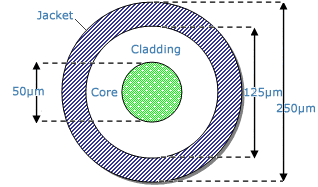
Optical fiber consists of three layers called as core, cladding and buffer coating or jacket. The light is transmitted through the core of the optical fiber.
Cross-Section of Optical Fiber
Fig: Cross-Section of Optical Fiber
Transparent concrete is manufactured using fine materials only. It does not contain coarse aggregates. This concrete can have the compressive strength of that of high strength concrete around 70 MPa ( 10,000 psi).
Light Transmitting Concrete
Fig: Light Transmitting Concrete
Materials used:
Cement: As the optical fiber is only responsible for transmission of light, there is no special cement required. So, ordinary Portland cement is used for transparent concrete.
Sand: Since the transparent concrete is manufactured only using fine materials, the size of sand should pass through 1.18mm sieve. The sand should be free from any impurities such as vegetation, large stones etc.
Water: Water to be used for transparent concrete should be of drinking water quality, free from any impurities.
Optical fibers: Optical fibers in the range of 4 to 5% by volume is used for transparent concrete. Thickness of the optical fibers can be varied between 2 µm and 2 mm to suit the particular requirements of light transmission.
Fig: Transparent Concrete Wall

Advantages of Transparent Concrete:

The main advantage of transparent concrete is that it can transmit light. There, it can be used to make green buildings. Since it can transmit light from natural as well as artificial sources, the building can have fewer lights to meet its demand for lighting. Thus saving huge energy cost.
Transparent concrete uses sunlight as source of light instead of electrical energy and reduces power consumption. This concrete can also be used cold countries to transmit heat with sunlight.

20 Types of Mortar Used in Masonry Construction


Different types of mortars used in masonry construction based on application, binding material, density and purposes. Mortar is a workable paste prepared by adding water to a mixture of binding material and fine aggregate. 
This plastic paste is useful to hold building materials such as stone or brick together. Different types of mortars used in masonry construction are presented below.

Types of Mortars Used in Masonry Construction

Following are the types of mortars based on different factors:
  1. Based on Applications
  2. Based on Binding Materials
  3. Based on Bulk Density
  4. Based on Strength (ASTM C270)
  5. Based on Special Purpose of Mortars
Based on Application

1. Bricklaying or Stone Laying Mortar

This type of mortar used to bind bricks and stones in masonry construction. The proportions of ingredients for bricklaying or stone laying mortar is decided based on kind of binding material used.
Fig. 1: Types of Mortars – Brick Laying or Stone Laying Mortar

2. Finishing Mortar

Finishing mortar is used for pointing and plastering works. It is also used for architectural effects of building to give aesthetic appearances. The mortar used for ornamental finishing should have great strength, mobility and resistance against atmospheric action like rain, wind, etc.
Fig. 2: Finishing Mortar
Based on Binding Material

3. Cement Mortar

Cement is used as a binding material in this type of mortar and sand is employed as aggregate. The proportion of cement and sand is decided based on the specified durability and working conditions.
Cement mortar will give high strength and resistance against water. The proportion of cement to sand may varies from 1:2 to 1:6.
Fig. 3: Cement Mortar

4. Lime Mortar

In this case, lime is used as binding material. There are two types of limes namely fat lime and hydraulic lime. Fat lime in lime mortar requires 2 to 3 times of sand and it is used for dry work.
Hydraulic lime and sand in 1:2 ratios will give good results in damp conditions and also suitable for water logged areas.inally, the lime mortar has a high plasticity so it can be placed easily. The pyramids at Giza are plastered with lime mortar.


Fig. 4: Lime Mortar

5. Gypsum Mortar

Gypsum mortar consists of plaster and soft sand as binding material and fine aggregate. Commonly, it has low durability in damp conditions.
Fig. 5: Gypsum Mortar

6. Gauged Mortar

In gauge mortar combination of lime and cement is employed as a binder material, and sand used as fine aggregate. Gauge mortar is, essentially, lime mortar which its strength increased by adding cement.
Consequently, the mortar will have high plasticity of the lime and high strength of the cement. The ratio of cement to lime ranges from 1:6 to 1:9, and it is cost effective.

7. Surkhi Mortar

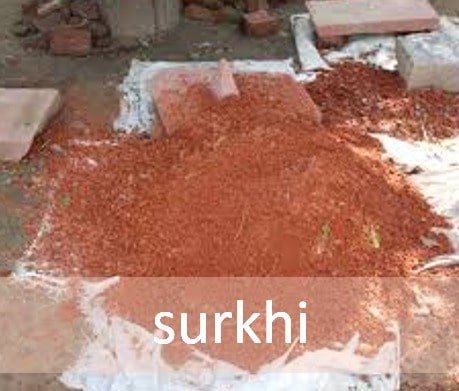
In surkhi mortar, lime is used as binder material and surkhi is employed as fine aggregate. The surkhi is finely-powdered burnt clay which provides more strength than sand and cheaply available in the market.
Fig. 6: Surkhi Mortar

8. Aerated Cement Mortar

Basically, it is cement mortar to which air entraining agent is added to increase plasticity and workability. The resulted mortar is termed as aerated cement mortar.

9. Mud mortar

In this type of mortar, mud is used as binding material and saw dust, rice husk or cow-dung is used as fine aggregate. Mud mortar is useful where lime or cement is not available.
The use of mud mortars in the Middle-East and central Asia, and American cultures of the south-western USA is well documented.
Fig. 7: Mud mortar
Based on Bulk Density

10. Heavy Mortar

If the mortar having bulk density of 15 KN/m3 or more then it is called as heavy mortar. Generally heavy quartzes are used as fine aggregate in this type of mortars.

11. Lightweight Mortar

If the mortar having bulk density of less than 15 KN/m3 then it is called as light mortar. Lightweight mortar is prepared by mixing lime or cement as binder, sand, and saw dust, rice husk, jute fibers, coirs, or asbestos fibers.
Cinder mortar is a variety of light-weight mortars. Lightweight mortar is generally used in the soundproof and heat proof constructions.
Based on Strength (ASTM C 270)

12. Type M Mortar

It is the highest strength mortar minimum 17.2 MPa (2500 psi). It is used for exterior masonry work and at or below grade application where substantial gravity or lateral loads are exerted. load bearing wall, footing, retaining wall are examples of below grade applications.
Fig. 8: Type M mortar

13. Type S Mortar

It is a medium-strength mortar minimum 12.4 MPa (1800 psi) with high bonding ability. it is used for grade applications with normal to moderate loading.
Type S mortar has great durability that is why it is highly suitable for locations where the masonry is in contact with the ground, such as paving or shallow retaining walls.
Fig. 9: Type S mortar

14. Type N Mortar

It is medium strength with minimum 5.2 MPa (750 psi) and most common type of mortar. Type N mortar used for reinforced interior and above-grade exterior load-bearing walls on which normal loads are imposed.

15. Type O Mortar

It is a low strength mortar with minimum 2.5 MPa (350 psi). Type O mortar employed for interior non-load-bearing applications with very limited exterior use. Added to that, it used for repointing where the structural integrity of the wall is intact.
Based on Special Purpose of Mortars

16. Fire Resistant Mortar

Fire resistant mortar is prepared by mixing aluminous cement to the fine powder of fire bricks. If there are any fire warnings to the structures in a particular zone, then fire resistant mortar will be used which acts as fireproof shield.
Fig. 10: Fire resistant mortar

17. Packing Mortar


The constituents of packing mortars are generally cement-sand, cement-loam or sometimes cement-sand-loam. This type of mortar is used to pack the oil wells. Packing mortar should be of high homogeneity, water resistance and high strength.


Fig. 11: Packing Mortar

18. Sound Absorbing Mortar

In sound absorbing mortar, cement, lime, gypsum, or slag used as binding materials and pumice, cinders as fine aggregate. It is used to reduce the noise level and acts as sound proof layer.

19. X-ray Shielding Mortar

To provide protection against ill effects of X-rays, the X-ray room walls and ceilings are plastered by X-ray shielding mortar. This is heavy type mortar with bulk density around 22KN/m3. Fine aggregates from heavy rock and suitable admixtures are used to prepare this type of mortar.

20. Chemical Resistant Mortar

It is generally used where there is a chance of chemical attack on the structures. There are so many types of chemical resistant mortars can be prepared but the selection of mortar is dependent on expected damage by particular chemical or group of chemicals.
The additives added may not resist all the chemical attacks. For example, silicate type chemical mortar resists nitric, chromic, Sulphuric or any acidic damages but it cannot prevent the structure against damage by alkalies of any concentration.