Monday, October 8, 2018

Formwork (Shuttering) for Different Structural Members -Beams, Slabs, Columns, Footings


Formwork (Shuttering) for Different Structural Members -Beams, Slabs, Columns, Footings


Concrete formworks (shutterings) are required for fresh concrete constructions such as walls, slabs, beams, columns, footings etc. Formworks requirements for different structural members are different and they are named based on type of structural member.
Formwork (shuttering) is a temporary mould to provide support to fresh concrete when placed in structural member until the concrete has set. This helps the structural member to gain sufficient strength to carry its self-load and load from other members.
There are many types of structural formwork or shuttering based on its material, their use and the type of structural members. They can be named based on that. However, core functioning of the formwork remains the same.

Types of Formwork (Shuttering) Based on Structural Member:

Formworks are used in construction of reinforced concrete foundations, columns, slabs, walls etc., and these are named as follows:
  • Footing Forms – Formworks for foundation
  • Column Forms – Formwork for RCC Column construction
  • Wall Forms – Formwork for RCC wall construction
  • Floor Forms – Formwork for construction of RCC Slabs

Footing Forms – Formworks for Foundation

The first step for any concrete construction starts with the construction of foundation. Foundation can be for columns or walls. So, based on type of structural member, the shape and size of footing are designed. Thus formwork size and shape depends on the type and dimension of the footing.
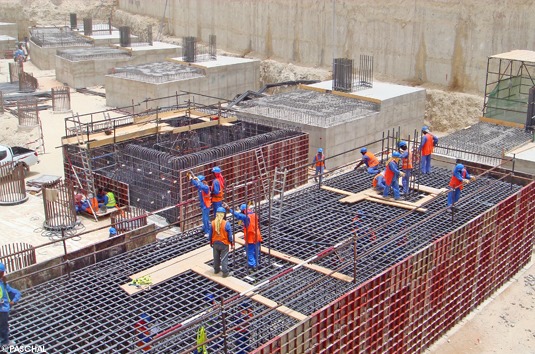
Footing Forms – Formworks for Foundation

Components of Footing Forms:

Components of Footing Formwork
Fig: Components of Footing Formwork – For Shallow Footing – Continuous Footing Formwork

Column Forms – Formwork for Concrete Column Construction

Reinforced concrete column forms are subjected to lateral pressure because of their small cross section, large heights and relatively high rates of concrete placement. Thus It is necessary to provide tight joints and strong tie support to the formwork.
As the sizes of concrete column increases, the stiffness of the formwork must be increased by either increasing thickness of sheathing or vertical stiffeners must be added to prevent sheathing deflection.
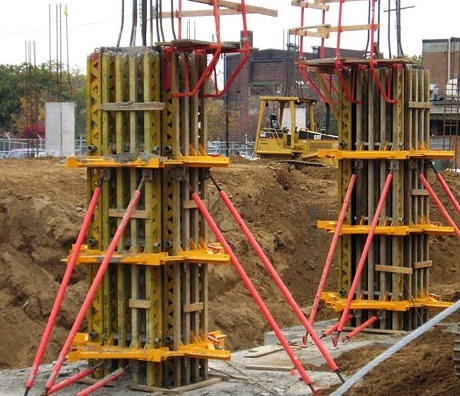
column-forms-formwork-for-reinforced-concrete-columns

Wall Forms – Formwork for RCC Wall Construction

Formwork for wall construction are subjected to relatively lower lateral pressure than column forms due to their large cross-sectional area.

The components of wall forms are:

  • Panel sheathing – It is used to shape the wall and retain the concrete until it sets.
  • Studs – to support the sheathing or Wales by forming a framework to keep the forms aligned and support the studs.
  • Braces – It is used to prevent deflection of forms under lateral pressure and keep the formwork erect.
  • Ties and spreaders – These are used to hold the sides of the forms at the correct spacing.
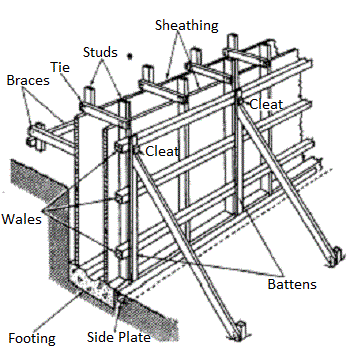
Components of a RCC Wall Formwork
Fig: Components of a Wall Formwork

Floor Forms – Formwork for construction of RCC Slabs

Formwork for reinforced concrete slabs depends on the type of slabs to be constructed. The floor slabs can be structural slabs supported on a steel or concrete structural frame, or slab-on-grade.
The design of formwork varies with the type of slab.
Structural Slab Formwork assembly is carried out as follows:
  • Positioning of the girder or beam form at the bottom.
  • Girder side forms overlaps the bottom form and rests on the shore heads and the sides of the column form.
  • Side forms is held in place by ledger strips nailed to the shore heads with double-headed nails.
  • Larger girders should have the side forms vertically stiffened to prevent buckling.
  • When constructing the girder and beam forms each part must be removed without disturbing the remainder of the form; strike-off formwork will commence with the beam and girder sides, followed later by the column forms, and finally by the beam and gird bottoms.
Structural Slab Formwork Components
Fig: Structural Slab Formwork Components
Slab-on-Grade Forms are forms for concrete slabs placed on grade. These slab formworks are usually quite simple as concrete is placed on compacted earth or gravel leveled base. Thus no support is required for concrete at the bottom.
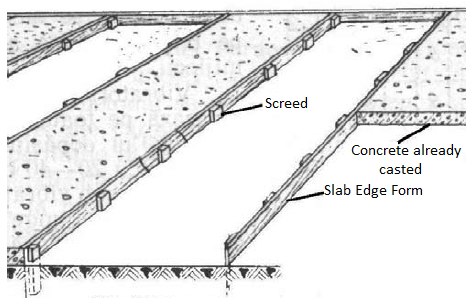
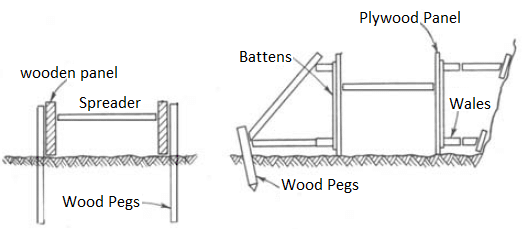
Components of a Slab-on-Grade Slab Formwork
Fig: Components of a Slab-on-Grade Slab Formwork
Slab-on-Grade Formwork assembly is carried out as follows:
  • Plank, plywood, or steel forms are used for forming / supporting the open edges of concrete.
  • These forms are held in place by supporting with wooden pegs.
  • The reinforcement in slab (if specified in the structural drawing) should be placed on its proper location according to the drawing on chairs, bolsters, and spacers made of either metal or concrete.
  • If the slab is to be casted in sections, construction joints must be provided between them, which will transmit shear from one to the other. The details of construction joints should be followed as per structural drawing.

Saturday, October 6, 2018

Methods of Curing Concrete Structures and their Comparisons


Methods of Curing Concrete Structures and their Comparisons


Methods of Curing Concrete for Different Structures

Adding water to Portland cement to form the water-cement paste that holds concrete together starts a chemical reaction that makes the paste into a bonding agent. This reaction, called hydration, produces a stone-like substance—the hardened cement paste.
Both the rate and degree of hydration, and the resulting strength of the final concrete, depend on the curing process that follows placing and consolidating the plastic concrete.
Hydration continues indefinitely at a decreasing rate as long as the mixture contains water and the temperature conditions are favorable. Once the water is removed, hydration ceases and cannot be restarted.
Curing is the period of time from consolidation to the point where the concrete reaches its design strength. During this period, you must take certain steps to keep the concrete moist and as near 73°F as practical.
The properties of concrete, such as freeze and thaw resistance, strength, water-tightness, wear resistance, and volume stability, cure or improve with age as long as you maintain the moisture and temperature conditions favorable to continued hydration.
The length of time that you must protect concrete against moisture loss depends on the type of cement used, mix proportions, required strength, size and shape of the concrete mass, weather, and future exposure conditions. The period can vary from a few days to a month or longer.
For most structural use, the curing period for cast-in-place concrete is usually 3 days to 2 weeks. This period depends on such conditions as temperature, cement type, mix proportions, and so forth. Bridge decks and other slabs exposed to weather and chemical attack usually require longer curing periods. Figure (1) shows how moist curing affects the compressive strength of concrete.

Methods of Curing of Concrete Structures and their Comparisons

Several curing methods will keep concrete moist and, favorable hydration temperature.
curing of concrete
Figure (1) Moist curing effect on compressive strength of concrete.
They fall into two categories: those that supply additional moisture and those that prevent moisture loss. Table below lists several of these methods and their advantages and disadvantages.
Concrete Curing MethodsAdvantagesDisadvantages
Sprinkling with Water or Covering with BurlapExcellent results if kept constantly wetLikelihood of drying between sprinklings; difficult on vertical walls
StrawInsulator in winterCan dry out, blow away, or burn
Moist EarthCheap but messyStains concrete; can dry out; removal problem
Pending on Flat SurfacesExcellent results, maintains uniform temperatureRequires considerable labor; un- desirable in freezing weather
Curing CompoundsEasy to apply and inexpensiveSprayer needed; inadequate coverage allows drying out; film can be broken or tracked off before curing is completed; unless pigmented, can allow concrete to get too hot
Waterproof PaperExcellent protection, preventsHeavy cost can be excessive; must drying be kept in rolls; storage and handling problem
Plastic FilmAbsolutely watertight, excellent protection. Light and easy to handleShould be pigmented for heat protection; requires reasonable care and tears must be patched; must be weighed down to prevent blowing away

Concrete Curing Methods that Supply Additional Moisture

Methods that Supply Additional Moisture:Methods that supply additional moisture include sprinkling and wet covers. Both these methods add moisture to the concrete surface during the early hardening or curing period. They also provide some cooling through evaporation.
This is especially important in hot weather. Sprinkling continually with water is an excellent way to cure concrete. However, if you sprinkle at intervals, do not allow the concrete to dry out between applications. The disadvantages of this method are the expense involved and volume of water required.
Wet covers, such as straw, earth, burlap, cotton mats, and other moisture-retaining fabrics, are used extensively in curing concrete. Figure (2) shows a typical application of wet burlap.
Lay the wet coverings as soon as the concrete hardens enough to prevent surface damage. Leave them in place and keep them moist during the entire curing period. If practical, horizontal placements can be flooded by creating an earthen dam around the edges and submerging the entire concrete structure in water.
Curing a wall
Figure (2) – Curing a wall with wet burlap sacks.

Concrete Curing Methods that Prevent Moisture Loss

Methods that prevent moisture loss include laying waterproof paper, plastic film, or liquid- membrane-forming compounds, and simply leaving forms in place. All prevent moisture loss by sealing the surface.
Waterproof paper (figure (3)) can be used to cure horizontal surfaces and structural concrete having relatively simple shapes. The paper should be large enough to cover both the surfaces and the edges of the concrete. Wet the surface with a fine water spray before covering.
water proof paper for curing
Figure (3) – Waterproof paper used for curing.
Lap adjacent sheets 12 inches or more and weigh their edges down to form a continuous cover with closed joints. Leave the coverings in place during the entire curing period. Plastic film materials are sometimes used to cure concrete. They provide lightweight, effective moisture barriers that are easy to apply to either simple or complex shapes.
However, some thin plastic sheets may discolor hardened concrete, especially if the surface was steel-troweled to a hard finish. The coverage, overlap, weighing down of edges, and surface wetting requirements of plastic film are similar to those of waterproof paper.
Concrete curing compounds are suitable not only for curing fresh concrete, but to further cure concrete following form removal or initial moist curing. You can apply them with spray equipment, such as hand-operated pressure sprayers, to odd slab widths or shapes of fresh concrete, and to exposed concrete surfaces following form removal.
If there is heavy rain within 3 hours of application, you must respray the surface. You can use brushes to apply curing compound to formed surfaces, but do not use brushes on unformed concrete because of the risk of marring the surface, opening the surface to too much compound penetration, and breaking the surface film continuity.
These compounds permit curing to continue for long periods while the concrete is in use. Because curing compounds can prevent a bond from forming between hardened and fresh concrete, do not use them if a bond is necessary. Forms provide adequate protection against moisture loss if you keep the exposed concrete surfaces wet. Keep wood forms moist by sprinkling, especially during hot, dry weather.

Methods of Finishing Hardened Concrete Surface


Methods of Finishing Hardened Concrete Surface


Finishing hardened concrete surface is carried out just after the removal of formwork to achieve finely finished surface. There are various methods and equipment that have been used to finish concrete surface. These finishing dried concrete surface techniques and equipment is presented.

Methods of Finishing Hardened Concrete Surface

1. Dry Grinding Finishing Method

  • Dry grinding is performed on dry concrete surfaces.
  • It is used to eliminate fins and marks caused by forms.
  • Abrasive discs are used for grinding and its outcome is excellent.
  • The abrasive disc constitutes of multiple layer of abrasive-impregnated cotton fiber material bonded together under heat and pressure with strong resin bond.
  • Thickness of abrasive is around 6.35mm and its diameter ranges from 17.78cm to 22.86cm.
  • Abrasive discs can be used to the work at an angle of 30 to 40 degrees using the weight of the tool for pressure.
  • They can be attached to any type of portable tool and should be operated at from 3,000 to 4,000 rpm.

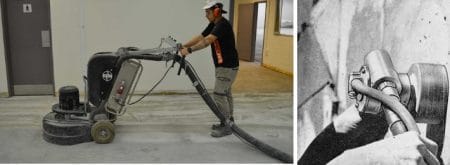
Finishing hardened concrete (dry grinding method)
Fig. 1: Finishing hardened concrete (dry grinding method)
Finishing concrete surface using stand-up edger; drying grinding
Fig. 2: Finishing concrete surface using stand-up edger; drying grinding

2. Wet Rubbing Finishing Method

  • It is executed on green concrete.
  • The procedure used for finishing hardened concrete using wet rubbing includes apply paints on a coating of cement with hand brush. Then, the wet cement is rubbed in; at this step, use water where necessary.
  • Finishing process is conducted by slow speed grinding disc (wheel), at the same time applying water. So, the operator can apply water and grind concrete Simultaneously.
  • The water and the rubbing action, brings up a cement paste which makes concrete very smooth, plaster-like surface.
  • The grinding disc is utilized with a right-angle head, to which a water hose is attached to, run water through the center of the grinding wheel onto the concrete.
  • The wet angle head has various gear reductions to decline the grinding speed to 300 to 500 rpm.
  • Pressure tank could be employed for water supply.

Finishing hardened concrete (wet rubbing method)
Fig. 3: Finishing hardened concrete (wet rubbing method)

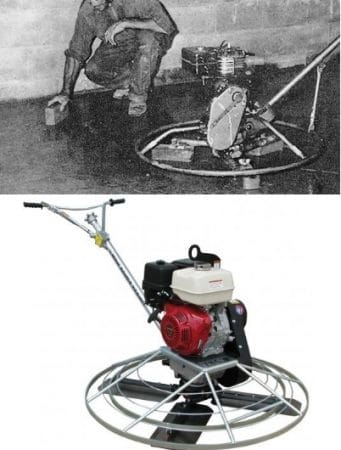
Finally, it is possible to use conventional rotary trowel for both dry grinding and wet rubbing by changing blades with grinding brick as illustrated in Fig. 5:

Conventional rotary trowel with brick grinding replaces blades
Fig. 4: Conventional rotary trowel with brick grinding replaces blades

3. Hand Rubbing Bricks

This technique used previously, but its application declined because it is found to be slow and costly for large areas.