Friday, October 5, 2018

Stamped Concrete and Its Preparation and Construction Methods


Stamped Concrete and Its Preparation and Construction Methods


What is Stamped Concrete?

Stamped concrete is a concrete which gives similar appearance to bricks, tiles, or wood etc., after stamping or texturing or patterning. Stamped concrete is generally used for sidewalks, driveways inside house, pool decks, interior flooring etc. to give aesthetic appearance.
When compared to bricks or tiles or wood etc., stamped concrete has better properties as follows
  • Low cost
  • Durable
  • Less maintenance required
  • Many Designs and colors are available
  • Even surface
Stamped Concrete

Preparation of Stamped Concrete Surface

Preparation of stamped concrete surface is very simple but care should be taken. The process involved in several steps which are explained below.

Preparation of Subgrade Soil

The subgrade soil should be well compacted and even surface. Otherwise soil erosion may occur which effects the concrete slab. We know that concrete is weak in tension, whenever there is an unevenness in the subgrade soil, then the surrounding concrete region subjected to bending and fails at where tensile force develops. So, care should be taken while preparing the subgrade surface.
stamped-concrete-subgrade

Arrangement of Forms for Stamped Concrete

Forms acts like barrier for fresh concrete to hold it in a particular place. These are made from wood or metal. After preparing subgrade, forms are arranged based on our choice of shape of deck or way. The forms should be in good condition to hold the concrete in correct place. The corners created by forms should be in clean shape.
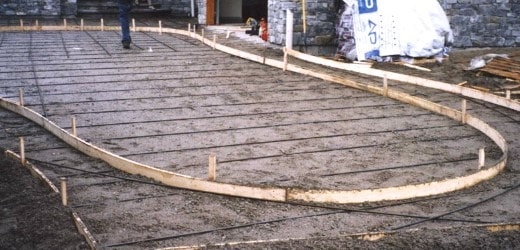
Forms for Stamped Concrete

Provision of Reinforcement in Stamped Concrete

Steel bars or wired mesh are used as reinforcement materials for stamped concrete. For small area surfaces it is not necessary but for larger decks and drive ways reinforcement will give superior stability. Another advantage is if soil erosion happens in future under the slab, because of steel it can bear some tensile strength also. So, providing reinforcement is better for long durability especially for driveways or vehicle parking places.
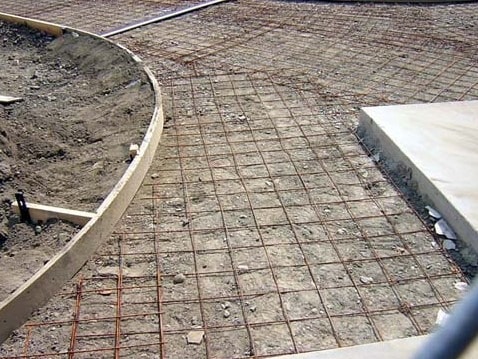
Reinforcement in Stamped Concrete

Pouring Concrete for Stamped Concrete

Generally concrete is prepared in ready mix plant and pour into arranged forms by tube or pipes. Pouring should be done as quickly as possible otherwise rapid hardening of concrete occurs. For small area works concrete should be carried with buckets and pour into the forms but care should be taken against segregation of concrete.
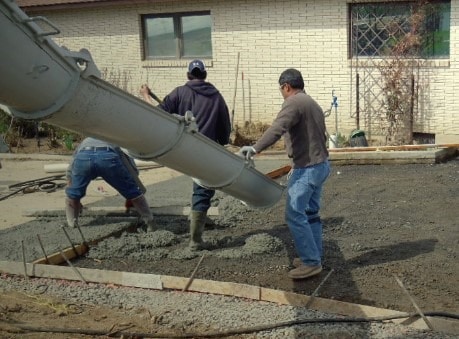
Pouring Concrete for Stamped Concrete

Leveling Stamped Concrete Surface

After pouring concrete, quickly strike off or level the concrete surface with smooth finishing. For this purpose, straight edges are used. It should complete quickly otherwise bleeding occurs. After finishing the concrete surface should be free from spots.
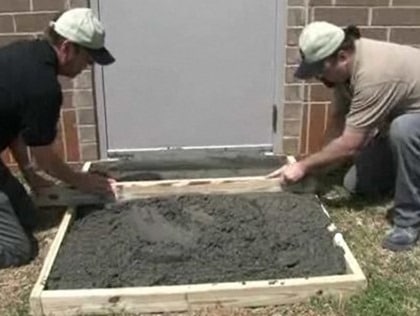
Surface Levelling

Coloring of Stamped Concrete

There are so many ways for coloring of concrete and they are
  • Integral color method
  • Dry shake color hardeners
  • Stains
  • Liquid release agents

Integral Color Method for Stamped Concrete

In this method, color is added to concrete during mixing of concrete. Whole concrete mix will possess same color so, if there is any breakage in the slab, the integral portion also exhibit same color. But in this case, we cannot get required amount of color because of mixing. It will give dull appearance.
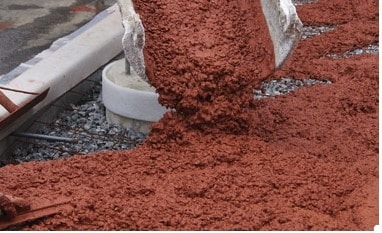
Coloring of Stamped Concrete

Dry Shake Color Hardeners

Dry shake color hardeners are applied on fresh concrete surface by hand. They are very fine powdered particles so, they settle in between cement and sand particles and make them less permeable. These are available in wide range of colors and gives bright appearance to the surface. But in this case color is only permitted to some depth of slab only.
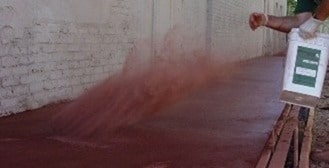
Color Hardeners for Stamped Concrete

Powdered and Liquid Release Agents

This is the best and popular method used for stamped concrete. In this method, integral colored concrete or normal concrete (with dry shake hardening) is poured and after stamping process darker liquid released agents are applied for bright color appearance. The release agents are available in powder and liquid forms. Powdered agents give more bright contrast than liquid agents.
Stamped Concrete Powdered and Liquid Release Agents

Stains in Stamped Concrete

In the above three processes we cannot create multiple color stamped concrete but stains can be applied to individually to the designed areas. So, it should be done after stamping process. They produce natural colors and give great appearance.

Stains in Stamped Concrete

Stamping of Concrete

For stamping purpose, special made stamps are available with many no.of designs. The stamps made from plastic or rubber. In this process just take the stamp mat and place it on the concrete surface and just press with small force. Stamping should be done quickly otherwise concrete may hardened. Finally check the design lines and correct them with sharp tool.
Stamping of Concrete

Checking Joints

After curing, check the joint lines thoroughly, if there are any cracked joints then fix them with integral colored concrete. And also install contraction joints at some planned points to prevent it from temperature changes and shrinkage.

Joints in Stamped Concrete

Curing of Stamped Concrete

After stamping leave it for 24 hrs. of initial setting time and then remove the excess amount of powdered agent with smooth brush.

Sealing of Stamped Concrete

Sealing is the final and important process in which sealer is applied to surface which improves the color quality of concrete. This will make the surface more impermeable and acts as protection layer from stains, dirt etc..
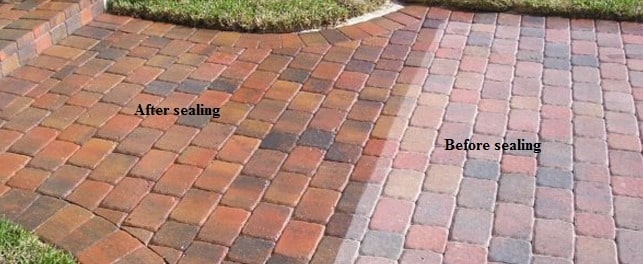
Sealing of Stamped Concrete

Thursday, October 4, 2018

Expansion Joint in Concrete – Types and Characteristics


Expansion Joint in Concrete – Types and Characteristics


Expansion joints are placed in concrete to prevent expansive cracks formed due to temperature change. Concrete undergoes expansion due to high temperature when in a confined boundary which leads to cracks.
Expansion joints are provided in slabs, pavements, buildings, bridges, sidewalks, railway tracks, piping systems, ships, and other structures.
This article emphases on need of expansion joint in concrete, characteristics of expansion joints, types of expansion joint and installation of expansion joints.

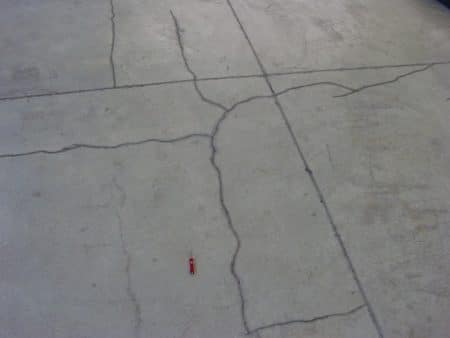
Cracks developed due to expansion of concrete.
Fig 1: Cracks developed due to expansion of concrete.

Need of Expansion Joint in Concrete

Concrete is not an elastic substance, and therefore it does not bend or stretch without failure. However, concrete moves during expansion and shrinkage, due to which the structural elements shift slightly.
To prevent harmful effects due to concrete movement, several expansion joints are incorporated in concrete construction, including foundations, walls, roof expansion joints, and paving slabs.
These joints need to be carefully designed, located, and installed. If a slab is positioned continuously on surfaces exceeding one face, an expansion joint will be necessary to reduce stresses. Concrete sealer may be used for the filling of gaps produced by cracks.

Characteristics ofExpansion Joints

  1. Expansion joints permits thermal contraction and expansion without inducing stresses into the elements.
  2. An expansion joint is designed to absorb safely the expansion and contraction of several construction materials, absorb vibrations, and permit soil movements due to earthquakes or ground settlement.
  3. The expansion joints are normally located between sections of bridges, paving slabs, railway tracks, and piping systems.
  4. The expansion joints are incorporated to endure the stresses.
  5. An expansion joint is simply a disconnection between segments of the same materials.
  6. In the concrete block construction, the expansion joints are expressed as control joints.

Types of Expansion Joint

Based on the location of joint, expansion joints are divided into following types,

1. Bridge Expansion Joint

Bridge expansion joints are designed to allow for continuous traffic between structures while accommodating movement, shrinkage, and temperature variations on reinforced and prestressed concrete, composite, and steel structures.

Expansion joint in bridges.
Fig 2: Expansion joint in bridges.

2. Masonry Expansion Joint

Clay bricks expand as they absorb heat and moisture. This places compression stress on the bricks and mortar, encouraging bulging or flaking. A joint replacing mortar with elastomeric sealant will absorb the compressive forces without damage.

3. Railway Expansion Joints

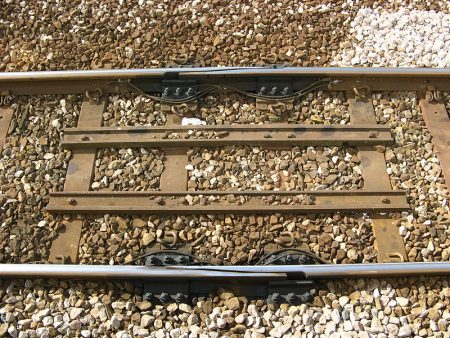
Usually, expansion joints are not provided in the railways tracks, but if the track is laid on a bridge having expansion joint, providing a expansion joint in the track becomes mandatory to mitigate the expansion in base concrete structure.

Expansion joint in railway tracks.
Fig 3: Expansion joint in railway tracks.

4. Pipe Expansion Joints

Pipe expansion joints are necessary in systems that convey high temperature substances such as steam or exhaust gases, or to absorb movement and vibration.
Based on the type of material used in making of joint, expansion joints are further classified into following types,
  1.  Rubber expansion joint
  2. Fabric expansion joint
  3. Metal expansion joint
  4. Toroidal expansion joint
  5. Gimbal expansion joint
  6. Universal expansion joint
  7. In-line expansion joint
  8. Refractory lined expansion joint

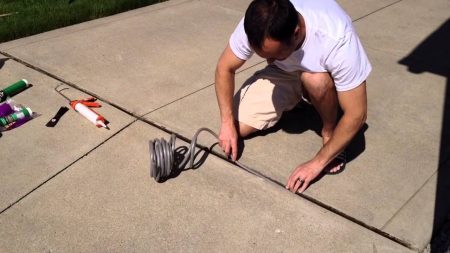
Use of filler material in expansion joint.
Fig 4: Use of filler material in expansion joint.

Installation of Expansion Joints

The depth of an expansion joint is usually one fourth of the slab thickness, or more if necessary. The expansion joint gap depends on the type of slab, like floating slab floor, vehicle pavement, sidewalk, or monolithic slab foundation. It is also influenced by the slab dimensions, type of concrete, and the reinforcing materials being used.
Cracks in concrete may occur at the expansion joints due to improper concrete mix or curing. These conditions cause shrinkage between the expansion joints and cracks can be formed.

1. Pre-Concrete Installation

When the site is prepared for the concrete pouring and the provisioning of the expansion joints in slabs are made prior to the placing of concrete. An individual expansion joint is created by the insertion of a flexible material that runs along the joint length.

2. After Concrete Installation

Once the concrete is set, suitable tools are used for making grooves in the poured concrete for placing of the joint materials.

Basics of Building Construction


Basics of Building Construction

Understanding the basics of building construction helps to construct a building project successfully. The steps involved in building construction are explained in this article.

Basic Steps in Starting a Building Project

When there is a plan to develop a new building, it is very necessary to have an idea about the start and the end of the building project. The flowchart below shows the construction flow from the start to the end of a building project

There may be variations as every project is unique and follows different design and construction process. In general, the basic steps involved in a building project are briefly explained.
  1. Planning
  2. Permits
  3. Preparation of Construction Site
  4. Foundation Construction
  5. Superstructure Construction
  6. Punch Lists
  7. Building Warranty Period

1. Planning

The planning in building construction involves three major steps:
  1. Developing the Building Plan
  2. Analysing the Finance
  3. Selecting the Construction Team
Once the site where the building project is indented to construct is chosen, the expertise of engineers and architects are taken to develop the site and the building plan. Sometimes, an appropriate site is selected after the building layout is prepared. The building plan is developed based on the owner’s requirements and budget.
Once the plan is in hand, the finance and total cost is estimated. The structural design details, the material estimates are prepared which help to derive project cost estimate. The cost calculated include:
  1. The material cost
  2. The construction cost
  3. The labor cost
  4. Miscellaneous cost
Based on the estimated cost, either a bidding process is performed or the project to handover to a known contractor. The contractor and the owner must agree to contract based on which the project is implemented. The contract mentions the completion period and necessary guides, exclusions to remove claims.

2. Permits and Insurance in Building Construction

Before starting a building construction, the owner must make sure that one has necessary permits taken to start the construction. Permits and insurance are obtained from different sources in cities and states.
A construction work conducted without permits results in project delay or project demolition or huge fines. Possessing insurance for the required parties helps to save the owner and the contractor.

3. Site Preparation

From here, the actual construction process starts. Based on the site and building plan, necessary excavations, leveling, and filling can be undergone to prepare the site. The necessary excavation for utilities, power, water and sanitation lines, temporary storage facilities are prepared. Mostly the works needed to set up the utilities are prepared. This is followed by an inspection from the government officials.
Inspections are performed at different stages on structural, building codes, the utilities, HVAC, electrical works etc. After the completion of the whole project, a final inspection is performed.

4. Foundation / Substructure Construction

Building structures are generally constructed on concrete foundations. Based on the soil type and water table level of the area, the foundation chosen can vary. If necessary, soil testing is performed to check the bearing capacity. Shallow foundations are required for low-rise building. For high-rise building, pile foundation is employed.
Once the foundation is selected, the soil is excavated to construct the foundation. It is performed based on the foundation layout. Formworks are placed in the foundation trenches and reinforcement is placed based on the foundation detailing design prepared in the planning stage. The reinforcement works performed by the contractor is periodically checked by the engineer in charge.
The concrete mix of the required proportion is poured to formwork and is cured to form the finished foundation.

5. Superstructure Construction

The superstructure is constructed once the substructure is complete. Generally, a framed structured is developed which is later finished with masonry walls. Adequate windows and exterior doors are placed based on the building plan. Other works coming under this section is:
  1. Construction of roofs or siding
  2. Installation of heating, ventilation and air conditioning
  3. Providing adequate electric and water lines connection line.
  4. Provide insulation works as required to protect from lighting
  5. Provision of waterproofing to the walls.
  6. Plastering and finishing the walls and surfaces
  7. Flooring works
  8. Exterior and Interior Painting

6. Punch List

Once the project is complete, the contractor inspects the whole work one by one and make a punch list. Those structural units or areas that were not constructed properly or are below the quality level is listed in the punch list. This is later corrected by the contractor in charge.

7. Warranty Period

Once the project is complete and handovered to the owner, the contractor specifies a warranty period. Within this period, any defects found in building constructed must be fixed and replaced by the contractor in charge. The warranty for materials and appliances are obtained from manufacturers and suppliers.