
Saturday, September 22, 2018

What are the Types of Ties Used in Building Construction


What are the Types of Ties Used in Building Construction?


Ties are tensioned reinforcements anchored and lapped mechanically or welded. Types of ties in building construction, their design and uses are discussed.

What are Ties in Building Construction?

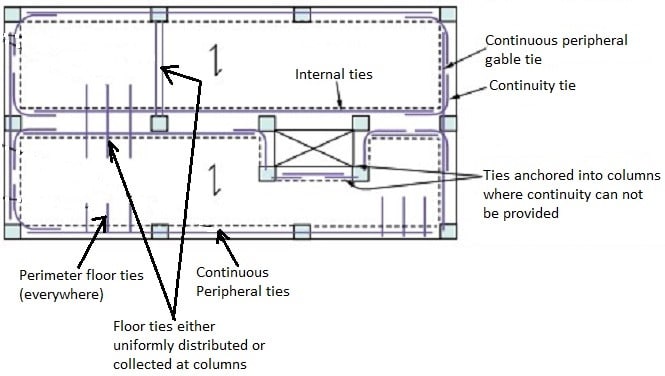
Ties are continuous tensioned reinforcements which are completely anchored and sufficiently lapped mechanically or using weld. There are various types of building ties used for various purposes. These types of ties are shown in figure-1.
Types of Ties Used in Building Construction
Fig.1: Different Types of Ties Used in Building Illustrated in a Typical Floor Plan

Types of Ties Used in Building Construction

Types of building ties include:
  • Peripheral ties
  • Internal ties
  • Horizontal column and wall ties
  • Vertical ties

Peripheral Ties in Building Construction

Peripheral ties are commonly provided at roof and floor level and it placed at 1.2m away from the perimeter wall or edge of the building, as explained in Figure-2.
Peripheral Ties in Building Construction
Fig.2: Location of Peripheral Ties
peripheral ties must withstand a tensile force equal to the lesser of 60KN or an amount computed according to the following equation.
F= 20+4no -> Equation-1
Where:
n: is the number of storey of the structure
The area of steel bars required for the peripheral ties can be computed according to the following equation:
Ast=F/ (0.87fy) -> Equation-2
Where:
Ast: is the steel area required for peripheral ties
Ft: Tensile force that peripheral tie should resist
Peripheral ties need to be anchored and lapped adequately. The location of peripheral ties need for a building is illustrated in Figure-3.
Location of peripheral ties in building construction
Fig.3: Location of peripheral ties are specified on typical floor plan

Internal Ties in Building Construction

Internal ties are placed at roof level and floor level in two directions nearly perpendicular to each other.
Internal ties should be effectively continuous along their length and connected at both ends to the peripheral ties or anchored to the columns or perimeter walls when such ties are continuous to columns or perimeter walls. Figure-4 illustrates the distribution of internal ties in typical floor plan
The maximum distance between internal ties is equal to the 1.5 times the longest distance between centers of vertical loading elements in the direction of ties.
The internal ties must withstand a tensile force equal or greater than the force computed according to the following formula:
Tensile force = 0.0267(gk+qk) lFt -> Equation-3
Where:
(gk+qk): is the sum of average characteristic dead load and live load exerted on the floor. These quantities are computed according to the specifications of Eurocode.
Distribution of Internal Ties in Building
Fig.4: Distribution of Internal Ties in a Typical Floor of a Building

Vertical Ties in Building Construction

It is specified to use vertical ties for buildings with minimum five storeys. Each wall and each column that support vertical loads need to be continuously tied from lowest level (foundation) to highest level (roof of the structure).
If the utilization of vertical ties is not possible, then the element must be designed in such a way that if such member is removed, then the surrounding elements should be designed to be able to bridge the gap and prevent failure due the removal of that element.
The force that vertical ties are subjected to is equal to the maximum design ultimate dead load and live load exerted on walls or columns from any one storey.

Horizontal Ties to Column and Wall

These ties are used to connect external load bearing elements to the structure certain levels. Therefore, all external loads bearing members such as walls and columns are to be tied or anchored into structure at each roof or floor level horizontally.
The design tie force is equal to the greater of the two values computed according to the following expressions:
Design tie force = 2For (floor to ceiling height in m / 2.5) Ft -> Equation-4
The smaller value is selected from equation-4
Design tie force = Three percent of the total ultimate vertical load in the wall or column at that level -> Equation-5
Horizontal ties should be provided in two directions at approximately right angle for corner columns.

Process of Brick Masonry Column Construction


Process of Brick Masonry Column Construction


Masonry column is a structural element which is one of the main load bearing element in a masonry structure. Process of reinforced and unreinforced masonry column construction is discussed.
Usually, the column construction is carried out by concrete to order to accommodate all the axial and compression forces coming over it under severe load action. Constructing a masonry column is the conversion of the masonry structure into a complete load bearing structure.
Brick Masonry Column
Fig.1. Brick Masonry Column
Mainly the column constructed by masonry can be reinforced or unreinforced to bring similar behavior to that of a complete concrete column. Different Ideas and concept behind masonry column design and construction are discussed below.

Features of Brick Masonry Columns
The construction of brick columns over concrete columns helps in increasing the architectural beauty. The constructed brick columns can either be round, rectangle or square or elliptical in cross-section. These can be constructed to the needful height. These columns can act as corner pillars, porch columns, boundary gate pillars or free-standing columns.
The construction of brick columns is fast and easy with less tools and labor compared with the concrete column construction. When compared with R.C.C columns, the brick column construction is more economical in nature.

Process of Construction of a Brick Column

As mentioned above, the bricks columns can be constructed either reinforced or unreinforced based on the load-bearing capacity required. The construction process of a brick column is summarized below:

Unreinforced Brick Column Construction

1. Preparing Layout on the Ground

Initially, the place and the center of the pillar or the column must be located on the ground by a temporary marking with a rod. This marking will help in supporting the vertical alignment and the horizontal alignment within the adjacent pillars.

2. Excavation and Foundation

The excavation is performed for constructing the ground support. The thickness of the excavation is based on the thickness of the foundation and the type of the masonry construction.
If there is no reinforcement to be placed on the masonry, a simple concrete bed of suitable mix is poured into the excavated area. The rod that is used as a marker of center is projected outside as shown in figure-2.
Unreinforced Brick Column Construction
Fig.2. The Rod representing the center of the column projected after laying the concrete mix for foundation

3. Brickwork for Masonry Column

Once the foundation layer is dried, the brickwork is started. The first-class bricks with a cement mortar of 1:4 ratio is used. This is sufficient to transfer the loads to the foundation safely.
The laying of the bricks must be done only after wetting them by dipping it in water. Certain brick column layer requires damp proof layer, for severe moisture conditions.
The brick is laid vertically upwards by maintaining the verticality and the horizontal alignment with the help of a plumb bob and compass.
Brickwork for Masonry Column
Fig.3. Laying of Bricks over the Concrete Foundation

4. Curing Works

Properly curing the brickworks for 7 to 10 days is required based on the construction.

5. Plastering, Finishing and Painting

Most of the brick column construction would give a good appearance without plastering. But if required, it can be plastered and finished. If necessary they can be painted.

Reinforced Brick Columns

The columns can be constructed by brick masonry by incorporating reinforcement into the same. This process of placing reinforcement in brick masonry will help in the increase in the load bearing capacity of the column.
As this type of construction have a requirement of placement of reinforcement bars unlike the case of concrete design. Special grooved bricks are employed that will have the provision for the placement of the reinforcement.
The figure-4 below shows the construction details of the reinforced brick column. The cavity space through which the reinforcement is passed through is filled with grout/mortar that makes the whole unit monolithic.
Reinforced Brick Columns
Fig.4. Plan and Cross-Sectional View of a Reinforced Brick Column
As shown in the figure, special cavities are intentionally made during the brick manufacturer for the placement of the reinforcement. Every fourth layer is provided with a steel plate as shown in the figure-1.
These will have a thickness of 6mm. The vertical reinforcement that is placed through the masonry is fixed at the bottom concrete foundation block.
The main application of reinforced masonry is for the construction of the retaining walls, lintels, loadbearing columns, the walls constructed on the soils that are subjected to more settlement. All these structures incorporate columns within it that too is constructed with brick masonry.

Friday, September 21, 2018

What is Frost Wall? Types and Uses of Frost Walls


What is Frost Wall? Types and Uses of Frost Walls


Frost wall or frost protected wall construction is to prevent soil beneath the building from freezing for protection of foundations in freezing temperature climates. Types of frost walls, their requirements and uses are discussed.
Frosting is a serious issue for the building structures during the colder climates. These undesirable effects are more pronounced and observed on the building foundation.
Any damage to the building foundation will affect the whole stability of the structure. In regions where the frosting is a persistent issue, the most common remedy is to construct deep foundation that will be lying over a footing level much below the frost line.
Hence the construction of buildings and structural elements in extreme climates is a very challenging procedure. The temperature characteristics of the building materials used for the construction is a sole factor that influence the construction.
The concrete placing and mixing in colder climate results in the contraction of the mix. These contractions of concrete will result in internal stresses.
If these issues of contraction and the internal stresses are not taken into consideration seriously there will be extreme issues of internal strain. The internal strain accumulation is a great danger for the structural integrity and the serviceability of the structure.

Need for Frost Protected Wall
Frost protected wall is constructed with an intention to prevent the soil around the building from freezing under high freezing temperatures. A form of heat conversion is used to transfer from the building to the soil beneath so that the soil does not freeze.
Construction of Frost Wall Foundation
Fig.1: Construction of Frost Wall Foundation in Freezing Temperature
As we know from the basics of soil mechanics, the soil matrix consists of voids that is filled with water and air. In dry soil, these soil voids will be filled with air. In the case of saturated soils, the voids will be filled with water that will get converted into ice under freezing temperature. The volume of water in a void will increase when the water is converted into ice.
The soils underneath the foundation is mostly filled with water. If the construction is on a colder region, these waters will get converted into ice. Any fall in temperature will melt the ice into water. Hence a procedure of freezing and thawing is experienced. This will result in an upward showing of the structure due to expansion and contraction.
Penetration of water in the interior of building
Fig.2: Penetration of water in the interior of building as the walls get wet
This frost heaving phenomenon will increase with the conversion of water in soil into ice. These frozen ices in the soil is called an ice lens. These ice lens will push the nearby soil mixture extensively. Any structure that is lying over such expanded soil will shove the structure in the upward direction.
Hence the only way to prevent such issues is to bring a means that will stop the freezing of the soil. The frost wall is such a unique technique implemented widely for this purpose.

What is Frost Wall?

The frost wall can be defined as an insulated wall that are constructed around the periphery of the foundation. These are constructed deep and beneath the frost line. As the frost wall are placed beneath the soil, the foundation won’t be subjected to upward pressure from the frost heave process.
The term frost wall is also used to mention walls that are constructed above the ground in the interior of the building structure. This will hence act as an insulation to maintain warmth for the building interior. These frost walls also collect heat from the structure and prevent the soil surrounding the building from freezing and related issues.

Types of Frost Wall

Based on the requirements of the load, temperature and the building features there are different types of frost wall that can be constructed. One such classification is:
  1. Load Bearing Frost Walls
  2. Non-Load Bearing Frost Walls

Load Bearing Frost Wall

This construction of frost wall will place the responsibility of foundation over the frost wall. The frost wall will itself act as a foundation wall by constructing it beneath deep the soil.
This will be clearly constructed beneath the frost line of the area. These type of frost walls are constructed in extreme weather conditions (freezing temperatures).

Non–Load Bearing Frost Walls

As the name implies, these frost walls are constructed just as an insulating wall. This is constructed in homes that are not insulated. These insulated non-load bearing walls will be constructed inside the building.
Non – load bearing frost walls helps in preventing the escape of heat through the foundation. The interior frost wall constructed must not be in contact with the exterior wall. Special care should be taken while constructing the same.
A gap is maintained between both the walls. It is also recommended to have a barrier to prevent moisture else the moisture will get converted into ice within the wall structure.

Requirements for Frost Wall Construction

The construction of the frost wall provides better performance if all the structural elements that accompany this construction too are of required properties.
Some of the basic features related to its requirements are mentioned below:
  • The basement wall constructed beneath the wall must be patched to prevent any open gaps. Mostly these basement walls are constructed with the help of cinder blocks. The gaps can be filled with the help of brick fillers.
  • If the basement walls are constructed with concrete, it is necessary to clear any cracks present in it with the help of a paint sealer. Special paints are available in the market that will help in preventing the penetration of moisture into the basement.
  • All structural elements must be built with a primary intention to prevent moisture penetration.

Application of Frost Wall

Below mentioned are the working and the construction of the frost wall for the preventing the shallow foundation from freezing and for non-heated buildings.

Frost Wall for protection of Shallow Foundation

The frost wall constructed with an intention to protect the shallow foundation is non-bearing frost walls. This type is used where the frost wall construction as a deep foundation is not at all feasible for the area or it does not bring any sort of economy.
The frost wall here is constructed by leaving a specified gap as per the constructor recommendation with the foundation. This is arranged such a way that the soil does not lose the heat from it.
These types of frost wall construction are constructed surrounding the foundation so that the heat radiated from the building is warmed up efficiently.
Frost wall insulation horizontally throughout the foundation
Fig.3. Insulation horizontally throughout the foundation
A rigid foam of insulation is constructed on the exterior of the foundation vertically and on the basement of the foundation horizontally. The construction of these insulation makes the heat formed within the interior of the building to move down the soil and prevent them from freezing.
Horizontal and Vertical Insulation for the frost walls
Fig.4.Horizontal and Vertical Insulation for the frost walls

Frost Wall for Non-Heated Buildings

The frost wall explained in above case provides warmth for the building only if the building constructed is a heated building. This type of frost wall won’t work for an unheated building type.
An alternative for such issue is to design a horizontal layer placed under the foundation of the entire building. This horizontal layer has to extend throughout the building area outward also. There is no form of vertical insulation provided.
The insulation provided are laid over the layer of gravel. Hence, the warmth will be entrapped within the soil and prevent the soil from freezing.