Friday, September 21, 2018

Highway Surface Drainage System and Its Design


Highway Surface Drainage System and Its Design


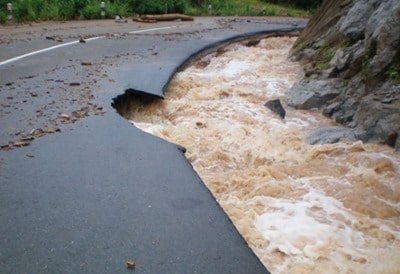
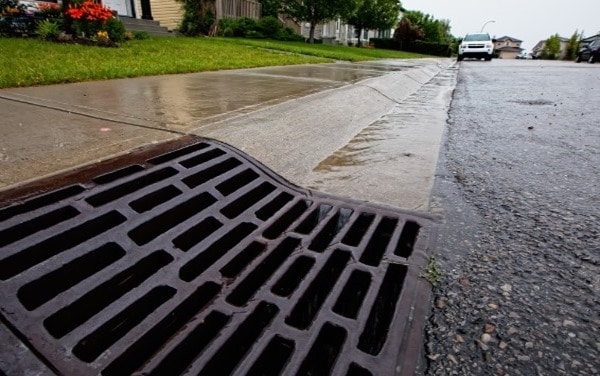
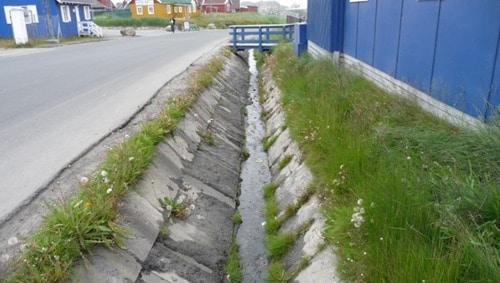
Surface drainage system is most important in Highway engineering. A pavement without proper drainage facilities will not serve for long time. The water or rainfall on road should be collected by side drains which carries the drain water to nearest stream or any water course.
So, prior to the construction of road, the designer should leave required space for providing proper drainage facilities as well as the pavement should also be constructed with minimum camber.
highway-surface-drainage-system-design

Design of Surface Drainage System for Highway

The design of surface drainage system carried by two types of analysis:
  • Hydrologic analysis
  • Hydraulic analysis

Hydrologic Analysis of Drainage for Highway

Whenever there is a rainfall, some of the rain water infiltrated into the ground and stored as ground water and some of the portion may evaporate into the atmosphere. Other than these losses, the water left on the surface is called as run off.
The method of estimating the run off is called hydrologic analysis. To estimate the maximum quantity of water expected to reach the drainage system is the main objective of hydrologic analysis. For this, one need to know the factors affecting run off and they are
  • Rate of rain fall
  • Moisture condition
  • Soil type
  • Ground cover presence
  • Topography
Other than the above factors, rain fall intensity, occurrence of storms in that area are to be studied from the old records. Hence, maximum run off can be estimated to build safe surface drainage system. The run off can be calculated by below formula
Q = C i Ad
Where Q = run off (m3/sec)
C = run off coefficient
i = intensity of rain fall (mm/sec)
Ad = area of drainage (m2)
Design of Surface Drainage
Run off coefficient “C” is the ratio of run off to the rate of rainfall. So, it is not same for all types of surfaces. It varies for different types of surfaces and its values for different surfaces are as follows:
Type of SurfaceCoefficient of run off
Pervious soil surface0.05 – 0.30
Soil covered with turf0.30 – 0.55
Impervious soil0.40 – 0.65
Gravel & WBM roads0.35 – 0.70
Bituminous & C.C roads0.80 – 0.90
If the drainage area contains different surfaces in it then run off coefficient is calculated as
C = (A1 C1+A2 C2+A3 C3) / (A1+A2+A3)
Where C1, C2, C3 are run off coefficients for different surfaces and A1, A2, A3 are their respective areas.
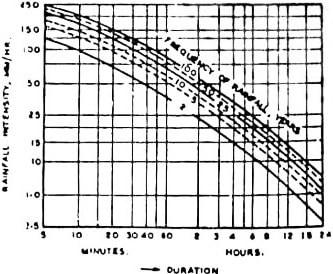
In the Next stage, Intensity of rainfall “i” is to be calculated. To find this, first we need to know the time taken by water to reach drainage inlet from the drainage area. This can be found out from the below graph. This is called as inlet time.
rainfall-time-period
Now we need to calculate the time required for water to travel from inlet of drainage to the outlet which is called as travel time This is calculated from the velocity allowed in the drainage line and generally it is kept at 0.3 – 1.5 m/sec.
After that both times (inlet time and travel time) are added which finally gives us the time of concentration. From this total duration, read the rain fall intensity from the below graph by assuming frequency of rainfall occurrence (say for 5 years, 10 years etc.)
rainfall-intensity
Lastly area of drainage is calculated by studying on the topographical maps of that region. Hence, the design value of run off “Q” is obtained finally.
Hydrologic Analysis of Drainage for Highway

Hydraulic Analysis of Highway Drains

Now comes the second stage hydraulic analysis, in which the dimensions of drainage channels or culverts are designed based on “Q” obtained in the above stage of analysis. Now we have discharge which is designed run off “Q”.
If we know the allowable velocity “V” in the channel, then the area of channel can be calculated from below formula:
Q = A.V
But the allowable velocity is not same for all types of channels. If the channel is lined, then the allowable velocity can be kept at normal. But if the channel is unlined it may cause severe damage to the channel in the form of silting or scouring.
So, the allowable velocity for different cases of unlined materials is as follows:
Soil typeAllowable velocity (m/sec)
Sand or silt0.30 – 0.50
Loam0.60 – 0.90
Clay0.90 – 1.50
Gravel1.20 – 1.50
Soil with grass1.50 – 1.80
Hydraulic Analysis of Highway Drains
Now we can find out the area of channel in m2. Next, the longitudinal slope of channel “S” is to be calculated by Manning’s formula:
Manning’s formula
Where V = Allowable velocity (m/sec)
N = Manning’s roughness coefficient
R = Hydraulic radius (m)
S= Longitudinal slope of channel
In the above formula, we already know the “V” value. Hydraulic radius “R” is the ratio of area of the channel to its wetted perimeter. Now comes, the toughness coefficient which is again varies according to lining material as follows:
Lining materialManning’s roughness coefficient, n
Ordinary soil0.02
Soil with grass layer0.05 – 0.10
Concrete lining0.013
Rubble lining0.04
Finally, longitudinal slope “S” is known and all the dimensions of drainage channel are known. Thus, the design of surface drainage system is complete. This method is mostly used for designing side drains of roads.

Thursday, September 20, 2018

What is pH of Water? Methods of Determining pH of Water


What is pH of Water? Methods of Determining pH of Water


What is pH of Water?

pH of water is a measure of amount of hydrogen ions that is present in the water. It determines if the water is alkaline or acidic in nature. pH stands for potential of hydrogen. As per the World Health Organization (WHO), value of pH for the water is 6.5 to 8.5.
pH can be calculated mathematically as
pH = -log [H]
This scale was developed by the scientist Sorenson in the year 1909. The below reaction implies that the water shows that the number of H+ and OH ions are equal in amount experimentally. It has also been proved that the product of both the concentration is equal to a constant ‘K’. The value of this constant found to be between 10 and 14.
H2O –> H+ + OH
For acids, the pH value is between 1 to 7. Alkaline will have pH value from 7 to 14.

Determination of pH of Water

There are two methods involved in the determination of pH value of water. They are:
  1. Colorimetric Method
  2. Electrometric Method
In environmental engineering experiments, every stage of water treatment is dependent on the pH value of the water. For example, the coagulation, disinfection, control of corrosion, acid-base neutralization and water precipitation.

Colorimetric Method for pH of Water

Take the pH standard solution and the water that is to be tested. Take the colorimetric paper. Dip this paper on the water sample. The obtained color is computed from the standard table and the respective pH value is recorded. This pH Value will conclude whether the sample of water is acidic or alkaline.
Standard pH Chart
Fig.1. Standard pH Chart

Electrometric Method for pH of water

One of the most widely accepted method for the hydrogen ion determination (pH) is the electrometric method. This method is highly accurate and used in laboratory work and by researchers. The accuracy of the pH value is 0.1 to 0.0001.
Determination of pH of water by pH meter
Fig.1. Determination of pH of water by pH meter

Apparatus for pH Determination

The apparatus required for the determination of water pH are:
  • pH meter that is suitable for field as well as laboratory analysis. These can have either one or two electrodes.
  • Distilled Water
  • Standard Buffer solutions with pH of 4, 7 and 10. The solutions of known standards can be used.
  • Thermometer that can read 77±18oC to the nearest value of 0.1 degree Celsius
  • glass stirring rod
  • Minimum capacity scale to read up to 1.1 lb

Procedure for pH Determination

The procedure of determination of pH of water involves the following steps:
  • The water sample is properly mixed and stirred using a glass rod
  • By using a watch glass, sample of water equal to 40ml (5ml more or less) is added to the beaker. The temperature of the water is allowed to stabilize by placing the sample stand for 1 hour. In between this time stirring can be done. After 1 hour, the temperature of the water is measured and this temperature is adjusted in the pH meter. Hence the pH meter shows temperature similar to that of the sample. All these adjustment to the apparatus must be performed and fixed before the test is conducted. There are some pH meters with automatic temperature controls. In such cases, the instructions provided by the manufacturer have to be followed.
  • The standard solutions are used to standardize the pH meter. Here also the temperature is adjusted as mentioned above procedure.
  • Next, into the water sample, the electrodes are inserted. The beaker is turned and adjusted so that there is good contact between the electrodes and the water.
  • Before starting the reading, the electrodes have to be placed in the solution for more than 30 seconds. This time period is required for the proper stabilizing of the meter to have proper reading. In pH meter that have an automatic reading system, a signal will be provided to tell that the meter is stabilized.
  • Once the reading is shown, it must be read to the nearest tenth of the whole number. If the value shows to 100th place then it has to be rounded off. The tenth-place digit is left if the 100th place is less than 5. For values greater than 5 after decimal, it is rounded to 1 unit. If the 100th place is equal to 5, the nearest even number is taken as rounded value.
  • The apparatus must be maintained after each use. The electrodes used are washed thoroughly with distilled water. If there is any form of film around the electrodes, it has to be cleared. Wiping of the electrodes must be avoided as this will result in polarization which will result in slow response of the experiment

Precautions and Tips

  1. The pH meter can be standardized by measuring the 7-pH buffer solution or any other solution of standard pH. Sometimes, the manufacturer of the pH meter may suggest other methods of standardizing, which too have to be followed.
  2. The electrodes have to be inserted into the water so that it does not touch the bottom of the beaker. Bottom contact with damage may cause damage to the electrodes.
  3. Any cause of slow response due to the polarization can be solved by washing the electrodes thoroughly.
  4. Periodic check has to be conducted to check the electrodes
  5. During the electrode storage, they have to be kept moist. And also follow the instructions of the manufacturer.

Steps Involved in Surveying for City or Township Construction


Steps Involved in Surveying for City or Township Construction


To build a new city or Township, surveying is to be done by considering all development works necessary for the city. The development works like street roads, property boundaries, water and sanitary pipes location, electrical lines, telephone lines etc. are involved in the city surveying.

Surveying Maps for a Township

Proper maps should be prepared for each of the systems of the city during surveying such as:
  • Topographic map
  • Street map
  • Property map
  • Water supply and sanitary map
  • Electrification map
  • Telephone line map
Each map should be prepared in such a way that a person can easily locate the required point in the map. Surveying is conducted for each system by their concerned departments or authorities.

Instruments for Surveying City or Township

Before discussing the preparation of maps, we must know the instruments used to conduct city surveying and they are
  • Transit theodolite with tripod
  • Leveling instrument with tripod
  • Plane table instruments
  • Leveling staff
  • Ranging rods, pegs, optical square, arrows etc.
  • Metric chain
  • Metallic tape
  • Invar tape

Preparation of Different Maps for a City

Topographic Map Preparation

In the preparation of topographic map, the whole area on which a township is going to build is divided into number of sectors. Each sector is enclosed by a polygon which are having a connection on common sides. In each sector, closed traversing is conducted using theodolite.
Plane table surveying is conducted in each sector and interior details like roads, parks, lakes etc. are located in the map. On the whole area some important points or constant points are noted and reduced levels (RL’s) are arranged at that points.
This is done by Fly leveling method. If there are any depressed areas like valley’s, lakes and high-rise areas like hills etc. then contour survey is conducted using tachometer method or plane table method.
In the map, the nature of ground is indicated by different markings or colorings or hatchings etc. Finally maps of all sectors are bring together to make it as a one map which gives the topographic details of whole city area.
Topographic Map for Township Survey

Street Map Preparation

Preparation of street map is very similar to topographic map preparation but in this case the map is prepared with large scale as compared to the scale of topographic map. In this case also, the whole city area is split into number of parts and each part is surveyed using plane table.
In each sector map, the details of each street, name of street, road networks joining streets, name of the roads etc. are mentioned. Benchmarks are located at various points along the streets for future references using fly leveling.
Street Map for Township Survey

Property Map Preparation

The property map is a large-scale map in which the boundaries of public properties and private properties are established. The boundaries are surveyed using plane table surveying.
After fixing boundaries the area is marked with plot numbers, premises numbers etc. in the map. By studying the property map, one can know about the boundaries of a particular area.
Here also the plane table surveying is carried out by dividing the whole area into parts.
Property Map for Township Survey

Water Supply and Sanitary Map Preparation

Generally, water supply pipes or sanitary pipes are located in the underground. The whole water pipes network is to be prepared into a map.
These pipes are represented by conventional lines in the map and for easy location of pipe lines, water supply and sanitary map is prepared on the street maps.
Then one can easily locate the required point of water supply at any street or house. In this lines, some important locations like inlets, outlets, purification points, valves, manholes, inspection chamber etc. are represented by specific symbols.
Water Supply and Sanitary Map Preparation

Electrification Map Preparation

In a city, the network of Electrical lines also laid in the underground. So, they are also located in street maps and represented by conventional lines.
To differ the electrical cables from the water supply or sanitary lines different colored lines are used and representation of each colored line is described in the map. In some areas, the electric cable network is arranged in the air using concrete columns or poles.
In this case also, conventional lines are used to represent electric cables. But their location is to be described. Important points like supply point, transformer location etc. should show in the map with specific symbols.
Electrification Map Preparation

Telephone Line Map Preparation

As similar to the water supply lines and electric lines, telephone cable lines are also laid in the underground so, that they also located in the street map using different colored conventional lines in the map. Important points are represented with specific symbols.
  • After preparing all the above maps, they are submitted to the development authority of the city and it will join with concerned departments and they will take the responsibility to build the city according to the map prepared. The concerned departments are municipality, electricity board, telecommunication departments etc.