
Monday, September 17, 2018

Steel Pile Foundations – Types, Design and Connections


Steel Pile Foundations – Types, Design and Connections


Precast piles and driven cast in piles make use of steel pipes. In the case of precast or totally performed piles, there are two classification such as hollow small displacement piles and solid piles. The hollow small displacement piles make use of steel pipes when steel pile foundation is recommended. When it comes to solid piles, steel H- piles are used.
In the case of driven cast in place piles the main classification is concrete tube steel tube. In case of steel tubes, we make use of closed ended tube and open-ended tubes.
Generally, the steel piles can be classified as:
Commonly used steel piles are rolled steel H section piles or pipe piles. The pipe piles have either an open or a closed end that is driven into the ground. I-section or wide flange piles can also used as pile foundation.
The H-sections are preferred more over I-sections, as the H-section have same thickness for the web and the flange. In the case of I section, the thickness of the web is less compared to its flange thickness.
If Q is the allowable structural capacity, A being the cross – sectional area of the steel and the allowable stress of the steel given by fsThen
Qall = A x fs
During the geotechnical investigation the design strength is determined as Qdesign and this must be within the Qall.

Connections in Steel Piles

The figure-1 below shows an H-pile being spliced by welding and riveting. Based on the requirement, the steel piles can be either welded or riveted for splicing purpose.
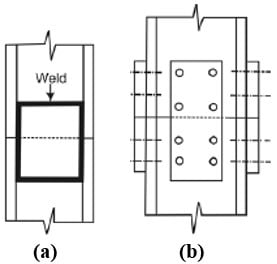
Splicing of H-Pile
Fig.1: Splicing of H-Pile by means of (a)Welding (b) Rivets and Bolts
The pile ends as mentioned might have a flat bottom or a conical bottom as shown in the figure-3. Here welded connections are provided.
Steel Piles with flat bottom and conical bottom
The piles are provided with driving shoes or driving points in order to facilitate easy movement in hard soils (Soft rock, shales and dense gravel). The figure-2 above forms two shoe types that can be provided for the piles.

Types of Steel Pile Foundations

1. Pipe Piles

Pipe piles are employed to behave as friction or end bearing piles. These piles are seamless and steel pipes that are formed by welding. The driving of these piles can be carried out with the help of an open or a close ended bottom. Hence, we have:

Open End Pipe Piles

These type of pipe piles is mostly used to penetrate a hard or a rock stratum. These piles after driving is sunk in the soil. The soil that is within the steel pipe is removed by means of compressed air or by means of water jetting process. After driving the steel pipe to required depth, the steel pipe is filled with concrete of standard specification.

Close End Pipe Piles

In this type of pipe piles, a conical element either made of steel or cast iron is attached to the open bottom by means of welding. This is the conical shoe. Once the pipe is driven into the soil, the pipe is filled with adequate amount of concrete.
The diameter of the pipe piles used can vary from 0.25m to 1.2m. The thickness of these pipe piles varies from 8 to 12mm. For pile foundation greater than 30 inches this type of pile works best.

2. Screw Piles

The screw piles are made of steel or cast iron. These form a long shaft that are terminating at the end in the form of a screw base or a helix. The shaft that is employed in the screw piles can be either a hollow one or a solid one.
Screw Piles
Fig.3: Screw Piles
The base of the screw has a diameter ranging from 0.45 to 1.5m. The screw bottom is driven into the soil by means of an electric motor that help in easy penetration into the strata.
The screw piles have great application in clay or loose soils. Screw piles in these areas help in increasing the bearing area. The installation of pile foundation in these types of soils are made easy by the steel screw piling.

3. Disc Steel Piles

The disc steel pipe has an arrangement similar to the screw piles, where it has cast iron disc attached to the bottom. The pile sinks into the soil while penetration. So, to facilitate the water jetting process a hole is made at the bottom.
These types of piles can be employed in soft or sandy soil. This area is well suited as it allows the sinking of the disc piles during the water jetting process.
Disc piles are more applied for marine constructions, as these areas require for large amount of total penetration.

4. H-Piles

Rolled steel H-beams performed as a bearing pile is one of the new technology developed in the piling industry. Hard driving of the pile into the soil strata results in large amount of impact forces and stresses. The H-piles can sustain this stress to a large extent. H-piles are mostly used to penetrate an area with rock or any other hard strata.
No extra process of jetting, coring or adopting methods need to used to perform the penetration of H -piles. The small cross section of the H -piles make the soil displacement process easier.

Advantages of H-Piles

  1. H-piles consume less space for storage
  2. The handling of H-piles are performed easily
  3. H-piles penetration can be performed closer to the existing structure
  4. The amount of unusual displacement caused nearby area during the penetration of the H -piles are very small.
  5. The splicing process in H-piles can be performed easily.
  6. The maximum depth to which H-piles can be driven is 100m.
  7. H -piles perform the function of both friction and compaction piles
  8. The Main application of H -piles are in trestles, retaining walls, cofferdams and bridges.

Corrosion of Steel Piles

The steel pipes irrespective of what type is employed have great chance for corrosion. In such situations the piles can be coated with coal tar or corrosion protecting coating. Sometimes certain chemicals or materials are encased on concrete to prevent the corrosion.

Saturday, September 15, 2018

Components of an Airport


Components of an Airport


There are various components of an airport which are structures. The planning and designing of these Airport components are carried out by civil and structural engineers.
Components of an Airport

Components of Airport

  1. Runway
  2. Taxiway
  3. Apron
  4. Terminal building
  5. Control tower
  6. Hanger
  7. Parking

Runway

Runway is a paved land strip on which landing and takeoff operations of aircrafts takes place. It is in leveled position without any obstructions on it.
Special markings are made on the runway to differ it from the normal roadways. Similarly, after sunset, specially provided lightings are helped the aircrafts for safe landing.
Many factors are considered for design of runway. The direction of runway should be in the direction of wind. Sometimes cross winds may happen, so, for safety considerations second runway should be laid normal to the main runway.
The number of runways for an airport is depends upon the traffic. If the traffic is more than 30 movements per hour, then it is necessary to provide another runway.
Runway can be laid using bitumen or concrete. Bitumen is economic but concrete runways have long span and requires less maintenance cost.
The width of runway is dependent of maximum size of aircrafts utilizing it. The length of runway is decided from different considerations like elevation of land, temperature, take off height, gradients etc.
Airport Runway
There are different runway patterns are available and they are
  • Single runway
  • Two runways
  • Hexagonal runway
  • 45-degree runway
  • 60-degree runway
  • 60-degree parallel runway

Single Runway

Single runway is the most common form. It is enough for light traffic airports or for occasional usages. This runway is laid in the direction of wind in that particular area.

Two Runway

Two runway contains two runway which are laid in different directions by considering cross winds or wind conditions in that particular area. The runways may be laid in the form of L shape or T shape or X shape.

Hexagonal Runway

This is the modern pattern of system of runway laying. In which the takeoff and landing movements of aircrafts can be permitted at any given time without any interference. This is most suitable for heavy traffic airports or busiest airports.

45 Degree Runway

45 degree run way is opted when the wind coverage for same airfield capacity is greater. This is also termed as four-way runway.

60 Degree Runway

When the wind in that area is prevailing in many directions, so, it is difficult to decide the direction in which runway is to be laid. In that case, 60-degree runway is opted which looks like triangular arrangement of runways.

60 Degree Parallel Runway

It is the extension of 60-degree runway, which is opted when the wind coverage is greater in other two directions then it is obvious that the third runway is to be chosen.
But if the air traffic is more, then it is difficult to control the operations. Hence, another runway is required parallel to the using one. For that purpose, 60-degree parallel runway is suitable.

Taxiway

Taxiway is path which connects each end of the runway with terminal area, apron, hanger etc. These are laid with asphalt or concrete like runways.
In modern airports, taxiways are laid at an angle of 30 degree to the runway so that aircrafts can use it to change from one runway to other easily. The turning radius at taxiway and runway meets should be more than 1.5 times of width of taxiway.
Airport Taxiway

Apron

Apron is a place which is used as parking place for aircrafts. It is also used for loading and unloading of aircrafts. Apron is generally paved and is located in front of terminal building or adjacent to hangers.
The size of area to be allotted for apron and design of apron is generally governed by the number of aircrafts expected in the airport. The aircraft characteristics also considered while design.
Proper drainage facilities should be provided with suitable slope of pavement. Sufficient clearances must be provided for aircrafts to bypass each other.
Airport Apron

Terminal Building

Terminal building is a place where airport administration facilities takes place. In this building, pre-journey and post journey checking’s of passengers takes place.
Lounges, cafes etc. are provided for the passengers. Passengers can directly enter the plane from terminal buildings through sky bridge, walkways etc.
Similarly, the passengers from plane also directly enter into the terminal building.
Airport Terminal Building

Control Tower

The control tower is a place where aircrafts under a particular zone is controlled whether they are in land or in air. The observation is done by the controller through radars and information is carried through radio.
The controller from the control tower observes all the aircrafts with in that zone and informs pilots about their airport traffic, landing routes, visibility, wind speeds, runway details, etc. based on which the pilot decides and attempts safe landing. So, control tower is like nerve system of an airport.
Airport Control Tower

Hanger

Hanger is a place where repairing and servicing of aircrafts is done. Taxiway connects the hanger with runway so, when a repair needed for an aircraft it can be moved to hanger easily.
It is constructed in the form of large shed using steel trusses and frames. Large area should be provided for Hanger for comfortable movement of aircrafts.
Airport Hanger

Parking

This is a place provided for parking the vehicles of airport staff or passengers which is outside the terminal building or sometimes under the ground of terminal building.
Airport Parking

Planning for Construction of Parking Structures – Parking Demand and Issues


Planning for Construction of Parking Structures – Parking Demand and Issues

Planning for Construction of Parking Structures

Whenever there is need for parking more than that can be accommodated in the surface lots that is served by a building or a service center, there comes the need for parking structures.
Parking can be defined a large consumer of land and resources. In general shopping centers requires 1.5 square feet of parking for every leasable square foot. This is 1 square feet for office buildings.
The owning and operation of parking structures are very costly. Its construction cost is five times greater than the amount taken for the surface parking construction.
Surface parking is not considered as the highest and the best use of parcel land. But a denser development or expansion of an existing land is possible by the construction of parking structures.
Acres of free land is given for parking which is not utilized properly. This can be taken a route of transportation making the public transportation economical and having good roadways.
It is essential to know while planning parking structures that how much parking is really needed. Along with it the best method to construct it in a cost-effective manner has to be decided. This will give a clear idea on the finance and how much to pay.
Planning for Construction of Parking Structures

Planning for Parking Space

The peak accumulation of the vehicles that are parked, which are generated by the land under the present conditions is called as the parking generation.
The number of spaces that have to be provided by a single building or a group of buildings to facilitate parking is called as the parking demand. This include extra spaces over and above the expected peak accumulation of the vehicles.
The demand for parking vary from one location to another. The variations will be dependent on the rate and density of development of that area, the availability of public transportation, the policies governed in the local area, the price incurred for parking and the local economic strength levels.
A sensible way of finding out the parking demand is by starting with a national standard. This standard assumes a 100% modal split to the automobiles that are running private. Then the adjustments are made based on the local conditions of the area under consideration.

Issues in Parking Demand

While planning, the parking demand is subjected to variety of issues. These issues are mentioned below:
  1. Issues in Units
  2. Design Day and Hour Issues
  3. Effective Supply
  4. Accessory Uses
  5. Complementary uses
Issues in Units
The requirement of parking is mainly expressed as ratio of x spaces per y unit of land use. Most of the ratio is represented by sq. ft. or square meter of the area of the building.
In old standard methodology, the calculation is carried out based on the net floor area(NFA). This is calculated as inside to inside measurement. But virtually the gross floor area (GFA) is followed by many which is outside to outside measurement of the building area.
There is gross leasable area (GLA) which is the GFA which is leased by the tenants. When multiple tenants occupy a land type we call it as GLA.
Design day and hour
Another important issue is the need for parking analysis to select a feasible design day and hour. It is not recommended to have a parking system to accommodate the vehicles number equivalent to peak accumulation. And such a decision will make the parking lot to remain free for non- peak times.
A parking system must not be designed that it cannot take adequate number of vehicles. The parking generation provides a regression curve of the average value of peak accumulation of vehicles.
Effective Supply
The need for effective supply becomes necessary when situations arise where the parking system shows a lesser efficiency than what it is expected to have. In situations where a vehicle is misparked, or the area is covered with snow, or reasons of vehicle manoeuvres must have the ability to accommodate for an extra space when necessary.
This means the parking demand must include the planning of providing the effective supply cushion when necessary. Parking demand is equal to the sum of the parking generated and the effective supply cushion.
Accessory Uses
These are space in the land use which is not a principal activity generator. But these have a role in the required operation. These areas become a question while calculating the parking area land and rate.
Complementary Uses
When a multi-tenant building land space is leased and used to serve the primary one we call it as complementary use. These have a different parking characteristic. This can cause sharing of the parking by different user.
Like the parking needs of a coffee shop of a multi-storey building can be figured in the same rate of office space. Use of multiple tenants in a mixed have must follow the regulations.

Organic Prestressing System – Applications, Features, Advantages


Organic Prestressing System – Applications, Features, Advantages

The organic prestressing system is a concept taken as an inspiration from the behavior of an organic structure (biomimetic or the nature formed structures) that is derived from nature, called the muscle. This resemble an active control system of prestressing.
The main objective of organic prestressing system is to reduce the stresses or the deformations caused due to the live load. The OPS can be defined as an automatic adaptive prestressing system that has the capability to either increase or decrease the prestressing force based on the load variation under service conditions of the structure.
For more understanding, one can express the organic prestressing system as a prestressing system that automatically adjust the tension applied to the cables based on the loads actuated. This is carried out by means of a control system. This adjusting serve the objective of minimizing the tensions and the structural deformations.
The development of OPS originated by a research project on Organic Prestressing which was initiated in FEUP. The results of the first numerical simulations bought a conclusion that the organic prestressing is mainly useful for the bridge equipment structures.
As the bridge construction have large importance on the variation in live load and deformations, the OPS can work best for the same. The development of OPS can be explained in the following stages of development, as shown in the table below.
Table.1.OPS Technology – Historic Synopsis
YearAccomplishments
1994-1999The R&D stage is developed at FEUP
2003The initial lab model
2004The first application of OPS system in full scale. The pilot project developed in FEUP
2009The OPS Bowstring Concept for 70M span
2011Upgrade of OPS for temperatures less than zero, First Large Viaduct; Multi-span
2013The first application of OPS for Cable stayed
2014Precast Segmental Construction – Use of OPS in launching Gantries
2015Application on 90-meter Span Multi -span Viaducts

Organic Prestressing System Browsing Concept

The OPS browsing system was developed between the period 2007 and 2009. The overhead equipment is gained by some of the browsing concept. The browsing concept have certain advantages in applications like in the movable scaffolding systems (MSS).
The movable scaffolding systems help in construction of bridge have curved curvature. This makes the assemblage more important. This method brings more stability in the launching stage. The organic prestressing system concept have also been developed in large movable scaffolding systems (LMSS).
Components of Organic Prestressing System
Fig.1: Main Components of Organic Prestressing System Browsing Concept

Elements and Concept of Organic Prestressing System

The main elements of OPS system considering the bridge construction equipment as the explanatory reference are the:
  1. The activator and the active anchorage
  2. The un-bonded cables used
  3. The sensors
  4. The electronic controller is present in the girder control unit
  5. The passive anchorage
  6. The deviation shores
The figure-2 shows a clear explanation about the following.
Elements and Concept of Organic Prestressing SystemFig.2: The main elements involved in a OPS technology in Bridge Construction
An algorithm that employs the girder mid-span deflection as the major variable is used as the criteria for OPS control. The pressure transducers are installed to monitor and measure the mid-span deflection. The sensors will continuously send signal to the control unit of the whole arrangement (PLC).
This control algorithm decides the decision based on the actuation of the loads. This change is affected on the tension of the cables that are prestressed. These variations are related to the hydraulic cylinders’ stroke variations. Now the mid-span deflection is the factor that govern the actuation decision.
The OPS are provided with distinctive and redundant sensors which will measure accurately and correctly. This guarantee that the algorithm decision is taken based on an accurate information.
Many warning operators are provided, to check the data. These operators work if any kind of inconsistency is detected. There are several alarm combinations to facilitate this incoherence and warn the operator to check the data. This facility is available on real time through a touch screen interface. This is installed on the girder control unit.
The operator has to confirm whether the data is correct or not, based on which immediate action is taken. This is to ensure that the operation is carried out regularly further and the cause of risk is prevented. Here, the bridge equipment behavior is clearly provided to the operator. This way the OPS system helps in the improvement of safety factor of the structure.

Advantages of Organic Prestressing System

Some of the advantages that is gained by the installation of OPS system are:
  • Lighter design of structures
  • Construction of efficient structures
  • Reduction of weight have good impact on the operational and the productivity cost
  • The load carrying capacity is increased
  • Efficiency of Work is Improved

Applications of Organic Prestressing System

The OPS system has been applied in the launching of gantry equipment in segmental construction of bridges. The OPS technology works best for the construction of long span bridges.
Other than the advantages mentioned above, it also has the capability to overcome the challenges like:
  • Excessive weight of the Equipment
  • Construction time – Delay in construction time due to difficulty in the equipment management is reduced by the OPS technology.
  • The versatility of the scaffolding equipment is improved
  • The transportation is made easy
  • The site assemblage is made easy
  • The space required for the storage of equipment is reduced.
  • Productivity
  • Instability of large spans
The deflection control in OPS system overcome the precast segmental construction span by span. They let new limits of construction bringing new creativity.

Features of Organic Prestressing Technology

The main features of OPS technology in bridge construction are:
  • The reduction of mid-span deflection.
  • Reduction of mid-span deflection in the case of launching gantries.
  • Equipment that are lighter in construction are attained
  • Ensure higher load capacity for the equipment
  • Higher safety level is ensured by having continuous monitoring of the scaffolding structures.
  • The OPS technology has ability to predefine the deflections.
  • More simpler steel connections are employed by the OPS technology. This will help in the reduction of tension.