Friday, September 14, 2018

Grade Beam Construction Process


Grade Beam Construction Process

What is grade beam?

Grade beams are commonly concrete beams which are designed to act as horizontal ties between footings or pile caps. They should be reinforced with continuous reinforcement that is developed within or beyond the supported column, or be anchored within the pile cap or footings, ACI 318-14.
The grade beam either rests directly on the soil or above the soil spans between piles. A continuous grade beam footing will transfer the load of a building to the ground or to its bearing points where their bases distribute the load to the soil.
In this article,  construction process of reinforced concrete grade beam will be discussed.

Grade beam construction process include:

  1. Preparation and excavation for grade beam
  2. Grade beam formwork installation
  3. Placing reinforcement of grade beam
  4. Pouring concrete for grade beam

1. Preparation and excavation for grade beam

Trenches for the grade beam is excavated Based on its level. Alternatively, if the grade beam is constructed directly on the ground, then the ground surface will be leveled and prepared.
Where the grade beam is used between piles as shown in Fig.1, construction preparation and excavations will begin after finalizing pile construction.
However, excavation of trenches for the grade beam will be executed along that of footing when the grade beam is used with footings.
Finally, if the grade is constructed above the ground surface, then installation of forms will be the first step in construction process of grade beam.
completion of site preparation
Fig. 1:Completion of trench excavation for the construction of grade beams between piles 
grade beam excavated along with footings
Fig. 2: Grade beam excavated along with footings

2. Formwork installation for grade beam

After the site preparation and excavation of trenches is completed, then forms will be placed according to the dimensions of the beam which shall be provided in the design drawings.
If the grade beam is constructed on the ground, then the bottom of the form shall be placed prior to its sides. In this case, flat soling brick is formed along the grade beam instead of bottom shutter.
After that, either the reinforcement cage is placed on the flat soling brick before side shuttering is fixed or one side of the form is placed followed by installation of reinforcements.
If the grade beam is constructed above the ground, then the formwork construction would be similar to that of conventional beam. So, shutters shall be placed for bottom, and both sides of the grade beam.
In this case, formwork can be fixed completely followed by reinforcement placement, or fix only the bottom shutter then place reinforcements, after that install side shutters. These construction sequences are selected based on ease of construction and convenient.
Lastly, after the completion of grade beam formwork, insure that designated grade beam dimensions are provided including sufficient reinforcement cover. added to that, shuttering strength, waterproofness, strength of supports of grade beam formworks, verticality of side shutters, and location of grade beam shall be checked as well.
placement of reinforcement on flat soling bricks
Fig. 3: Placement of reinforcement on flat soling bricks
Shuttering bottom and one side of grade beam and placed reinforcement
Fig. 4: Shuttering bottom and one side of grade beam and placed reinforcement

3. Placing reinforcement of grade beam

After finishing shuttering or placement of flat soling bricks for the bottom of the grade beam, reinforcement placement begins directly or after side one side of the formwork is placed.
Necessary reinforcement detailing such as size and number of longitudinal reinforcements and its required length, number and spacing of stirrups are provided in structural drawings.
Finally, number and size of top; bottom; and extra reinforcements, lap length and placement, hooks,spacers, and clear reinforcement cover shall be checked after reinforcement placement is finished.
fixing grade beam reinforcement after installation of side shutter
Fig. 5: Fixing grade beam reinforcement after installation of side shutter

4. Pouring concrete for grade beam

Grade beam can be casted with ready mix concrete or on-site machine-mixed concrete. The former is desired if the concrete volume is large.
If ready mix concrete is used, then concrete supplier needs concrete strength only. However, if on-site machine mix concrete is employed then ratio of concrete constituents shall be found.
Poured concrete shall be compacted adequately using vibration equipment or any other suitable means, then finish the top of grade beam.
Finally, the side-shutter of grade beam can be removed 24 hours after pouring concrete. However, bottom shutter cannot be removed till concrete achieve its strength. This time duration for stripping bottom shutter depends on the clear span of the beam.
concreting of grade beam
Fig. 6: Concreting of grade beam
Fig. 7: Stripping shuttering of grade beam after concrete achieved required strength

Types of Drawings used in Building Construction


Types of Drawings used in Building Construction

Different types of drawings is used in construction such as architectural drawings, structural, electrical, plumbing and finishing drawings. These drawings provides layout plans and details for construction of each and every part of the building.
Drawings plays an important role in the construction field to convey the ideologies and perspective of the designer to the layman at site. The drawings may be used to indicate the overall appearance, inside or outside the structure, or they may be used to indicate precise measurements and other details for construction.

Types of Construction Drawings

There are different type of drawing used for the construction process. Depending upon the purpose they serve, construction drawings are divided into 5 types,

1. Architectural Drawing

Architectural drawing can be termed as the mother drawing for all the other drawings used for construction. It contains all the details of the project such as location site plan, setting out plan, elevations, sections and other details.

1.1 Site Plan

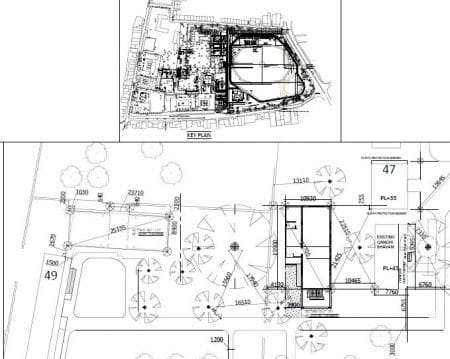
This is primary drawing used for marking out the plan on the ground. It represents the location, orientation and information about the sites topography, landscaping utilities ,and site work.
Layout Plan
Fig 1: Layout Plan

1.2 Working Plan

This drawing gives the information of horizontal dimensions of the building, thickness of walls, clear spaces inside the building and column locations. it also shows the openings required in the building such as doors, windows and ventilators.

1.3 Section Drawings

Section drawings represents the material of construction to be used, heights and measurement of the different components of buildings, type of structural components such as type of slab , etc. Its represents the drawing when the building is cut through a vertical plane.

1.4 Elevation Drawing

Elevation drawing represents the information of openings, size and shape of external surface, height of building and finish of the building after completion. These drawings are made by having a aesthetic view of the building.

2. Structural Drawing

Structural drawings can be termed as the backbone drawing of the building. It consists all the information about the structural intervention that are coming on a building. It contains many type of drawing with very minute details and description.

2.1 General Note

This is more of a codes and by laws of the buildings. No drawing is found in this, but the details of all the structural drawings are mention in this such as concrete mix, lapping length, curing time, abbreviation, codes and other work procedures.
General Notes
Fig 2: General Notes

2.2 Excavation Drawing

This drawing represents the footing excavation dimension, column position, footing plan and grid lines of column.
Excavation Layout
Fig 3: Excavation Layout

2.3 Column Layout

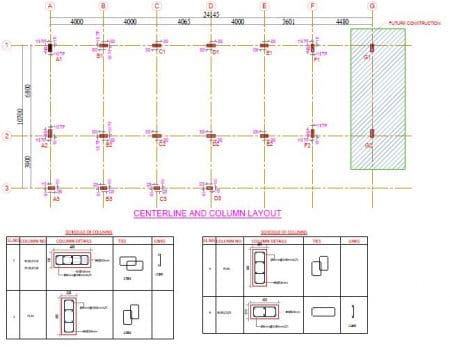
This drawing represents the position and orientation of columns and column reinforcement details.
Column Layout
Fig 4: Column Layout

2.4 Plinth Beam Layout

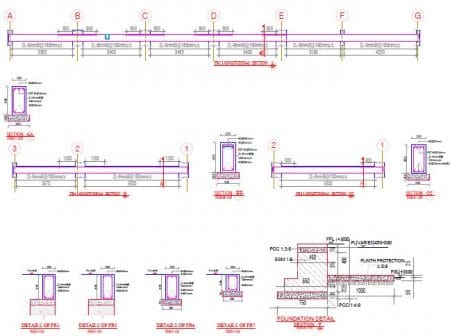
This drawing represents the dimensions, position and section of plinth beam and the details of reinforcement in plinth beam.
Plinth Beam Layout
Fig 5: Plinth Beam Layout
Plinth Beam Details
Fig 6: Plinth Beam Details

2.4 Lintel Beam Layout

This drawing represents the dimensions, position and section of lintel beam and the details of reinforcement in lintel beam.
Lintel Beam Layout and Details
Fig 7: Lintel Beam Layout and Details

2.5 Roof Beam and Shuttering Layout

This drawing represents the details of reinforcement of roof beam, its section and shuttering details.
Roof Beam and Shuttering Layout
Fig 8: Roof Beam and Shuttering Layout

2.6 Roof Slab Layout

This drawing represents the details of reinforcement of roof slab, its section and openings in the roof for various purpose such as stairs or skylight.
Roof Slab Layout
Fig 9: Roof Slab Layout

3. Electrical Drawing

Electrical drawing represent the details of electrical fixtures, location of switches, fan, light and others. It also represents the load calculation, tapping for electricity, wiring path and other interventions such as AC and UPS and its components.
Electrical Drawing
Fig 10: Electrical Drawing

4. Plumbing Drawing

Plumbing drawings give the location of sanitary, piping for water supply system, fixture, and the process to connect every fixture.
Plumbing Drawing
Fig 11: Plumbing Drawing

5. Finishing Drawings

Finishing drawings represents the finish type of every component of the building such as flooring pattern, painting color, false ceiling shape, plastering texture and elevation design. These details are sometime given in elevation drawings also.
There is no standard rule of drawings required for a project. Depending upon the type of building and requirement, types of drawings are made and issued .

What is Gabion? Its Types, Applications, and Advantages


What is Gabion? Its Types, Applications, and Advantages

What is gabion?

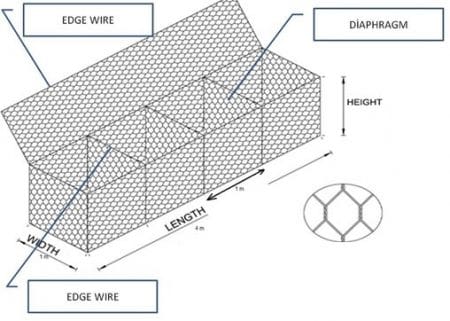
Gabion is a welded wire cage or box filled with materials such as stone, concrete, sand, or soil. So, gabion is a partially flexible block construction used for slope stability and erosion protection in construction. Various types of gabions are constructed and used in different engineering constructions.
Sometimes, live rooting branches may be placed between the rock-filled baskets which improves durability and stability of the gabion. This article presents gabion definition, types, applications, and advantages.

Gabion wire mesh properties

Wire mesh used to manufacture the cage of gabion shall poses certain properties otherwise it might not serve its purpose properly. Table 1 provides the desired properties of gabion wire mesh.
Table-1: Gabion wire mesh properties
Raw materialGabion wire mesh properties
Technical propertiesUnitDescriptionsTolerances
Meshmm50×70, 60×80, 80×100, and 100×120
Maximum wire thicknessmm2-50.05
Amount of coveringgr/m230-3005
Tensile strengthMPa350-20002
Elongation (25cm long)10%
Zinic coating strengthTurns5Shall not break or crack
Fig. 1: Wire mesh boxes for gabions

Types of Gabions

There are number of gabion configurations that can be selected based on their cost and function. Common types of Gabion are as follows:

1. Gabion baskets

  • It is a net wire mesh that produced in box-shaped and in different sizes.
  • Used in highway and railway works.
  • It would be economical unless filling materials are not available from quarries near the project site.
Basket gabion
Fig.2 : Basket gabion

2. Gabion mattresses

  • Gabion mattresses, also known as reno mattresses.
  • Gabion mattresses height is shorter than the other types of measurements as it might be observed from the Fig. 3.
  • It is employed in the channel coating for preventing erosion. So, it tackles wave and erosion induced velocity.
  • Common size, 6 m long by 2 m wide by 0,3 m high.
gabion mattress
Fig. 3: Gabion mattress

3. Gabion sacks

  • This type of gabions is formed quickly.
  • It has a porous and flexible structure.
  • Gabion sacks are usually used in hydraulic works in emergency conditions.
gabion sacks
Fig. 4: Gabion sacks

4. Gabion wire mesh

  • It is utilized to keep the possible rock and stone fall on the highway and railway surfaces.
  • Gabion wire mesh maintains stability of the slope close to highway and railways.
  • It is applied for anti-erosion to slope.
  • It enhances embankment soil strength in combination with geogrid reinforcement.
gabion wire mesh used to prevent rock fall from highway slopes
Fig. 5: Gabion wire mesh used to prevent rock fall from highway slopes

5. Decorative Gabion Elements

  • It is used indoor and outdoor decoration, garden design and landscaping.
  • Gabion elements offer suitable environment for the growth of plant roots
decorative gabion elements
Fig. 6: Decorative gabion elements

Applications of gabions

Gabions are used in several engineering projects and serve various purposes. common applications of gabions are as follows:
  • Retaining structures such as retaining walls (Fig. 7), revetment and toe walls to embankments and cuttings.
  • Corrosion prevention structures for instance sea walls, river bank defenses, canal banks (Fig. 8), dams, weirs, groynes and for the protection of reservoirs and lakesides.
  • cylindrical metal gabion is used for dams or in foundation construction.
  • It is employed as a noise barrier.
  • Gabions are also used as a temporary flood walls.
  • It is utilized to change the direction of the force of flood water around weak structure
  • Stepped gabions improve energy dissipation in channels.
  • Finally, it is used for aesthetic purposes
Gabion retaining wall for road embankment
Fig. 7: Gabion retaining wall for road embankment
Gabion mattresses used for covering channels to prevent erosion
Fig. 8: Gabion mattresses used for covering channels to prevent erosion
use of gabions in landscaping
Fig. 9: Use of gabions in landscaping
gabions used for aesthetic purpose
Fig. 10: Gabions used for aesthetic purpose

Advantages of gabions

1. Durability

Gabion has a very high resistance to atmospheric corrosion because of the well bonded zinc coating on the wire and their ability to support vegetation growth.

2. Flexibility

This feature permits the gabion to settle and deform without failure and loss of efficiency. Specifically, when unstable ground and moving water are encountered.

3. Permeability

It provides automatic and easy drainage which eliminates the need for the installation of drainage pipes.

4. Strength

Gabions are satisfactory strong that is it is capable of resisting flood force, torrential force, and ice and earth pressure.

5. Economical

It is more economical in terms of both material and labor in comparison with other gabion alternatives.

6. Environmentally friendly

Recycled materials can be placed into the gabion cage. The gaps in the soil between filling materials allow the plantation to grow over time. Gabion elements are not affected by natural phenomena.