Thursday, September 13, 2018

Construction of Foundation – Depth, Width, Layout and Excavation


Construction of Foundation – Depth, Width, Layout and Excavation

Procedure for construction of foundation starts with decision on its depth, width and marking layout for excavation and centerline of foundation. Foundation is the part of structure below plinth level  in direct contact of soil and transmits load of super structure to soil. Generally it is below the ground level. If some part of foundation is above ground level, it is also covered with earth filling. This portion of structure is not in contact of air, light etc., or to say that it is the hidden part of the structure.
Footing is a structure constructed in brickwork, masonry or concrete under the base of a wall or column for distributing the load over a large area.

Depth of Foundation

Depth of foundation depends on following factors:
  1. Availability of adequate bearing capacity
  2. Depth of shrinkage and swelling in case of clayey soils, due to seasonal changes which may cause appreciable movements.
  3. Depth of frost penetration in case of fine sand and silt.
  4. Possibility of  excavation nearby
  5. Depth of ground water table
  6. Practical minimum depth of foundation should not be less than 50 cm. to allow removal of top soil and variations in ground level.
Hence the best recommended depth of foundation is from 1.00 meter to 1.5 meter from original ground level.

Width of Foundation / Footings

The width of footings should be laid according to structural design. For light loaded buildings such as houses, flats, school buildings etc. having not more than two storeys, the width of foundation is given below:
  1. The width of footing should not be less than 75 cm for one brick thick wall.
  2. The width of footing should not be less than 1 meter for one and half brick wall.

Processes involved in Construction of Foundation

The processes executed in the foundation works are given below:
  1. Excavation of earth work in trenches for foundation.
  2. Laying out cement concrete.
  3. Laying the footing in case of raft or column construction.
  4. Laying Anti termite treatment.
  5. Laying Brick work up to plinth level.
  6. Laying Damp proof course on the walls.
  7. Refilling of earth around the walls
  8. Refilling of earth in the building portion up to the required height according to plinth level.
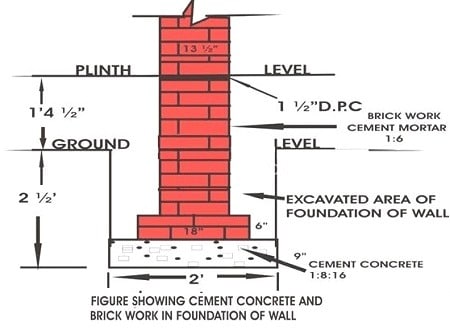
Excavation for Foundation of Wall
Fig.1: Excavation for Foundation of Wall
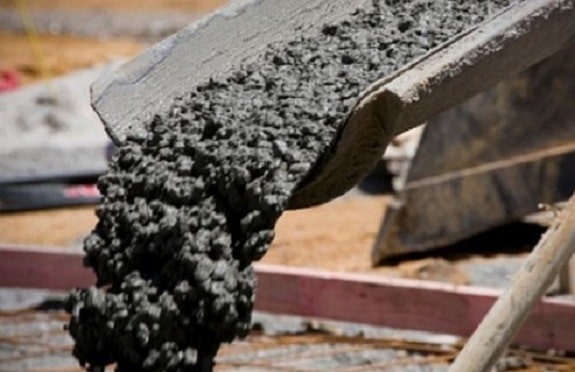
Concrete in foundation
Fig.2: Concrete in foundation
Concrete and Brickwork in Foundation of Wall
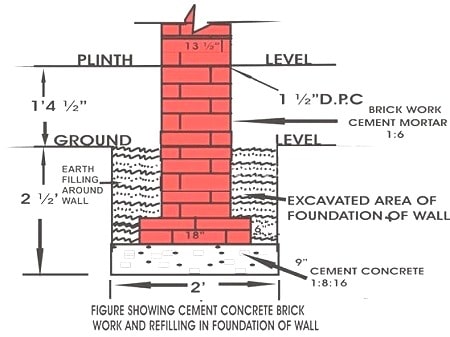
Fig.3: Concrete and Brickwork in Foundation of Wall
Concrete and Brickwork in Foundation Refilling

Fig.4: Concrete and Brickwork in Foundation Refilling

Precautions while designing a Foundation

  1. A foundation should be designed to transmit combined dead load, imposed load and wind load to the ground.
  2. Net loading intensity of pressure coming on the soil should not exceed the safe bearing capacity.
  3. Foundation should be designed in such a way that settlement to the ground is limited and uniform under whole of the building to avoid damage to the structure.
  4. Whole design of the foundation, super structure and characteristics of the ground should be studied to obtain economy in construction work.

Ratio of Cement Concrete and Mortar for Foundation

  1. The cement concrete 1:8:16 is generally used in the foundation of walls in construction work.
  2. In case of column raft cement concrete 1:4:8 is the best recommended ratio for it in the foundation.
  3. For brick masonry cement mortar 1:4 to 1:6 is used as loading condition.
In case of column and raft footings up to plinth level cement concrete 1:2:4 or 1:1.5:3 are used.

Soil having Safe Bearing Capacity

Dry coarse and well graded dense sand have maximum shear resistance and maximum bearing capacity. In general submerged soil and clay have less bearing capacity.

Precautions during Excavation for Foundation

The depth and width of foundation should be according to structural design.
  1. The depth of the foundation should not be less than 1 meter in case the design is not available.
  2. The length, width and depth of excavation should be checked with the help of center line and level marked on the marking pillars.
  3. The excavated material/ earth should be dumped at a distance of 1 meter from the edges.
  4. Work should be done on dry soil.
  5. Arrangement of water pump should be made for pumping out rain water.
  6. The bottom layer of the foundation should be compacted.
  7. There should be no soft places in foundation due to roots etc.
  8. Any soft/ defective spots should be dug out and be filled with concrete/ hard material
Excavation for foundation where root of tree exists
Fig.5: Excavation for foundation where root of tree exists
Excavation of wall in foundation root removed
Fig.6: Excavation of wall in foundation root removed
Pit of root filled with hard material
Fig.7: Pit of root filled with hard material
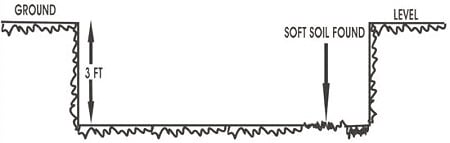
Excavation of foundation of wall with a patch of soft soil
Fig.8: Excavation of foundation of wall with a patch of soft soil
Excavation of wall foundation with soft soil removed
Fig.9: Excavation of wall foundation with soft soil removed
Pit of soft soil filled with hard material
Fig.10: Pit of soft soil filled with hard material

Demarcation / layout Procedure for foundation

The following procedure is recommended for demarcation of a building.
  1. For layout of a building baseline is marked on the ground either from center line of the road or from any permanent building nearby. This line helps to mark out the front of a building. Side baseline is also marked with the help of side structure or road or it can be marked with the help of first baseline or boundary of the plot.
  2. Fix temporary pegs at the center line of walls/columns on both sides of walls and columns in front and back side.
  3. Fix peg at the center line of walls/columns on both sides of wall and columns in left and right side of front of building.
  4. Check diagonals of the square or rectangle formed after fixing pegs.
  5. Construct marking pillars with pegs at a distance of 1.5 meter to 2 meters and their top surface should be plastered.
  6. Mark center line on the top of marking pillars with the help of thread (Soot) or with the Theodolite in big projects and the diagonal and other dimension should be checked.
  7. Level marking pillars on all corners of building and the top level is fixed at a proposed plinth level.
  8. Mark the foundation of walls/columns according to drawing on the ground with the help of centerline marked on the marking pillars .
  9. Mark foundation trenches on the ground with chalk powder.
  10. Excavate the foundation of the walls /columns up to required level and the excavation must be checked with the help of center line and level marking pillars to avoid any complication later on.
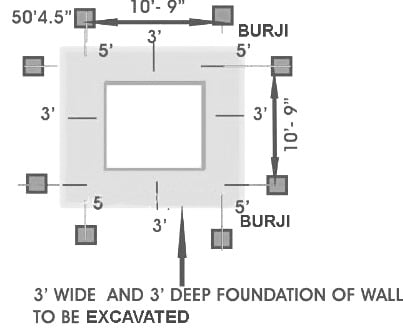
Excavation for foundation under wall
Fig.11: Excavation for foundation under wall

Advantages of Layout with the help of marking pillars

  • It saves time for measuring and setting of point again and again at the time of construction.
  • It increases the efficiency of mason and foreman for doing their jobs.
  • Accuracy can be checked at any time at any step.
  • If any mistake is found, it can be easily be rectified at early stage. It is very difficult to rectify the mistake in later.
  • Cross check can be done by senior engineer in minimum time.
  • A qualitative work is maintained.

Disadvantages for doing the work without layout

At some sites of work the contractor brings steel pieces, erects the same on the ground and start the work of excavation. In due course these steel pieces are just discarded. Thus no proper reference point is available while doing further jobs.
  • It involves extra time for measuring the offset again and again.
  • Accuracy can not be checked at early stage and it will be very difficult to rectify the same in later stage.
  • It involves wastage of time and money while doing rectification. This also leads to bad quality of work.

Materials used during Setting up of Layout

  1. Leveling Instrument
  2. Long Nails
  3. Hammer
  4. Right Angle
  5. Steel Tape
  6. Thin Cotton Thread
  7. Bricks
  8. Cement
  9. Screen Sand
  10. Lime Powder
  11. Theodolite

Concrete Mix Design Calculation for M20, M25, M30 Concrete with Procedure & Example


Concrete Mix Design Calculation for M20, M25, M30 Concrete with Procedure & Example

Concrete mix design is the process of finding right proportions of cement, sand and aggregates for concrete to achieve target strength in structures. So, concrete mix design can be stated as Concrete Mix = Cement:Sand:Aggregates.
The concrete mix design involves various steps, calculations and laboratory testing to find right mix proportions. This process is usually adopted for structures which requires higher grades of concrete such as M25 and above and large construction projects where quantity of concrete consumption is huge..
Benefits of concrete mix design is that it provides the right proportions of materials, thus making the concrete construction economical in achieving required strength of structural members. As, the quantity of concrete required for large constructions are huge, economy in quantity of materials such as cement makes the project construction economical.
Concrete Mix design of M20, M25, M30 and higher grade of concrete can be calculated from example below.
CONCRETE MIX DESIGN CALCULATION FOR M20 M25 M30 WITH EXAMPLE

Concrete Mix Design

Data Required for Concrete Mix Design

(i) Concrete Mix Design Stipulation

(a) Characteristic compressive strength required in the field at 28 days grade designation — M 25
(b) Nominal maximum size of aggregate — 20 mm
(c) Shape of CA — Angular
(d) Degree of workability required at site — 50-75 mm (slump)
(e) Degree of quality control available at site — As per IS:456
(f) Type of exposure the structure will be subjected to (as defined in IS: 456) — Mild
(g) Type of cement: PSC conforming IS:455
(h) Method of concrete placing: pump able concrete

(ii) Test data of material (to be determined in the laboratory)

(a) Specific gravity of cement — 3.15
(b) Specific gravity of FA — 2.64
(c) Specific gravity of CA — 2.84
(d) Aggregate are assumed to be in saturated surface dry condition.
(e) Fine aggregates confirm to Zone II of IS – 383

Procedure for Concrete Mix Design of M25 Concrete

Step 1 — Determination Of Target Strength

Himsworth constant for 5% risk factor is 1.65. In this case standard deviation is taken from IS:456 against M 20 is 4.0.
ftarget = fck + 1.65 x S
= 25 + 1.65 x 4.0 = 31.6 N/mm2
Where,
S = standard deviation in N/mm= 4 (as per table -1 of IS 10262- 2009)

Step 2 — Selection of water / cement ratio:-

From Table 5 of IS 456, (page no 20)
Maximum water-cement ratio for Mild exposure condition = 0.55
Based on experience, adopt water-cement ratio as 0.5.
0.5<0.55, hence OK.

Step 3 — Selection of Water Content

From Table 2 of IS 10262- 2009,
Maximum water content = 186 Kg (for Nominal maximum size of aggregate — 20 mm)

Table for Correction in water content

ParametersValues as per Standard reference conditionValues as per Present ProblemDepartureCorrection in Water Content
Slump25-50 mm50-7525(+3/25) x 25 = +3
Shape of AggregateAngularAngularNil
Total+3
Estimated water content = 186+ (3/100) x 186 = 191.6 kg /m3

Step 4 — Selection of Cement Content

Water-cement ratio = 0.5
Corrected water content = 191.6 kg /m3
Cement content =
From Table 5 of IS 456,
Minimum cement Content for mild exposure condition = 300 kg/m3
383.2 kg/m3 > 300 kg/m3, hence, OK.
This value is to be checked for durability requirement from IS: 456.
In the present example against mild exposure and for the case of reinforced concrete the minimum cement content is 300 kg/m3 which is less than 383.2 kg/m3. Hence cement content adopted = 383.2 kg/m3.
As per clause 8.2.4.2 of IS: 456
Maximum cement content = 450 kg/m3.

Step 5: Estimation of Coarse Aggregate proportion:-

From Table 3 of IS 10262- 2009,
For Nominal maximum size of aggregate = 20 mm,
Zone of fine aggregate = Zone II
And For w/c = 0.5
Volume of coarse aggregate per unit volume of total aggregate = 0.62

Table for correction in estimation of coarse aggregate proportion

ParameterValues as per Standard reference conditionValues as per present problemDepartureCorrection in Coarse Aggregate proportionRemarks
W/c0.50.5NilSee Note 1
Workabilitypump able concrete-10%See Note 2
Total-10%
Note 1: For every ±0.05 change in w/c, the coarse aggregate proportion is to be changed by 0.01. If the w/c is less than 0.5 (standard value), volume of coarse aggregate is required to be increased to reduce the fine aggregate content. If the w/c is more than 0.5, volume of coarse aggregate is to be reduced to increase the fine aggregate content. If coarse aggregate is not angular, volume of coarse aggregate may be required to be increased suitably, based on experience.
Note 2: For pump able concrete or congested reinforcement the coarse aggregate proportion may be reduced up to 10%.
Hence,
Volume of coarse aggregate per unit volume of total aggregate = 0.62 x 90% = 0.558
Volume of fine aggregate = 1 – 0.558 = 0.442

Step 6: Estimation of the mix ingredients

a) Volume of concrete = 1 m3
b) Volume of cement = (Mass of cement / Specific gravity of cement) x (1/100)
= (383.2/3.15) x (1/1000) = 0.122 m3
c) Volume of water = (Mass of water / Specific gravity of water) x (1/1000)
= (191.6/1) x (1/1000) = 0.1916 m3
d) Volume of total aggregates = a – (b + c ) = 1 – (0.122 + 0.1916) = 0.6864 m3
e) Mass of coarse aggregates = 0.6864 x 0.558 x 2.84 x 1000 = 1087.75 kg/m3
f) Mass of fine aggregates = 0.6864 x 0.442 x 2.64 x 1000 = 800.94 kg/m3

Concrete Mix proportions for Trial Mix 1

Cement = 383.2 kg/m3
Water = 191.6 kg/m3
Fine aggregates = 800.94 kg/m3
Coarse aggregate = 1087.75 kg/m3
W/c = 0.5
For trial -1 casting of concrete in lab, to check its properties.
It will satisfy durability & economy.
For casting trial -1, mass of ingredients required will be calculated for 4 no’s cube assuming 25% wastage.
Volume of concrete required for 4 cubes = 4 x (0.15x1.25) = 0.016878 m3
Cement = (383.2 x 0.016878) kg/m3 = 6.47 kg
Water = (191.6 x 0.016878) kg/m3 =3.23 kg
Coarse aggregate = (1087.75 x 0.016878) kg/m3 =18.36 kg
Fine aggregates = (800.94 x 0.016878) kg/m3 =13.52 kg

Step 7: Correction due to absorbing / moist aggregate:-

Since the aggregate is saturated surface dry condition hence no correction is required.

Step 8: Concrete Trial Mixes:-

Concrete Trial Mix 1:

The mix proportion as calculated in Step 6 forms trial mix1. With this proportion, concrete is manufactured and tested for fresh concrete properties requirement i.e. workability, bleeding and finishing qualities.
In this case,
Slump value = 25 mm
Compaction Factor = 0.844
So, from slump test we can say,
Mix is cohesive, workable and had a true slump of about 25 mm and it is free from segregation and bleeding.
Desired slump = 50-75 mm
So modifications are needed in trial mix 1 to arrive at the desired workability.

Concrete Trial Mix 2:

To increase the workability from 25 mm to 50-75 mm an increase in water content by +3% is to be made.
The corrected water content = 191.6 x 1.03 = 197.4 kg.
As mentioned earlier to adjust fresh concrete properties the water cement ratio will not be changed. Hence
Cement Content = (197.4/0.5) = 394.8 kg/m3
Which also satisfies durability requirement.
Volume of all in aggregate = 1 – [{394.8/(3.15×1000)} + {197.4/(1 x 1000)}] = 0.6773 m3
Mass of coarse aggregate = 0.6773 x 0.558 x 2.84 x 1000 = 1073.33 kg/m3
Mass of fine aggregate = 0.6773 x 0.442 x 2.64 x 1000 = 790.3 kg/m3

Concrete Mix Proportions for Trial Mix 2

Cement = 384.8 kg/m3
Water = 197.4 kg/m3
Fine aggregate =790.3 kg/m3
Coarse aggregate = 1073.33 kg/m3
For casting trial -2, mass of ingredients required will be calculated for 4 no’s cube assuming 25% wastage.
Volume of concrete required for 4 cubes = 4 x (0.15x1.25) = 0.016878 m3
Cement = (384.8 x 0.016878) kg/m3 = 6.66 kg
Water = (197.4 x 0.016878) kg/m3 =3.33 kg
Coarse aggregate = (1073.33 x 0.016878) kg/m3 =18.11 kg
Fine aggregates = (790.3 x 0.016878) kg/m3 =13.34 kg
In this case,
Slump value = 60 mm
Compaction Factor = 0.852
So, from slump test we can say,
Mix is very cohesive, workable and had a true slump of about 60 mm.
It virtually flowed during vibration but did not exhibit any segregation and bleeding.
Desired slump = 50-75 mm
So , it has achieved desired workability by satisfying the requirement of 50-75 mm slump value .
Now , we need to go for trial mix-3 .

Concrete Trial Mix 3:

In case of trial mix 3 water cement ratio is varied by +10% keeping water content constant. In the present example water cement ratio is raised to 0.55 from 0.5.
An increase of 0.05 in the w/c will entail a reduction in the coarse aggregate fraction by 0.01.
Hence the coarse aggregate as percentage of total aggregate = 0.558 – 0.01 = 0.548
W/c = 0.55
Water content will be kept constant.
Cement content = (197.4/0.55) = 358.9 kg/m3
Hence, volume of all in aggregate
= 1 – [{(358.9/(3.15 x 1000)} + (197.4/1000)] =0.688 m3
Mass of coarse aggregate = 0.688 x 0.548 x 2.84 x 1000 = 1070.75 kg/m3
Mass of fine aggregate = 0.688 x 0.452 x 2.64 x 1000 = 821 kg/m3

Concrete Mix Proportions of Trial Mix 3

Cement = 358.9 kg/m3
Water = 197.4 kg/m3
FA = 821 kg/m3
CA = 1070.75 kg/m3
For casting trial -3, mass of ingredients required will be calculated for 4 no’s cube assuming 25% wastage.
Volume of concrete required for 4 cubes = 4 x (0.15x1.25) = 0.016878 m3
Cement = (358.9 x 0.016878) kg/m3 = 6.06 kg
Water = (197.4 x 0.016878) kg/m3 =3.33 kg
Coarse aggregate = (1070.75 x 0.016878) kg/m3 =18.07 kg
Fine aggregates = (821 x 0.016878) kg/m3 =13.85 kg
In this case,
Slump value = 75 mm
Compaction Factor = 0.89
So, from slump test we can say,
Mix is stable, cohesive, and workable and had a true slump of about 75 mm.
Desired slump = 50-75 mm
So , it has achieved desired workability by satisfying the requirement of 50-75 mm slump value .
Now , we need to go for trial mix-4.

Concrete Trial Mix 4:

In this case water / cement ratio is decreased by 10% keeping water content constant.
W/c = 0.45
A reduction of 0.05 in w/c will entail and increase of coarse aggregate fraction by 0.01.
Coarse aggregate fraction = 0.558 +.01 =.568
W/c = 0.45 and water content = 197.4 kg/m3
Cement content = (197.4/0.45) = 438.7 kg/m3
Volume of all in aggregate
= 1 – [{438.7/(3.15 x 1000)} + (197.4/1000)] = 0.664 m3
Mass of coarse aggregate = 0.664 x 0.568 x 2.84 x 1000 = 1071.11 kg/m3
Mass of fine aggregate = 0.664 x 0.432 x 2.64 x 1000 = 757.28 kg/m3

Concrete Mix Proportions of Trial Mix 4

Cement = 438.7 kg/m3
Water = 197.4 kg/m3
FA = 757.28 kg/m3
CA = 1071.11 kg/m3
For casting trial -4, mass of ingredients required will be calculated for 4 no’s cube assuming 25% wastage.
Volume of concrete required for 4 cubes = 4 x (0.15x1.25) = 0.016878 m3
Cement = (438.7 x 0.016878) kg/m3 = 7.4 kg
Water = (197.4 x 0.016878) kg/m3 =3.33 kg
Coarse aggregate = (1071.11 x 0.016878) kg/m3 =18.07 kg
Fine aggregates = (757.28 x 0.016878) kg/m3 =12.78 kg
A local correction due to moisture condition of aggregate is again applied on this proportions. With corrected proportions three concrete cubes are cast and tested for 28 days compressive strength.
A summary of all the trial mixes is given in the following Table.

Recommended mix proportion of ingredients for grade of concrete M25:

From Compressive Strength vs. c/w graph for target strength 31.6 MPa we get,
W/c = 0.44
water content = 197.4 kg/m3
Cement content = (197.4/0.44) = 448.6 kg/m3
Volume of all in aggregate
= 1 – [{448.6/(3.15 x 1000)} + (197.4/1000)] = 0.660 m3
A reduction of 0.05 in w/c will entail and increase of coarse aggregate fraction by 0.01.
Coarse aggregate fraction = 0.558 +.01 =.568
Volume of fine aggregate = 1 – 0.568 = 0.432
Mass of coarse aggregate = 0.660 x 0.568 x 2.84 x 1000 = 1064.65 kg/m3
Mass of fine aggregate = 0.660 x 0.432 x 2.64 x 1000 = 752.71 kg/m3