
Thursday, September 13, 2018

Spray Foam Insulation for Buildings – Properties,Working and Benefits


Spray Foam Insulation for Buildings – Properties,Working and Benefits

Spray foam Insulation is a spray applied plastic that is used for the insulation of the buildings. A spray foam insulation is a combination of two components A and B. Where A is Isocyanate and B is a Polyol resin.
The main two characteristics of the spray foam insulation are that they resist heat transfer effectively and reduce the infiltration of air into the seam, joints, and cracks.
Spray Foam Insulation Applied on the Building Exterior; Image Courtesy: www.whysprayfoam.org
Fig.1: Spray Foam Insulation Applied on the Building Exterior; Image Courtesy: www.whysprayfoam.org
The two materials are heated and collected in a spray gun. The mixture is sprayed out of the spray gun during the application. The mixture reacts to become a foam and when sprayed will cover the floor, wall and the cavity areas.
The physical properties attained by a foam insulation is extraordinary that it is considered as one of the best materials that can be used to insulate home and structures.

History of Spray Foam Insulation

Before 5 decades, the increasing fuel prices was a great concern for the homeowners. They tried to use formaldehyde in order to retrofit and insulate the homes. The formaldehyde was used to fill the holes, cavities and walls with liquid formaldehyde. Once the liquid is injected, they will start to expand and fill the areas.
The use of this material soon made the homeowners to realize the health issues emitted from these. They also found that the protection provided by these materials are incomplete. The formaldehyde couldn’t fill the cavities evenly that it resulted in cold spots. The US government hence banned the use of these materials due to the health concerns it gives rise to.
Now, the product is once again in to market but the material used is Isocyanate an alternative to formaldehydes.

Working of Spray Foam Insulation

The spray foam insulation consists of materials that will change their characteristics when sprayed on the surface to be insulated. The mixture when sprayed will travel from the gun and gets heated before coming out of the gun. This heating will make the mixture to react together and become foam when applied on the surface.
Spray foam Insulation application
Fig.2: Spray foam Insulation application
The expansion of the foam will be happening within fraction of seconds. This property enables the foam insulation to cover up large areas of the commercial building very fastly within minutes. When compared to the insulation of buildings with rolls and sheets, the foam application is a better choice. The areas which are very tough to insulate with the rolls and sheets are easily accessible by the foam insulation like ceilings and attics.
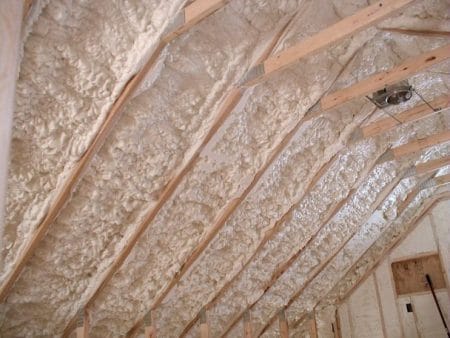
Spray Foam Insulation Expansion
Fig.3: Spray Foam Insulation Expansion
The homes and building that are partially finished can be insulated with foams in their exposed areas and made usable.

Properties of Spray Foam Insulation

The major properties provided by spray foam insulation in buildings are mentioned below:

1.Energy Efficient

The phenomenon of air filtration results in the loss of energy from the building by 40%. Presence of gaps, holes and air leaking can increase the energy bills. The use of spray foam insulation will help to act as an air barrier that will close the gaps. The escape of air from the indoor of the building is prevented.
Figure -4 below shows the picture of a house completely sealed by a spray foam insulation as per the American Chemistry Council,Inc (2011).
Building Air Sealed by Spray foam Insulation
Fig.4: Building Air Sealed by Spray foam Insulation; Image Courtsey : American Chemistry Council (2011)

2. Cool Roofs

Bringing cool roofs helps the house to be energy efficient. This helps to maintain a lower temperature when compared to the traditional roofs. The spray foam roofs do not demand for metal fastening thus avoiding the potential for thermal shots.

3. Strength and Durability

The spray foams help to create a strong bond that makes the roof and other components air tight avoiding the chances of water seepage. This can considerably increase the lifespan and durability of the building structure.
The bond provided by the spray foam insulation increase the resistance of the building against the uplift caused by the winds. High winds causes huge damage to roof without spray foam insulation compared with the insulated ones.
The buildings insulated with spray foam insulation can help the building prevent wetting and drying during floodwater. This hence increases the strength and the resilience of the building.
The spray foam application in the cavities helps the moisture and condensation activities to reduce thus increasing the durability of the wall systems.

Benefits of Spray Foam Insulation

The benefits of spray foam insulation are:
  1. Spray foam insulation is easy to install and fast.
  2. Bring properties equivalent to traditional insulation methods
  3. The application is clean and precise. No mess is left after the application of spray foam.
  4. Installation of foams are performed fastly by the technicians
  5. The spray foam insulation provides a tight energy seal with the roof or wall surface
  6. This insulation protects the home from humidity, pest, and rodents
  7. Air quality is improved reducing the indoor air pollutant level
  8. Roofs are made more durable by this insulation as water seepage is resisted.
  9. The new foam material does not contain any ozone depleting materials.
  10. The heating and cooling costs of the building can be reduced by 40 %.

Tomorrow's Shirts Are Being Made With Wood.

Tomorrow's Shirts Are Being Made With Wood. 

Here's Why This is so cool.DOMENIC OLMEDA30 AUG 2018Wood might not strike you as the most sophisticated - or comfortable - fabric out there (especially if you tried covering yourself in 2x4s).However, when discussing the clothes of 2018 and beyond, wood, or specifically wood fiber and pulp, is paving the way for garments that are softer, comfortable, and even cleaner than those cotton undershirts you grew up wearing.

RibbedTeehas created a line of ultra-soft, breathable, and eco-friendly men's undershirts that are so advanced, Tony Stark would probably throw one on to make sure he's not getting any sweat stains inside his Iron Man suit.The secret lies with their TENCEL materials, which are derived from sustainable cellulosic fibers.What Is TENCELFor those of us not involved in the textile industry, cellulosic fibers are structured from cellulose and are made by dissolvingnatural materials, like cellulose or wood pulp, and then regenerating them via extrusion and precipitation.

From cotton to modal, there are a number of cellulosic fibers out there, and they're all known for promoting high absorbency, temperature control, soft touch, and even slow growth of bacteria.RibbedTee manufactures theirEVO TENCEL shirtsin the US with TENCEL, which is made from sustainable Lyocell cellulosic fibers and excels in all of the above categories thanks to its high absorption capabilities, unique nano-fibril structure, and amazingly smooth surface.

The Key to Staying Sweat-FreeTENCEL's properties reduce a greater amount of moisture formed on its fibers when compared to polyester and synthetics.In addition to keeping you dry, TENCEL's absorbency supports the body's natural thermal regulating mechanism and creates a less favorable environment for bacterial growth.While this is all impressive, you might be wondering why anyone would invest in futuristic undershirts in the first place. The reality is that part of being your best involves feeling your best.

So, making the effort to ensure your shirtsfit and breathe as well asRibbedTees do plays a partin helping you operate at peakefficiency.Your old cotton shirts and undergarments might work just fine for covering yourself up, but with options like RibbedTees out there, you're basically wearing a pair of Chucks to a marathon.For those interested in trying out undershirts from RibbedTee, first-time customers cantake 20% off their purchase, and bulk orders can get over 20% off. Plus, you can also visit the stash drawer for nearly new products with deep discounts.

This is a promotional ScienceAlert Academy post, in partnership with StackCommerce. We carefully vet all courses and products to make sure they're relevant to our readers, and make a share in the profits of any sales.

What is Steel Reinforcement? Types and Properties of Steel Rebars


What is Steel Reinforcement? Types and Properties of Steel Rebars

What is Steel Reinforcement?

Steel reinforcement are steel bars that are provided in combination with plain cement concrete to make it reinforced concrete. Hence these structures form steel reinforced cement concrete structure (R.C.C). Steel reinforcement is commonly called as ‘rebars’.

Need for Steel Reinforcement

Plain concrete is weak in tension and strong in compression. Tensile property for concrete structures is obtained by incorporating steel reinforcement. The steel reinforcement is strong in both tension and compression. The tensile property provided by the steel reinforcement will prevent and minimize concrete cracks under tension loads.
The coefficient of thermal expansion of steel reinforcement and concrete are similar in that they undergo similar expansions during temperature changes. This property will ensure that the concrete is subjected to minimal stress during temperature variations.
The surface of the steel reinforcement bars is patterned to have a proper bond with the surrounding concrete material.
The two main factors that provide strength to the concrete structures are steel and concrete. The design engineer will combine both the elements and design the structural element such a way that the steel resists the induced tensile and shear force, while the concrete takes up the compressive forces.

Types of Steel Reinforcement

The steel reinforcement used in concrete construction is mainly of 4 types. They are:
  1. Hot Rolled Deformed Steel Bars
  2. Cold Worked Steel Bars
  3. Mild Steel Plain Bars
  4. Prestressing Steel Bars

1. Hot Rolled Deformed Bars

Hot rolled deformed bars are most commonly used steel reinforcement for R.C.C structures. As the name says, the hot rolling of the reinforcement is undergone leaving certain deformations on its surface in the form of ribs. These ribs help to form a bond with the concrete. The typical yield strength of hot-rolled deformed bars is 60000psi.
Hot Rolled Steel Bars
Fig.1: Hot Rolled Steel Bars; Image Courtesy-RIVA Stahl Gmbh

2. Cold Worked Steel Bars

A cold worked reinforcement bar is obtained by letting the hot rolled steel bars to undergo cold working. In the cold working process, the bars will undergo twisting and drawing. The process is performed at room temperature. The cold worked steel bars do not undergo a plastic yield thus have less ductility when compared with hot rolled bars.

3. Mild Steel Plain Bars

The mild steel plain reinforcement bars do not have ribs on their surface. They have a plain surface. These bars are used for small projects where the major concern is the economy. The tensile yield strength of these bars has a value of 40000psi.
Mild Steel Bars
Fig.2: Mild Steel Bars; Image Courtesy: Vision Alloys

4. Prestressing Steel Bars

The prestressing steel reinforcement are steel bars used in the form of strands or tendons. Multiple strands are employed in concrete in order to perform the prestressing action. The strands are made of multiple wires either 2 or 3 or 7 wire strands.
The wires used here are cold formed and have a high tensile strength ranging from 250000 – 270000 psi. This high strength helps to effectively prestress the concrete.

Advantages of Steel Reinforcement

Steel reinforcement is a reinforcing choice compared to other reinforcing materials due to its unique advantages. They are:
  1. Compatibility with Concrete: The fresh concrete is placed on the formwork mold already prepared with reinforcement. The steel reinforcement won’t float in concrete during the concrete placing procedure. Hence, steel reinforcement does not demand special tying up with formworks.
  2. Robustness of Steel Reinforcement: The steel bars are robust in nature that they have the ability to withstand the rigors, the wear and tear during the construction activities.
  3. Bent Property of Steel Reinforcement: The steel bars once manufactured to standard size, it can be bent to the required specifications. Hence fabricated steel bars are delivered easily at the site.
  4. Recycling Property: The steel reinforced left over after the service life of a structure is recycled again and used for new construction.
  5. Easily Available: Every region of a country will have a steel supplier or manufacturer. Hence steel reinforcement is easily available.

Disadvantages of Steel Reinforcement

The main disadvantages of steel reinforcement are mentioned below:
  1. Reactive Nature of Steel Reinforcement: In concrete structures where the cover is small and subjected to external moisture and salt action, the reinforcement undergoes reaction and starts to corrode. These can lessen the strength of concrete and finally to failure.
  2. Expensive: The cost of steel reinforcement in high. This will increase the cost of construction
  3. Melts at high temperature: At higher temperatures, the steel reinforcement may melt. This is the reason why the steel reinforcement are tied up and not welded.

Reactive Powder Concrete – Composition and Advantages


Reactive Powder Concrete – Composition and Advantages

What is a Reactive Powder Concrete?

Reactive powder concrete (RPC) is the ultra-high strength concrete prepared by replacing the ordinary aggregate of normal concrete with quartz powder, silica fume, steel fibers etc. RPC not only has high strength but also has high ductility. Its compressive strength ranges from 200 Mpa to 800 Mpa.

Composition of Reactive Powder Concrete

Reactive powder concrete contains Very fine powders like cement, fine sand, quartz powder of size less than 300 micron, silica fume, 1 cm length steel fibers of size 180 microns and super plasticizer. Typical Composition of ingredients in Reactive powder concrete of 200 Mpa and 800 Mpa are tabulated below.
Table 1: Typical Composition of RPC of 200 Mpa
IngredientQuantity (kg/m3)
OPC ( Type V)955
Fine Sand (150 – 400 micron)1051
Silica Fume229
Precipitated Silica10
Super Plasticizer13
Steel Fibers191
Water153

RPC Structure
Fig 1: Side Walk System of above Shown Bridge is Constructed using RPC
Table 2: Typical Composition of RPC of 800 Mpa
IngredientQuantity (kg/m3)
OPC ( Type V)1000
Fine Sand (150 – 400 micron)500
Ground Quartz powder (4 microns)390
Silica Fume230
Super Plasticizer18
Steel Fibers630
Water180

Functions of Ingredients of Reactive Powder Concrete

Functions of each of the ingredients and their selection parameters are discusses below. The ingredients of reactive powder concrete are
  1. Cement
  2. Sand
  3. Quartz Powder
  4. Silica Fume
  5. Steel Fibers
  6. Super Plasticizers

1. Cement

  • Ordinary Portland cement of medium fineness is suitable for making RPC. The Cement particle size should be 1 micron to 100 microns.
  • The function of cement is to act as binding material and also to generate primary hydrants of concrete.
  • Optimum percentage of principle minerals or Bogues Compounds required to make RPC are tabulated below:
Table 3: Optimum Percentage of Principle Minerals of Cement
Tricalcium Silicate (C3S)60%
Dicalcium Silicate (C2S)22%
Tricalcium Aluminate (C3A)3.8%
Tetra-calcium Alumino Ferrite (C4AF)7.4%

2. Sand

  • Natural river bed or crushed sand of particle size 150 to 600 micron is recommended.
  • It should be of good hardness and readily available at low cost.
  • In reactive powder concrete, sand particles are highest sized particle hence, their function is to give strength to the concrete mix.
Fine Sand
Fig 2: River Bed Sand

3. Quartz powder

  • Generally quartz powder is available in crystalline form. It is selected based on its fineness.
  • The particle size should be 5 microns to 25 microns.
  • The main function of quartz is to give maximum resistance to the concrete against heat.
Quartz Powder
Fig 3: Quartz Powder

4. Silica Fume

  • Silica fume is generally obtained from ferrosilicon industries. It should be selected in such a way that it should contain less quantity of impurities in it.
  • The particle size of silica fume is about 0.1 micron to 1 micron.
  • Its function is to fill the small voids and also to enhance flow properties of concrete.
  • It also helps to generate secondary hydrates in the concrete.
Silica Fume
Fig 4: Silica Fume

5. Steel Fibers

  • Steel fibers of length 13 to 25 mm and 0.15 to 0.2 mm diameter are selected to prepare reactive powder concrete.
  • It improves ductility of the concrete.
Steel Fibers
Fig 5: Steel Fibers

6. Super Plasticizer

  • Polyacrylate is used as super plasticizer in RPC.
  • The main function of polyacrylate is to decrease the water cement ratio and also to improve the workability of concrete.

Advantages of Reactive Powder Concrete

Following are the advantages of Reactive powder concrete compared to other types of concretes.
  • Due to its High ductility property it always compete with steel.
  • Fine ingredients makes the concrete void proof and no leakage of gas or liquid occurs.
  • There is a reduction of dead load of structure due to higher shear capacity along with superior strength.
  • RPC members have great resistance against seismic forces.
Reactive Powder Concrete Structure
Fig 6: Light Rail Transit Station Built using Reactive Powder Concrete

Limitations of Reactive Powder Concrete

Reactive powder concrete also have some limitations which are as follows:
  • Aggregate replacing materials used in RPC are slightly expensive which increases the project cost.
  • Optimization of principle minerals in concrete also increase the cost of concrete.
  • Long term properties of reactive powder concrete are not known since it is still in developing stage.
  • There is no official code provided for Reactive powder concrete mix design.