Thursday, August 30, 2018

Spray Foam Insulation for Buildings – Properties,Working and Benefits


Spray Foam Insulation for Buildings – Properties,Working and Benefits

Spray foam Insulation is a spray applied plastic that is used for the insulation of the buildings. A spray foam insulation is a combination of two components A and B. Where A is Isocyanate and B is a Polyol resin.
The main two characteristics of the spray foam insulation are that they resist heat transfer effectively and reduce the infiltration of air into the seam, joints, and cracks.
Spray Foam Insulation Applied on the Building Exterior; Image Courtesy: www.whysprayfoam.org
Fig.1: Spray Foam Insulation Applied on the Building Exterior; Image Courtesy: www.whysprayfoam.org
The two materials are heated and collected in a spray gun. The mixture is sprayed out of the spray gun during the application. The mixture reacts to become a foam and when sprayed will cover the floor, wall and the cavity areas.
The physical properties attained by a foam insulation is extraordinary that it is considered as one of the best materials that can be used to insulate home and structures.

History of Spray Foam Insulation

Before 5 decades, the increasing fuel prices was a great concern for the homeowners. They tried to use formaldehyde in order to retrofit and insulate the homes. The formaldehyde was used to fill the holes, cavities and walls with liquid formaldehyde. Once the liquid is injected, they will start to expand and fill the areas.
The use of this material soon made the homeowners to realize the health issues emitted from these. They also found that the protection provided by these materials are incomplete. The formaldehyde couldn’t fill the cavities evenly that it resulted in cold spots. The US government hence banned the use of these materials due to the health concerns it gives rise to.
Now, the product is once again in to market but the material used is Isocyanate an alternative to formaldehydes.

Working of Spray Foam Insulation

The spray foam insulation consists of materials that will change their characteristics when sprayed on the surface to be insulated. The mixture when sprayed will travel from the gun and gets heated before coming out of the gun. This heating will make the mixture to react together and become foam when applied on the surface.
Spray foam Insulation application
Fig.2: Spray foam Insulation application
The expansion of the foam will be happening within fraction of seconds. This property enables the foam insulation to cover up large areas of the commercial building very fastly within minutes. When compared to the insulation of buildings with rolls and sheets, the foam application is a better choice. The areas which are very tough to insulate with the rolls and sheets are easily accessible by the foam insulation like ceilings and attics.
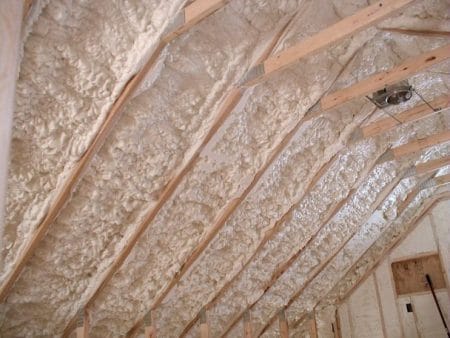
Spray Foam Insulation Expansion
Fig.3: Spray Foam Insulation Expansion
The homes and building that are partially finished can be insulated with foams in their exposed areas and made usable.

Properties of Spray Foam Insulation

The major properties provided by spray foam insulation in buildings are mentioned below:

1.Energy Efficient

The phenomenon of air filtration results in the loss of energy from the building by 40%. Presence of gaps, holes and air leaking can increase the energy bills. The use of spray foam insulation will help to act as an air barrier that will close the gaps. The escape of air from the indoor of the building is prevented.
Figure -4 below shows the picture of a house completely sealed by a spray foam insulation as per the American Chemistry Council,Inc (2011).
Building Air Sealed by Spray foam Insulation
Fig.4: Building Air Sealed by Spray foam Insulation; Image Courtsey : American Chemistry Council (2011)

2. Cool Roofs

Bringing cool roofs helps the house to be energy efficient. This helps to maintain a lower temperature when compared to the traditional roofs. The spray foam roofs do not demand for metal fastening thus avoiding the potential for thermal shots.

3. Strength and Durability

The spray foams help to create a strong bond that makes the roof and other components air tight avoiding the chances of water seepage. This can considerably increase the lifespan and durability of the building structure.
The bond provided by the spray foam insulation increase the resistance of the building against the uplift caused by the winds. High winds causes huge damage to roof without spray foam insulation compared with the insulated ones.
The buildings insulated with spray foam insulation can help the building prevent wetting and drying during floodwater. This hence increases the strength and the resilience of the building.
The spray foam application in the cavities helps the moisture and condensation activities to reduce thus increasing the durability of the wall systems.

Benefits of Spray Foam Insulation

The benefits of spray foam insulation are:
  1. Spray foam insulation is easy to install and fast.
  2. Bring properties equivalent to traditional insulation methods
  3. The application is clean and precise. No mess is left after the application of spray foam.
  4. Installation of foams are performed fastly by the technicians
  5. The spray foam insulation provides a tight energy seal with the roof or wall surface
  6. This insulation protects the home from humidity, pest, and rodents
  7. Air quality is improved reducing the indoor air pollutant level
  8. Roofs are made more durable by this insulation as water seepage is resisted.
  9. The new foam material does not contain any ozone depleting materials.
  10. The heating and cooling costs of the building can be reduced 

Wednesday, August 29, 2018

Classification of Roads and Their Details


Classification of Roads and Their Details

Road transportation is an essential network for any country. Classification of roads based on many factors such as materials, locations, traffic etc. are discussed.

Classification or Types of Roads

The roads are classified based on many factors as follows.
  • Materials
  • Location & function
  • Traffic volume
  • Width
  • Economy
  • Traffic type
  • Rigidity
  • Topography

Types of Roads Based on Materials

  • Earthen roads
  • Gravel roads
  • Murrum roads
  • Kankar roads
  • WBM roads
  • Bituminous roads
  • Concrete roads

Earthen Roads

Earthen roads are laid with soil. They are cheaper of all types of roads. This type of road is provided for less traffic areas and or for countryside areas. Good drainage system should be required which reflects good performance for longer period.
Types of Roads Based on Materials

Gravel Roads

Gravel roads are also low quality roads but they are good when compared to earthen roads. Compacted mixture of gravel and earth is used as pavement material in this case.
Gravel Roads

Murrum Roads

Murrum is a matter obtained from the disintegration of igneous rocks by weathering agencies. This is used to make roads called as murrum roads.
Murrum Roads

Kankar Roads

Kankar is nothing but impure form of lime stone. Kankar roads are provided where lime is available in good quantity. These are also low quality and performance wise they are similar to gravel and murrum roads.
Kankar Roads

WBM Roads

Water Bound Macadam (WBM) roads contain crushed stone aggregate in its base course. The aggregates are spread on the surface and these are rolled after sprinkling water.
WBM roads provides better performance compared to earthen, gravel, murrum and kankar roads.
WBM roads are laid as layers about 10cm thickness of each layer. They are very rough and may disintegrate immediately under traffic.
WBM Roads

Bituminous Roads

Bituminous roads are very popular roads around the world. They are most used roads in the world. They are low in cost and good for driving conditions. They are flexible and thickness of bituminous roads depends upon the subgrade soil conditions.
Bituminous Roads

Concrete Roads

Cement concrete is used to construct the pavements in case of concrete roads. These are very popular and costlier than all other types of roads. They are not flexible so, they require less maintenance.
Concrete roads are suitable for high traffic areas. Concrete roads are laid with joints and time of construction is more.
Concrete Roads

Types of Roads Based on Location and Function

  • National highways
  • State highways
  • District roads
  • Rural roads or village roads

National Highways

National highways are main roads of a particular country. They connects all major cities to the capital of the country. They run throughout the length and breadth of the country. Minimum two lane road is provided for national highways.
Types of Roads Based on Location and Function

State Highways

State highways are second main roads which connect major parts of state with in it. State highway ultimately connects to the national highways.
State Highways

District Roads

District roads are provided with in the cities and connects markets and production places to state and national highways. Two types of district roads are there namely,
  • Major district roads
  • Minor district roads
Major district roads connect headquarters of neighboring district with main parts of district while minor district roads are laid with in the district.
district-roads

Rural Roads or Village Roads

Village roads connects the nearby villages with each other. They lead to nearby town or district roads. Usually low quality roads are provided as village roads because of low traffic.
Rural Roads or Village Roads

Types of Roads Based on Traffic Volume

  • Light traffic roads
  • Medium traffic roads
  • High traffic roads

Light Traffic Roads

The roads which are carrying 400 vehicles daily on an average is called light traffic roads.

Medium Traffic Roads

If a road carrying 400 to 1000 vehicles per day then it is said to be medium traffic road.

High Traffic Roads

If a road is carrying is more than 1000 vehicles per day then it is considered as high traffic road.

Types of Roads Based on Economy

  • Low cost roads
  • Medium cost roads
  • High cost roads
The economy depend upon the location and function of roads and also on the traffic analysis.

Types of Roads Based on Traffic Type

  • Pedestrian ways
  • Cycle tracks
  • Motorways

Pedestrian Ways

Pedestrian ways are exclusively built for pedestrians and no vehicles are permitted in this way.

Cycle Tracks

Cycle tracks or bicycle tracks are provided on both sides of pavement for cyclists hence they can travel safely.

Motorways

Motorways are also known as expressways. Only few vehicles are accessible to use this type of roads. The vehicles which can move with high speed acceleration are permitted into this way. Motorways makes travel quick and provides comfort for high speed vehicles.

Types of Roads Based on Rigidity

  • Flexible roads
  • Rigid roads

Flexible Roads

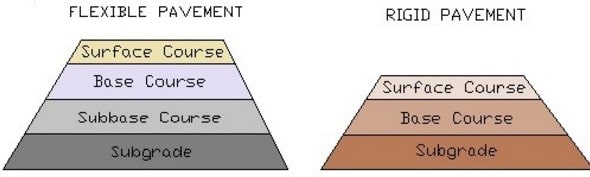
Flexible roads consists flexible layer as pavement surface which require good maintenance otherwise it can be disintegrated easily with heavy traffic. All types of roads except concrete roads are come under this category.

Rigid Roads

Rigid pavements are non-flexible and cement concrete roads are come under this category.
Types of Roads Based on Rigidity

Types of Roads Based on Topography

  • Plain area road
  • Hilly area roads

Plain Area Road

The roads constructed on leveled surface is known as plain area roads.

Hilly Area Roads

Roads constructed in hilly regions are called as hill area roads or ghat roads. Generally these are provided around the hill in spiral shape.
Hilly Area Roads

What is Geometric Design of Highways and Factors Affecting it?


What is Geometric Design of Highways and Factors Affecting it?

Geometric design of highway is the determination of layout and features visible on highway. The emphasis is more on satisfying the need of the driver as well as to ensure the safety of the vehicle, the comfort while driving and efficiency. Other related factors are also considered based on the project.
The main features considered for geometric design of highway are:
  • Cross section elements
  • The gradient
  • The intersection
  • The consideration of sight distance
The geometric design of highway is influenced by:
  • The characteristics of the vehicle
  • The behavior of the driver
  • The psychology of the driver
    Traffic characteristics
  • Traffic Volume
  • Traffic Speed
Severity of movement and accidents can be reduced largely by implementing a proper design. The main objective of geometric design is to get optimum efficiency in the traffic operation period and maximum safety.
All these features must be attained with maximum economy in the cost and construction. Unlike the construction of pavement, the planning process is carried out in advance.
Geometric Design of Highways

Factors Affecting the Geometric Design of Highways

The various factors that govern the geometric design of highways are:
  • The Design Speed
  • The topography factors
  • Other Factors

Design Speed of Highways

The most important factor affecting the geometric design of the highway is the design speed. The design speed parameter affects the:
  • Length of the vertical curves
  • The horizontal curves
  • The sight distances
Speed is a parameter that have huge variation will the person driving, the vehicle type, the topography etc. This is the reason why the design speed is taken as a primary factor in the geometric design of highways.
The highest continuous speed, given that the weather conditions are conducive, to facilitate safety travelling of the vehicles is called as the design speed. Legal speed is different from the design speed. The legal speed is the speed at which the drivers tend to travel beyond a safe speed. Desired speed is the maximum speed at which the driver can travel when they are constrained by means of a local geometry or traffic.
As mentioned before, speed is a factor that bring variations of different types. This requires having different vehicle design speeds to satisfy the requirement of all vehicle drivers. So, by standard: 85th percentile design speed is the normally adopted design speed.
85th percentile design speed can be defined as the speed which is higher than speed taken by 85% of the drivers on that road. For some countries this value will be in the range of 95 to 98 percentile speed.

Topography Factors

Second important factor that affects the geometric design is the topography. For a plain terrain, it is very easy to construct the highway as per the standards. As the terrain and the gradient increases the construction cost will increase for a specific design speed.
So, to keep the construction cost and time under control, the geometric standards vary with different terrain or topography. This is hence classified as steeper gradients and sharper curves.

Other Factors Affecting Geometric Design

Other miscellaneous factors that will affect the geometric design of highways are:
  • Vehicle
  • Human
  • Environment and Economy
  • Traffic
  • Other Factors
Large variety of vehicles are now made which range from tiny to massive units. The weight of the axle, the dimensions of the car and the characteristics of the vehicle influence greatly the design aspects. The design aspects involve the pavement width, the clearances, the radii of curve and the parking geometrics.
To facilitate this requirement, a design vehicle is set which own a standard weight, operating characteristics, and dimension. This helps to establish a design controls so that vehicle of designated type is accommodated.
The physical, mental and psychological characteristics of the human affect greatly the geometric design of the highway.
Always a reasonable value of traffic is considered for the geometric design. The design for a higher traffic value result in a design that is uneconomical. This value is collected from various and previous traffic data collected and recorded.
While developing a geometrical design, it is very essential to give importance to the environmental concerns like noise and air pollution. The design developed considering all the above factors have to be economical in nature. It should come within the capital and the maintenance cost that is allotted.
The highway geometric design has to be such a way that the overall aesthetics of the environment is not affected.

Expansive Cement – Manufacture, Properties, Types and Uses


Expansive Cement – Manufacture, Properties, Types and Uses

Expansive cement is special type of cement when mixed with water, which forms a paste that tends to increase in volume to a significantly greater degree than Portland cement paste after setting. The expansion of the cement mortar or concrete is compensated for the shrinkage losses. In this article we study about the manufacture, properties, types and uses of expansive cement.

Manufacture of Expansive Cement

The process of manufacture if this type of cement is same as that of Portland cement, but the raw materials used for formation of clinkers are different. Firstly limestone and clay are heated together to a temperature of around 2,600 degrees Fahrenheit and clinkers are formed and in the next batch limestone, calcium sulphate and bauxite together at a temperature of about 2,300 degrees Fahrenheit, where sulfoaluminate clinkers are formed. These two clinkers are grounded together to form expansive cement. when this cement is exposed or mixed with water, sulfoaluminate expands in volume.
Use of expansive cement mortar in grouting of anchor bolts.
Fig 1: Use of expansive cement mortar in grouting of anchor bolts.

Physical properties of Expansive Cement

Table 1: Properties of expansive cement
PropertiesValue
Setting Time75 min
Air Conctent12 %
7 Days expansion
Min0.04 %
Max0.10 %
Compressive Strength
7 Days14.7 Mpa
28 Days24.5 MPa

Types of Expansive Cement

Depending upon the type of expansive compound used in the cement, expansive cement is divided into 3 types,

1. K Type expansive cement

The raw material in this type of cement contains, portland cement, anhydrous tetracalcium trialuminate sulfate (C4A3S), calcium sulfate (CaSO4), and lime (CaO), which are grounded and expansive cement is formed.

2. M Type expansive cement

The Portland cement clinkers are grounded with calcium sulfate.

3. S Type expansive cement

In this type of expansive cement, a portland cement containing a high computed tricalcium aluminate (C3A) content and an amount of calcium sulfate above the usual amount found in portland cement.

Uses of Expansive Cement

  1. This cement is used in large, continuous floor slabs without joints
  2. It work well to fill holes in foundations and to create self-stressed concrete that is stronger than conventional portland cement concrete.
  3. Pre-stressed concrete components for bridges and buildings are made using this material.
  4. Used for construction of water retaining structures and also for repairing the damaged concrete surfaces.
  5. Used in grouting of anchor bolts.