Wednesday, August 29, 2018

White Cement – Manufacture, Properties and Uses


White Cement – Manufacture, Properties and Uses

White cement is same as that of grey Portland cement but the only differ is in the colour and fineness. This colour of this cement is determined by its raw materials and the process of manufacture. In this article we study about manufacture, properties, uses and difference of white cement.

Manufacture of White Cement

The manufacturing process of white cement is same as that of grey cement, but the selection of raw material is an important part in the manufacturing process. The oxides of chromium, manganese, iron, copper, vanadium, nickel and titanium imparts the grey colour to the cement. In white cement manufacture, these raw materials are kept to least percentage.
Limestone and clay is used as a prominent raw material for the manufacture of white cement. The manufacture process are same as that of OPC cement, the only differences are the heat required for the burning of raw material is more and fineness is more.
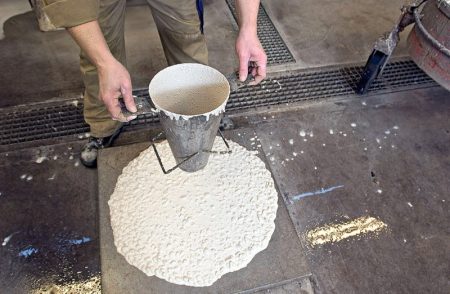
Concrete made of White cement.
Fig 1: Concrete made of White cement.

Following Raw material are used to make white cement

  1. Lime Stone -High Carbonate & Low Iron.
  2. Clay – High Alumina and Low Iron
  3. Oil / Pet Coke / Rubber
  4. Gypsum / Salenile

Properties of White Cement

Table 1: Properties of white cement and their values.
PropertiesValue
Fineness395 m2/kg
Setting Time100 min
Compressive Strength
1 day21 MPa
2 day38 MPa
7 day61 MPa
28 day74 MPa
Compact Density3150 kg/m3
Bulk Density1100 kg/m3
Brightness87%

Uses of White Cement

  1. Used for prestige construction projects and decorative works.
  2. Used for coloured concrete with the use of inorganic pigments to produce brightly coloured concretes and mortars.
  3. Due to its whiteness, it finds its application in architectural beauty, interior and exterior decorations, floorings, ornamental concrete products such as idols while grey cement is mostly used for construction purposes.
  4. Used in roads due the property of high reflectiveness to add visibility to highway medians.
  5. White cement is also used in a high amount for manufacturing precast members. Beautiful precast members are made utilising the white Portland cement.
  6. They are also used widely for making cast stones of appealing appearance.
  7. White cement is comparatively a costly cement type and is, therefore, used only selectively.
Building constructed using white cement.
Fig 2: Building constructed using white cement.

Differences between White Cement and Grey Cement

Table 2: Difference between grey and white cement.
PropertiesGrey CementWhite Cement
Raw MaterialsRaw materials contain a high amount of Iron Oxide and Manganese Oxide.Raw materials contain a very little amount of Iron Oxide and Manganese Oxide.
FinenessUsually less fine than white cement.Usually finer than gray cement.
Kiln FuelCoal, petroleum coke, fuel oil, natural gas.Oil is used to avoid contamination by coal ash.
Energy ConsumptionLow.High.
CostLess expensive.Expensive than gray cement.

How to Mitigate Human Induced Vibrations in Reinforced Concrete Structures?


How to Mitigate Human Induced Vibrations in Reinforced Concrete Structures?

Human induced vibration may create serious serviceability problems in reinforced concrete structures. There are several modern strategic projects that have suffered from such problem for instance Millennium Bridge in London-UK.
The bridge suffered from lateral synchronous excitation. The bridge had to closed and mitigated to eliminate such problem. From this example it becomes quite clear that human induced excitation need to be taken seriously and tackled properly.
In this article, several human induced excitation mitigation strategies will be discussed.
London Millennium Bridge - Vibration in Structure
Fig.1: London Millennium Bridge suffered from lateral excitation caused by human footsteps

How to Control Human Induced Vibrations in Reinforced Concrete Structures?

Mitigation strategies for Human induced vibration include:
  • Passive vibration control methods
  • Active vibration control methods
  • Semi active vibration control methods (or controlled passive methods)
The above vibration mitigation approaches may be used separately or combined to provide the desired result. These major vibration mitigation systems will be discussed in the following sections:

Passive Vibration Control Methods

Passive methods commonly decline energy dissipation demand in the main structure though eating most of the energy imposed on the structure.
Not only do isolation systems provide energy absorption capability but also introduce flexibility in the structure. Consequently, the amount of energy that may transfer to the structure would be declined considerably.
Moreover, passive damping supplemental tools eat most of energy that the structure experience. So, such device protects structures from the detrimental effects that inputted energy may cause.
Passive damping supplemental devices generate forces against the movement of the structure in which they are attached. The most outstanding advantage of such devices is that their dynamic features would not change with time.
Furthermore, they do not need to connect to external source of energy to help them in controlling vibrations. That is why these devices cannot cope with variations in external loads such as variations in excitation frequencies.
Finally, various passive damping supplemental devices are available to be used to tackle vibration serviceability problems of reinforced concrete structure due to human induced excitation.
For example, friction dampers, viscous damper, viscoelastic treatments, tuned mass damper or vibration absorber, tuned liquid damper, pendulum tuned mass damper, unbonded braces, impact damper, constrained layer damping, and yield plates.
Figure 2 and Figure 3 shows the application of passive methods to control the imposed vibration which the structure suffered from.
Stock Bridge Type Damper
Fig.2: Stock Bridge Type Damper
Pier damper used in London Millennium footbridge
Fig.3: Pier damper used in London Millennium footbridge to control lateral excitation (tuned mass damper)

Active Vibration Control Methods

The most obvious characteristic of active vibration control is that it is connected to an external source of energy. This energy is used to manipulate the power of actuators which in turn employ control force to a structure in its vibration mitigation function.
Active vibration control strategies can adapt to various loading conditions and able to control different vibration modes in the structure.
With regard to the design of active vibration control system, the design methods are considerably variable and the selection of each method is based on several factors for example favored performance objectives, the nature of the active control device, and features of the controlled target.
Lastly, there are various active vibration control systems for instance active tendon control system, active mass driver, active gyro stabilizer, active pulse control system, active aerodynamic appendages, and active constrained layer damping.
Figure 4 illustrates active vibration control system which initially detects vibration using sensors and then control the vibration properly.
Active vibration control system
Fig.4: , as it may be observed a sensor would detect the vibration and then the vibration would be suppressed and controlled.

Semi Active Vibration Control Methods (Controlled Passive Methods)

As the name of the technique may suggest, semi active vibration is the combination of active and passive vibration control system.
Semi active vibration control devices have stiffness and damping characteristic which can be adjusted in real time but energy cannot be injected into the controlled system.
There are several types of semi active vibration control devices for instance electrorheological damper as shown in Figure 5, netorheological damper, semi active tuned liquid damper, semi active pendulum tuned mass damper, and semi active tuned vibration absorber as it may be observed from Figure 6.
Typical arrangement of electrorheological fluid damper
Fig.5: Typical arrangement of electrorheological fluid damper
Semi active liquid tuned damper configuration
Fig.6: Semi active liquid tuned damper configuration

Terms Used in Plane Table Surveying


Terms Used in Plane Table Surveying

Meanings of various terms used in plane table surveying must be known before attempting for survey. Each term in plane table survey is useful and their determination during the surveying procedure is important.

Terms Used in Plane Table Surveying

1. Centering

Centering is the process of setting up plane table in such a way that the plotted position ‘o’ on the drawing sheet corresponding to the ground station ‘O’ is exactly over the station.

2. Orientation

It is the alignment of plane table by rotating it in the horizontal plane so that all the plotted lines are parallel to the corresponding ground lines. It is done by using a trough compass by back sighting or resection.

3. Back Sight

Back sight is taken from the plane table station to another station whose position is known and is already been plotted on the drawing sheet. It is a method of orientation of plane table.
To back sight a station, let’s say A, when the plane is centered over the station A, the alidade is placed along the plotted line ab. Plane table is then rotated till the station B is bisected. Thus, plane table is oriented by back sighting.

4. Fore Sight

Fore sight is taken from the plane table station to another station whose position has not been marked on the drawing sheet.

5. Radiation

It is the method of locating a point by drawing a radial line from the plane table station to the station under consideration. For this, the plane table is set up and orientation. Then a ray is drawn in the direction of that point using alidade. A length equal to distance of that point is cut off to a suitable scale.

6. Intersection

Intersection in plane table surveying is the method of location the point by intersection of two rays drawn from two different stations. It is used when it is not possible, or it is difficult to measure the radial distance of the unknown point due to some obstruction and the radiation method cannot be used.

7. Resection

Resection in plane table survey is the method of locating a station occupied by the plane table when the position of that station has not been earlier plotted on the drawing sheet when the plane table occupied other station.
Resection is done by sighting two points whose position has earlier been plotted in the two-point problem. Alternatively, it can be done by sighting three points whose positions have earlier been plotted in the three-point problem.

8. Plane table traversing

It is a method of traversing the plane table during survey. The traverse is directly plotted on the drawing sheet by drawing traverse lines with the help of an alidade. No angle measurements are during plane table traversing.

Monday, August 27, 2018

Construction of Steel Frame Structure Foundations, Columns, Beams and Floors


Construction of Steel Frame Structure Foundations, Columns, Beams and Floors

Construction of steel framed structures includes construction of its foundations, columns, beams and floors systems. Construction phases of structural steel frame are discussed.
Construction of Steel Frame Structural Elements
Fig.1: Construction of Steel Frame Structure

Construction of Steel Frame Structural Elements

Steel frame structure construction procedures are as follow:
  • Construction of steel frame structure foundation
  • Steel column construction
  • Erection of steel beams
  • Floor systems used in the steel frame structure construction
Construction of Steel Frame Structure Foundations, Columns, Beams and Floors
Fig.2: Steel Structure Frame

Construction of Steel Frame Structure Foundation

Steel framed structure construction begins with the construction of its foundation. Generally, the types of foundation required for the given structure is based on the soil bearing capacity.
Soil investigation including surface and subsurface exploration is used to assess the condition of soil on which steel frame structure rests.
For example, when moderate or low loads are imposed, then it is advised to use reinforced concrete bearing pads or strip foundation. These foundation types transfer loads to soil capable of supporting transferred loads.
Reinforced Concrete Bearing Pad Foundation for Steel Frame Structure
Fig.3: Reinforced Concrete Bearing Pad Foundation for Steel Frame Structure
If the strength of soil is poor and the imposed load is large, then it is recommended to consider pile foundation. The pile foundation would transfer the load of the structure to the stiff soil.
Pile Foundation for Steel Structures
Fig.4: Pile foundation to transfer loads of steel frame structure though low soil bearing capacity of stiff soil with adequate bearing capacity
Steel Bearing Pile Driven into Ground
Fig.5: Steel Bearing Pile Driven into Ground

Steel Column Construction

The next step of steel frame construction is the placement of steel columns. The section of the steel is specified based on the load imposed.
There are various sizes of steel column section to choose and these steel columns are commonly produced in advance.
The most significant point in column installation is the connection between foundation and column and splices between columns.
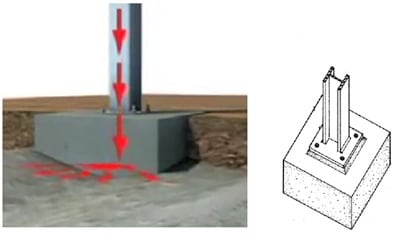
Regarding foundation to column joints, base plates are welded to the end of columns. The most desired shape of base plate is square and rectangular shape. Typical details of column to foundation connection is shown in Figure-6.
It should be known that, the most desired shape of base plate is rectangular and square shape because such plates provide largest spacing between the bolts which is desirable.
Steel Column to Foundation Details
Fig.6: Steel Column to Foundation Details, (A) Top bolt places created in base plate, (B) Side view of column base to foundation
As far as column splices are concern, it is provided in every two or three storey to ease erection process in addition to simplify steel column production and deliveries.
The distance between floor and column splice is about 60cm. When circular steel columns are used, weld connection is used to join both steel columns above and below.
Column Splices
Fig.7: Column Splices

Erection of Steel Beams

Various prefabricated beam sections are available to be used in the construction multi storey steel frame structure. Beams commonly transfer loads from floors and roof to the columns.
Steel beam members can span up to 18m, but the most usual range of steel beam spans rang from 3m to 9m.
While steel beams are erected, column to beam connection and beam to beam connections are encountered. There are different types of column to beam connection which are selected based on the type of loads imposed on the column to beam joint.
For example, if the joint is subjected to vertical loads only, then simple connections are used. Flexible end plate, fin plate and double angle cleat are examples of simple connections which are shown in Figure-8.
Different types of column to beam connection
Fig.8: Different types of column to beam connection suitable for the case where vertical loads are applied solely: (A) Flexible end plate, (B) fin plate, (C) Double angle cleat
If the joint is subjected to both vertical loads (shear force) and torsion forces, then full depth end plate connections and extended end plate connections should be considered as shown in Figure-9.
Full depth and extended end plat connection
Fig.9: Full depth and extended end plat connection used when the column to beam connection subjected to both shear and torsion stress
As far as beam to beam connection is concerned, end plate beam to beam connection is used to join secondary steel beams to primary steel beams.
Since top flange of secondary beams support floor system, so it must be leveled with top flange of the primary beams. This can be obtained by notching the top flange of the secondary beam as shown in Figure-10 and Figure-11.
Notched Part of Secondary Beam
Fig.10: Notched Part of Secondary Beam
End Plate Beam to Beam Connection
Fig.11: End Plate Beam to Beam Connection
Alternatively, projected bracket is welded to the primary beam and then secondary beam is attached without the need for notching secondary steel beams as shown in Figure-12.
Bracket Welded to Primary Steel Beams
Fig.12: Provision of Bracket Welded to Primary Steel Beams

Floor Systems Used in Steel Frame Structure Construction

There are various types of floor systems which can be used in the steel frame structure construction. Floors are commonly installed as the beams are erected.
Not only do the floors systems support vertical applied loads but also they act like diaphragms and resist lateral loads through the use of bracings.
Examples of floor systems include Short-span composite beams and slabs with metal decking, Slimdek, Cellular composite beams with slabs and steel decking, Slimflor beams with precast concrete units, Long-span composite beams and slabs with metal decking, Composite beams with precast concrete units and Non-composite beams with precast concrete units. 
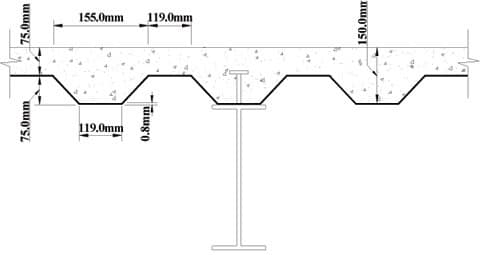
Composite Floors used in Steel Frame Structure
Fig.13: Details of Composite Floors used in Steel Frame Structure
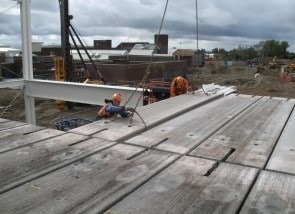
Precast Concrete Slab Placed on Structural Steel Frame
Fig.14: Precast Concrete Slab Placed on Structural Steel Frame

Construction of Bracing and Cladding in Steel Framed Structures

Bracings are used to resist lateral forced imposed on structure and it transfer lateral loads to the columns and then to the foundation.
Bracing with Connection Details
Fig.15: Bracing with Connection Details
Regarding cladding of steel frame structure, various types of cladding such as brick cladding and sheet cladding can be used to protect the inside area of the structure.