Monday, August 27, 2018

Sight Distance in Highway Engineering – Types and Calculations


Sight Distance in Highway Engineering – Types and Calculations

The visibility of the road ahead of the driver will help in the safe and efficient operation of the vehicles. This will hence demand the geometric design to be highly efficient so that the length of the road is highly visible to the driver even from a distance ahead. This distance is hence termed as the sight distance.

Sight Distance and Their Types

The actual distance that is observed along the road surface which is visible for a driver from a specified height above the carriage way is called as the sight distance at a point. This distance will let the driver see all the stationary and the moving objects in front of the vehicle.
Mainly in the geometric design of road construction, mainly three sight distances are taken into consideration. They are:
  1. SSD – Stopping Sight Distance or Absolute Minimum Sight Distance
  2. ISD – Intermediate Sight Distance: This is twice the value of SSD
  3. OSD – Overtaking Sight Distance
Other than these we have:
  1. Head Light Sight Distance
  2. Safe Sight Distance
The distance that is available for the driver during the night travel is called as the head light sight distance. At night the drive is facilitated by the illumination of the head lights.
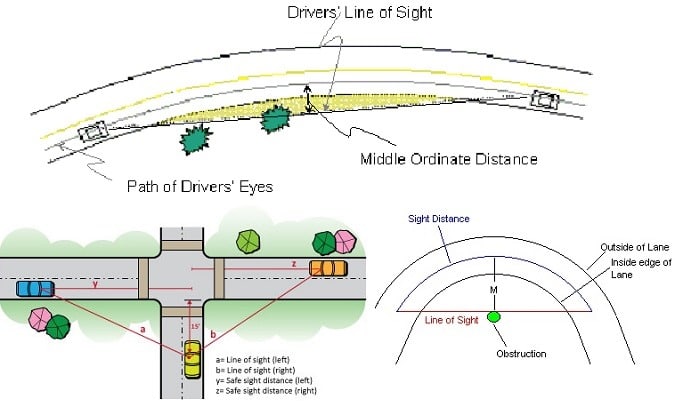
The sight distance available to enter an intersection is called as the Safe sight distance.
Whatever be the stopping distance taken into consideration, it is necessary for the driver who is traveling at the design speed to possess sufficient carriage way distance. This distance will be within the line of vision to stop the vehicle from colliding with a moving or stationary object in the traffic lane.
Sight Distance in Highway Engineering

Stopping Sight Distance

This is defined as the sight distance that is available for the moving the vehicle in the highway that will enable the driver to stop the vehicle safely without collision with any other obstacle.
As mentioned above, the parameter safe stopping distance is the most important feature in the traffic engineering. Safe stopping distance is the distance from the point it first perceives to the time the deceleration is complete. Adequate time is necessary for the drivers for them to react to the obstacle spontaneously.
This demand the sight distance used in the geometric design to be equal to the safe stopping distance. The Stopping distance can be defined as the sum of Lagging distance to the brake distance.
The lagging distance is the distance that is moved by the vehicle in a time period ‘t’ at a velocity of ‘v’ in m/s. Hence lag distance is ‘vt’.
The distance that is traveled by the vehicle during the operation of braking is called as the braking distance. In the case of a level road, the work that is done in stopping the vehicle is equated to the kinetic energy of the vehicle which will give us the braking distance.
Let ‘F’ be the maximum frictional force that is developed and ‘l’ be the braking distance. Hence, the work that is done against friction is given by
Fl = fWl –> (1)
Here W = the weight of the vehicle. The Kinetic energy attained at the design speed of the vehicle
= (1/2g) mv= (1/2g)Wv2 –> (2)
(1) Is equated to (2), we get
(1/2g) Wv2 = fWl
l = (1/(2fg))v2
Hence,
The Stopping Sight Distance (SSD) = Lag Distance + Braking Distance
-> SSD = vt + (1/(2fg))v2
Here, v is the speed in m/s2, t is the reaction time taken, f is coefficient of friction, g is the acceleration due to gravity.
The Table-1 Below shows the coefficient of friction for different design speeds.
Table-1: Coefficient of longitudinal friction
Speed kmph<0405060>80
f0.40.380.370.360.5
If the road possesses an ascending gradient in an amount equal to +n%, to the braking action the component factor of gravity will be added. This will decrease the braking distance. This component of gravity is acting along the direction of the braking force which is given by
Wsin? ~ Wtan? = Wn/100
After equating the kinetic energy and the work done we get,
l = v2 / (2g (f + n/100 ))
We can also derive the braking distance for a descending gradient which is performed similarly, and we get:
SSD = vt + (v2/ (2g (f ±0.01n)))

Overtaking Sight Distance (OSD)

Overtaking Sight Distance (OSD)
Fig.1: Representing Overtaking Sight Distance through Time Space Diagram
The minimum distance available for the driver to safely overtake the slow vehicle in front of him by considering the traffic in the opposite direction is called as the overtaking sight distance. This distance will make us see whether the road is clear to undergo an overtaking movement.
The overtaking sight distance is also called as the passing sight distance that will be measured along the center line of the road. This is the line level over which the driver keeping an eye level of 1.2 m above the road level can easily see the top of the object 1.2 m above the road surface.

Factors Affecting Overtaking Sight Distance

The main factors that affect the OSD are:
  • Spacing Between the vehicles
  • Speed of the vehicles
  • The gradient of the road
  • The acceleration rate of the overtaking vehicle
  • The velocities of the vehicle which is overtaking, overtaken and that coming in the opposite direction
  • The driver skill
  • The reaction of the driver

Computation of Sight Distance

The computation of the sight distance mainly depends on the:
  1. Driver’s Reaction Time
  2. Vehicle’s Speed
  3. Efficiency of Brakes
  4. The frictional Resistance Existing Between the Tire and Road
  5. Gradient of Road

Brake Efficiency

Many factors like the age of the vehicle, the characteristics of the vehicle will affect the brake efficiency of the vehicle. An efficiency of 100% implies that the vehicle will stop at the moment the brake is applied. Obtaining 100% is not practicable. This is an ideal condition of the vehicle.
This means, for a lower value of brake efficiency, it is necessary to obtain a higher value of sight distance. In the process of determining a safe geometric design, it is required to assume 50% brake efficiency.

Friction between the Road and the Tire

The stopping of a vehicle is also dependent on the frictional resistance between the tire and the road. Having a higher value of frictional resistance will result in efficient stopping of the vehicle when applied. Here, the sight distance required will be less.
During the computation of sight distance, no special provision or consideration is given for the brake efficiency. This is considered along with the factor of longitudinal friction. In India, the value of longitudinal friction is between 0.35 and 0.4. This is as per the Indian Road Congress.

Speed of the Vehicle

The speed of the vehicle clearly affects the sight distance. If the speed employed is high, the time required to stop the vehicle will be high. This means that with the increase in the speed there is increase in the sight distance.

Driver’s Reaction Time

The time from the moment the driver observes the obstacle in front of him to the moment he applies brake is called as the reaction time of the driver. Based on the PIEV theory, the reaction time can be divided into 4 components.
All these times will be combined to form a total perception reaction time while undergoing actual practice and design of highway. From studies conducted it is reviewed that the drivers will require about 1.5 to 2 seconds for normal conditions. As this value may vary based on the characteristics of the vehicle, a higher value for the reaction time can be employed for the design purpose. In India, as per IRC, the reaction time is set to be 2.5 seconds.

Gradient of Road

The sight distance is greatly influenced by the gradient of the road. There are chances for the vehicles to stop suddenly when the vehicle is climbing suddenly. This situation will ask for a small sight distance. When the vehicle is moving down, the movement is supported by the gravity action. This will hence ask for more time to stop the vehicle. In this situation, the required sight distance is more.

Bar Bending Schedule for Pile Foundation with Calculations


Bar Bending Schedule for Pile Foundation with Calculations

To clearly understand the bar bending schedule of a pile foundation, it is necessary to be familiar about the typical reinforcement details of a pile foundation. Pile foundation is a common type of deep foundation, used for supporting heavy loaded structures when the site under consideration have a very weak soil that is compressible in nature.

Layout of a Typical Pile Foundation

A typical pile foundation arrangement have the load structure supported by a pile cap, which is in turn supported by several piles as shown in the plan and front view arrangement in the below figures.
Pile Foundation Arrangement – Superstructure, Pile Cap and Piles
Fig.1: Pile Foundation Arrangement – Superstructure, Pile Cap and Piles

Structural Specification and Reinforcement Details of a Pile Foundation

The figure-2 shows the typical reinforcement details and drawing of a pile foundation. The details of pile cap are not explained in this article.
Pile Foundation Reinforcement Details
Fig.2: Pile Foundation Details
The whole arrangement is clearly understood from the figure-2. The pile cage has vertical reinforcement held together by outer and inner rings. The Reinforcement in pile construction include:
  1. Vertical Reinforcement
  2. Outer Ring Reinforcement
  3. Inner Ring Reinforcement
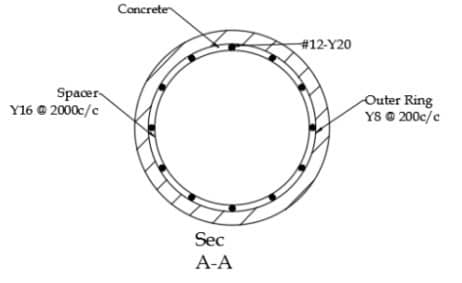
The above details are mentioned in the figure-3 below. The Outer rings are provided as helical rings and the inner is circular or spiral ties.
Cross-section details of pile foundation
Fig.3: Cross-section details in section A-A of figure-2
The development length ‘Ld is provided outside of the column piercing into the pile cap. The anchorage length to the recommended amount is provided to the bottom of the column as shown in figure-2.
From the Figure:
  1. Length of Pile = 20m
  2. Diameter of Pile = 0.6m
  3. Diameter of:
    1. Vertical Reinforcement = 20mm – 12nos
    2. Outer Helical Ring = 8mm @ 200mm c/c
    3. Inner spiral ties = 16mm @ 2000mm c/c
  4. Bottom Length of Anchorage = 300mm
  5. Development Length = 40d
  6. Clear Cover = 75mm

Calculation for Bar Bending Schedule of Pile Foundation

Step 1: Length of Vertical Reinforcement

In the case of bar bending schedule of a column or a pile, there comes need for lapping the rods so that the length of pile (20m) is attained. Hence, a lapping length equal to 5Dd is provided in extra. Therefore,
Total Cutting Length for Vertical Reinforcement = Anchorage Length at the bottom of the pile + the height of the pile + development length (40d) + Lap length (50d) – clear cover provided at the bottom.
i.e. Lv = 300 + 20000 + 40d +50d -75 = 300 + 20000+ (40 x 12) + (50 x 12) – 75
Total length of vertical reinforcement, Lv = 21.3m
Note: During tying the bar, it is recommended to tie at the middle, as tying at the ends of the bars will be subjected to higher stress values.

Step 2: Inner Spacing Ring – Number and Length of each Ring

Here, we have to determine the length of each inner ring along with their numbers arranged.
The number of rings (Nr) = [Length of the Pile / Spacing] + 1
= [20000/2000] +1 = 11 No’s
The circumference of the ring gives the length of each ring. For this the radius of the ring has to be determined. Given the radius of the pile, the clear cover, outer ring radius:
The radius of the ring = [Radius of the pile – clear cover – diameter: of outer ring – diameter: of vertical reinforcement:]/2
= [600 – 75 – 8 – 12]/2= 252.5mm
Hence, Length of ring = 2xpixr
= 2 x 3.147 x 252.3 = 1584.4mm = 1.58m

Step 3: Outer Helical Ring – Number and Length of each ring

For every specification of outer helical ring, the radius of the same have to be determined.
Radius of Helical Ring Outer = [Diameter of Pile – Clear Cover]/2
= [600 -75]/2 = 262.5mm
Length of ring = 2xpixr
= 2 x 3.147 x 262.5 = 1648.5mm = 1.65m
The number of rings (Nr) = [Length of the Pile / Spacing] + 1
= [20000/200] +1 = 101 No’s

Step 4: Bar Bending Schedule

SpecificationDiameter of Bars (m)No. of Bars(m)Length of rods(m)Total Length(m)
Vertical Bar121221.3255.6
Inner Ring bar16111.5817.4
Outer ring bar81011.65166.65

Sunday, August 26, 2018

Different Ingredients of Cement-Their Proportion, Functions and Limitations


Different Ingredients of Cement-Their Proportion, Functions and Limitations

The Ordinary Portland cement contains different ingredients with varied proportions. Each ingredients imparts different property to the cement. To produce good quality of cement, we must know the proportions, functions and limitations of different ingredients of cement.

Proportion of Ingredients of Cement

Different ingredients of cement and their proportions are as follows:
  1. Lime (CaO)
  2. Silica (SiO2)
  3. Alumina(Al2O3)
  4. Iron (Fe2O3)
  5. Magnesia (MgO)
  6. Calcium sulfate (CaSO4)
  7. Sulfur (SO3)
  8. Alkalis
Percentage of Cement Ingredients
Fig 1: Proportion of Cement Ingredients

Functions and Limitations of Cement Ingredients

1.Lime (CaO)

Lime or calcium oxide is the most important ingredient of cement. The cement contains 60 to 67% of lime in it. It is obtained from limestone, chalk, shale etc. Adequate quantity of lime in cement is helpful to form the silicates and aluminates of calcium.
If lime is added in excess quantity the cement becomes unsound as well as expansion and disintegration of cement will occur.
If lime content is lower than the minimum requirement strength of cement will reduce and also setting time of cement will decrease.
Lime or Calcium oxide
Fig 2: Powdered lime

2.Silica (SiO2)

Silica or silicon dioxide is the second largest quantity of cement ingredients which is about 17 to 25%. Silica can be obtained from sand, argillaceous rock etc. Sufficient quantity of silica helps for the formation of di-calcium and tri-calcium silicates which imparts strength to the cement.
Excess silica in cement will increase the strength of cement but at the same time setting time of cement also increased.
Silica
Fig 3: Silica Fume

3.Alumina (Al2O3)

Alumina in cement is present in the form of aluminum oxide. The range of alumina in cement should be 3 to 8%. It is obtained from bauxite, alumina contain clay etc. Alumina imparts quick setting property to the cement.
In general, high temperature is required to produce required quality of cement. But alumina when added with cement ingredients it behaves as a flux and reduces the clinkering temperature which finally weakens the cement. So, to maintain the high temperature alumina should not be used in excess quantity.
Aluminum Oxide
Fig 4: Alumina

4.Iron oxide (Fe2O3)

Iron oxide quantity in cement is ranges from 0.5 to 6%.It can be obtained from fly ash, iron ore, scrap iron etc. The main function of iron oxide is to impart color to the cement.
At high temperatures, Iron oxide forms tricalcium aluminoferrite by reacting with aluminum and calcium. The resultant product imparts the strength and hardness properties to the cement.
Iron Oxide Different Colors
Fig 5: Iron Oxide Pigment

5.Magnesia (MgO)

Cement contains Magnesia or Magnesium oxide in the range of 0.1 to 3%. Magnesia in cement in small quantities imparts hardness and color to the cement.
If it is more than 3%, the cement becomes unsound and also strength of the cement reduces.
Magnesia
Fig 6: Magnesium Oxide

6.Calcium sulfate (CaSO4)

Calcium sulfate is present in the form of gypsum in the cement. It is found together with limestone. It ranges between 1 to 3%.
The function of calcium sulfate in cement is to increase the initial setting time of cement.
Calcium Sulfate or Gypsum
Fig 7: Gypsum Powder

7.Sulfur (SO3)

Sulfur or sulfur trioxide in the cement is about 1 to 3%. Its function is to make the cement sound. If it is in excess quantity the cement becomes unsound.
Sulfur in Cement
Fig 8: Sulfur Trioxide

8. Alkalis

Alkalis like soda and potash are present in the cement which normally ranges from 0.1 to 1%. During manufacturing process of cement most of the alkalis are carried away by the flue gases at the time of heating. Hence cement contains very small quantities of alkalis in it.
If alkalis content is more than 1% then it will cause several problems like alkali aggregate reaction, efflorescence, staining etc.
Excess Alkali Effects on Cement
Fig 9: Efflorescence Due to Excess Alkali