Sunday, August 26, 2018

The Four Generations of High Rise Building Construction


The Four Generations of High Rise Building Construction

The level of high rise construction we see today is a result of series of construction process and development carried throughout years. Initially, it was heavy and sturdy structures, which with time have changed to lightweight structures as we see today.
the high-rise buildings we see presently and those undergoing construction is the fourth generation of high rise buildings. The high-rise building in the fourth generation have strong emphasis building safety and protection along with the life safety factors.
We will see through the different generation of high rise building construction briefly in the coming section.
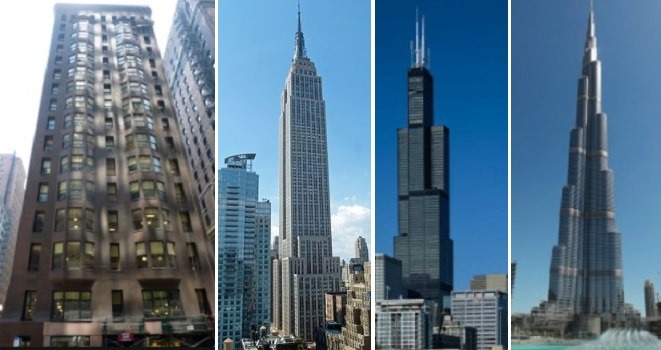
Four Generations of High Rise Building Construction

High-Rise Building Construction in First Generation

The high-rise building that were constructed during the first generation take walls that are heavy in weight. The exterior wall was constructed by means of stones or bricks.
When considering the thickness of the wall, they were given in a larger thickness. This is to ensure that the complete load over the building is carried properly by the walls.
An example of first generation high rise building is the Monadnock Building in Chicago. This was built from 1889 to 1891. The building is 16 stored and is considered as the tallest load bearing structure in the world. The walls at the base have a thickness of 6 feet. This thickness was a way to carry the loads from the upper floors.
Most of the authorities in the first generation came up with a recommendation that a thickness equal to 12 feet is necessary to support the load from the first story. This thickness value was added with four inches with each increase of story.
This hence limited the construction of stories greater than 10. The Monadnock Building mentioned above was an exception at that period.
Many first-generation high-rise building were characterized by their facades made from cast iron. Some of the buildings has columns made from cast iron but were unprotected. Even the wrought iron columns and steel beams were employed.
Most of the floor during the period where made from wood. This was a weak link during a fire attack. This had resulted in numerous building collapse.
Vertical openings that were unprotected was a common construction practice in the high-rise building construction. Everywhere in a high rise building the use of open stairways, elevator shafts and the light wells were common. These features are restricted in the modern high-rise construction of buildings.
Monadnock Building in Chicago
Fig.1: Monadnock Building in Chicago

Second Generation of High-Rise Building Construction

The high-rise construction in second generation can also be called as pre-world war II High rise construction. This era has given rise to the development of the protected steel frame structures.
The following were the features that characterized the high-rise building in this generation:
  • Assembly of fire resistance
  • Shaft enclosures
  • Compartmentalization
  • Use of non-combustible materials
Masonry enclosure were provided for all kind of metal structural members. This was also provided for vertical shafts that was enclosed by masonry and tiles.
The floor construction was carried out by having concrete floors that were constructed on brick or arches of hollow tile. The floor areas were subdivided. The use of combustible materials was limited in the construction as a step to improve fire resistance.
The buildings constructed in the Pre-world war II were considered to be most excellent buildings. In order to have closer access to the natural ventilation and lighting, the building have floor spaces that were small. It was common in the building.
More open floor areas were derived in the modern high-rise buildings with the invention of central heating system, air conditioning systems (HVAC), fluorescent lighting systems etc.
The high-rise building in this period had floors that were well segregated fire area. The Empire State building in New York is the best example of second generation high rise building construction.
Empire State building in New York
Fig.2: The Empire State building in New York

Third Generation High Rise Building Construction

The third-generation construction of high rise buildings are known as post-world War II high rise construction. This have resulted in the evolution of much more lighter construction methods and materials.
This era was the rise of steel frame type structure with core, or in other words, center core construction technique. A common exterior wall surrounded the inner core structure.
The exterior wall is either glass or some sort of stone material. The exterior steel frame has curtain wall that are attached to it by fastening. The fastening is done such a way that a gap exists between the structural frame and the curtain walls.
Within this gap, a fire stopping material is placed or a kind of vertical fire extension have chances to occur. This is a major problem behind fires in major high rise buildings.
The method and type of stopping used are similar to that used to fill the gap as mentioned above, is very important. Many buildings have used friction fire stopping material like rock wool to be placed in the curtain wall gap. This is held in place by means of friction.
When the material becomes wet due to any reason of rain or air conditioning water or any other reason, this material absorbs the water and become heavy. Once it become too heavy it falls out. Such situation makes the curtain wall gap unprotected. This creates an open path for the spreading of vertical fire.
This generation makes use of central heating as well as ventilation system (air conditioning etc.) inside the building very significantly. This is more related to the air movement and the extension of smoke and fire related issues. These third-generation buildings can be defined as windowless as the common HVAC system is used.
The occupants faced the problem of egress due to the lack of fire towers and less remote scissor stairs. The modern high rise construction has the stair in the core structure that they no longer will remain remote for access. As these cores have most of the stair arrangement, it was observed that they were more contaminated by the smoke and product of combustion when a chance of serious fire issue is commenced.
Pressurization for the stairwells were provided by many of the modern high rises, but they were futile. During a mass evacuation, the pressurization to the stair well become of no use as there is multiple opening of door quickly.
Many mega high-rise structures followed unique construction features to reach the desired heights. The Seas Tower and the former World Trade Center used the tubular construction design.
The tubular structural design makes use of high load bearing members to bound and surround the buildings. The interior members have to take less load. The sections and designs are hence placed based on this criteria in a tubular building construction. In order to support the floor, truss combination is used.
Seas Tower in Chicago
Fig.3: Seas Tower in Chicago

Fourth Generation of High Rise Construction

This generation of high rise building construction have begun and are on its course. This is also called as the post-9/11 high rise construction. This generation structures make us see the resurrection of many features that are seen in the second generation.
Considering all the limitation of past generation construction, the newer high-rise construction considers a means of egress through a stairwell. This also consider a means for assisting the fire departments by means of logistical operations.
For examples, the use of elevators carried in a heavy enclosure which is resistant to fire, explosion, collapse and smoke.
These robust construction techniques come out to be costly. But the concern about fire and life safety compromise with the cost.
Burj Khalifa, Dubai – Fourth Generation High Rise Construction
Fig.4: Burj Khalifa, Dubai – Fourth Generation High Rise Construction

Saturday, August 25, 2018

Common Causes of Failures of Dam Structures


Common Causes of Failures of Dam Structures

Dam structures are subjected to horizontal loading from the water head behind, the pressure from the water towards the dam materials, the neighboring geology as well as from the size of the reservoir. These features are unique in the case of dam structures.

Common Causes of Failures of Dam Structures

The most common reason behind the failure of dam structures from the review taken from past studies is overtopping. The overtopping is caused either due to overtopping, which is something concerned with the design of the spillway.
Causes of Failures of Dam Structures
Overtopping is a major failure that is created due to heavy floods. There are two main factors that cause the overtopping failure. One is the continuous flow that is created due to surface elevation that will exceed the complete structural elevation profile.
The second main reason is the over wash from the waves, where the surface of the water stays below the structure elevation profile. Most of the embankment dams does not have much withstanding power towards the overtopping effect. But the concrete dams will withstand this to certain level as they have strong rock foundation.
Failure of Dam due to Overtopping
Fig.2. Failure of Dam due to Overtopping
Many other causes of dam failures are mentioned below:
  1. Water Breaching
  2. The foundation of the dam is inadequate
  3. Piping causes erosion of the foundation
  4. Subsidence and the movement of the foundation
  5. Uplift from the ground and sliding of the structure
  6. Variation in temperature unequally throughout the dam structure
  7. Water breaching issues
  8. Dynamite blasting in the nearby areas causing vibration to the dam structure
  9. Seismic load action
  10. Wave action on the structure and weak energy absorption characteristics of the structure
  11. Higher amount of silting causing greater loads that expected during the design of the dam.
  12. The concrete and nearby rock or the soil surface loosing shear capacity.

Causes of Failures of Earth Dam Structures

In the case of earth dam, the unique feature is that the material used for the structure is made from earth materials or the rocks that is nearby the site. This makes the structure to be heterogeneous in nature that it shows different properties for different conditions of moisture as well as internal pore pressures. This material will bring variations in the physical properties like density, shear strength and permeability.
Other primary phenomena that will create failures for the earthen dam structures are:
  1. Inadequate spillways constructed causing overtopping issues
  2. Piping erosion
  3. Failure of the structure along the outlet pipes
  4. Animals creating undermining issues on the foundation
  5. The water will cause the clay blanket to swell. The water pressure will force the front wall of the structure
  6. Puddle core settlement
  7. Drainage and saturation of the drainage
  8. Shrinkage in clay caused from droughts
  9. Compaction not up to the desired level
  10. Breach formed at the intake device
  11. Slip of the upstream slope and use of material that is unsuitable
  12. Upstream clay face subjected to sloughing
  13. The clay blanket will be subjected to swelling due to the water. This is then forced on to the front wall.
  14. Slope instability creating rapid draw down and slide failures

Causes of Failures of Gravity Dam Structures

Another type of dams are the gravity damswhich are constructed from concrete and masonry. The major causes of failures of gravity dam structures are:
  1. Erosion of soil near to the foundation causing settlement.
  2. Construction joints undergoing failure
  3. The quality of the material used is very poor
  4. The degradation of the material due to excessive exposures.
  5. Rock foundation subjected to horizontal shear.
  6. The footing constructed found to be too shallow in nature. This creates scour or blowout of the foundations.

Causes of Failures in Arch Dam Structures

Another type of dam is the arch dam. This dam differs from other dams in terms of in plane stresses existing and the thrust. These factors are employed for the design of the structure in large extend. These factors are completely dependent on the soil and the conditions of the rock.
Other major reasons causing failure in arch dams are:
  1. The structure lacks the ability to adjust with the existence of the slip plane. This instability of the structure may not be identified in the soil investigation.
  2. Penstock vibration resulting in cracks on the structure.
  3. Inadequate grouting action of the contraction joints causing cracks in the structure.

Causes of Failures in Buttress Dam Structures

Another type of dam is the buttress dam. This dam is unique in the case that the horizontal forces are transferred to the rock foundation. This is carried out by means of a vertical component of the water pressure. This is the force that is analyzed for the sliding and overturning failure of the dam structure. The main reasons behind the damage of these structures are:
  1. Alternate freeze and thaw cycles undergone by the abutments will cause frost damage.
  2. Masonry bases that are constructed poorly for multiple set of concrete dams causing failure of the concrete masonry joints
  3. Abutments subjected to cracking
  4. Permeability in concrete or formation of porous concrete

Working at Heights in Construction – Regulation and Precautions


Working at Heights in Construction – Regulation and Precautions

Working at heights in construction works is associated with hazards and accidents. Thus, safety procedures are of utmost importance while working at heights.
At least 50-60 deaths are accounted per year in construction projects with number of injuries around 4000 due to accidents associated with working at heights.
These risks are mostly subjected to the painters and the decorators who maintain the facade beauty of the building structures. Some of the miscellaneous works that are done in large heights are the window cleaning, maintenance work at height, changing of the street lamps, tree surgery etc.
Regulations for Working at Heights were prepared which provides safety procedure to be followed during such works. This not only include the construction work but also all works that must be carried out at height.
A study conducted by the Health and Safety Engineer on past 5-year period record of construction accidents conclude that a well-designed construction projects have lesser chance to welcome hazards and accidents.
Sufficient dimensions for guard rails must be provided as per the building regulation of that particular area / state for the construction of warehouses, factories, public buildings, retail premises, offices etc.
Working at Heights in Construction - Regulation and Precautions

Hierarchy of Control as Per Work at Height Regulations

Certain hierarchy of measures were taken by the work at height regulations to save the workers from accidents due to the working at heights. They are:
  1. The requirement of working at height is avoided to the maximum
  2. An existing safe place for work is employed
  3. Provision of more equipment oriented works to avoid accidents
  4. The chances of accidents due to heights and consequences of falls are mitigated
  5. Proper Instruction, training to the workers and supervision must be controlled.

How to Work at Heights in a Construction Project?

working at height in a construction projects involves hazards and risks. Understanding the safety risks associated with each type of construction work such as brick masonry, wall plastering, painting etc. is required for safety and precautions.
Preparing a checklist for risk associated with each work and then following it on construction site is essential first step towards working at height. Training of workmen for safety risks and hazards is the next step. Regular supervision by a competent supervisor is necessary for working at heights.
For details how to work at heights in construction projects, construction hazards and their control is discussed below.

Construction Hazards due to Working at Heights and Their Control

There are many chances of hazards that can be caused in a construction site due to the high dynamic nature of the work. So, it is necessary to have a precaution while dealing with such dangerous site than to have a reactive mind.
Some of the control measures and chances of hazards are mentioned below.

A Safe Working Place

During the progress of work at heights, it is very essential to have a safe and clear access and egress from the workplace. The units that are used for the works like the working platforms, the scaffolds, ladders, gangways, material hoists; all must be completely safe so that the worker can trust it and do the work.
This check of working platforms must be done through regular inspection and maintenance if needed. The working place must be kept clean and tidy as possible. Otherwise slipping and tripping might be the cause of accidents.

Work Accidents and Protection of Injured

The working activities at heights can result in injuries sometimes to death. It is very essential to bring special care to protect the workers while working at heights. No profit in project is obtained without having any concern on the safety for the workers.
Safe systems of works are essential for the works like roofing, steel work, rendering, cladding, erection, high pressure water, concrete repairs, painting, and demolition works if any. Other hazardous problems due to electricity, vibrations, and noise can also affect the workers while working at height.
Other main cause of accidents is the use of false work. The false work are temporary structures that are used to support a non-supporting structure during its refurbishment or construction.
One such example is the use of wooden structure to have brick work. It is always recommended that competent person must use false work by carrying out proper planning, erection, and dismantling.
Large accidents due to the collapse of false work have been recorded. These accidents at large heights make it more severe problem.
The cleaning of buildings involves grit-blasting and high-pressure water jets which are found to be every dangerous activity. These are mostly carried out by standing over the scaffolding or even ladders for high rise buildings, 30 to 35 stored ones or more.
It is very necessary to have protection of the workers, the occupants residing, the pass-by from harmful effects of debris, dust, noise, flooding of the walkways and more importantly falling of heavy debris and elements. The workers dealing with the same must carry essential goggles, gloves, and ear defenders.
The equipment used must be properly cleaned and must undergo proper inspection by trained specialists. All the above, proper supervision on whether the above-specified activities is undergone or not is necessary.

Protection Against Falls

The recommendations provided by the work at height regulations are mentioned to protect the lives from falls:
  1. If working at height is essential, proper planning and organizing is necessary before its commencing.
  2. The workers involved in working at heights must be competent.
  3. The risk involved in working height must be analyzed and appropriate working equipment must be provided accordingly.
  4. Working near fragile surface if necessary must be properly planned and managed.
  5. Properly inspected and maintained equipment must be used when working at heights. Any undesirable behavior of equipment at the working time at height can cause serious issues.

Fragile Roofs and Surfaces

Falling of workers from roofs made from fragile surfaces are recorded as a severe accident cause every year. Roof works that are carried out in pitched types are dangerous and requires risk management methods. This must be carried before the commencement of the work.
These fragile surfaces deteriorate with age due to the exposure to different climatic temperatures which result in the loss of strength to act as a support for the workers to work. Work must hence be started after looking to the condition of the roofs.
If that is the case, use of scaffolding, ladders and other support platforms becomes essential. Warning signs at suitable locations, indications to show that the roof is fragile must be provided.
If the roof is fragile, the following measures must be taken:
  1. Carrying out the work underneath the roof must be done with the help of working platform
  2. If a working platform cannot be provided, a mobile elevating working platform will work well. This helps the workers to stand on a bucket and carry out the work safely.
Situations where the access to the fragile roof is not possible, then it is necessary to provide perimeter edge protection and staging. This help to spread the load.
Some of the fragility reasons seen for roofs are:
  1. Deterioration of roofs with age
  2. Corrosion of the roof cladding and fixing
  3. Quality of the original materials are poor
  4. The damage due to thermal and impact load
  5. The supporting structure must be damaged
  6. Damage due to extreme weather conditions
The roof materials considered to be fragile are:
  1. Asbestos sheets
  2. On built up sheeted roofs
  3. Glass
  4. Roof lights
  5. Fiber cement sheets
  6. Metals sheets- corroded one

Structural Details of Burj Khalifa – Concrete Grade and Foundations


Structural Details of Burj Khalifa – Concrete Grade and Foundations

Structural Details of Burj Khalifa

The world’s tallest building, Burj Khalifa took 6 years for its construction and was inaugurated on 4th January 2010. The structure is 828m tall and the whole system is a reinforced concrete tower structure.
This was the first attempt in world history to have such a large height for structures. This reason made the designers to employ one of the best and latest technology and innovative structural design.
The structural features of Burj Khalifa is explained in the following section.
Structural Details of Burj Khalifa
Fig.1: Burj Khalifa

Burj Khalifa Project Details

The structure is located in Dubai, United Arab Emirates. The structural features include:
  • 160 + story tower
  • Podium structure adjacent
  • Have a six story office adjacent
  • A two story pool facility near
The tower comprises 2,80,000 m2 area. This area is utilized for 700 residential apartments located from 45 to 108 floors. Remaining spaces is till the 160th floor is occupied by the corporate officers. The total project cost is estimated to be US$20billion. The tower construction itself costs $4.2billion.
The structural elements used and their amount is mentioned below:
  1. Concrete Used = 250000 cubic meter
  2. Curtain Walls = 83,600sq.m of glass and 27,900 sq.m of metal
  3. Steel Rebars Used = 39,000 tones
  4. Man-Hours = 22million man-hours

Shape of the Tower

Adrian Smith is the man behind the structural and the architectural design of Burj Khalifa. The basic structure is a central hexagon core with three wings, which is clustered around it, as shown in figure-2.
While moving up along the tower, one wing at each tier is set back. This makes decreasing cross section when moving up. The structure consists of 26 terraces.
Cross Section plan of Burj Khalifa
Fig.2: Cross Section plan of Burj Khalifa

Structural System of Burj Khalifa

The Burj Khalifa employs a ‘Y’ shaped floor plan. This plan provide higher performance and provides a full view of the Persian Gulf. The shape and the upward setbacks help the structure to reduce the wind forces that is acting on the structure. The shape was finally fixed based on the series of wind tunnel tests.
The structural system employed for Burj Khalifa can be called as the Buttressed Core System. The whole system is constructed by using high performance concrete wall. Each wing buttresses the other through a hexagonal central core as shown in figure-2.
The central core has a higher resistance towards the torsional resistance. The structure is more designed for wind force and related effects.
There are corridor walls that extend from the central core to the end of the wing. At the end, these walls are thickened by means of hammer walls. These walls resist the wind shears and moments by acting like the web and the flanges of the beams.
There are perimeter columns which are connected to the mechanical floors. The connection between the perimeter columns and the mechanical floors is provided by means of outrigger walls. This help to resists higher wind loads laterally.
The outrigger depth is three storey heights. There is periodic encounter of outrigger system through the height of the tower.

High Performance Concrete Used in Concrete

The high-performance concrete used in Burj Khalifa guarantee low permeability and higher durability. The C80 and C60 cube strength concrete is used incorporating fly ash, Portland cement, and the local aggregates. A young’s modulus of 43800N/mm2 is said to be granted by the C80 concrete.
The largest concrete pumps in the world were used to pump concrete to height up to 600 m at a single stage. Two numbers of this type of pump was used.
As the temperature of the location (Dubai) is very high, there were chance of cracks due to shrinkage. So, the concrete pouring process was carried out at night at a cooler temperature. Ice was added to the concrete mix to facilitate the desired temperature.
To withstand the excessive pressure caused due to the building weight, special concrete mixes were employed. Every batch was tested before placing.

Foundation of Burj Khalifa

The superstructure of Burj Khalifa is supported over a large reinforced concrete raft. This raft is in turn supported by bored reinforced concrete piles. The raft has a thickness of 3.7m and was constructed in four separate pours.
The grade of concrete raft is C50 which was self-consolidating concrete. The concrete volume used in the raft is 12,500 meter cube. The number of piles used were 194. The piles were 1.5m in diameter and have a length of 43m. Each pile has a capacity of 3000 tons.
The concrete grade used in piles where C60 SCC concrete which were placed by tremie method. This utilized polymer slurry to carry out the process. To reduce the detrimental effects of chemicals, cathodic protection where provided under the raft.
Pile Raft Foundation in Burj Khalifa
Fig.3: Pile Raft Foundation in Burj Khalifa. Photos From the Construction Stage