Saturday, August 25, 2018

Tensile Piles or Uplift Piles – Piles Under Tension – Analysis and Design


Tensile Piles or Uplift Piles – Piles Under Tension – Analysis and Design

Pile foundation that is constructed to resist the uplift forces can be called as Tension Piles.These are also called as uplift piles or anchor piles. In those areas where there are chances of extraction of piles from the ground, the uplift piles will work well.
Foundations are broadly classified as deep and shallow foundations based on the load carrying capacity and the properties of the soil at the site. The most widely used type – Pile foundations, come under the category of deep foundations.
Any foundation structure that have a depth greater than three times the breadth of the structure can be categorized as pile foundations. Pile foundations form slender and columnar structures intended to transfer mainly compressive loads from large superstructures. The below-transferring medium may be either weak soil or a stratum that is compressible or a strong rock stratum like structure.

Tension Piles Under Uplift Forces

Different reasons for the development of the uplift forces are the:
  • Seismic Forces
  • Overturning Moments
  • Hydrostatic Pressure
Tension Piles Under Uplift Forces
These forces are expected in the construction of large structures like transmission towers, jetties, tall structures, chimneys, jetties etc. Most of the skyscrapers are subjected to higher wind loads or seismic forces that induce overturning moments which in turn result in uplift. Uplift forces can develop because of hydrostatic pressure, seismic activity or overturning moments.
When the structure undergoes overturning, one end is subjected to compression and other tension force. These forces must be transmitted safely to the ground with the help of the foundation (Pile) constructed. This will prevent the uplift caused. The transmission of the loads to the bottom strata is carried throughout the length of the pile.
The construction of tension piles transfers this uplift force safely with the action of friction along the pile length which is acquired by under-reaming. The tension piles use sheet piling walls to resist the horizontal forces if any.
The vertical piles installed to serve this purpose must possess sufficient depth which is the main factor resulting in the shaft friction to resist the uplift forces. Different modifications in the piles can bring reduction of uplift forces to a large extent.

Uplift Resistance of Piles and Tension Piles

It is recommended to have a long pile in depth to take up the uplift load in the shaft friction. In some situation, it may be difficult to incorporate the long depth due to the presence of a hard rock stratum below the soil. So, to mobilize the remaining frictional resistance, it must be augmented through the addition of dead weight to the pile. This will help overcome the uplift forces. Another solution for this issue is the anchoring of the pile to the rock stratum.
pile-foundation-under-floor
Fig.1. Piles Provided Under the Floor for a Shipbuilding Dock
In the other side, the addition of dead weight for the piles is found uneconomical. In some applications like shipbuilding (Figure-1), it is necessary for the piles to take up alternative compressive loads and uplift forces.
An increase in dead weight in such situations will tremendously increase the construction costs and the compression rakers will be subjected to high compression loads. These issues can be solved by providing anchors for the piles that will be taken down to the rock layer.

Design of Piles for Uplift Pressure

The design of the pile foundation (Tension Piles) is performed such a way that no complete overturning or collapse has to occur under extreme conditions of loading or undergo a displacement at any severe combinations of the working loads. This consideration will not affect the functioning of the foundation under severe load conditions.
The country and the followed codes and specifications will define the maximum or the permissible displacement possible for the piles.The ultimate resistance of the pile and the pile group is determined for design when displacement is not a concerned factor. The allowable loads can be calculated by adding a factor of safety to the computed load in the design of pile foundation for uplift pressure.

Analysis of Tension Piles

The universal approach followed for the analysis is the Limiting Frictional Approach. The method will evaluate the uplift resistance of the piles. The piles under uplift might be subjected to uplift pressure that will result in the failure surface. The formation of failure surface is one mode of studying or analyzing the failure in the piles. Another method is to derive empirical relations through experimental investigations. In analysis, piles are considered as cylindrical shaft.
Given below is a brief idea of analysis of single pile laying in

1. Clayey Soil

The Ultimate Uplift Resistance Qu = caAs + Wp
Here, ca = average adhesion along the pile shaft
Wp = Weight of the Pile, The embedded pile will possess a surface area As and the undrained cohesion value is cu.
Undrained Shear Strength
Fig.2. Relationship between Ca/Cu & the Cu (Undrained Shear Strength)

The figure-2 below shows the graph between Ca/Cu and Cu developed by (Sowa, 1970). These values in the chart is developed almost correctly for a pile under downward loading. The ratio Ca/Cu is more for soft clays and the stiffer clays will have lesser value.

2. Sandy Soil

The gross uplift Qu in the case of piles that is placed in sandy soil is dependent on the skin resistance. The skin resistance will be developed between the pile shaft & the soil.
If d is the diameter of the pile, ‘L’ is the embedment length,
tension-pile-uplift
Where the coefficient of earth pressure is given by Ks, the soil pile frictional angle is soil-pile-frictional-angleis given by the effective unit weight of the soil.
average-skin-friction

Curves in Alignment of Highways – Types of Curves


Curves in Alignment of Highways – Types of Curves

What is a Curve in Roads?

A curve is nothing but an arc which connects two straight lines which are separated by some angle called deflection angle. This situation occurs where the alignment of a road way or rail way changes its direction because of unavoidable objects or conditions. The object may be a hill or a lake or a temple etc. so, for the ease of movement of vehicle at this point a curve is provided.
Curves in Alignment of Highways

Types of Curves in Alignment of Highways

In general, there are two types of curves and they are
  • Horizontal curves
  • Vertical curves

Horizontal Curves

The curve provided in the horizontal plane of earth is called as horizontal curve. In connects two straight lines which are in same level but having different directions. Horizontal curves are of different types as follows
  • Simple circular curve
  • Compound curve
  • Reverse curve
  • Transition curve
  • Spiral
  • Lemniscate

Simple Circular Curve

Simple circular curve is normal horizontal curve which connect two straight lines with constant radius.
Simple Circular Curve

Compound Curve

Compound curve is a combination of two or more simple circular curves with different radii. In this case both or all the curves lie on the same side of the common tangent.
Compound Curve
Compound Curve

Reverse Curve

Reverse curve is formed when two simple circular curves bending in opposite directions are meet at a point. This points is called as point of reverse curvature. The center of both the curves lie on the opposite sides of the common tangent. The radii of both the curves may be same or different.
Reverse Curve

Transition Curve

A curve of variable radius is termed as transition curve. It is generally provided on the sides of circular curve or between the tangent and circular curve and between two curves of compound curve or reverse curve etc. Its radius varies from infinity to the radius of provided for the circular curve.
Transition curve helps gradual introduction of centrifugal force by gradual super elevation which provides comfort for the passengers in the vehicle without sudden jerking.
Transition Curve

Spiral Curve

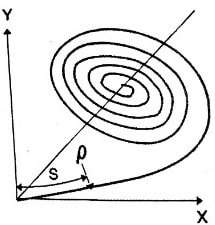
Spiral is a type of transition curve which is recommended by IRC as ideal transition curve because of its smooth introduction of centrifugal acceleration. It is also known as clothoid.
Spiral Curve

Lemniscate

Lemniscate is a type of transition curve which is used when the deflection angle is very large. In lemniscate the radius of curve is more if the length of chord is less.
Lemniscate

Vertical Curves

The curves provided in vertical plane of earth is called as vertical curve. This type of curves are provided when the ground is non-uniform or contains different levels at different points. In general parabolic curve is preferred as vertical curve in the vertical alignment of roadway for the ease of movement of vehicles. But based on the convexity of curve vertical curves are divided into two types
  • Valley curve
  • Summit curve

Valley Curve

Valley curve connects falling gradient with rising gradient so, in this case convexity of curve is generally downwards. It is also called as sag curve.
Vertical Curves
Valley Curve

Summit Curve

Summit curve connects rising gradient with falling gradient hence, the curve has its convexity upwards. It is also called as crest curve.
Summit Curve
Summit Curve

Floating Foundations – Principles, Suitability and Construction Difficulties


Floating Foundations – Principles, Suitability and Construction Difficulties

What is a Floating Foundation?

A foundation is laid on ground by excavating some amount of soil. After that, a structure is built on it. In case of floating foundation, the weight of structure built on the soil is nearly equal to the total weight of the soil (including water in the soil) excavated from the ground before the construction of structure.
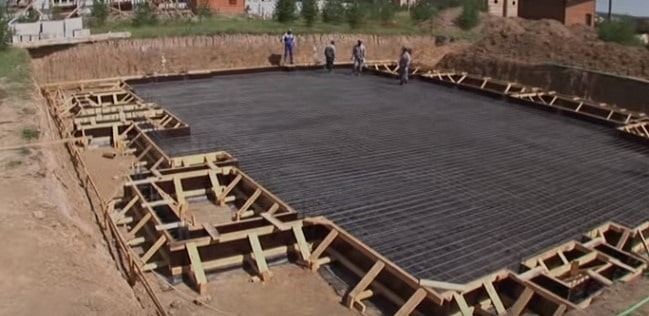
Floating Foundation Construction

Principle of Floating Foundation

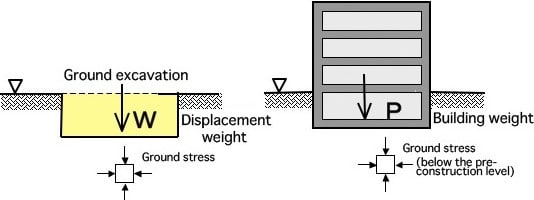
The main principle of floating foundation is to balance the weight of removed soil by a structure of same weight which causes zero settlement to the structure. So, this foundation is also called as balancing raft foundation.
Principle of Floating Foundation
Let’s consider a ground with water table at the top as shown in the above picture. The ground is excavated up to certain depth which is below water table. Now in the next step, a building is constructed which is as same weight as of the removed soil and water.
Even the depth of excavation is below the table the total vertical pressure in the soil below the foundation is unchanged because of its balancing weight. But here one point is to be noted that we cannot build a structure immediately after the excavation.
During the time of construction, the effective vertical pressure under the depth of excavation may slightly increase because of unbalancing weight. So, this type of foundations can also be called as partly compensated foundations instead of fully floating or compensated foundations.

Suitability of Floating Foundations

Floating foundations are desirable for the following types of soils:
  • Soils which are having good shear strength but having a problem of large settlements and differential settlements under heavy loads. In which case, floating foundation can reduce the settlement values to greater extent.
  • Soils which are having low shear strength and there is no hard layer of soil at reasonable depth. Here also, floating foundation helps to reduce the shear stresses to satisfactory level and hence settlement is prevented.

Difficulties in Construction of Floating Foundation

During the construction of floating foundation some problems may arise which can be prevented by taking proper care. The problems will arise during
  • Excavation
  • Dewatering
  • Critical depth
  • Bottom heave

Excavation

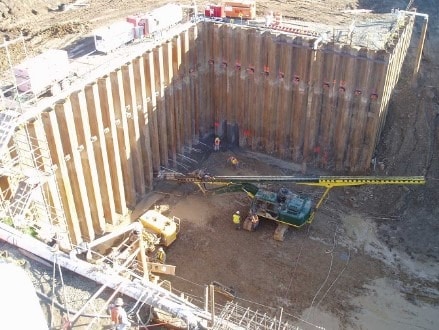
The excavation for floating foundation should be done carefully. The walls of excavated part should be supported using sheet piles or timber piles or soldier piles etc.
Floating Foundation Excavation

Dewatering

If the depth of the excavation is below the water table then dewatering is essential. It is better to examine the water table level prior to the excavation. Dewatering should be done cautiously otherwise it may cause lowering of water table which disturbs the adjoining structures.
Floating Foundation Dewatering

Critical Depth

If the soil is of low shear strength as specified above, there is a limit to the depth of excavation which is known as critical depth. There are two equations are available to determine critical depth of excavation given by Terzaghi and Skempton respectively.
1) Terzaghi equation for the critical depth is:
Terzaghi equation for the critical depth
Where,
Dc = critical depth
s = shear strength of soil
B = width of foundation (if width is less than length of foundation “L”)
soil-unit-weight = unit weight of soil
2) Skempton’s equation for critical depth is
Skempton’s equation for critical depth
Where Nc = Skempton’s bearing capacity factor.
By using any one the above two equations, the critical depth or maximum depth of excavation can be determined.

Bottom Heave

When the soil is excavated up to some depth, the pressure of the soil below this depth is lowered which results the formation of heave. The formed heave causes settlement to the structure or foundation. We cannot prevent the formation of heave but there are some methods to minimize the formation of heave.
Bottom Heave
Excavating narrow trenches and filling them with concrete soon after the excavation minimizes the heave formation. Installing friction piles before excavation or after the completion of half excavation can also prevents the formation of heave. By lowering water table also, it can be minimized. To prevent the heave formation in the side walls of excavated trench, lateral supports should be provided.

Thursday, August 23, 2018

Quick Setting Cement- Phenomenon, Uses and Disadvantages


Quick Setting Cement- Phenomenon, Uses and Disadvantages

It is one of the type of cements where the initially set in 5 mins and final set is achieved in 30 mins, which is used in the special conditions of construction like in running water. In this article we study about the properties, phenomenon, uses, advantages and disadvantages of quick setting cement.
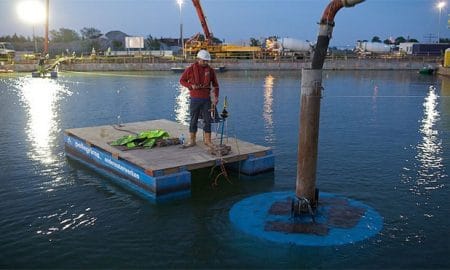
underwater concreting using Quick setting cement
Fig 1 : Underwater concreting using Quick setting cement

Phenomenon of Quick setting cement

Generally, when the water is added into the cement hydration takes places and the chemical reaction occurs which make the cement to harden where the initial setting time is 30 mins and final setting time being 10hrs.
In this special type of cement, where the setting time of the cement is to be less and hardening of cement to be fast. The cement clinkers are grinded with aluminium sulphate, which accelerates the setting time of cement. aluminium sulphate is used as accelerating admixture in the dosage range of 1% to 3% by weight of cement clinkers . The mechanism of function of aluminium sulphate is that it increases the rate of hydration of tricalcium silicate (C3S) and tricalcium aluminate (C3A) phases of cement, thereby providing earlier heat evolution and strength development. It acts as a catalyst in the hydration of tricalcium silicate (C3S) and tricalcium aluminate (C3A).
Concrete specimens with varying percentage of aluminium sulphate were tested for compressive strength, splitting tensile strength and flexural strength. The results obtained were compared with results of normal M-20 concrete mix and it was found that maximum increase in compressive strength, splitting tensile strength and flexural strength occurred for quick setting cement concrete at 3 days age and 7 days age. However, there was no considerable increase in compressive strength, splitting tensile strength and flexural strength at 28 days age.

Uses of Quick setting cement

  1. It is used in under water construction.
  2. It is also used in rainy & cold weather conditions.
  3. Where, quick strength is needed in short span of time.
  4. Used higher temperature where water evaporates easily.
  5. Used for anchoring or rock bolt mining and tunneling
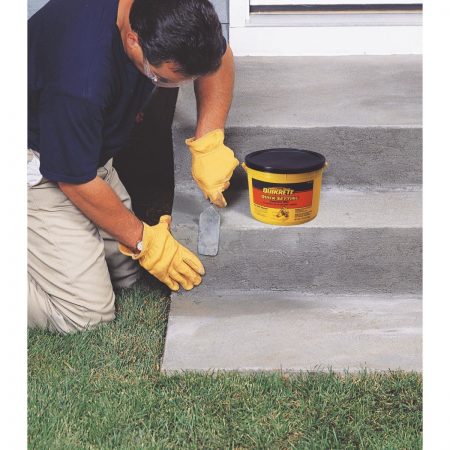
  6. Used for fixing concrete steps.
  7. For the anchorage of Rock Bolt in Tunnel & all works underground, quick setting cement is required.
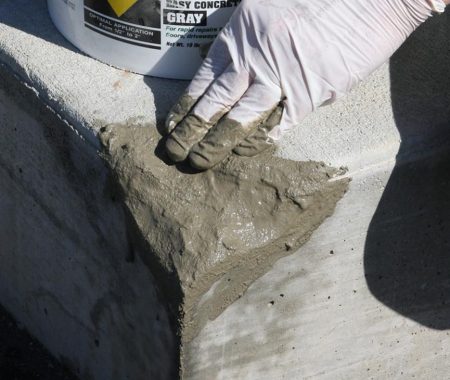
Repair of steps edges with quick setting cement
Fig 2 : Repair of steps edges with quick setting cement
Repair of steps edges with quick setting cement
Fig 3: Repair of steps edges with quick setting cement

Disadvantages of Quick setting cement

  1. Due to content of sulphates in the aluminium sulphate , there are major chance of sulphate attack on the reinforcement corrosion and durability is compromised.
  2. When water is added the work should be completed fast or else it sets and difficult to mix.
  3. In quick setting cement, if the heat is not dissipated properly it can result in cracks in the cement after setting.
  4. It is not widely available.
  5. It is expensive.

Reciprocating Pump – Components, Working and Uses


Reciprocating Pump – Components, Working and Uses

What is a Reciprocating Pump?

Reciprocating pump is a positive displacement pump where certain volume of liquid is collected in enclosed volume and is discharged using pressure to the required application. Reciprocating pumps are more suitable for low volumes of flow at high pressures.

Components of Reciprocating Pump

The main components of reciprocating pump are as follows:
  1. Suction Pipe
  2. Suction Valve
  3. Delivery Pipe
  4. Delivery Valve
  5. Cylinder
  6. Piston and Piston Rod
  7. Crank and Connecting Rod
  8. Strainer
  9. Air Vessel
    Components of Reciprocating pump
    Fig 1: Components of Reciprocating pump

1. Suction Pipe

Suction pipe connects the source of liquid to the cylinder of the reciprocating pump. The liquid is suck by this pipe from the source to the cylinder.

2. Suction Valve

Suction valve is non-return valve which means only one directional flow is possible in this type of valve. This is placed between suction pipe inlet and cylinder. During suction of liquid it is opened and during discharge it is closed.

3. Delivery Pipe

Delivery pipe connects cylinder of pump to the outlet source. The liquid is delivered to desired outlet location through this pipe.

4. Delivery Valve

Delivery valve also non-return valve placed between cylinder and delivery pipe outlet. It is in closed position during suction and in opened position during discharging of liquid.

5. Cylinder

A hollow cylinder made of steel alloy or cast iron. Arrangement of piston and piston rod is inside this cylinder. Suction and release of liquid is takes place in this so, both suction and delivery pipes along with valves are connected to this cylinder.

6. Piston and Piston Rod

Piston is a solid type cylinder part which moves backward and forward inside the hollow cylinder to perform suction and deliverance of liquid. Piston rod helps the piston to its linear motion.
Working of Piston in Reciprocating Pump
Fig 2: Piston During Suction and Discharge ( Image Source : www.powerzone.com )

7. Crank and Connecting Rod

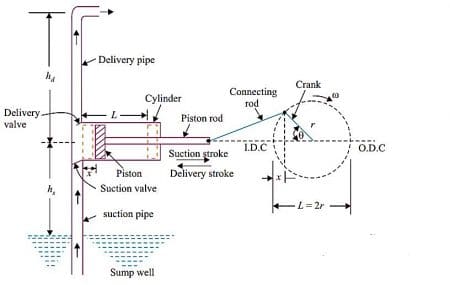
Crank is a solid circular disc which is connected to power source like motor, engine etc. for its rotation. Connecting rod connects the crank to the piston as a result the rotational motion of crank gets converted into linear motion of the piston.
Crank Causing Displacement of Piston
Fig 3: Crank Rotation ( Image Source : www.powerzone.com )

8. Strainer

Strainer is provided at the end of suction pipe to prevent the entrance of solids from water source into the cylinder.

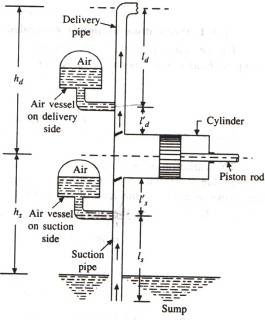
9. Air Vessel

Air vessels are connected to both suction and delivery pipes to eliminate the frictional head and to give uniform discharge rate.
RECIPROCATING PUMP FITTED WITH AIR VESSEL AT BOTH SUCTION AND DELIVERY SIDE
Fig 4: Reciprocating Pump With Air Vessels

Working of Reciprocating Pump

The working of reciprocating pump is as follows:
  • When the power source is connected to crank, the crank will start rotating and connecting rod also displaced along with crank.
  • The piston connected to the connecting rod will move in linear direction. If crank moves outwards then the piston moves towards its right and create vacuum in the cylinder.
  • This vacuum causes suction valve to open and liquid from the source is forcibly sucked by the suction pipe into the cylinder.
  • When the crank moves inwards or towards the cylinder, the piston will move towards its left and compresses the liquid in the cylinder.
  • Now, the pressure makes the delivery valve to open and liquid will discharge through delivery pipe.
  • When piston reaches its extreme left position whole liquid present in the cylinder is delivered through delivery valve.
  • Then again the crank rotate outwards and piston moves right to create suction and the whole process is repeated.
  • Generally the above process can be observed in a single acting reciprocating pump where there is only one delivery stroke per one revolution of crank. But when it comes to double acting reciprocating pump, there will be two delivery strokes per one revolution of crank.

Uses of Reciprocating Pump

Reciprocating pump is mainly used for
  • Oil drilling operations
  • Pneumatic pressure systems
  • Light oil pumping
  • Feeding small boilers condensate return
Reciprocating Mud Pump
Fig 5: Reciprocating Mud Pump