Wednesday, August 15, 2018

Grading of Bitumen- Different Methods of Bitumen Grading


Grading of Bitumen- Different Methods of Bitumen Grading

There are different methods of grading of bitumen such as chewing, penetration grading, viscosity grading and superpave performance grading of bitumen which are discussed in this article.

History of Bitumen Grading

The correlation between the bitumen stiffness and temperature varies with the type of bitumen employed. The bitumen type varies based on their origin as well as a method of refining.
The figure below explains this, where it is observed that bitumen A and Bitumen B have different relationships with temperature.
Relationship between temperature and stiffness for different bitumen
Fig.1: Graph representing relationship between temperature and stiffness for different bitumen
Due to these variations, it was necessary to fix a test temperature. A temperature at which the grading of bitumen can be carried out. This will also give a way to compare different binders of bitumen. For example, if we have bitumen A and B, bitumen B at 25oC is stiffer than bitumen A at the same temperature. But at 60 degree Celsius the condition is reversed.
The bitumen stiffness at a lower temperature is also an essential criterion to have resistance against thermal cracking. The above explanation of bitumen A and B are from the estimates obtained for three temperatures 25, 60 and 135 degree Celsius as shown in figure-1.
The temperature of 135 degrees is near to those temperatures at which the bitumen mix is used for mixing and compacting during the construction. This temperature would give bitumen possess a motor oil form; thin in layers. This state makes them be easily mixed with aggregates.
To have proper mixing and compaction temperatures for asphalt mixtures, it is necessary to find the stiffness of bitumen. Here the stiffness in terms of kinetic viscosity must be determined.
The temperature 60 degree Celsius is similar to a temperature of the bituminous pavement on an extremely summer day. Here the possible failure caused will be rutting. The determination of stiffness at 60 degrees will be more useful in bringing adequate resistance in the summer season. Based on this value, a minimum stiffness value for the binder can be maintained. Here the stiffness is determined in terms of viscosity.
Rutting Damage Caused in Bituminous Pavement
Fig.2: Rutting Damage Caused in Bituminous Pavement Just after few period of construction
The average annual temperature of an asphalt pavement during a year is almost near to 25 degree Celsius. The stiffness determination of bitumen at 25 degrees will help us to find the maximum stiffness that is needed to resist the damages like fatigue cracking or raveling.
These damages are caused after five to ten years of service life i.e. with age. Rutting is caused just by construction. But raveling is caused after a duration showing the inadequacy of the structure.
Fatigue Crack formed in Bitumen pavement
Fig.3: Fatigue Crack formed in Bitumen pavement after certain age
Grading of Bitumen – Different Methods of Bitumen Grading

Different Methods of Grading of Bitumen

Following are the different methods used for grading of bitumen
  1. Grading by chewing
  2. Penetration grading
  3. Viscosity grading
  4. Superpave performance grade

Grading of Bitumen by Chewing

During the 19th century, chewing was the method used to determine the stiffness i.e. hardness if the bitumen. This was the time when no penetration test was developed. It was carried out by experienced US inspectors. Based on the test conducted, the sample was either accepted or rejected. The temperature of bitumen tested was such that, it favors human body temperature.

Penetration Grading of Bitumen

The American Society for Testing Materials (ASTM) D 04 carried out bitumen grading at a temperature of 25 degree Celsius for the testing of the road and pavement materials in 1903.
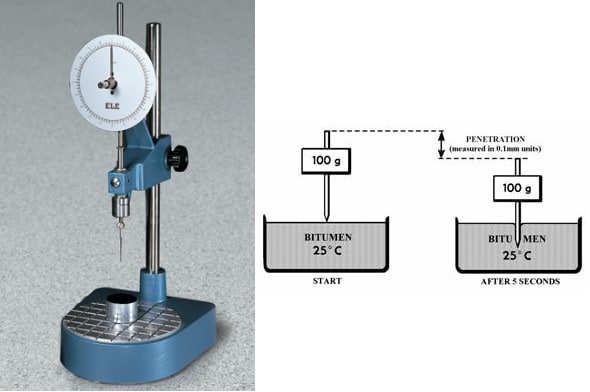
The penetration test involves penetration of a needle that is loaded by 100g, into a bitumen sample maintained at a temperature of 25-degree Celsius in a water bath for a period of 5 seconds. The penetration value is measured in millimeters.
1 penetration unit = 0.1mm.
The greater the penetration value, the softer the bitumen become. The ASTM standard D 946 gives 5 penetration grades for the bitumen binders. They are:
  1. Hardest Bitumen Grade 40 –50
  2. 60 –70
  3. 85-100
  4. 120-150
  5. Softest Bitumen Grade 200-300
The penetration grading system is 100 years old bitumen grading method. In India, before 2006, the most widely used grade of bitumen was 60 to 70. For the construction of low volume roads and to perform spraying, penetration value from 80 to 100 was used.
The disadvantages of penetration grading of bitumen are:
  • The method of penetration grading is not a fundamental test. It makes use of empirical tests.
  • For polymer modified bitumen, this method cannot be employed
  • At higher and lower temperatures during service, similitude at 25 degree Celsius affects the performance. As shown in below figure, three bitumen binders with 60 to 70 penetration grade is plotted against stiffness values.
Penetration Grading of Bitumen
Fig.4: Graph representing relationship between stiffness and temperature of three binders A, B and C with penetration grade 60 -70
The three binders A, B, and C have same stiffness vale of 65 at 25 degree Celsius, but different values at higher and lower temperatures. Hence the bitumen C is subjected to rutting under higher service temperature, as its stiffness is low at higher temperatures.
  • To guide the contractors for asphalt mixing and to know the temperature of compaction, no bitumen viscosity is available.
  • The temperature susceptibility of the binders is not controlled by the penetration grading. The temperature susceptibility is the slope of temperature v/s stiffness line. Steep slope curve represents high temperature susceptible binders, which are not appreciated. This is because, at high temperatures, they are very soft and low temperatures they are stiff.

Viscosity Grading of Bitumen

In the 1970s, US introduced the method of viscosity grading at 60 degree Celsius. This was to ensure a solution for construction problems and to have high temperature performance. These were tender mixes that must undergo mix pushing and shoving under the roller, without which it cannot be rolled properly.
Prior to 1970s, the US construction used 60 to 70 penetration grade that shows variation towards rutting action. They showed lower viscosity at 135 degree Celsius. This caused tender mix problems during the construction process.
The viscosity test, unlike penetration grading, is a fundamental test carried out at 60 degree Celsius. This temperature is the maximum temperature to which the road pavement is subjected to at summer. The measurement is in terms of Poise.
In India, the equipment for testing the viscosity at 60 and 135 degrees are available. They are very simple to handle with. In the US, Six Asphalt Cement (AC) viscosity grades were specified. They are,
Grade
Viscosity at 60 degree Celsius, Poises
AC -2.5 SOFTEST250±/-50
AC-5500±/-100
AC-101000±/-200
AC-202000±/-400
AC-303000±/-600
AC-40 HARDEST4000 ±/-800
In the US, Bitumen is mentioned as asphalt cement or asphalt. The grades with lower viscosity i.e. AC-2.5 and AC-5 were used for cold service temperatures; areas like Canada. In Northern tier states, AC-10 was used. Mostly in the US, AC-2- was used.
Only five grades excluding AC-30 was initially determined. These have a mean viscosity that will double from grade to grade. This resulted in no overlap in viscosity range. But the problem of AC-20 to be too soft and AC-40 to be too hard, that was faced by countries Florida, Georgia, and Alabama made AC-30 to be incorporated and hence six grades.
The figure below shows the AC-30 bitumen viscosity grade which is equivalent to VG-30 in India.
Viscosity Grading of Bitumen
Fig.5: Graph representing temperature and stiffness (in terms of viscosity) relationship of AC-30 (VG-30) Bitumen

Advantages of Viscosity Grading of Bitumen

The advantages of viscosity grading system are:
  1. Same rutting performance is given by the binders of same viscosity grade, unlike the case of penetration grades.
  2. The viscosity grading system retains minimum performance in terms of fatigue cracking. This will enable acceptable performance. This is for an average yearly temperature of 25 degrees.
  3. The potential on tender mixes can be minimized with the minimum specified values of kinematic viscosity at a temperature of 135 degrees Celsius.
  4. The maximum allowable temperature susceptibility can be established by specifying the minimum value of penetration at 25 degrees and the kinematic viscosity at 135 degrees.
  5. For a wide variety of temperatures, the viscosity binders were employed. A temperature of 60 degrees for rutting, 25 degrees for raveling or fatigue problems or 135 degrees for construction activity.
  6. The suppliers can provide the users with accurate asphalt mixing and temperature values for construction. This is possible because of the measurement of viscosity at two temperatures.

Superpave Performance Grading of Bitumen

The performance grading of bitumen is based on the evaluation of the material performance when in use, unlike being rational as in viscosity grading system. The viscosity grading system is more into experience based method of grading. And this has proved to have excellent performance for over 20 years in US pavement construction.
The Superpave grading was developed as a part of a 5year strategic highway research planning (SHRP) from 1987 to 1992, to have a performance based grading system for bitumen. These were developed based on the engineering features that will help in solving many of the engineering problems.

Features of Superpave Performance Grading of Bitumen

The Superpave performance grading system make use of a new set of bitumen tests. The method incorporates the following salient features:
  • The system includes tests and specification for bitumen binders. This bitumen binder may have either modified or unmodified bitumen.
  • The field performance by the engineering principles will influence the physical properties determined from the Superpave bitumen tests. That is, it is not achieved by experience alone.
  • The bitumen simulation for a period of 5 to 10 years, to understand its performance with age was developed. This is a long-term bitumen aging test.
  • The tests and specification of Superpave system intend to avoid three main damages in bitumen i.e. raveling, fatigue cracking and thermal cracking. These failures happen at high, intermediate and low temperature respectively.
  • The pavement is taken for testing for the entire range of temperature as shown in the figure below. A rotational viscometer is taken to determine the viscosity at 135 degree Celsius. The viscoelastic property of bitumen at two temperatures is determined with the help of a dynamic shear rheometer. The first temperature is “high temperatures” maximum 7-day temperature during a hot summer day of the project site. The second one is “intermediate temperature”, which is the average annual temperature of the pavement at the project site.
  • During Winter a bending beam rheometer and direct tension tester are used to measure the bitumen rheological properties at the project site.
Superpave Performance Grading of Bitumen
Fig.6: The testing carried on the pavement at project site for entire range of temperature in a Superpave grading system (As per FHWA)
The performance of Superpave is dependent on climate. The Superpave performance grade (PG) for project location where the temperature during 7 days is greater than 64 degree Celsius and a minimum temperature of -22 degrees are PG 64 to 22.
The available higher grades are PG 52, PG 58, PG 64, PG 70, PG 76 and PG 82. The lower grades are -4, -10, -16, -22, -28, -34 and so on. Both the temperature levels increment at a rate of 6 degrees.
If in Rajasthan the project site has maximum 7-day record temperature of pavement as 70 degrees and a minimum temperature of -3 degree, PG 70 to 4 bitumen will be specified for that project.


Bituminous Materials – Types, Properties and Uses in Construction


Bituminous Materials – Types, Properties and Uses in Construction

Materials that are bound together with bitumen are called bituminous materials. The use of bituminous materials were initially limited to road construction. Now the applications have spread over the area of roof construction, for industrial purposes, carpet tiles, paints and as a special coating for waterproofing.
Bituminous Materials–Types, Properties and Uses in Construction

History of Bituminous Materials

Before the era of bitumen, tar was used as the binder material for bituminous materials.
After the 20th century, the new types of vehicles with pneumatic tires came into its existence in the UK. The time was when tar was used in road construction in larger areas.
The road was constructed using water bound and graded aggregates as per the principles that were developed by Macadam. Macadam roads produced large amount of dust due to the action of the pneumatic tires and the speed of the vehicles moving. This led to binding the surface of the road with this tar.
Tar would act as a dressing to coat the surface. It is well suited for the purpose as it can be made semi-fluid and sprayed accordingly. This on cooling will get stiffened and protects the road from water attacks.
The history of bitumen came from the refinery bitumen that was used in Mexican oil fields in the UK, around 1913. But in 1920, the Shell Haven refinery was the one who has a role in bringing the bitumen into road construction.

Difference between Bitumen and Tar

When compared to tar, bitumen is less temperature susceptible. So, for a given temperature, the bitumen has larger stiffness compared to the tar at the same temperature.
This proved higher deformation resistance and softening resistance compared to the tar. In future, under high abrasion forces, they behave more brittle and highly crack resistant.
With time, the vehicles increase, so the traffic. Hence it was essential to bring roads with increasing performance. This lead to the complete use of bitumen than tar.

Types of Bitumen

To go with a wide variety of circumstances, a wide variety of bituminous mixtures were developed. The main variation is brought by the change in the bitumen content, the bitumen grade, the aggregate type used and the size of the aggregates.
Traditionally in UK, the bitumen is categorized into two. The first one is “asphalt” and the second one is “macadam“. In North America, the asphalt is called as bitumen itself.
Asphalts are bitumen mixture whose strength and stiffness is gained through the mortar property. While in the case of macadam, the strength is dependent on the aggregates that are used in the mix (i.e. grading of the aggregates).
For each case mentioned, the property of the bitumen change. It is found that the asphalt properties are more governed by the bitumen properties than in the case of macadam.
Asphalt Mix and its Characteristics
Fig.1: Representation of Asphalt Mix and its Characteristics
Macadam Mix and its Characteristics
Fig.2: A Representation of Macadam Mix and its Characteristics

Use of Bituminous Material in Flexible Pavement

The bituminous materials are mostly employed for the construction of flexible pavement. When the road construction makes use of concrete slabs, we call it a rigid construction.
The flexible pavement itself have several layers, each having specific functions to be carried out, under loads. A general flexible pavement layer in a flexible pavement is shown in figure.3.
Layers in a Flexible Pavement Construction
Fig.3: Different Layers in a Flexible Pavement Construction
Based on the position and the function of the material, the nature of the material also varies. The surface course, the binder as well as the base may be of asphalt. But the type and the properties of asphalt in each of these layers vary based on the location and the function.
The asphalt in the surface course is different when compared with the asphalt that is used in the binder course or in the base.

Constituents of Bituminous Materials

Graded aggregate and bitumen are the compositions of bituminous material. There is a small proportion of air present in the same, which make the bituminous material a three-phase material.
The whole property of the bituminous material is highly dependent on the individual properties of each phase and their respective mix proportions. The two solid phases i.e. the bitumen and the aggregate are different in nature.
The aggregate is stiff and hard in nature. The bitumen is flexible and vary under temperature as they are soft. So, the whole performance of the material is greatly influenced by the bitumen proportion in the whole mix.
The supply of bitumen can be carried out in a variety ways based on whether the demand is for laying or is to facilitate some other performance. When the quality and the performance of the bituminous material is concerned, the aggregate constituent quality is also a primary factor.
We can either go for continuously graded aggregates, which are called as asphalt concrete (Before in the UK, it was called as macadam as discussed in before sections) or else the aggregates used can be gap graded, which are known as hot rolled asphalts or stone asphalt (This was known before as asphalts in the UK).
The filler is the fine component of the aggregates, that would pass through 63 microns. The graded aggregate mix might contain some quantity of fillers. But when it is not adequate, extra filler either in the form of Portland cement, or hydrated lime, or limestone dust are used.

Sources of Bitumen

The bitumen has mainly two sources, they are:
  • Natural Bitumen
  • Refinery Bitumen

Natural Bitumen or Natural Asphalts

The bitumen is obtained from petroleum naturally with the help of geological forces. They are found to seen intimately connected with the mineral aggregates. They are found deposited at bitumen impregnated rocks and bituminous sands that have only a few bitumen in percentage.
The Val de Travers region of Switzerland and the ‘tar sand’ area of North America gain notable range of bitumen deposits. The rock asphalts gain bitumen in 10%, in the form of limestone or sandstone impregnated bitumen.
Lake asphalt composes of bitumen ‘lake’ that is found as dispersed finely divided mineral matter in bitumen. The roads in the UK make use of bitumen from the deposits of before mentioned lake deposits found in the Trinidad Lake.
The asphalt found from the lake are refined to a partial state by heating it to a temperature of 1600C. This is done in open skill to remove out the excess water. Later the material is filtered. This is then barreled and transported.
It is hard to use the material directly on the roads as it consists of 55% of bitumen, mineral matter of 35% and 10% of organic matter. This even after treatment is blended with refinery bitumen before use.

Refinery Bitumen

This bitumen is the residual material that is left behind after the crude oil fractional distillation process. The crudes from different countries vary based on their respective bitumen content.
It is found that crudes from Middle east and the North Sea have to undergo further process even after distillation to get final bitumen. These sources have a very small bitumen content.
But crude from the Caribbean and around countries give the higher content of bitumen that can be extracted with great ease.

Manufacture of Bitumen

The manufacture of bitumen is a lengthy process which is represented briefly in the below flowchart. The bitumen is a residual material. The final bitumen property will depend upon the extent of extraction, the viscosity, and the distillation process.
The present refinery plant has the capability to extract bitumen more precisely as the required viscosity and consistency.
Preparation of Refinery Bitumen
Fig.4: Flowchart Showing Preparation of Refinery Bitumen

Structure of Bitumen

The hydrocarbons and its derivatives formed in a complex colloidal system will compose to form the bitumen structure.
Bitumen is a colloidal system that dissolves in trichloroethylene. This solvent is used to determine the constituents that are present in the bitumen.
The bitumen constituents can be subdivided as follows:
  • Asphaltenes: These are found to be insoluble in light aliphatic hydrocarbon solvents
  • Maltenes: These are soluble in n-heptane
The colloidal system of bitumen is a system with solid particles of Asphaltenes, that together form a cluster of molecules or these can be micelles; a continuum of Maltenes.
Based on the micelles dispersion, the bitumen can either exist in the form of a sol or in the form of a gel. Sol is formed when there is complete dispersal. The gel is formed when the micelles undergo flocculation to become flakes.
The bitumen take a gel character, when it has a higher quantity of saturated oil of molecular weight less. That bitumen with aromatic oils show sol character. This is one with more Asphaltenes.

Influence of Bitumen Constituents in the Material Properties

The individual fractions that form a bitumen surely have some contribution towards the properties of the bitumen material.
  • The Asphaltenes is the fraction that shapes body for the material.
  • The resin in the bitumen contributes to adhesiveness and ductility of the material.
  • The viscosity and the rheology of the material are taken care by the oils present in the bitumen material.
  • The stiffness of the material is governed by the sulfur that is present in significant amounts mainly in high molecular weighed fractions.
  • The presence of a certain complex of oxygen will affect the acidity of the bitumen. The acidity of the bitumen is a factor whose determination will help in knowing the adhering capability of the bitumen with the aggregate particles.

Various Lab Tests on Bitumen for Pavement Construction


Various Lab Tests on Bitumen for Pavement Construction

Various laboratory tests on bitumen is conducted to check quality and different properties of bitumen for pavement construction. Bitumen is a black or brown mixture of hydrocarbons obtained by partial distillation of crude petroleum.
Bitumen is insoluble in water. It composes 87% carbon, 11% hydrogen and 2% oxygen by weight. It is obtained in solid or semi-solid state. It is generally used as surface coarse for roads, roof coverings etc.

Tests on Bitumen to Check Quality and Properties for Pavement

To ensure the quality of bitumen several tests are performed which are as follows.
  • Ductility test
  • Flash and Fire point test
  • Float test
  • Loss on heating test
  • Penetration test
  • Softening point test
  • Specific gravity test
  • Viscosity test
  • Water content test

Ductility Tests on Bitumen

The property of bitumen which allows it to undergo deformation or elongation is called ductility of bitumen. The ductility of bitumen is measured by the distance in Cm (centimeter), to which the bitumen sample will elongate before breaking when it is pulled by standard specimen at specified speed and temperature.
Firstly the bitumen sample is heated to 75-100oC and melted completely. This is poured into the assembled mold which is placed on brass plate. To prevent sticking the mold and plate are coated with glycerin and dextrin. After filling the mold, placed it in room temperature for 30-40 minutes and then placed it in water for 30 minutes.
Then take it out and cut the excess amount of bitumen with the help of hot knife and level the surface. Then place the whole assembly in water bath of ductility machine for 85 to 95 minutes. Then detach the brass plate and the hooks of mold are fixed to machine and operate the machine.
The machine pulls the two clips of the mold horizontally and then bitumen elongates. The distance up to the point of breaking from the starting point is noted as ductility value of bitumen. The minimum value should be 75cm.
Ductility Tests on Bitumen

Flash and Fire Point Tests on Bitumen

Flash point of bitumen is defined as the point of lowest temperature at which bitumen catches vapors of test flame and fires in the form of flash. Fire point of bitumen is defined as the point of lowest temperature at which the bitumen ignites and burns at least for 5 second under specific conditions of test.
Flash and fire point test helps to control fire accidents in bitumen coated areas. By this test we can decide the bitumen grade with respect to temperature for particular areas of high temperatures.
Flash and Fire Point Tests on Bitumen

Float Tests on Bitumen

Float test is used to determine the consistency of bitumen. But we generally use penetration test and viscosity test to find out the consistency of bitumen except for certain range of consistencies. The float test apparatus consists of aluminum float and brass collars as shown in below figure.
These collars are filled with melted bitumen sample and cooled to 5oC and then attached them into aluminum floats and this assembly is placed in water bath at a temperature of 50oC. Note down the time in seconds from the instant the float is put on the water bath until the water breaks the material and enters the float.
Float Test on Bitumen

Loss on Heating Tests on Bitumen

When the bitumen is heated, water content present in the bitumen is evaporated and bitumen becomes brittle which can be damaged easily. So, to know the amount of loss ness we will perform this test. In this test, take the bitumen sample and note down its weight to 0.01gm accuracy at room temperature.
Then place the sample in oven and heat it for 5 hours at 163oC. After that take out the sample and cooled it to room temperature and take the weight to 0.01gm accuracy and note down the value. Then for the two values of weight before and after heating we can compute the loss of mass. The loss should be less than 5% of total weight otherwise it is not preferred for construction.
Loss on Heating Test for Bitumen

Penetration Test on Bitumen

The penetration value of bitumen is measured by distance in tenths of mm that a standard needle would penetrate vertically into bitumen sample under standard conditions of test. By this test we can determine the hardness or softness value of bitumen.
In this test, firstly heat the bitumen above its softening point and pour it into a container of depth attest 15mm. bitumen should be stirred wisely to remove air bubbles. Then cool it to room temperature for 90 minutes and then placed it in water bath for 90 minutes.
Then place the container in penetration machine adjust the needle to make contact with surface of sample. Make dial reading zero and release the needle for exactly 5 seconds and note down the penetration value of needle for that 5 seconds. Just repeat the procedure thrice and note down the average value.
Penetration Test on Bitumen

Softening Point Test on Bitumen

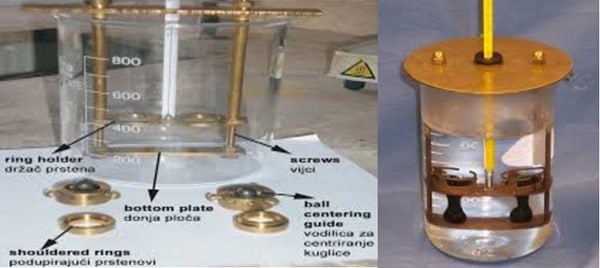
Softening point of bitumen indicates the point at which bitumen attains a particular degree of softening under specified conditions of the test. Take small amount of bitumen sample and heat it up to 75-100oC. Ring and ball apparatus is used to conduct this test. Heat the rings and apply glycerin to prevent from sticking. Fill this rings with bitumen and remove the excess material with hot sharp knife.
Assemble the apparatus parts, balls are arranged in guided position that is on the top of bitumen sample. And fill the beaker with boiled distilled water. Then apply temperature @ 5oC per minute. At certain temperature bitumen softens and ball slowly move downwards and touches the bottom plate, this point is noted as softening point.
Softening Point Test on Bitumen

Specific Gravity Test on Bitumen

Specific gravity of bitumen is the ration of mass of given volume of bitumen to the mass of equal volume of water at specified temperature. Specific gravity is the good indicator of quality of binder. It can be determined by pycnometer method.
In this method, take clean and dry specific gravity bottle and take its weight(w1).in the 2ndcase, fill the bottle with distilled water and dip it in water bath for 30 minutes and note down the weight(w2). Next, fill half the bottle with bitumen sample and weigh (w3).
Finally fill the bottle with half water and half portion with bitumen and weigh (w4). Now we can find out specific gravity from the formulae.
Specific Gravity Formula for Bitumen
specific-gravity-test-on-bitumen

Viscosity Test on Bitumen

Viscosity is the property of bitumen which influences the ability of bitumen to spread, penetrate into the voids and also coat the aggregates. That is it influences the fluid property of bitumen. If viscosity of bitumen is higher, compactive effort of bitumen reduces and heterogeneous mixture arises.
If viscosity is lower, then it will lubricate the aggregate particles. Viscosity is determined by using tar viscometer. The viscosity of bitumen is expressed in seconds is the time required for the 50 ml bitumen sample to pass through the orifice of a cup, under standard conditions of test and at specified temperature.
Viscosity Test on Bitumen

Water Content Test on Bitumen

When bitumen is heated above the boiling point of water, sometimes foaming of bitumen occurs. To prevent this bitumen should have minimum water content in it. Water content in bitumen is determined by dean and stark method. In this method, the bitumen sample is kept in 500ml heat resistant glass container.
Container is heated to just above the boiling point of water. The evaporated water is condensed and collected. This collected water is expressed in terms of mass percentage of sample. It should not more than 0.2% by weight.
Water Content Test on Bitumen