Wednesday, August 15, 2018

Bituminous Mix Design for Pavement – Types, Materials and Properties


Bituminous Mix Design for Pavement – Types, Materials and Properties

A pre-planned bituminous mix design for pavement construction helps in producing a mix that is workable, durable, strong, and economical in nature. One of the widespread use of bitumen is in the pavement design and construction.
There are mainly two stages of mix design in bringing a bituminous pavement:
  • Dry Mix Design
  • Wet Mix Design
In the bitumen mix design, we will determine the:
  • Proportion of bitumen
  • The fine aggregates required for the pavement design and construction
  • The coarse aggregates for the construction
  • The filler materials required

Objective of Bituminous Mix Design

The main objective of the bituminous mix design is to proportion various components for pavement construction to achieve the following objectives:
  • To obtain a durable pavement, sufficient amount of bitumen is required
  • Adequate strength must be provided to obtain resistance against the shear deformation under higher temperatures.
  • Additional voids have to be incorporated to facilitate the compaction performed by the traffic
  • The placement must be performed with ease which will demand sufficient workability
  • The premature cracking in the bitumen pavement can be avoided by providing sufficient flexibility for the bitumen.
  • The flexibility must be attained at smaller temperatures so that the shrinkage cracks can be avoided.

Main Constituents of Bitumen Mix

The main constituents of a bitumen mix for pavement construction are:
  • Coarse and Fine Aggregates
  • Filler
  • Binder
The coarse aggregates are known for their abrasion resistance and toughness. These aggregates offer compressive and shear strength to the mix. These also facilitates good interlocking properties between aggregates. Examples for this type of aggregates are granites.
The fine aggregates fill the voids in the mix created by the coarse aggregates and provide stiffening to the binder. Examples of fine aggregates used are sand and rock dust.
Fillers play the role of filling the voids, they help in stiffening the binder and offer higher permeability. Example for this type of fillers are cement, lime and rock dust.
Binders also play the role of filling the voids. These help to undergo particle adhesion and for gluing purpose. This hence increases the impermeability property of the pavement. Example for this type of the binder are bitumen, tar, and asphalt.
Constituents of Bitumen Mix

Types of Bitumen Mixes

There are different types of mix that can be prepared. They Involve:
  • Open-graded bituminous mix
  • Well graded bituminous mix
  • Gap-graded bituminous mix
  • Unbounded bituminous mix
In case of Open-Graded Mix, the filler and the finer aggregates are absent. These mixes are porous in nature and offer good frictional properties. This lower the strength if the pavement is constructed for a high-speed pavement construction.
Gap-Graded Bituminous Mix: As the name implies, large coarse aggregates are missing in these types of mix. This has good fatigue property as well as tensile strength.
Well – Graded Mix: A well-graded mix is a dense mix. These have all ranges of aggregates and are sufficiently packed. This facilitate the proper filling of voids in a systematic manner. These types of mix offer good compressive strength and tensile strength.
Types of Bitumen Mixes

Layers in a Bituminous Pavement

The different layers that is involved in a bituminous pavement are:
  • Base Course
  • Binder Course
  • Concrete layer of bitumen or asphalt
The layer of mineral aggregates like gravel, stones, and sand together form the bituminous base course layer. This layer is treated as the foundation for the laying the binder and the surface course.
The bituminous binder course is the second layer above the base course which act as the first layer of bitumen. This is done in a two-layer resurfacing. This is also called as a leveling course.
The third layer is the concrete form of bitumen or asphalt. The bituminous concrete is a combination of aggregates that is continuously graded from the maximum size which is mainly less than 25mm to the fine filler of size smaller than 0.075mm to make the mix sufficiently impervious. This provides a layer will have acceptable levels of dissipative and elastic properties.
layers-in-bituminous-pavements

Basic Requirements of a Bituminous Mix

The main and essential features a bitumen mix must possess are explained below:
  • Good Stability
  • Good Durability
  • Workability
  • Skid Resistance
  • Flexibility

Stability of Bitumen Mix

The resistance of the pavement towards the deformation under action of vehicle or the dynamic load is the called as the stability of the bitumen mix. The main two examples of failure caused in the bitumen pavement due to lack of stability are:
  • Shoving
  • Grooving
The areas in the pavement under severe action of acceleration gain a rigid deformation in the traverse direction. This is called as shoving. The channelization of the traffic will result in the formation of a longitudinal ridging which is called as grooving.
The stability of the bitumen pavement is influenced by the following parameters:
  • Interparticle friction between the aggregates
  • The cohesion offered within the bitumen
  • Bond within all the particles
Stability is determined by sufficient bonding between the particles. This require adequate amount of binder so that it coats the particles at the time when it offers friction. There are also chances to have a lower value of stability when the binder content is large and the particles of the mix are kept apart without any kind of bond.

Durability of the Bitumen Mix

The resistance of the mix against the external weathering and abrasive actions can be called as the durability property. The wheel loads with high abrasion action on the pavement result in the formation of tensile strains. Lack of durability of the pavement result in the following failures:
  • Pot Holes
  • Stripping
Pot holes is the local deterioration and stripping is the failure that expose all the aggregates. Higher binder content help in reducing the chances of disintegration to some extend.

Skid Resistance of Bituminous Pavement

The skid resistance is the resistance of the pavement against the skidding action of the vehicle. This is mainly related to the surface texture of the pavement. The bitumen content also influences this property to a large extend. In high-speed traffic conditions, this is an essential factor to be considered. An open-graded coarse surface will help in providing maximum skid resistance.

Workability of the bituminous mix

A bituminous mix have to be easily handled for its proper placement and compaction. This can be only performed if there is sufficient workability for the mix. This property will let the mix to take adequate shape and condition.
The workability of the mix depends on the following factors:
  • The aggregate type – angular, flaky and elongates
  • The content of bitumen
  • The gradation of aggregates
  • Shape and texture of the aggregates
  • Type of bitumen

Flexibility of Bitumen Mix

The level of bending strength required to counteract the traffic load is called as the flexibility property. This is the one that will help in preventing the cracking surface of the pavement. The fracture is the cracks that is formed on the surface. The reason behind these fractures are the shrinkage and brittleness of the binder.
The repeated bending of the surface due to the traffic loads over it result in the brittleness. Flexibility is increased with higher bitumen content.
Some of the desirable properties required by a bitumen mix are:
  • Proper binding of the particles present in the bitumen mix. This facilitate waterproofing properties.
  • The traffic demand has to meet adequately by having sufficient stability
  • The bitumen mix have to be economical
  • The bitumen mix must have sufficient workability to help construction procedures
  • Voids must me intentionally left so that compaction during traffic can be performed
  • The mix must be flexible to face the changing temperature conditions

Tuesday, August 14, 2018

How to Prepare Engineering Report of Foundation Investigation?


How to Prepare Engineering Report of Foundation Investigation?


According to Eurocode 7, engineering report of foundation investigation need to be prepared and submitted to the client or owner as part of design process. The report should consider all information and data from historical records, site observation, trial pits, boreholes, and laboratory tests.
In this article, the arrangement and contents of engineering report of foundation investigation will be discussed.
Foundation Investigation Report

Preparing Engineering Report of Foundation Investigation

Engineering report of foundation investigation is composed of the following components
  • Introduction
  • General description of the site
  • General geology of the area
  • Description of the soil conditions found in boreholes and trial pits
  • Laboratory test results
  • Discussion of results of investigation in relation to the foundation design and construction
  • Recommendation
  • Conclusion

Introduction

There are number of major points which need to be explained in this part and these points are as follow:
  • It should be stated clearly the client or individual for whom the investigation is conducted.
  • Motivations to conduct the investigation.
  • How the investigation conducted.
  • Specify the time at which the investigation carried out.
  • The introduction should explain whether the investigation is limited and carried out to achieve certain data to perform evaluation by the designer, or it is a thorough investigation with boreholes, tests, and analysis of results to consider suitable methods of design.
  • If the investigation is limited due to financial restrictions or other factors and the engineer find out that the investigation is insufficient, then he should state the factors that cause limitation of the investigation.

General Description of the Site

There are features and data related to the site that need to be recorded in this section. General site features and information may include:
  • Beneficial information related to the previous application of site can be obtained from historical records and such information needs to be explained.
  • General configuration and surface feature of the site. For instance, old buildings, mine shafts, quarries, filled areas, watercourses, roads, tracks, hedges, and trees should be recoded.
  • If the site experienced erosion, earthquakes, and slope instability, it should be clearly and thoroughly described in addition to record cracks of surrounding building due to settlements.

General Geology of the Area

In this part of the engineering report, the following information should be provided:
  • Provide notes with regard to geology of the site
  • Compare available information, which may be in form of memoir and maps, to the information obtained from boreholes.
  • If there are any faults, mines, springs, swallow holes, quarries, and other features at the project site, then they should be taken into consideration if they influence in the foundation work.
Description of the soil conditions found in boreholes and trial pits
The following information should be provided in this section:
  • It is required to provide general description (not detailed description) of soil site which should include changes in levels of different strata, ground water table, and ground configuration.
  • if several boreholes have been taken, then it is a good strategy to draw number of these through the section of the site.
  • This is to show configuration and level variation of the strata that is crucial to the engineering problem.
Nonetheless, these diagrams should not include detailed information of soil profile for instance changed in ground water table in successive strata because such information could lead to costly error.

Laboratory Test Results

This part of the engineering report should include the following information:
  • Short description about types of tests which are carried out.
  • Refer to any uncommon test result
  • Detailed test results should not be provided in this section and they should be given in appendices.
  • If non-standard test procedure is utilized for any particular test, then the test procedure should be explained.

Discussion of results of investigation in relation to the foundation design and construction

This part by far the most significant components of the engineering repot for foundation design and construction.
The discussion should be clear and concise and efforts should be made to prevent the use of words such as (but) and (if).
It is recommended to divide this section into differ parts so as to make it more clear, readable, and understandable.
The subheadings of the discussion includes
  • Introduction: in this part of discussion description of the main structure and related imposed loadings should be provided
  • General ground condition assessment
  • Foundation type that could be used.
  • Another subheading is special structures if present such as electricity generation station and turbine house. These structures usually require special foundations.
  • The last part of the discussion is about the design Method.
Note:
In the discussion, the discussion about inappropriate foundations should be avoided since it would be waste of time.
The discussion should clearly state type and depth of foundation, allowable bearing pressure, and anticipated settlement due to allowable pressure. Moreover, the benefit of adopting deeper foundation to allow for higher bearing pressure or decreasing foundation settlement.
Furthermore, if the pile foundation is adopted, then the engineering report should state bearing strata, to which the pile is driven, pile penetration likelihood into the strata, working load magnitude per pile,
Finally, the pile installation difficulty and any possible influence on the surrounding structure should be specified.

Recommendations

The facts that have been achieved in the report should be used as base for the foundation design recommendation. It is advised that, the head of investigation and the design have good communication throughout the entire stages of the work.

Conclusion

Typically the following points should be provided in conclusion:
  • The major points of discussion will be summarized in this section provided that the discussion is lengthy.
  • Findings which are drawn from the investigation will be provided as well.

Factors Affecting Embankment Dams Design and Construction


Factors Affecting Embankment Dams Design and Construction

There are number of factors that affect embankment dam design. That is why the designer needs to take these factors into consideration during the design. These factors will be discussed briefly in the following sections.

Factors Affecting Design and Construction of Embankment Dams

  • Availability of materials for construction
  • Characteristics of embankment dam site
  • Shape and size of valley in which the dam is constructed
  • Climate of the area
  • Diversion of river
  • Time available for construction
  • Function of the reservoir
  • Probable wave action
  • Earthquake activity in the area
Design and Construction of Embankment Dams

Availability of Materials for Dam Construction

Commonly, construction materials for embankment dams are widely available and often can be obtained at or close to construction site at low cost.
Materials for Dam Construction
Fig.1: Using different types of material for dam construction
Type of material at available at construction site would influence the embankment dam design. Table 1 provides type of dam designed based on the available materials. The economy of construction can be improved by using excavated material in the construction for instance earth excavated for spillway construction.
Table-1: Embankment dam designed and constructed based on the available construction material
Type of material available at project siteDesigned embankment dam based on available construction material
Impervious soil materialHomogeneous embankment dam, figure 2
Rock and impervious materialRock fill dam, figure 3
Previous and Impervious materialZoned earth dam, Figure 4
Homogeneous Embankment Dam
Fig.2: Homogeneous Embankment Dam
Rock Fill Embankment Dam
Fig.3: Rock Fill Embankment Dam
Zoned Earth Dam
Fig.4: Zoned Earth Dam

Characteristics of Embankment Dam Site

Generally, embankment dams can be constructed on nearly all kinds of soil. The properties of soil on which the dam is constructed affect the design considerably. One of the outstanding affect is controlling the type of treatment used for the foundation.
Moreover, soil properties influence the dimension of the dam for instance if the soil has low bearing capacity, then it would be necessary to reduce slopes, use greater cross section and freeboard.
These measures are required to tackle deferential settlement of the embankment dam.
Embankment Dam Site
Fig.5: Embankment Dam Site, Compaction of Soil Foundation

Shape and Size of Valley in which Dam is Constructed

If the valley on which embankment dam is constructed is narrow and has abutments with steep slopes, then embankment design would be influenced. In this case, construction space would be limited and subsequently a simpler design, which may need special construction provision, shall be used. As far as wide valley with low abutment slopes will not affect the design.
Embankment dam constructed in a narrow valley
Fig.6: Embankment dam constructed in a narrow valley
Embankment dam in open area
Fig.7: Embankment dam in open area

Climate of the Area

Generally, climate of the region will influence the embankment design. For example it is recommended to use sloped core for the dam if the construction is carried out during rainy season.
Added to that, when embankment dam is constructed in arid area, then one more year might be required to collect water and begin the construction. This because the construction moisture content of fine grain soil in this area cannot be controlled.

Diversion of River

Diversion of river is another factor that affects the design of the dam. For narrow valley, the river is diverted through tunnels.
River diversion through tunnel
Fig.8: River diversion through tunnel, left side inlet of the tunnel, right side is the path of the tunnel on each side of the river
In this case, the designer shall study all possible cases of river diversion and arrange his/her design with diversion river options. When the embankment dam is built on major river, then each side of the dam would constructed from abutments and the central portion of the dam will be left and used as diversion river.
Diversion of River
Fig.9: River is allowed from one side of the valley and construction of the dam starts from the other side of the valley
This part of the dam, which is called closure section, is constructed at the final stage of dam construction. The closure section should be constructed rapidly so as to prevent the overtopping of the dam. So, special design and construction measured should be used for closure section for example introducing extra drain filter.

Time Available for Construction

Time allocated for embankment dam construction is another factor that its design is based on. If the height of the dam is considerable and the dam needed to be constructed in short time, then higher pore water pressure is likely.
Consequently, flatter slope should be considered for the dam to tackle the pore water pressure. It should be known that, fine grain soil requires long time to be dealt with, so if construction time is restricted, produced impervious layer should be installed to save time.

Function of the Reservoir

The function of the reservoir specified the permissible water loss due to seepage thorough foundation and embankment. Subsequently, the design of the dam would be affected. For example, if the dam is used water conservation, then the dam should be impervious whereas more previous dams are accepted for flood control purposes.

Probable Wave Action

Reservoir length and wind velocity control wave action seriousness and the degree of protection needed for the upstream of the dam. Upstream face of the dam experience erosion due to cyclic wave action unless proper protection measure is considered for the upstream of the dam.
It is reported that, cover upstream with layer of dumped rock is not only an effective protector but also considerably cost effective.
Embankment dam with rock facing
Fig.10: Embankment dam with rock facing provided to protect upstream from wave action

Earthquake Activity in the Area

If the dam is constructed in an area that prone to earthquake, then the designer should consider more conservative feature for the design.
For example, flatter slope, better filter, thicker core, allocating longer construction time, larger capacity downstream drain.

What is the Column Kicker? Its Formworks, Application and Advantages


What is the Column Kicker? Its Formworks, Application and Advantages


What is Column Kicker? Why it is Used in the Construction?

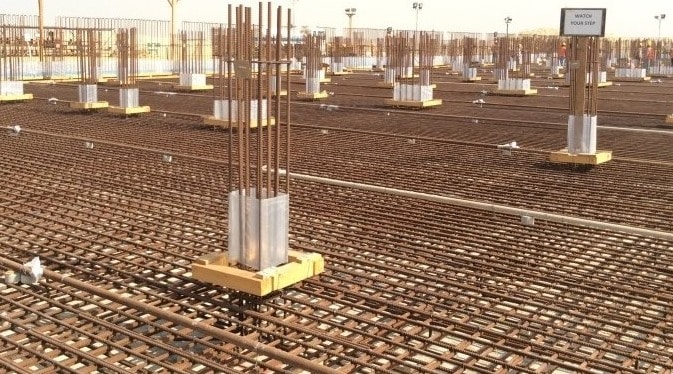
Column Kicker is a small concrete step used at the bottom of columns or walls to make sure that correct coordinates of columns or walls are maintained between floor slabs. So, column kicker should be used at all position where columns or walls are constructed. After the construction of kicker is completed, then the formwork of columns or slabs can be placed immediately, and the kicker will guarantee exact column base alignment and location.
Column Kicker
Fig.1: Column Kicker

Dimensions and Formwork of Column Kicker

The thickness of column kicker ranges from 50mm to 150mm whereas its width and length is the same as the column for which the kicker is constructed. The best height of column kicker is 150mm because it provides good structural start for column or wall.
Structurally, the thickness of kicker less than 150mm is not desired. If the kicker thickness is greater than 150mm, then it tends to slump with the weight of concrete in them.
After the formwork of column kicker is placed, then fresh concrete is placed monolithically with the slab.
Column Kicker Formwork
Fig.2: Column Kicker Formwork Installation

Advantages of Column Kicker

  • Maintains column and wall dimension between slabs
  • Prevent the movement of longitudinal reinforcement of columns
  • Helps the maintaining of vertical alignment of column
  • Simplify the installation of column formworks, so it enhances quality speed of construction.
  • It ensure the provision of designated column concrete cover
Checking column cover after kicker formwork is placed
Fig.3: Checking column cover after kicker formwork is placed

Disadvantages of Column Kicker

The most outstanding disadvantage of kicker is the possible formation of joints at the bottom of columns or walls. That is why it is sometimes eliminated, and acceptable techniques are used to install column and wall shuttering. But the risk of errors is increased if kickers are not used.