Tuesday, August 14, 2018

Why is Timber Construction Popular in 21st Century?


Why is Timber Construction Popular in 21st Century?


Timber is a favorite construction material from the historic time and now, one of the favorite construction material of the future. Timber construction material when compared with other construction material gain:
  • High Insulation property
  • The carbon-dioxide emission is less
  • Highly sustainable material
Sustainability is explained in terms of pollution and emission caused, which is less compared to other materials. If we consider the amount of trees used for this purpose, the sustainability is less.

Why is Timber Construction Popular in 21st Century?

There are many specific reasons inbuilt in timber material that made it to be demanded greatly in 21st century. It is studied from the research that a percentage of 70% of new houses are made out of timber. These records for 25% of total construction. This percentage is said to increase in the future.
Some of the root causes behind the regain of timber construction popularity are mentioned below:

1. The Invention of Cross Laminated Timber (CLT)

The development of cross laminated timber has greatly influenced the popularity of timber for use in construction. This is not a material great enough to compete with concrete or steel, but this has taken some role in people’s mind to choose them over other construction material.
The CLT material is a combination of layered wood forms. These are combined together with the help of glue and finally pressed to become monolithic. All small forms of timber materials can be collected and combined together to form large construction material of required size.
The CLT material is light and highly stable in nature. This material strength is comparable with the strength of the steel and the brick. In London, the researchers name it as the “new concrete”.
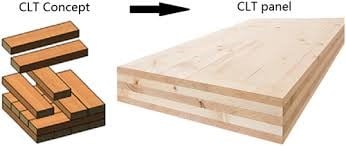
Cross Laminated Timber

2. Prefabricated Home Construction

Homes that are manufactured and modular in nature are categorized as prefabricated homes. The timber with its high insulating property and low energy consumption prove as a good prefabricated material.
Timber prefabricated homes are highly insulated for heat and sound with energy efficiency more than 50%. This efficiency is greater than that attained from a traditional house construction.

3. Speed of Timber Construction

As mentioned before, the CLT have brought a new picture for timber construction. The use of CLT increased the speed of construction. The time taken to construct the timber homes is very faster compared with the traditional house construction.
Initially timber frames are constructed in its dry state. The dry plasterboards can be used as walls which helps in the stabilization of moisture adaptation.
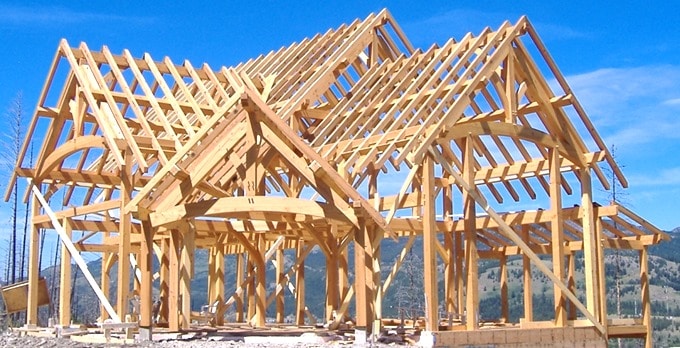
Speed of Timber Construction

4. Cost of Timber Construction

Timber is less costly compared with steel frame construction but costlier than brick construction. Other benefits are that the timber is more durable and the maintenance required for the same is less.

5. Strength of Timber Construction

Steel when compared with timber is light and stronger in construction. But special studies on timber and the development of CLTs have proven this as a material with higher strength and stability. Its proven characteristics have made its application on high rise construction.
The Bridport House in London is an example of cross laminated timber high rise project. This is an eight-storey building and 5 storey building combination.
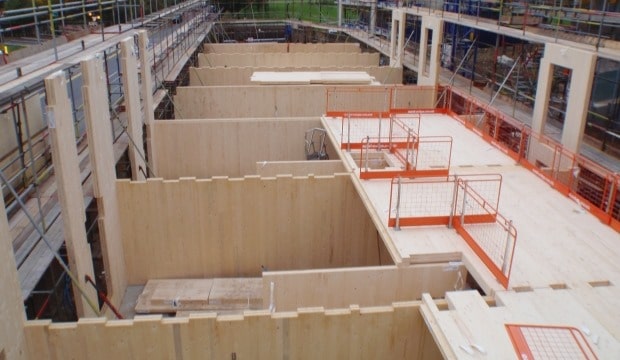
Bridport House in London - Timber Construction

6. Insulation Properties of Timber Construction

Timber acts as an external cladding for preventing sound and heat with great thermal efficiency. The timber provided can be less than 5cm thick which is lesser than the thickness of the masonry provided. This low thickness is enough for providing the thermal efficiency as the insulation properties is derived from the interior of the wood.
The heat transfer in timber is very low when compared with other materials like steel. Timber homes save money in our energy bill.

7. Environmental Impact from Timber Construction

The timber construction has great importance for being environmental friendly as the material is a renewable source. The steel when compared with timber is a great source of pollution. Timber construction is hence a great promoter of zero carbon housing systems.


Materials and Methods of Thermal Insulation of Buildings


Materials and Methods of Thermal Insulation of Buildings

What is Thermal Insulation of Buildings?

In general, people living in hot regions wants to make their inside atmosphere very cool similarly people living in cold regions, wants warmer atmosphere inside. But, we know that the heat transfer takes place from hotter to colder areas. As a result, heat loss happens. To overcome this loss in buildings thermal insulation is provided to maintain required temperature inside the building. The aim of thermal insulation is to minimize the heat transfer between outside and inside of building.
Thermal Insulation of Buildings

Materials and Methods of Thermal Insulation of Buildings

There are many forms of thermal insulation materials are available in the market as follows:
  1. Slab or block insulation
  2. Blanket insulation
  3. Loose fill insulation
  4. Bat insulating materials
  5. Insulating boards
  6. Reflective sheet materials
  7. Lightweight materials

1. Slab or Block Insulation

The blocks are made of mineral wool, cork board, cellular glass, and cellular rubber or saw dust etc. These are fixed to the walls and roofs to prevent heat loss and maintains required temperature. These boards are available in 60cmx120cm (or more area) with 2.5cm thickness.
Block Insulation

2. Blanket Insulation

Blanket insulation materials are available in blanket shape or like paper rolls which are directly spread over the wall or ceilings. They are flexible and having a thickness about 12 to 80mm. these blankets are made of animal hair or cotton or wood fibers etc..
Blanket Insulation

3. Loose Fill Insulation

Stud space is provided in wall where windows and doors are to be provided. In that studding space of wall loose fill of some insulating materials is provided. The materials are rock wool, wood fiber wool, cellulose etc.

4. Bat Insulating Materials

These are also available as blanket rolls but bat insulating rolls are having more thickness than blanket type materials. These are also spreader over the walls or ceilings.
Bat Insulating Materials

5. Insulating Boards

Insulating boards are made from pulp of wood, cane or other materials. These pulp is pressed hard with some stress at suitable temperature to make it as a solid boards. They are available in many sizes in the market. And these are generally provided for interior lining of walls as well as for partition walls.
Insulating Boards

6. Reflective Sheet Materials

Reflective sheet materials like aluminum sheets, gypsum boards, steel sheet Materials will have more reflectivity and low emissivity. So, these materials are having high heat resistance. The heat gets reduced when solar energy strike and gets reflected. These are fixed outside of the structure to stop the heat entrance into the building.
Reflective Sheet Materials

7. Lightweight Materials

By using light weight aggregates while preparing concrete mixture will also results good results in heat loss preventions. Concrete will have more heat resistance if it is made of light weight aggregates like blast furnace slag, vermiculite, burnt clay aggregates etc.

Other General Methods of Building Thermal Insulation

Without using any thermal insulating materials as said above we can achieve the thermal insulation from the following methods.
  • By providing roof shading
  • By proper height of ceiling
  • Orientation of building

8. By Providing Roof Shading

By providing roof shading for the building at the place where sun directly strikes the building during peak hours, we can reduce the heat by shading of roof. Accurate angle should be provided for shading to prevent from sun light.

9. By Proper Height of Ceiling

The heat gets absorbed by the ceiling and emitted downwards that is into the building. But, the point should be noted is, the vertical gradient of radiation intensity is not significant beyond 1 to 1.3 m. it means it can travel up to 1 to 1.3 m downward from the ceiling. So, provision of ceiling at 1 to 1.3m height from the height of occupant will reduce some heat loss.

10. Orientation of Building

The building orientation with respect to sun is an important thing. So, the building should be constructed in an orientation in such a way that it shouldn’t subject to more heat losses.

24 Different Components used for Pitched Roof Construction


24 Different Components used for Pitched Roof Construction


What is Pitched Roof?

Pitched roof is a type of roof which is provided with some slope as structure covering. We know that the roofs are generally provided at top to cover and protect the structure from different weather conditions. Pitched roofs are generally used where rainfall is heavy. If buildings are constructed with some limited width, then also we can go for pitched roofs.

Components or Elements of Pitched Roofs

Following are the elements of pitched roofs:
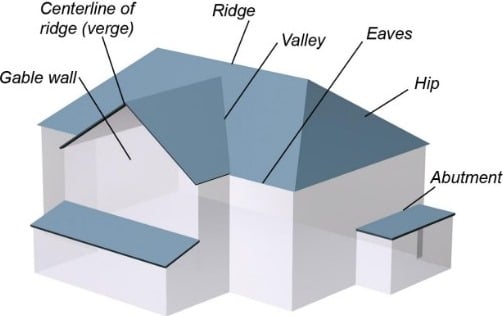
Components of a Pitched Roof

1. Span

Span of roof is the clear distance between the two supports on which roof is positioned by some other elements.

2. Ridge

The apex of the angle which is developed at top by the inclined surfaces at the top of slope.

3. Rise

The vertical distance or height of top of ridge from wall plate is called as rise.

4. Wall plates


Wall plates are provided at top of wall or supports. And these are generally made of wood and are used to fix the common rafters.

5. Pitch

Pitch is nothing but slope of roof with the horizontal plane and is calculated as the ration of rise to span.

6. Eaves

The bottom edge of sloped roof surface is called as eaves from which rain water is drops down during raining.

7. Hip

Hip is a place where two sloping surfaces meet, where exterior angle is more than 180o.

8. Hipped end

At the end of a roof sloped triangular surface is formed which is called as hipped end.

9. Valley

It is also a place where two sloping surfaces intersects but the exterior angle is less than 180.

10. Verge

Verge is the edge of gable roof which runs between ridge and eaves.

11. Ridge board

Ridge board is a wooden member which is provided long the ridge lie or apex of the roof. Common rafters are supported by this ridge board. This is also called as ridge beam or ridge piece.

12. Common Rafters

Common rafters are wooden members fixed to the ridge board perpendicularly. They run from ridge to the eaves. These are fixed to the purlins at intermediate points. Batten or boarding’s are supported by this rafter. In general, the spacing between rafters is 30 to 45 cm.
Components of a Pitched Roof

13. Purlins

Purlins are wooden or steel members supported by truss or wall. If the span is large they are used to support the common rafters.

14. Hip rafters

These rafters are provided at the hip end. And they run diagonally from ridge to the corners of the wall.

15. Valley rafters

Valley rafters run diagonally from ridge to the eaves. They are provided in sloping positions to bear support valley gutters. The ends of purlins and jack rafters will receive by the valley rafters.

16. Jack rafters

The rafters run from hip to the valley are called as jack rafters and usually they are short in length.

17. Eaves board

The ends of lower most roof covering materials are rests on eaves board. It is made of wood and usually 25mm x 25mm thickness and width. It is placed at the feet of common rafters.

18. Barge board

To hold the verge formed by the common rafters a wooden board is used which is called as barge board.

19. Post plate

Post plate is similar to wall plate. Post plates are parallel to the face of the wall and run continuous. Post plates provide support for the rafters.

20. Battens

Battens are usually made of wood and they are nailed to the rafters to give supports for the roof covering material.

21. Template

Template is a masonry block made of concrete or stone which is placed under the truss to provide larger load area of the wall.

22. Boarding’s

Boarding’s are similar to battens and these are also used to give support for the roof covering material by nailing them to the rafters.

23. Truss

Truss is frame which consists of triangles and designed to support the roof tops.

24. Cleats

To support the purlins, short sections of steel or wood are fixed to the rafters and these sections are called as Cleats.

18 Types of Fixtures and Fastenings for Doors and Windows


18 Types of Fixtures and Fastenings for Doors and Windows

Fixtures and fastenings are provided for doors and windows to provide operating facilities, security for rooms and ease of opening and closing etc. Different types of fixtures and fastenings such as, hinges, bolts, handles, locks are available.

Types of Fixtures and Fastenings for Doors and Windows

Hinges

Hinge is fixture which helps the door to rotate freely along its axis. There are so many types of hinges are there which are as follows.

1. Butt Hinge

This is the most common type of hinge used for doors and windows. It has two flanges made of cast iron or steel. One flange is screwed to the door or window and other one screwed to frame.
Butt Hinge

2. Back Flap Hinge

This are similar to butt hinges and used for thin doors. Back flap hinges have wide flanges than butt hinges. They are fixed to the back side of door and frame.
Back Flap Hinge

3. Counter Flap Hinge

This hinge has two centers, and these can be folded back to back.
Counter Flap Hinge

4. Parliamentary Hinge

When the opening is very small or narrow, then it is better to provide parliamentary hinges to provide more space of opening as well as to avoid obstruction while moving furniture etc.
parliamentary-hinge

5. Spring Hinge

Spring hinges are used for swinging doors. The door is closed automatically due to spring action in this case. Spring hinges are available as single acting and double acting spring hinges.
Spring Hinge

6. Rising Butt Hinge

It is similar to normal butt joint, but it has helical nickel joint in between flanges which helps the door to raise vertically upwards when opened. This is useful for the rooms having carpets etc. the raise may be about 10mm.
Rising-Butt-Hinge

7. Garnet Hinge

It has Tw different shaped hinges. One is of long arm shaped which is fixed to the door and another is of plate shaped which is fixed to the frame. This type of hinge is used for battened or ledged doors.
Garnet Hinge

8. Strap Hinge

It is also used for battened and ledged doors and windows. It has two long arm shaped flanges.
Strap Hinge

9. Pin Hinge

This type of hinge consist two flanges which are joined by pin. If the pin is removed then we can separate the flanges. This is generally used for heavy doors. Two flanges are separately fixed to the door and frame.
Pin Hinge

10. Nar-Madi Hinge

This is also used for heavy doors, but it consists only one flange which is fixed to the door. Pin is fixed to the frame to which flange is attached whenever is needed.
Nar-Madi Hinge

Bolts

Door or window bolts are used to provide security for the rooms. Different types of bolts are described below.

11. Hook and Eye Type Bolts

This type of bolt is used to keep the windows shutter in required position when it is opened. Hook is fixed to the shutter frame and eye is fixed to the window rail.
Hook and Eye Type Bolts

12. Flush Bolt

In case of flush bolt the bolt flush is desired to keep with the face of the door.
Flush Bolt

13. Aldrop Bolt

Aldrop bolt is olden type and most common type bolt. To lock this bolt pad locks are used.
Aldrop Bolt

14. Barrel Bolt

To fix the back faces of doors barrel bolts are used. It contains socket and plate, socket is fixed to the frame and plate is fixed to the back face of door.
Barrel Bolt

15. Espagnalette Bolt

This is used for highly secured doors and casement windows which cannot be reached easily.
Espagnalette Bolt

16. Hasp and Staple Bolt

This is also locked by using pad lock as aldrop bolt. Hasp is fixed to the door or window while staple is fixed to frame.
Hasp and Staple Bolt

17. Handles

Handles are used to open or close the door or windows. There are many types of handles are available. Some of them are Bow type, Lever handle, Door handle, Wardrobe handle Etc.
Window Handles
Door Handles

18. Locks

Locks used for doors and windows are many types and some of them are padlock, mortise lock, rim lock, cupboard lock and lever handle lock etc.
Door Locks