Tuesday, August 14, 2018

12 Types of Loads Considered for Design of Bridge Structures


12 Types of Loads Considered for Design of Bridge Structures


Various types of loads are considered for design of bridge structures. These loads and their combinations decides the safety of the bridge construction during its use under all circumstances. The design loads should be considered properly for perfect design of bridge. Different design loads acting on bridges are explained below.

Types of Loads for Design of Bridge Structures

Various design loads to be considered in the design of bridges are:
  1. Dead load
  2. Live load
  3. Impact load
  4. Wind load
  5. Longitudinal forces
  6. Centrifugal forces
  7. Buoyancy effect
  8. Effect of water current
  9. Thermal effects
  10. Deformation and horizontal effects
  11. Erection stresses
  12. Seismic loads
Loads for Design of Bridge Structures

1. Dead Load

The dead load is nothing but a self-weight of the bridge elements. The different elements of bridge are deck slab, wearing coat, railings, parapet, stiffeners and other utilities. It is the first design load to be calculated in the design of bridge.

2. Live Load

The live load on the bridge, is moving load on the bridge throughout its length. The moving loads are vehicles, Pedestrians etc. but it is difficult to select one vehicle or a group of vehicles to design a safe bridge.
So, IRC recommended some imaginary vehicles as live loads which will give safe results against the any type of vehicle moving on the bridge. The vehicle loadings are categorized in to three types and they are
  • IRC class AA loading
  • IRC class A loading
  • IRC class B loading

IRC Class AA Loading

This type of loading is considered for the design of new bridge especially heavy loading bridges like bridges on highways, in cities, industrial areas etc. In class AA loading generally two types of vehicles considered, and they are
  • Tracked type
  • Wheeled type
Tracked Vehical Loads on Bridge Structures
Wheel Loads on Bridge Structures

IRC Class A Loading

This type of loading is used in the design of all permanent bridges. It is considered as standard live load of bridge. When we design a bridge using class AA type loading, then it must be checked for class A loading also.

IRC Class B Loading

This type of loading is used to design temporary bridges like Timber Bridge etc. It is considered as light loading. Both IRC class A and Class B are shown in below figure.
IRC Class A and B Loads

3. Impact Loads

The Impact load on bridge is due to sudden loads which are caused when the vehicle is moving on the bridge. When the wheel is in movement, the live load will change periodically from one wheel to another which results the impact load on bridge.
To consider impact loads on bridges, an impact factor is used. Impact factor is a multiplying factor which depends upon many factors such as weight of vehicle, span of bridge, velocity of vehicle etc. The impact factors for different IRC loadings are given below.

For IRC Class AA Loading and 70R Loading

SpanVehicle typeImpact factor
Less than 9 metersTracked vehicle25% up to 5m and linearly reducing to 10% from 5 m to 9 m.
Wheeled vehicle25% up to 9 m
Greater than 9 metersTracked vehicle (RCC bridge)10% up to 40 m
Wheeled vehicle (RCC bridge)25% up to 12m
Tracked vehicle (steel bridge)10% for all spans
Wheeled vehicle (steel bridge)25% up to 23 m
If the length exceeds in any of the above limits, the impact factor should be considered from the graph given by IRC which is shown below.
Impact Loads on Bridge Structures

For IRC class A and class B loadings

Impact factor If = A/(B+L)
Where L = span in meters
A and B are constants
Bridge typeAB
RCC4.56.0
Steel9.013.50
Apart from the super structure impact factor is also considered for substructures
  • For bed blocks, I= 0.5
  • For substructure up to the depth of 3 meters If = 0.5 to 0
  • For substructure greater than 3 m depth If = 0

4. Wind Loads

Wind load also an important factor in the bridge design. For short span bridges, wind load can be negligible. But for medium span bridges, wind load should be considered for substructure design. For long span bridges, wind load is considered in the design of super structure.
Wind Loads on Bridges

5. Longitudinal Forces

The longitudinal forces are caused by braking or accelerating of vehicle on the bridge. When the vehicle stops suddenly or accelerates suddenly it induces longitudinal forces on the bridge structure especially on the substructure. So, IRC recommends 20% of live load should be considered as longitudinal force on the bridges.
Longitudinal Forces on Bridges

6. Centrifugal Forces

If bridge is to be built on horizontal curves, then the movement of vehicle along curves will cause centrifugal force on to the super structure. Hence, in this case design should be done for centrifugal forces also.
Centrifugal force can be calculated by C (kN/m) = (WV2)/(12.7R)
Where
W = live load (kN)
V = Design speed (kmph)
R = Radius of curve (m)
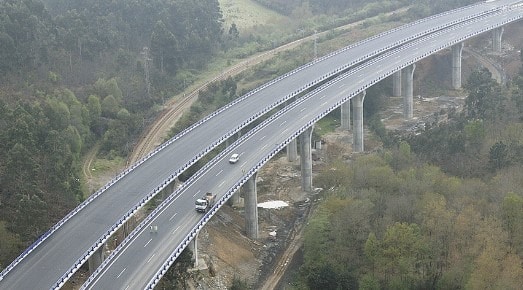
Centrifugal Forces on Bridge Curves

7. Buoyancy Effect

Buoyancy effect is considered for substructures of large bridges submerged under deep water bodies. Is the depth of submergence is less it can be negligible.

8. Forces by Water Current

When the bridge is to be constructed across a river, some part of the substructure is under submergence of water. The water current induces horizontal forces on submerged portion. The forces caused by water currents are maximum at the top of water level and zero at the bottom water level or at the bed level.
The pressure by water current is P = KW [V2/2g]
Where P = pressure (kN/m2)
K = constant (value depending upon shape of pier)
W = unit weight of water
V = water current velocity (m/s)
G = acceleration due to gravity (m/s2)

9. Thermal Stresses

Thermal stresses are caused due to temperature. When the temperature is very high or very low they induce stresses in the bridge elements especially at bearings and deck joints. These stresses are tensile in nature so, concrete cannot withstand against this and cracks are formed.
To resist this, additional steel reinforcement perpendicular to main reinforcement should be provided. Expansion joints are also provided.
Thermal Stresses on Bridges

10. Seismic Loads

When the bridge is to be built in seismic zone or earthquake zone, earthquake loads must be considered. They induce both vertical and horizontal forces during earthquake. The amount of forces exerted is mainly depends on the self-weight of the structure. If weight of structure is more, larger forces will be exerted.
Seismic Loads on Bridge Structure

11. Deformation and Horizontal Effects

Deformation stresses are occurred due to change is material properties either internally or externally. The change may be creep, shrinkage of concrete etc. similarly horizontal forces will develop due to temperature changes, braking of vehicles, earthquakes etc. Hence, these are also be considered as design loads in bridge design.

12. Erection Stresses

Erection stress are induced by the construction equipment during the bridge construction. These can be resisted by providing suitable supports for the members.

Types of Defects in Timber as a Construction Material


Types of Defects in Timber as a Construction Material

There are various types of defects in timber as a construction material. These defects in timber can be due to natural forces, fungi, insects and during seasoning and conversion. Types of these defects in timber is discussed in detail.
Trees gives us the timber which is converted into required form and finally used. Before reaching this final stage, timber comes across many critical stages like growing without defects, cutting at the right time, seasoning, converting and using. Different types of defects occur in timber at these various stages.

Types of Defects in Timber as a Construction Material

In general, the defects in timber are mainly due to:
  1. Natural forces
  2. Fungi
  3. During Seasoning
  4. During conversion
  5. Insects

Defects in Timber due to Natural Forces

  1. Wind cracks
  2. Shakes
  3. Twisted fibers
  4. Upsets
  5. Rind galls
  6. Burls
  7. Water stain
  8. Chemical stain
  9. Dead wood
  10. Knots
  11. Coarse grain
  12. Foxiness
  13. Druxiness
  14. Callus

1. Wind Cracks in Timber

If the wood is exposed continuously to the high-speed winds, the outer surface shrinks and forms crack externally which are called wind cracks.
Wind Cracks in Timber

2. Shakes in Timber

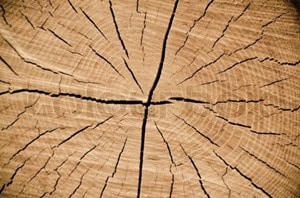
Shakes are nothing but cracks which separates the wood fibers partly or completely. Different shakes are formed in different conditions as follows:
  • Cup shakes are formed due to non-uniform growth of a tree or excessive bending by cyclones or winds. In this case, the shakes develop between annual rings and separates them partly.
  • Heart shakes, the other type of shakes which develop in maturity approaching trees whose inner part is under shrinkage. The shake spread from pith to sap wood following the directions of medullary rays.
  • Ring shakes are similar to cup shakes, but they completely separate the annual rings.
  • Star shakes are formed due to extreme heat or severe frost action. They develop wider cracks on the outside of timber from bark to the sap wood.
  • Radial shakes are developed radially from pith to the bark.
Shakes in Timber

3. Twisted Fibers in Timbers

When the tree in its younger age is exposed to high speed winds, the fibers of wood gets twisted. This type of wood is not suitable for sawing. So, this can be used for making poles, posts etc.
Twisted Fibers in Timbers

4. Upsets

Upsets, a defect of timber in which the fibers of wood are crushed and compressed by fast blowing winds or inappropriate chopping of tree.
Upsets

5. Rind Galls

Rind galls are curved swellings of trees which are formed at a point where a branch of the tress is improperly removed or fell down.
Rind Galls

6. Burls

Burls are uneven projections on the body of tree during its growth. These are mainly due to the effect of shocks and injuries received by the tree during its young age.
Burls

7. Water Stain

When the wood is in contact with water for some time, the water will damage the color of wood and forms a stain on its surface. This defect is called as water stain.
Water Stain

8. Chemical Stain

Chemical stain is formed on the wood by the action of any external chemical agents like reaction by the gases present in atmosphere etc. The stain area gets discolored in this defect.
Chemical Stain

9. Dead Wood

The wood obtained from the cutting of dead tree is light in weight and is actually defected. It is reddish in color and its strength is very less.
Dead Wood

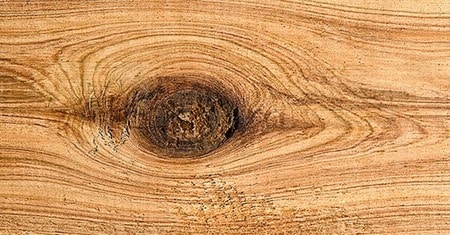
10. Knots in Timber

The central part or stem of a tree is majorly used in the conversion of timber. Branches from the stem are removed and whole rounded stem is taken. But the base of branches forms a mark on the stem which results dark colored stains on the surface after conversion. This dark colored stains are due to the continuity of wood fibers. These dark colored rings are known as knots.
Knots in Timber

11. Coarse Grain Defect in Timber

The age of tree can be known by the number of annual rings. For fast growing trees, the gap between the annual rings is very large. This type of trees are called as coarse grained tress and timber obtained from them is of less strength.
Coarse Grain Defect in Timber

12. Timber Foxiness

When the timber is stored without proper ventilation, the trees growth near the banks of water bodies and over matured trees may exhibit this type of defect. Foxiness is generally indicated by red or yellow spots.
Timber Foxiness

13. Druxiness

Druxiness is a defect of timber in which the top surface of timber indicates white spots. These spots will give the access to fungi.
Druxiness

14. Callus

The wound of the tree is covered by a soft skin which is called as callus.
Callus

Defects in Timber due to Fungi

  1. Dry rot
  2. Wet rot
  3. Brown rot
  4. White rot
  5. Blue stain
  6. Heart rot
  7. Sap stain

1. Dry Rot in Timber

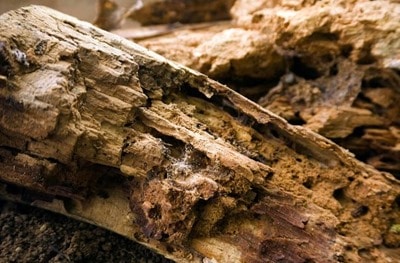
Dry rot is caused by certain type of fungi which actually eats wood for their living. They make food by converting timber into dry powder form. This occurs mainly when there is no ventilation of air or if the wood improperly seasoned.
Absence of sunlight, dampness, presence of sap will increase the growth of dry rot causing fungi. This can be prevented by using well-seasoned wood and also by painting the timber surface with copper sulphate.
Dry Rot in Timber

2. Wet Rot in Timber

Wet rot is caused by fungi which decomposes the timber and converts it into grayish brown powder form. Wet rot causing fungi growths mainly when there is alternate dry and wet conditions of timber.
Wet Rot in Timber

3. Brown Rot in Timber

The cellulose compounds of the wood are consumed by certain types of fungi which then makes the wood brownish and this defect is called as brown rot.
Brown Rot in Timber

4. White Rot in Timber

Some types fungi attacks lignin of wood and leaves cellulose compounds hence the wood will turn into white color which is called white rot.
White Rot in Timber

5. Blue Stain in Timber

Blue stain is a defect caused by some kind of fungi which makes the timber bluish in color.
Blue Stain in Timber

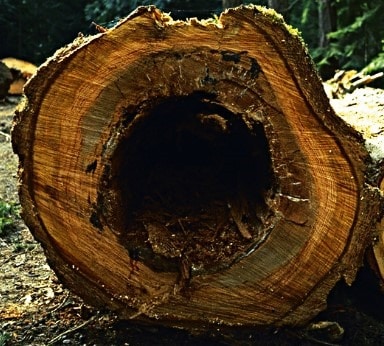
6. Heart Rot in Timber

Heart rot is caused in the trees when the heart wood is attacked by fungi through its newly formed branch. This type of fungi makes the tree hollow by consuming heart wood. This defect is known as heart rot.
Heart Rot in Timber

7. Sap Stain in Timber

When the moisture content in the timber is more than 25%, some types of fungi attacks the sap wood and makes it discolored. This type of defect is known as sap stain.
Sap Stain in Timber

Defects in Timber During Seasoning

  1. Bow
  2. Cup
  3. Check
  4. Split
  5. Twist
  6. Honey combing
  7. Case hardening
  8. Collapse
  9. Warp
  10. Radial shakes

1. Bow

When the converted timber is stored for longer time, some timber planks may have curve along its length which is known as Bow.
Bow in Timber

2. Cup

If the timber planks are curved along its width then it is called Cupping of timber.
Timber Cup

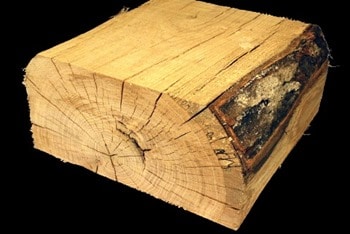
3. Check

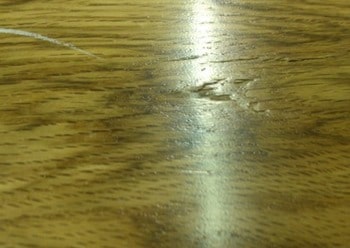
Check is formation of crack in the wood which will separate the wood fibers. They are formed due to over seasoning of wood.
Timber Check

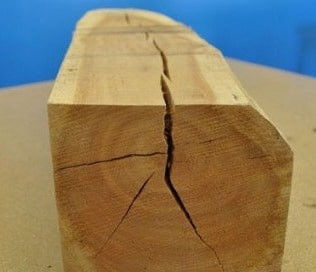
4. Split

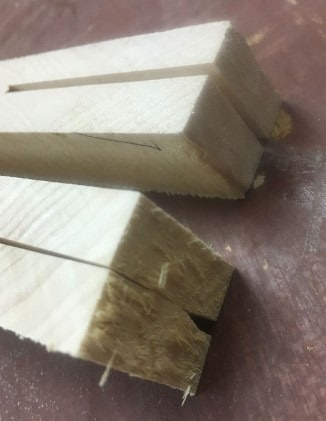
Split is formed when a check extends from one end to the other end which will split the wood into number of pieces.
Timber Split

5. Twist

Twist is formed when the timber piece is spirally distorted along its length. It looks like propeller blade after twisting.
Timber Twist

6. Honeycombing

Honey combing occur in the inner part of the timber which cannot be identified by just seeing. This is mainly due to stresses developed during drying of timber.
Timber Honeycombing

7. Case Hardening

Case is nothing but the top surface of wood which dries rapidly during seasoning but the inner part didn’t. Then this defect is called as case hardening.
Timber Case Hardening

8. Collapse

During drying, some part of the wood may dry rapidly while some may not. Because of this improper drying shrinkage of wood occurs which results the defect called collapse.
Timber Collapse

9. Warp

The loss of shape of wood due to stresses developed during drying is called warping. Cupping bowing, twisting of wood come under warping.
Timber Warp

10. Radial Shakes

Radial shakes are developed after the tree being felled down and exposed to sun for seasoning. In this case, the cracks run radially from bark to the pith through annual rings.
Timber Radial Shakes

Defects in Timber During Conversion

  1. Diagonal grain
  2. Torn grain
  3. Chip mark
  4. Wane

1. Diagonal Grain Defect in Timber

During conversion of timber different cutting saws are used. The cutting should be done properly. If there is any improper cutting by saw then a diagonal grains will appear.
Diagonal Grain Defect in Timber

2. Torn Grain

In the conversion many tools are used. If any of the tools or any other heavy things are dropped accidently on the finished surface of timber it will cause small depression which is called as torn grain.
Torn Grain Defect in Timber

3. Chip Mark

When the timber is cut through planning machine the parts of machine may form chip marks on it. Usually they are indicated by chips on the finished surface.
Chip Mark Defect in Timber

4. Wane

The edge part of the timber log contains rounded edge on one side because of its original rounded surface. This rounded edge is called wane.
Wane in Timber

Defects in Timber due to Insects

  1. Termites
  2. Beetles
  3. Marine borers

1. Termites in Timber

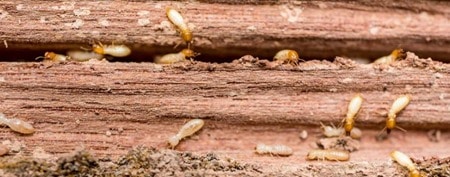
Termites also known as white ants which forms a colony inside the timber and eat the core part of the timber rapidly. They do not disturb the outer layer of timber so one cannot identified their presence. The trees in tropical and sub-tropical regions are mostly affected by these termites.
However, some trees like teak, Sal etc. cannot be attacked by termites because of the presence of termite preventing chemicals in their cellulose part.
Termites in Timber

2. Beetles in Timber

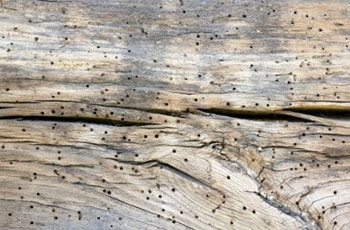
Beetles are a type of insects which destroy the sap wood of the tree and makes a tunnel like hole from the bark. Usually the diameter of hole is around 2 mm. They convert sap wood into powder form and these holes are used by larvae of these beetles. Almost all hardwood trees can be prone to damage by these beetles.
Beetles in Timber

3. Marine Borers in Timber

Marine borers are usually found near coastal areas. They do not consume wood but they make large holes of diameter up to 25mm in the timber to live inside it. They excavated up to 60mm deep in the wood. The wood attacked by marine borers is of less strength and discolored. They can attack all types trees present in their region.
Marine Borers in Timber